

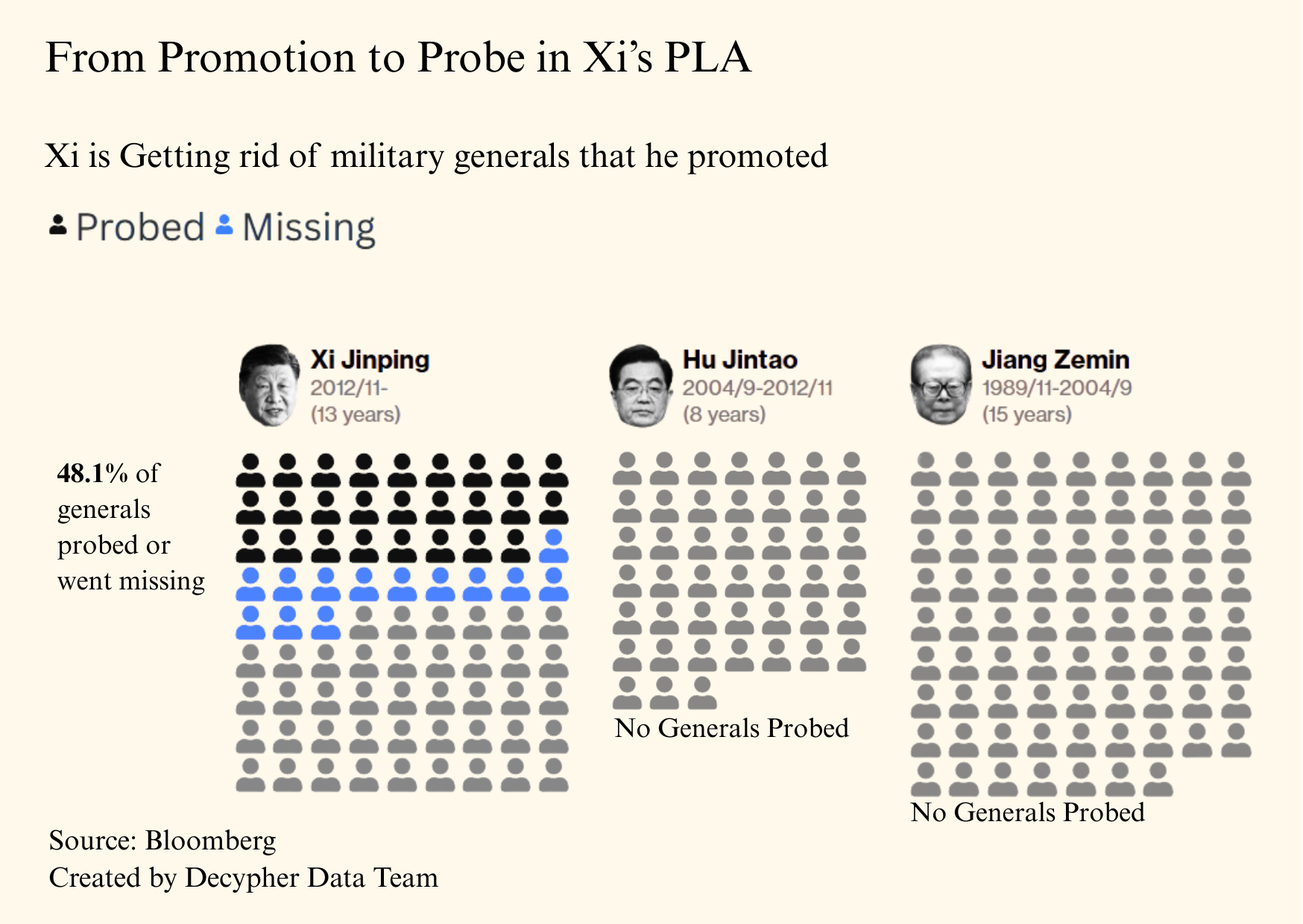
When news broke that General Zhang Youxia—a man once called Xi Jinping’s “sworn brother”—had been placed under investigation for corruption, the message to China’s elite was unmistakable. Credentials don’t matter. Combat experience doesn’t matter. Even decades of party ties would not save you.
The numbers tell part of the story. In 2012, when Xi took power, the People’s Liberation Army was untouchable—a power unto itself. The Central Military Commission stood beyond the reach of political purges. Fast forward to today: one uniformed officer remains. Zhang himself embodied the old guard’s credibility. A Politburo member, the PLA’s most senior general, one of the few commanders with actual battlefield experience. He also happened to be among the handful of people with enough institutional weight to challenge Xi’s succession plans.
Yet the purges go deeper than mere consolidation. They’re rewriting the rules of paramount leadership itself.
The End of Constraints
Deng Xiaoping built his system around collective leadership. Even paramount leaders faced institutional checks, operated within unwritten boundaries. Xi has systematically dismantled these constraints. “It’s clear now that nobody in the leadership is safe, regardless of their connection with Xi,” one analyst observed.
This transcends ordinary authoritarianism. What we’re witnessing is a fundamental reorganization of decision-making in the world’s largest standing army and second-largest economy. The architecture of power has changed.
The Real Danger Isn’t Readiness
The PLA can fill empty slots. It has the bench strength to maintain operations. The genuine risk lies elsewhere—in how information flows.Organizations develop predictable pathologies when risk warnings become synonymous with political disloyalty. Information gets filtered on its way up. Assessments skew optimistic. Costs get minimized, sometimes openly, more often through careful omission.
Call it the Purge Paradox: tighter control now, worse information later. Replace professional judgment with sycophancy, and miscalculation becomes dramatically more likely. Here’s what matters. Wars don’t typically start when leaders are most eager to fight. They start when leaders are most prone to misjudge. The current geopolitical climate—chaotic in both hemispheres—desperately needs China to project stability, not amplify uncertainty.
Taiwan’s Contradictory Timeline
Taiwan faces opposing pressures from these purges. In the short term, organizational shock suppresses momentum. Command chains need rebuilding. Coordination mechanisms require recalibration. When your entire apex structure is in shock, the organizational instinct leans toward blame avoidance, not aggressive action.
Once the command structure gets rebuilt under “rectifying the army and preparing for war,” centralization intensifies. Obedience matters more. When centralization overwhelms professional judgment—particularly amid nationalist fervor—realistic risk assessment suffers.
Then there’s the external feedback loop. As Beijing’s transparency drops and the top brass gets swept clean, Washington, Tokyo, and Taipei prepare for worst cases. Beijing reads this as “the opponent is closing the window,” which reinforces its own sense of urgency. The result: both sides increasingly resemble parties preparing for war, even while insisting they want to avoid it. Accidental escalation becomes more probable.
What It Means for the Region
China spent years cultivating an image of stability and long-term strategic planning. The purges undercut that narrative. Central Asian partners, who valued Beijing’s predictability, now watch command structure chaos with concern. For Taiwan, the disruption may constrain Xi’s options less than many think—regional theater commands maintain some operational autonomy from Beijing’s turbulence.
Xi isn’t just consolidating power. He’s constructing a decision-making apparatus where personalized authority overrides institutional wisdom. Where loyalty trumps competence. Where bad news doesn’t travel upward. This doesn’t make war inevitable. It makes miscalculation more likely. In a region where a single miscalculation could prove catastrophic, that’s the variable that counts.
Redefining Paramount Power
The purges illuminate something fundamental about contemporary China. Xi has redefined what paramount power means—not just in degree but in kind. The old system had guardrails, however informal. The new system has none.
Whether this redefinition stabilizes or destabilizes Asia remains the essential question. For now, we can only observe and wait. But the trend lines point in a troubling direction: more centralization, less accurate information, higher risk of strategic mistakes.
In international relations, systems that eliminate corrective mechanisms eventually make catastrophic errors. The question isn’t if, but when. And for a region as consequential as Asia, that’s not a comfortable place to be.
Decypher Data Dive📊
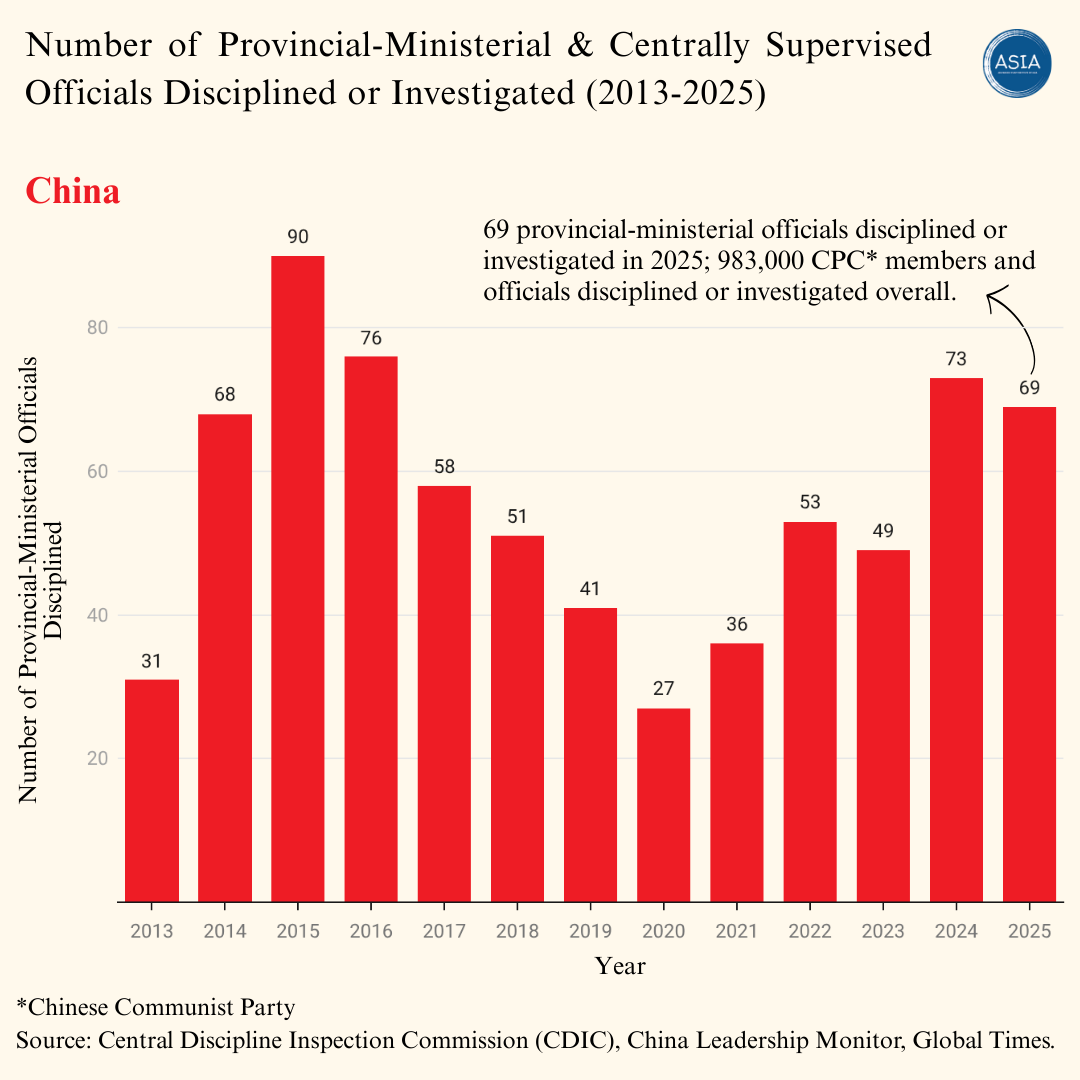
The visualisation shows China’s disciplinary actions against provincial-ministerial and centrally supervised officials between 2013 and 2025. The peak occurred in 2015, when 90 senior officials were disciplined or investigated. The number declined between 2016 and 2020 but began rising again thereafter. In 2025, 69 provincial-ministerial officials were disciplined or placed under investigation, as part of a nationwide drive that saw 983,000 CPC members and officials face disciplinary action or scrutiny.
— — —
Produced by Decypher Team in New Delhi, India
— — —