

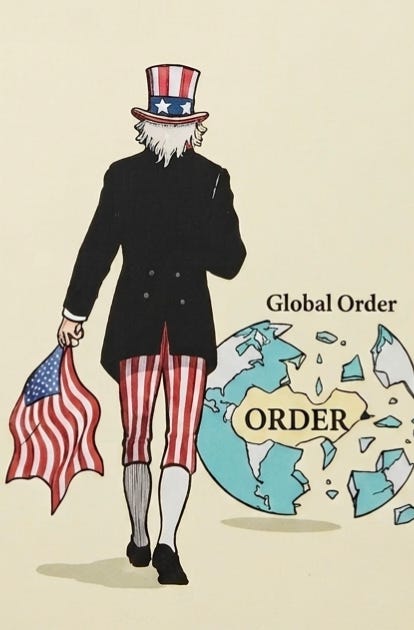

The standard reading of Xi Jinping’s invocation of the Thucydides Trap at the Beijing summit on 14 May 2026 is that he was inviting the United States into a managed multipolar future. That reading is wrong. Xi was inviting the United States to accept a managed unipolar succession. The framing is friendly, the rhetoric is both/and, the language is multipolar. The architecture being built is not.
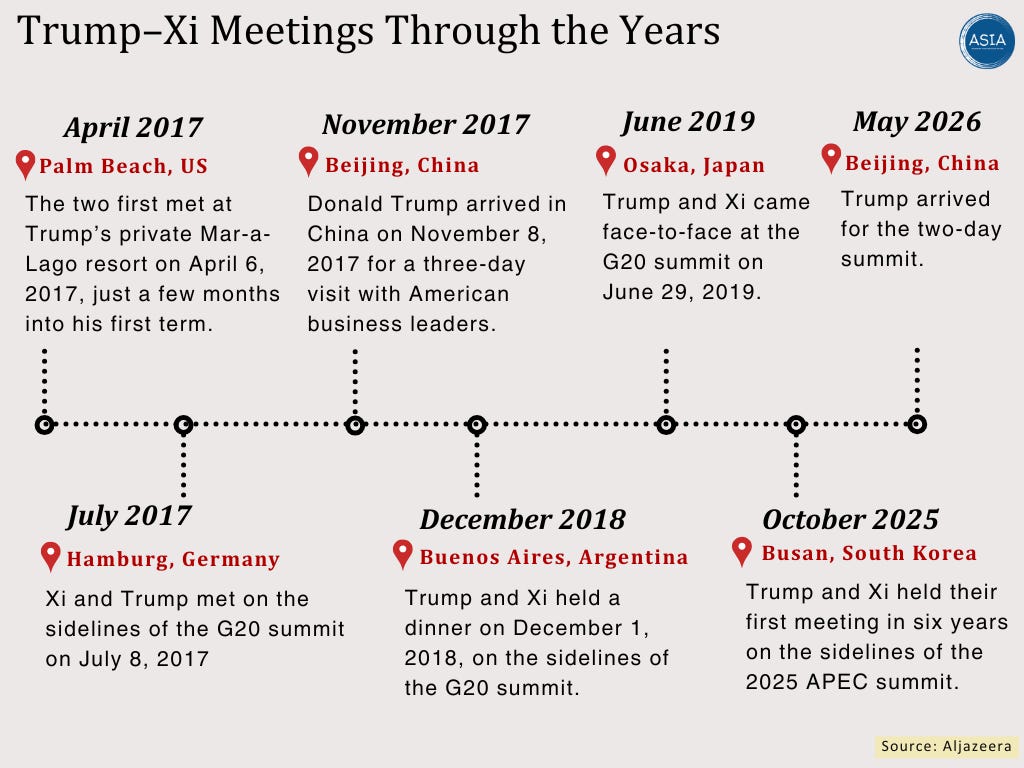
Two recent texts, read together, supply the brief. Sam Chetwin George’s analysis in Foreign Affairs describes the security architecture of a power preparing to fill the structural slot. The Chinese state-aligned essay positioning China as “indispensable global stabilising anchor” writes the legitimating doctrine. The first is the operations manual. The second is the prospectus. They describe one project: the construction of a successor unipole.
The Thucydides tell
Citing Thucydides is the first tell. Graham Allison’s framing — the rising power destined to clash with the established hegemon — is a story about unipolar transitions, not multipolar equilibria. Athens and Sparta did not negotiate a multipolar Mediterranean. They fought over which would hold the central position. By choosing this frame, Xi accepted the unipolar-succession terms of debate. The polite request — “can we transcend the trap?” — is not a request for shared leadership. It is a request that the incumbent accept managed displacement rather than fight to retain the slot.
There is a multipolar vocabulary Xi did not use. He did not speak of concert diplomacy. He did not invoke the 1945 settlement, with its assumption of multiple veto-holding poles. He did not cite the Bandung principles, which were the first articulation of non-aligned multipolarity. He cited Thucydides, which is what historians cite when they are writing about the end of one hegemon and the beginning of another.
The public goods doctrine
The state-aligned essay, published alongside the summit, is more revealing than the summit itself. Its core claim is that China has evolved from “a mere growth engine into an indispensable global stabilising anchor.” The vocabulary is hegemonic. Indispensability is the trait of a hegemon, not of a peer. Stabilisation is the public goods provision that hegemons perform — and which the academic literature on hegemonic stability has, for half a century, identified as the defining feature of unipolar systems.
The piece lists the goods. Supply-chain redundancy when others fail. High-purity helium when Qatar cuts back. Fertiliser to Southeast Asia and Africa. Solar manufacturing at 80 per cent global share. RMB settlement at 41 per cent of Middle Eastern oil trade. Panda Bonds at RMB 800 billion. Belt and Road land corridors handling the freight diverted from the Red Sea. The China-Europe Railway Express up 32 per cent year on year.
This is not multipolar contribution. It is unipolar substitution. A multipolar provider would offer one rail among several. China is offering the rail. The phrase “global public good” appears in the piece without irony. Public goods provision is what Charles Kindleberger’s hegemonic stability theory identifies as the function of the hegemon. The Chinese essay accepts the function and claims the title.
The dependencies celebrated in the piece share a structural property: network effects with single-pole gravitation. Eighty per cent of solar manufacturing is not a balance. It is dominance. RMB at second-most-used in Middle Eastern oil trade is not diversification. It is the early phase of currency-area succession. Belt and Road is not connectivity. It is the rail layer of a Chinese-centric global order, with terms set in Beijing.
The security architecture
Chetwin George supplies the second leg: the security architecture being readied to defend the position. Chen Yixin’s mobilisation order — “build an overseas security protection system across the entire chain” — is not a defensive crouch. It is the operational doctrine of a power that has accepted it can no longer free-ride on a security order it does not control.
The historical parallel Chetwin George draws is the right one. The Monroe Doctrine of 1823 was sold as anti-imperial. The Roosevelt Corollary of 1904 quietly transformed it into the operating system of an informal hemispheric empire. The mechanism is general. Interests require protection. Protection requires presence. Presence invites resistance. Resistance demands further protection. The American case became hemispheric, then global. The Chinese case is starting global, because the interests started global. Belt and Road’s geography means there is no domestic-only phase to retreat to.
Zheng Yongnian’s “Interventionism 2.0” reads as careful tactical doctrine — proxy force, extraterritorial law enforcement, bilateral cooperation as legitimating cover — but its strategic premise is unambiguous. The non-interference doctrine is being retired. It was always more propaganda than substance, as Chetwin George correctly notes. What is new is that Beijing is now willing to retire the propaganda too.
Jin Canrong’s “peace disease” framing is the cultural preparation. The argument that Chinese society’s aversion to conflict is a strategic vulnerability is not a fringe view. Xi himself coined the phrase in 2018. Rising powers, the argument runs, do not consolidate without demonstrating force. This is unipolar-succession doctrine in plain language. A power preparing for multipolar coexistence does not need to cure itself of pacifism. A power preparing to take a contested structural slot does.
Chen’s own December 2025 essay in Study Times, the Party’s leading theoretical journal, names the category directly. He calls “unipolar hegemony” — his words, in the official journal — “increasingly unsustainable.” The critique is aimed at Washington. The conceptual frame is unipolar. The vocabulary Chinese officials reach for to describe the ending system is the vocabulary their architecture is built to inherit.
What multipolarity is not
The conventional reading of Beijing’s rhetoric — that China wants a multipolar world — is consistent with what Beijing says and inconsistent with what Beijing builds. A multipolar world has multiple competing infrastructure stacks, multiple competing currencies, multiple competing security architectures, and no single power providing the public goods on which others depend.
What Beijing is constructing is the opposite. One dominant infrastructure stack (BRI, AIIB, RCEP, the China-Europe Railway). One ascending reserve currency (RMB internationalisation through trade settlement, swap lines, Panda Bonds). One increasingly forward-deployed security architecture (Djibouti, Cambodia, the Solomon Islands security agreement, the contested Tajik facility, the “across the entire chain” doctrine). One technology stack at the frontier (the indigenous semiconductor build, the DeepSeek-to-Huawei AI architecture, the dominance of clean-energy manufacturing).
Each is a unipolar instrument. None is multipolar. The rhetorical commitment to multipolarity is, in the precise sense, transitional courtesy. It is the polite face the rising unipole presents to the falling unipole while the succession is in progress. Once the succession is complete, the multipolar language can be retired. It was always a useful fiction for the climb.
The alliance test
The clearest measure of whether what is being constructed is multipolar or unipolar lies in the alliance architecture. Hegemons build alliance systems. Multipolar orders do not — or rather, they build several roughly equivalent systems that hedge against each other. The American postwar settlement built NATO, the US-Japan treaty, the US-Korea treaty, ANZUS, the Rio Treaty, the Manila Pact, Five Eyes intelligence integration. The structural feature was treaty-grade commitment from a single hub to multiple spokes, with the hub guaranteeing security against a defined threat. The system is asymmetric by design. The hub provides the guarantee. The spokes accept conditional sovereignty. The result is the operating system of a unipole.
The Chinese project is reproducing the pattern with substitutions. The Shanghai Cooperation Organisation is not a NATO equivalent — it carries no Article 5 commitment and the spokes are restive. BRICS+ is a coordination forum, not an alliance. But the structural features are present in altered form. Belt and Road creates infrastructural dependency. The yuan-settlement layer creates monetary dependency. The Huawei-led stack creates digital dependency. The “across the entire chain” architecture creates protection-provision dependency. Each is bilateral or quasi-bilateral. Each runs through Beijing. The spokes are different from the American case — economic rather than military — but the hub is the same and the asymmetry is the same.
What does not exist is a Beijing-led counter-alliance to the American treaty system. The conventional reading interprets this as evidence of Chinese multipolarity. The unipolar-succession reading interprets it as evidence that Beijing has read its predecessor’s history correctly. Treaty alliances are expensive. They commit the hub to deploy force on behalf of the spoke. The American case shows the cost: Vietnam, Iraq, Afghanistan, the open question of Taiwan. Beijing is building a hub-and-spoke system cheaper than the American one — economic indispensability without security commitment — but the topology is unipolar in both cases. The hub guarantees access, not war.
The test for the incumbent alliance system is whether it holds, fractures, or transitions. NATO has held through the Iran war but with audible strain — French and German calls for strategic autonomy have not stopped because Washington has been less reliable than promised. The US-Japan alliance has held, but Tokyo’s chip-equipment industry has lobbied openly against further alignment with Washington’s controls; the position is more conditional than allied rhetoric admits. Seoul has held, with growing internal debate. Australia has held, but its trade dependency on China makes the holding expensive. The Gulf states have not held in any meaningful sense — Riyadh and Abu Dhabi run parallel security and currency relationships with Beijing that would have been unthinkable in 1990. ASEAN has chosen non-alignment as a bloc position, which is a softer form of the same drift. Italy exited the BRI in 2023; the Czech Republic has cooled on Chinese digital infrastructure; but Hungary signed deeper. The pattern is not collective defection or collective loyalty. It is selective hedging by every American ally simultaneously, calibrated to each capital’s own threat environment.
Each individual hedge is sub-critical. The aggregate is corrosive. If unipolar succession requires the incumbent alliance system to weaken without an equivalent succeeding system being needed, the data so far is consistent with that requirement being met.
Succession is not assured
This is a thesis about intention, not about achievement. The argument that China is constructing a successor unipole does not entail that it will succeed.
Three forces work against the succession. The first is American coercive capacity. Dollar weaponisation, the chip chokepoint, the carrier presence, the alliance system itself: each remains substantial and each can be intensified. A determined incumbent can deny a substitute its diffusion window even if it cannot recover the curve. This is the coercion blind spot that no framework — neither hegemonic stability theory nor its Chinese counterparts — adequately models. The 2026 sanctions on Hengli Petrochemical and other Chinese refiners processing Iranian crude are the early form of this denial strategy. Beijing’s May 2026 instruction to its banks and firms to disregard them is the early form of the response. The contest over whether the rails will hold has started.
The second is the resistance built into the alliance hedge itself. The bilateral-dependency model has a structural vulnerability: each relationship can be revised by the partner without coordinating with others. The Australian federal government cancelled Victoria’s BRI deal in 2021. Italy exited in 2023. The Czech Republic cooled. Lithuania broke in 2021; the new Vilnius government is seeking partial reconciliation, but the deadlock holds. Each move is sub-critical on its own. Each demonstrates that the dependencies are not as locked-in as Beijing’s architecture assumes. If the incumbent alliance system does not collapse but rather adapts — European, Japanese, and Korean capitals finding new equilibria with both Washington and Beijing — the unipolar succession becomes blocked by hedging in the middle, not contest at the top. A successor unipole requires not just incumbent decline but a critical mass of partners accepting the new hub. The numbers are not yet there and the trend is not monotonic.
The third is the strain of empire itself. Chetwin George’s closing line — that China may discover its global interests tighten into a snare of its own making — is the right historical caution. The mechanism that turned the Monroe Doctrine into Vietnam and Iraq is the same mechanism Beijing is now entering. Interests, presence, resistance, escalation. The Chinese system has structural advantages the American system lacked — patience, internal discipline, longer horizons — but the mechanism is mechanical and the system has not yet been tested by serious overseas reverses. Djibouti and Cambodia are easy cases. The first hard one will be revealing.
The right name
What is happening in Beijing this week is not a thaw. It is not a great-power summit between equals managing a rivalry. It is a coronation rehearsal in which the outgoing unipole is shown the choreography of its own succession, asked to participate gracefully, and offered the dignity of continued commercial access in exchange.
Xi’s invocation of the Thucydides Trap is the cleanest available signal of what is being attempted. The trap is between hegemons. The transcendence on offer is managed inheritance. The audience for the message is not Donald Trump, who did not appear to register it. The audience is the alliance capitals — Berlin, Tokyo, Seoul, Canberra, Riyadh, Abu Dhabi, Jakarta — watching for which pole will hold the structural position over the next thirty years. The substitution they are being asked to consider is not from American security to Chinese security. It is from American dependency to Chinese dependency, with the security question deferred.
The right name for China’s project is not multipolar revisionism. It is unipolar succession. Can it be China’s world, we don’t know yet?
— — —
Essay: Amogh Dev Rai- Research Director at the Advanced Study Institute of Asia (ASIA), affiliated with SGT University, Gurugram.
Produced by Decypher Team in New Delhi, India
— — —