

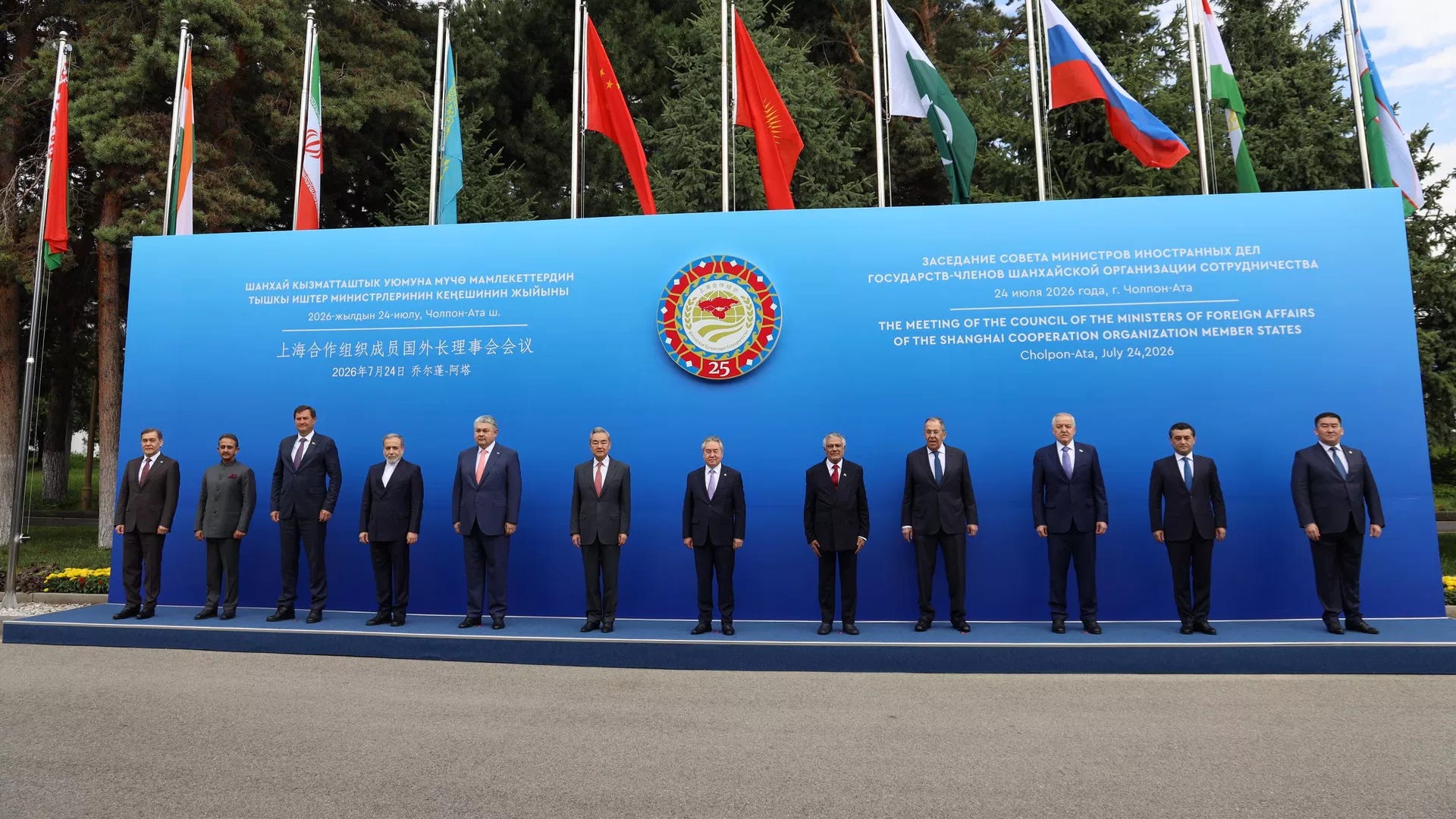

As ten heads of government gather in Bishkek for the Shanghai Cooperation Organisation’s twenty-fifth anniversary, the organisation looks more consequential than it has ever been. China, Russia, India, Pakistan, Iran and the four Central Asian republics now sit inside the same institution, alongside Belarus. Together, its members account for more than three billion people and roughly a quarter of global GDP. Yet size has not made the SCO particularly capable of resolving the disputes between them. India and Pakistan remain adversaries; India and China still manage a contested border; Russia and China cooperate closely without sharing identical interests in Central Asia. The SCO is good for something more limited: it keeps security bureaucracies cooperating, gives Central Asian states a forum containing both Russia and China, and allows governments that do not trust one another to remain in regular contact without requiring political alignment.
That sounds modest because the organisation began with a modest problem. The SCO’s predecessor, the Shanghai Five, emerged after the Soviet collapse left China facing newly independent states along what had been a heavily militarised Sino-Soviet frontier. China, Russia, Kazakhstan, Kyrgyzstan and Tajikistan signed agreements in 1996 and 1997 to build military confidence and reduce armed forces along their common borders. Uzbekistan joined when the SCO was created in 2001, by which time terrorism, separatism and extremism had become its principal security concerns. The organisation did not begin as an alternative world order. It began because neighbouring governments had practical security problems that were easier to manage together.
Some of that machinery still works. The SCO created the Regional Anti-Terrorist Structure in Tashkent to connect member states’ security agencies, and cooperation has gradually spread into organised crime, narcotics and border security. In December 2025, representatives of SCO states participated in the Sahand-Antiterror exercise in Iran. This May, their anti-narcotics agencies met in Bishkek and agreed on draft programmes through 2030 on synthetic drugs, information exchange and coordinated operations. None of this resembles collective defence. It is bureaucratic cooperation: officials sharing information and procedures in areas where governments with otherwise divergent foreign policies still have overlapping interests.
The limits appear as soon as that cooperation becomes politically contentious. Counterterrorism is supposedly the SCO’s foundational issue, yet at the organisation’s defence ministers’ meeting in June 2025, the members could not even adopt a joint statement. India demanded language reflecting its concerns after the Pahalgam attack; consensus collapsed amid disagreement over terrorism and Pakistan. Reuters reported that the meeting ended without a declaration. The episode captured the SCO neatly. Security agencies can exercise together, but the organisation cannot make India and Pakistan agree on what terrorism means when the question touches their bilateral conflict.
That gap between technical cooperation and political consensus has widened as the SCO has expanded. India and Pakistan joined in 2017, Iran in 2023 and Belarus in 2024. Enlargement made the organisation geographically and symbolically larger while importing more disagreements into a system that operates by consensus. The SCO now represents around 25 per cent of global GDP and more than 3.4 billion people, but those figures tell us more about the size of its membership than its capacity to act collectively.
Why, then, keep joining?
India is perhaps the clearest answer. New Delhi participates in the SCO while also belonging to the Quad with the United States, Japan and Australia. It competes strategically with China, maintains an exceptionally close defence relationship with Russia and has a hostile relationship with Pakistan. SCO membership does not force India to reconcile any of these positions. It simply gives India another institutional space in which to manage all of those relationships.
Russia and China use the same room differently. Both have increasingly presented the SCO as evidence of a more multipolar international system and of institutions that do not depend on Western leadership. India is far less interested in making the SCO an anti-Western bloc. Yet the organisation can accommodate both positions because its members are not required to adopt a common grand strategy. The original SCO declaration explicitly described it as an organisation that was not an alliance directed against other states or regions. What once distinguished it from military blocs has become central to its durability.
Central Asia benefits particularly from that looseness. Kazakhstan, Kyrgyzstan, Tajikistan and Uzbekistan live with Russian security influence and rapidly expanding Chinese economic power, but none has an obvious interest in allowing either relationship to become exclusive. The SCO places both larger powers inside a multilateral institution in which the Central Asian republics are formally equal participants. It does not remove the enormous power asymmetry between them. It gives smaller states another arena to manage that asymmetry.
This is also why describing the SCO simply as a China-Russia vehicle misses something. Beijing and Moscow are indispensable to it, but an organisation designed only to transmit their preferences would be less useful to India or the Central Asian states. Kazakhstan can work with China through the SCO while expanding ties with Europe and the Gulf. India can sit beside China in Bishkek while strengthening Indo-Pacific partnerships elsewhere. Membership becomes an additional relationship rather than an exclusive geopolitical choice.
The Bishkek summit demonstrates the other practical benefit of such an institution: convening. The 31 August–1 September summit gives presidents and prime ministers a ready-made setting for bilateral meetings that might otherwise require their own diplomatic choreography. Rivals can share a summit without suggesting that their bilateral disputes have been resolved. For governments navigating several competing relationships at once, the availability of such spaces matters.
There is a price for all this flexibility. The SCO talks frequently about trade, connectivity and economic cooperation but has never created anything comparable to a common market or a meaningful economic union. It cannot guarantee collective defence. It cannot resolve the India-Pakistan conflict or the India-China border. Its expansion makes consensus still harder, while the increasingly ambitious language surrounding a new Eurasian or multipolar order regularly exceeds what its institutions can deliver.
But those failures become less puzzling once the SCO is judged against the job it can actually perform. It is strongest where states can separate a practical problem from their larger geopolitical disagreements: intelligence exchanges, anti-narcotics work, border contacts, meetings between officials. It becomes weakest precisely where cooperation requires members to agree on whose interpretation of a political conflict is correct.
Twenty-five years after the Shanghai Five began negotiating troops along a border, the SCO has therefore changed from a relatively focused security arrangement into something broader and looser. It cannot make India and Pakistan cooperate politically, reconcile India and China or turn Eurasia into a coherent economic bloc. It can keep their officials exchanging information, their leaders returning to the same summit and the Central Asian states from having to organise their regional diplomacy around one exclusive great-power patron.
That is considerably less than the architecture of a new world order. But it is also more useful than a talking shop. The SCO works because it asks its members to cooperate where they can and permits them to remain adversaries where they cannot.
Essay: Preksha Jalan- Associate Fellow, Digital History Lab at The Advanced Study Institute of Asia (ASIA).
Produced by Decypher Team in New Delhi, India