

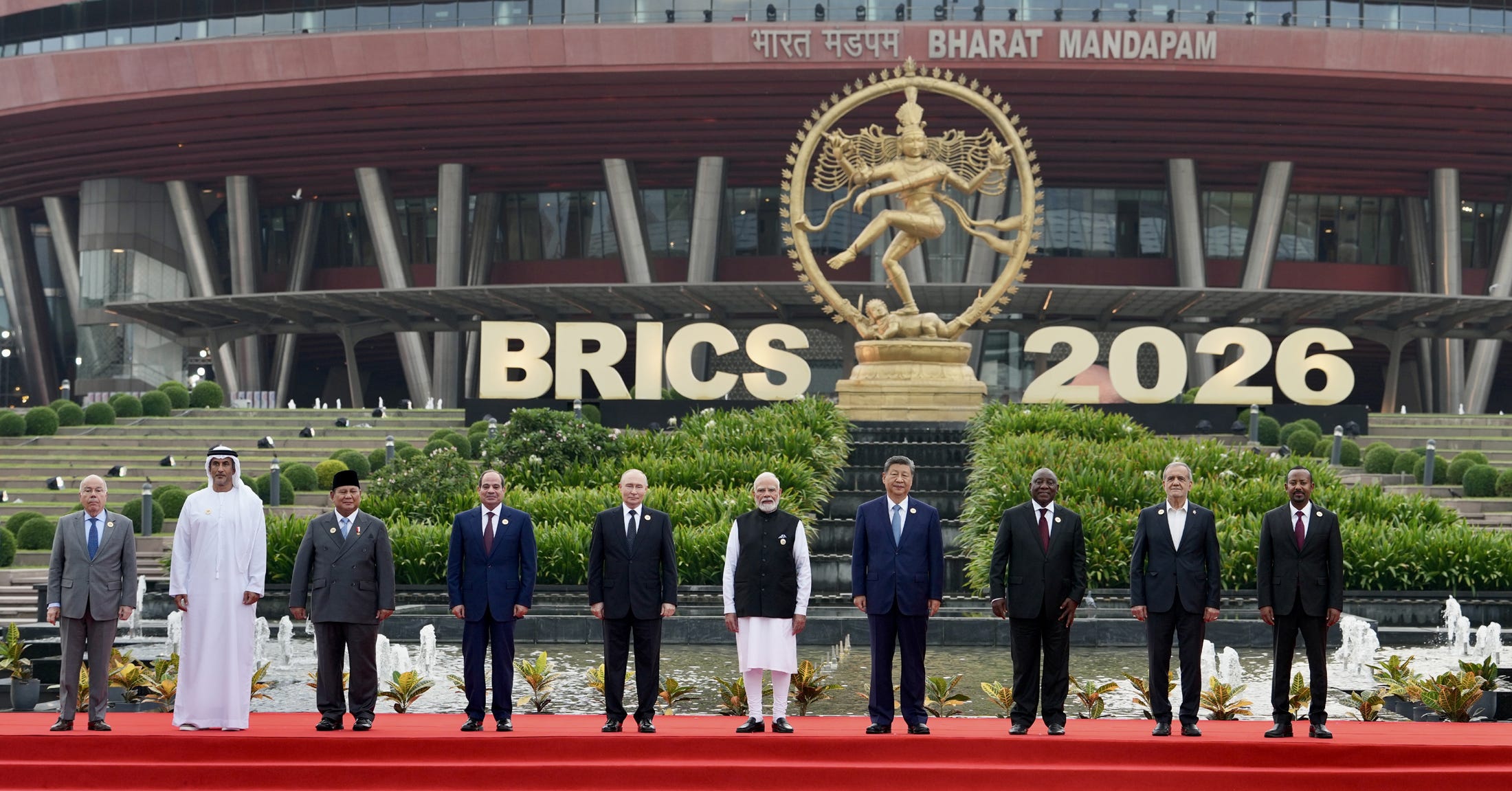

The New Delhi summit tested a problem created by BRICS’s own expansion. The grouping now includes eleven states with different security relationships, competing regional interests and highly unequal economic weight. Iran and the UAE disagree over the regional security order; India and China continue to manage a disputed border alongside a large trade imbalance; several members maintain close security or economic relationships with the United States.
The relevant measure of the summit, therefore, is not whether BRICS acted as a unified geopolitical bloc. It is whether the expanded grouping produced agreements in areas where its members’ interests overlap despite these differences. Four developments in Delhi help answer that question.
Key Announcements from the Joint Statement
The New Delhi Declaration retained familiar BRICS positions on reforming the UN and international financial institutions, increasing developing-country representation and opposing unilateral tariffs and coercive economic measures. More useful for assessing the grouping are the mechanisms members agreed on.
Cross-border payments were one. BRICS did not announce a common currency. Instead, the declaration continued work on interoperability between national payment and financial messaging systems, greater settlement of trade and investment in local currencies, and increased local-currency financing through the New Development Bank. It also supported phased development of a New Investment Platform. The BRICS Payment Task Force acknowledged that there is “no one-size-fits-all approach”.
This places an important limit on claims about de-dollarisation. BRICS is not constructing a monetary union. Its members are developing additional channels through which some transactions can occur without requiring dollar settlement. These mechanisms can lower transaction costs and, for countries vulnerable to sanctions, reduce exposure to disruptions in existing payment systems. Their current scale, however, is nowhere near enough to replace the dollar-centred financial system.
The declaration therefore points towards redundancy rather than replacement: maintaining access to existing institutions while developing additional mechanisms where dependence has become a source of economic risk.
UAE – Iran Meeting
The meeting between Iranian President Masoud Pezeshkian and Abu Dhabi Crown Prince Sheikh Khaled bin Mohamed bin Zayed was the highest-level UAE-Iran contact since the 2026 war. The discussion covered bilateral relations, de-escalation and regional stability. No settlement of their security disagreements or new regional arrangement was announced.
The meeting’s significance is clearer when compared with what happened earlier in the year. BRICS foreign ministers failed to produce a joint statement in May partly because Iran and the UAE could not agree on language concerning West Asia. In Delhi, the eleven members did agree. Reporting by the Indian Express indicates that reaching the compromise required extensive negotiations involving India, Iran, the UAE, as well as China, Russia, Brazil and Egypt. The final language did not resolve the underlying dispute. It emphasised sovereignty, civilian protection, restraint and continued energy and trade flows in terms broad enough for both countries to accept.
It is a limited but identifiable institutional outcome. Between May and September, BRICS moved from being unable to produce common language on the conflict to containing the disagreement sufficiently to adopt a declaration and host bilateral contact between the two sides. Whether that contact leads to sustained de-escalation remains unknown. Delhi demonstrated that membership can provide an additional channel for managing a dispute, even when BRICS lacks the authority or common position required to resolve it.
Structural Dialogues across Poly-ruled states
The economic discussions expose a different limitation. Greater trade between BRICS countries is frequently presented as evidence of growing South-South economic integration. India’s experience shows why the composition of that trade matters as much as its volume.
The clearest case is China. India’s bilateral trade deficit reached approximately $112.16 billion in FY26. Indian exports remain concentrated in commodities and relatively low-value products, while imports from China include machinery, electronics, integrated circuits, batteries, fertilisers and industrial inputs. India consequently depends on Chinese goods in sectors that are themselves important to expanding domestic manufacturing.
The Modi-Xi meeting in Delhi explicitly addressed this problem. The two sides agreed to discuss the structural trade imbalance, supply-chain concerns and more predictable market access for Indian businesses. This followed a gradual stabilisation of bilateral relations after the 2020 border confrontation, including resumed flights, visa easing and renewed diplomatic engagement, while the boundary dispute itself remains unresolved.
This distinction matters for evaluating BRICS economic cooperation. Moving trade away from Western markets does not necessarily reduce economic dependence if it increases concentration elsewhere. China’s manufacturing capacity gives it a structural advantage within BRICS that institutional declarations cannot remove.
For India, the question is consequently not simply how to increase intra-BRICS trade, but how to alter its composition. Market access, domestic manufacturing capacity and supply-chain diversification matter more to reducing the deficit than political agreement at BRICS. Diplomacy can create the negotiating channel; it cannot by itself correct the productive asymmetry that generates the deficit.
Possible alternative to American Shield?
BRICS has made some progress where alternatives can be created transaction by transaction. Local-currency settlement can reduce the need for dollars in particular trades. New Development Bank lending provides another source of development finance. Payment-system interoperability could eventually provide additional routes for cross-border transactions. None requires members to agree on a common adversary or foreign policy.
The American role in the Gulf rests on military capabilities and long-standing bilateral arrangements: bases, intelligence, logistics, air and naval forces, missile defence and the capacity to reinforce partners during crises. BRICS has no equivalent collective capability. It has no mutual-defence commitment, integrated military command or common definition of the threats against which members would be protected. Its membership makes such convergence particularly difficult. Iran seeks a reduced American military presence in the Gulf. The UAE still depends substantially on American security cooperation. India works closely with the United States while maintaining its relationship with Russia and managing competition with China. India and China themselves have not resolved their border dispute.
BRICS can therefore supplement existing arrangements more readily than it can replace them. Payments, development finance and diplomatic consultation allow selective cooperation because they do not require members to identify the same security threats. A collective security system would.
Delhi consequently provides a more limited measure of BRICS’s development. Its members can increasingly separate areas in which cooperation is possible from disputes they cannot resolve. That worked sufficiently to produce a declaration despite Iran-UAE differences, to keep India-China economic negotiations open despite continuing strategic competition, and to advance payment cooperation without monetary integration.
It does not yet amount to an alternative security order. For now, BRICS’s institutional capacity lies in managing specific disagreements and creating supplementary economic mechanisms, rather than replacing the political, financial and security structures within which its members continue to operate.
Essay: Preksha Jalan- Associate Fellow, Digital History Lab at The Advanced Study Institute of Asia (ASIA).
Produced by Decypher Team in New Delhi, India