


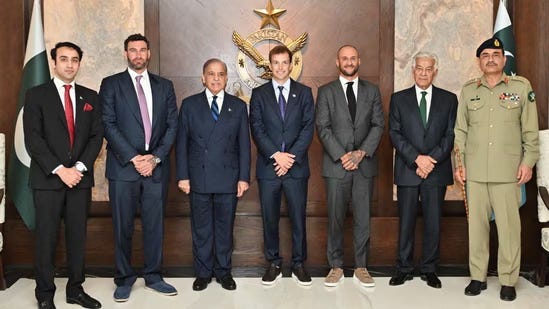
There is a photograph where Zachary Witkoff is flanked by the powers that be in Pakistan. He is, of course, the son of Steve Witkoff — American roving diplomat, Trump’s most important aide for negotiating peace everywhere from Gaza to Moscow, a man who seems to be on a plane to somewhere difficult at all times. In the corner of the photograph is Bilal Bin Saqib, who at 35 has managed to be a state minister and now runs Pakistan’s Virtual Assets Regulatory Authority. It does what it says, but not quite yet. We will get to it.
Bilal Bin Saqib, MBE — the British crown gave him that for delivering meals to NHS workers during the Covid pandemic, which tells you something about the man’s instinct for the right cause at the right moment — is someone who finds the correct people before most people have identified who the correct people are. He was affiliated with World Liberty Financial, the Trump family’s crypto platform, as an adviser before he had any government title. He pulled Changpeng Zhao into the Pakistan Crypto Council — Binance’s founder, fresh from a U.S. federal sentence, subsequently pardoned by Trump — as a strategic adviser. He went to Las Vegas for a Bitcoin conference where JD Vance and the Trump sons were present. When a seat opened on a trade delegation to Washington he took it without a suit, bought a blazer off a rack, and sat across from American trade officials on subjects he had not previously studied. He describes his philosophy as: throw enough mud at the wall, something will stick. He is not wrong.
But Bilal is not quite the story. Or rather, he is the visible part of it.
The man to watch is General Asim Munir. Pakistan’s army chief, which in Pakistan means the person who actually runs things, figured out something earlier than almost anyone else in the region: Trump is amenable to deals. Not strategy, not alliance management, not the careful long-game of diplomatic relationship-building that foreign ministries are designed to conduct. Deals. Personal ones. Ones that flow through the commercial universe the president and his family inhabit — and at this particular moment, that universe runs on crypto. Munir looked at this, looked at Pakistan’s situation — broke, diplomatically isolated, perpetually dependent on IMF bailouts, too China-adjacent for Washington’s comfort — and decided that the country needed someone who spoke the language. Not a diplomat. Not a technocrat. A 35-year-old with an MBE and a Bitcoin obsession who already knew Zachary Witkoff’s number.
The returns from this calculation are real and should be stated plainly. A 19% tariff rate on Pakistani goods, below most of Southeast Asia, at a moment when the administration was using tariffs the way a man uses a hammer when he is not entirely sure what he is building. A U.S. terrorist designation for the Balochistan Liberation Army, which Islamabad had been requesting with diminishing hope for years. A redevelopment deal for the Roosevelt Hotel in Manhattan, negotiated by Steve Witkoff — whose son was, at roughly the same time, signing crypto letters of intent with Pakistani officials in Islamabad, a circularity that nobody in either government has found it necessary to acknowledge. And the largest return: Pakistan now sits between Washington and Tehran, delivering 15-point action plans, being floated as a venue for pre-deadline talks in a crisis that could close the Strait of Hormuz and reshape South Asia’s energy economics for a generation.
For a country that spent most of the past decade being processed by the IMF rather than courted by Washington, this is a genuine shift. Munir read the situation correctly. Bilal executed at pace.
Now for the part that the celebratory coverage has not quite got around to.
World Liberty Financial wants Pakistan’s market. Forty million crypto users. An estimated $300 billion in annual trading volume. The third-largest unbanked population on earth. That appetite is not incidental to the partnership — it is the partnership, from the American side. Pakistan has opened its virtual asset market to a company in which the sitting president holds a financial stake, in exchange for tariff relief and diplomatic relevance. If China had proposed equivalent terms — market access for diplomatic returns, routed through a company with traceable ties to Chinese leadership — Islamabad would have called it what it was. Corruption. The terms here are identical. The description is different, and the difference in description is doing considerable work.
The IMF has not gone anywhere. Pakistan still needs the fund, which has watched El Salvador’s Bitcoin adventure complicate its own negotiations and drawn the obvious conclusions. Pakistan’s proposed national crypto reserve and the two gigawatts of generation capacity earmarked for mining are the kinds of commitments that funds write down and remember. This tension exists. It has been deferred, not resolved, which is a distinction that tends to matter eventually.
On Iran: Islamabad’s back-channel to Tehran is real, built across decades of careful fence-sitting that most of Pakistan’s partners would have preferred it not do. That consistency now has value. But Pakistan also has an acute energy problem — the Hormuz blockade is not an abstraction for a country already managing electricity shortages — which means the mediation is not disinterested. A go-between with a strong material stake in a particular outcome is a particular kind of go-between, and if the talks fail, or if Trump decides Pakistan has not delivered and adjusts his warmth accordingly — which he has done to other partners, without much ceremony — the association has costs.
Pakistan has navigated American administrations before. In the 1980s it made itself indispensable to Washington’s Afghan operation and collected its dividends — some of which are still loose in the world in forms nobody intended. This version is less consequential and, one hopes, less toxic in its long-term effects. But it is the same transaction underneath: find what the administration needs, supply it efficiently, take what you can while the window is open.
Munir, it seems, understood this before anyone gave him a framework for it. Bilal was the instrument he found to act on the understanding. The photograph in Islamabad — the one where Zachary Witkoff stands flanked by Pakistan’s most powerful men while Bilal hovers just off to the side — is less a diplomatic image than a receipt. Something was purchased. The bill has not yet arrived.
When it does, Pakistan will need more than a letter of intent and a man who is good at finding the right room.

A War No One is Watching
Pakistan and Afghanistan are shooting at each other. The world has not noticed. It should.
On 27 February, Pakistani officials said the words out loud: open war. Not a counter-terrorism operation. Not a calibrated signal. Open war — against a neighbouring country, across a border that has never been formally accepted by either side, in a region that sits between Iran, China, India, and Central Asia. The statement passed through the news cycle in roughly forty-eight hours.
It deserved considerably more.
What triggered it was a Pakistani airstrike inside eastern Afghanistan in late February, aimed at what Islamabad described as TTP — Tehrik-e-Taliban Pakistan — infrastructure. The Taliban hit back. Pakistani military posts came under attack. That exchange, unremarkable on its own, was the moment the conflict shifted register: from the chronic low-level friction that has defined this border for years into something with the structure of a real war. Reciprocal. Sustained. With no obvious exit.
Where Pakistan is striking
The geography matters. Earlier Pakistani operations had largely stayed close to the border — remote provinces, suspected militant camps in areas where sovereignty is notional on a good day. What changed in February was the depth of the strikes. Kandahar. Kabul. The Taliban’s historic heartland and the country’s capital. Striking Kabul is not a border operation. It is a statement about what Pakistan is willing to do and to whom.
Since then, the rhythm has been: artillery, airstrikes, a brief pause, then more. An Eid ceasefire in late March lasted under a week. Pakistan resumed operations on 26 March. On 29 March, Afghan authorities said Pakistani shelling had hit the outskirts of Asadabad in Kunar province, killing at least one civilian and wounding more than a dozen. The ceasefire’s collapse was not a surprise. Nothing about this conflict suggests either side has a theory of how it ends.
A ceasefire that lasts less than a week is not a diplomatic failure. It is the logic of the conflict making itself visible.
The argument neither side can win
The war turns on a single question that cannot be resolved by assertion: is TTP operating from Afghan soil? Pakistan says yes. The evidence it points to is a sustained campaign of militant attacks inside Pakistan since the Taliban returned to power in 2021, attacks that Islamabad traces back across the border. The IEA says no, that Afghan territory is not being used against Pakistan, and that Pakistani strikes are simply a violation of sovereignty dressed up as counter-terrorism.
Both positions contain truth, which is precisely why the dispute has no diplomatic resolution in sight. The Afghan Taliban and TTP grew from the same militant ecosystem. They share networks, fighters, and ideological heritage going back two decades. TTP elements continue to be reported in eastern provinces — Kunar, Nangarhar, Khost. But the Afghan Taliban are also now a government, with ports and customs revenue and infrastructure to protect. The idea that Kabul is running TTP as a deliberate instrument of policy against Pakistan gives the IEA more coherence than it has. The idea that the presence of TTP fighters in eastern Afghanistan is simply irrelevant to Kabul’s choices gives the IEA more innocence than it deserves.
Neither government has the domestic space to admit this ambiguity. So the war continues.
What the Pakistani army needs from this
Pakistan’s military does not make Afghanistan policy in isolation from its domestic situation, and its domestic situation is bad. TTP attacks have been rising. The economy is bad enough that the government has had to allocate Rs125 billion just to subsidise fuel prices and keep public anger from boiling over. Institutional legitimacy is contested. In that context, cross-border military action does something useful for the army: it demonstrates that the state is doing something. It is not purely cynical — TTP is a real threat, and the pressure to respond is real — but the timing and scale of the operations cannot be separated from what the army needs to be seen doing.
The problem is that the strategy has no clear endpoint. Pakistan does not have the capacity for a prolonged land campaign inside Afghanistan. The strikes are designed to impose costs, not to produce a military outcome. And the IEA, internationally isolated and economically strangled, has nowhere to go. Imposing costs on a party with nothing left to lose is not leverage. It is noise.
No one is coming to mediate
Qatar tried. Turkey tried. China has expressed concern — primarily because instability threatens its infrastructure investments in the region. None of it has moved the needle. The broader international moment does not help: this is a period in which every major power is managing its own crises, and a bilateral conflict between a diplomatically isolated emirate and a nuclear-armed state in fiscal distress does not rise to the top of anyone’s agenda.
Pakistan retains enough residual geopolitical utility — as a potential interlocutor in other contexts, as a country too nuclear and too large to simply ignore — that it faces limited external pressure to stand down. The IEA has no international standing to leverage and no economic cushion to absorb further disruption. The border crossings, including Torkham, have already seen intermittent closures. Both sides are using what pressure tools they have. Neither is working.
Wars that no one watches do not stay small. They stay unmanaged.
The thing worth remembering
This is a nuclear-armed state in a condition of open military conflict with a neighbour that has no functioning economy, no international exits, and no domestic constituency for compromise. The Taliban cannot be seen capitulating to Pakistani demands without losing the one thing that holds the IEA together: the claim that it expelled a foreign military and bowed to no one. Pakistan cannot be seen doing nothing while its soldiers die and its cities are attacked. Both positions are politically rational. Together, they produce a war with no off-ramp.
The global media moved on. The war did not.

Pakistan’s Economy
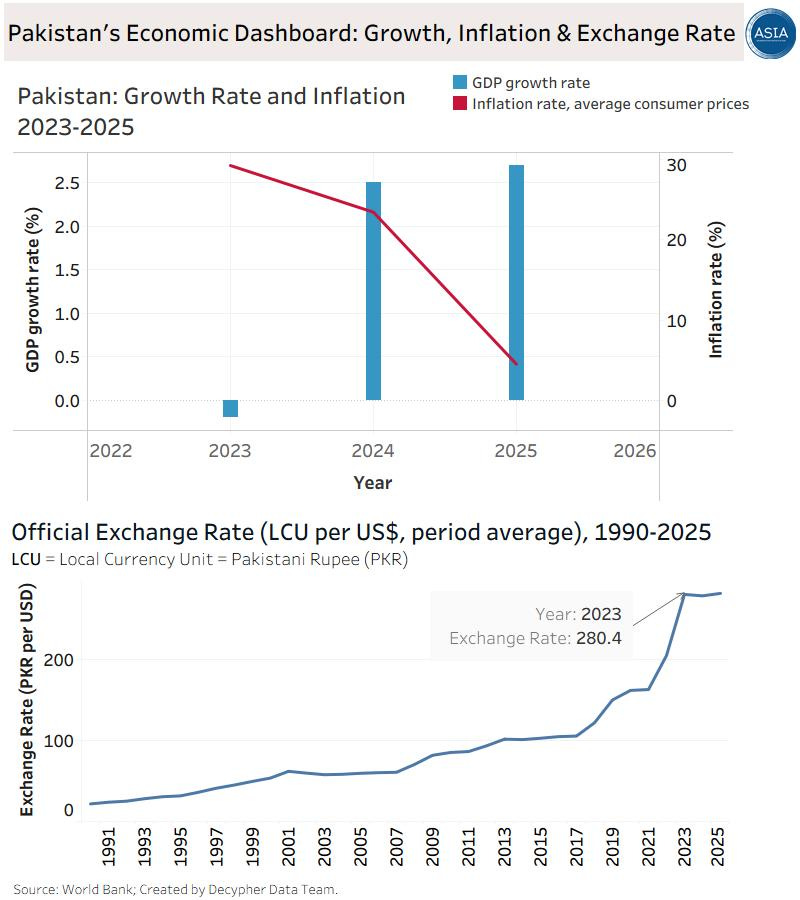
Pakistan’s economy struggled in 2023, but GDP growth is showing gradual improvement in 2024–2025. The Pakistani Rupee has steadily depreciated against the US dollar, driven by persistent trade deficits, low foreign reserves, high inflation, and ongoing political instability (World Bank, IMF).
— — —
Long View: Amogh Dev Rai- Research Director at the Advanced Study Institute of Asia (ASIA), affiliated with SGT University, Gurugram.
Essay: Preksha Jalan
Data: Bhupesh.
Produced by Decypher Team in New Delhi, India
— — —