


Two Chinas on One Map
A month-ahead read on what the Trump-Xi summit, the provincial debt spiral, and the tech-sovereignty build tell us about whether coexistence is possible and whether the foundations can hold the weight.
The Trump-Xi summit scheduled for mid-May will produce handshakes, communiqués, and the usual theatre of great-power civility. Beneath it, the structural signals point in a different direction. The South China Morning Post reported on 7 May that beneath the surface of the summit, major trade conflict is building, and that Beijing has “quietly and methodically amassed increasingly effective tools” to counter what it sees as Washington’s heavy-handedness. In March, the US Trade Representative launched two new Section 301 investigations into Chinese excess capacity and forced labour, to which China retaliated with investigations of its own targeting US measures on green products and supply chains. The tariff truce — extended in November 2025 to run through November 2026, with bilateral tariffs reduced to 10 per cent from the April 2025 peak of 125 per cent — holds on paper. The investigatory machinery being assembled beneath it is designed to produce the legal basis for reimposing tariffs the moment the truce expires or the political calculus shifts.
Can the US and China coexist? The question is wrong. They already coexist. The question is whether the coexistence is stable or whether it is a truce in which both sides are building the instruments to escalate. The signals from the past thirty days say the latter. The Section 301 probes are not diplomatic noise. They are the statutory mechanism through which new tariffs become legally available after the Supreme Court struck down one of Trump’s key tariff tools in February. China’s counter-probes mirror the structure exactly. The symmetry is not accidental. It is the architecture of managed escalation: each side builds the legal basis for the next round while maintaining the fiction of negotiation.
The coexistence is real. Its stability is not. Each side builds the legal basis for the next round while maintaining the fiction of negotiation.
The Chaos Map places this interface in the lower-left quadrant — relational order. Summits, truces, diplomatic protocols. But the probes and counter-probes sit above it in relational chaos, pulling the system upward. The month-ahead signal: watch whether the summit produces a concrete extension of the truce beyond November 2026 or merely a restatement of existing terms. The former is stabilisation. The latter is a countdown.
The debt that builds nothing
The second China — the one the summit will not discuss — sits on the right side of the map in conceptual chaos. The IMF’s 2026 Article IV report identifies LGFV debt as the primary source of financial vulnerability, noting that nearly one-third of local government financing vehicles are technically insolvent and survive only through constant refinancing. The estimated scale of hidden local debt ranges from $7 trillion to $11 trillion, against a total non-financial sector debt-to-GDP ratio that reached 290.6 per cent by the end of 2024.
Guizhou became the first Chinese province to seek central government assistance after revelations of local debt totalling trillions of yuan. In 2025, Guiyang, the provincial capital, allocated 12.19 per cent of its land-sale revenues to interest payments alone — nearly $545.7 million per year, up 9.35 per cent from 2024. Among the highest-risk provinces are Guizhou, Inner Mongolia, Ningxia, Liaoning, and Qinghai. Beijing’s response — a ¥10 trillion restructuring programme that refinances hidden LGFV bonds into lower-interest provincial bonds — has been characterised by the Atlantic Council as “extend and pretend”: the central government has chosen to put off its day of reckoning.
Can provinces this indebted really compete with the world? The honest answer is: some can, some cannot, and the divergence is the signal. Beijing, Shanghai, and Guangdong have LGFV bond yields around 2–3 per cent and access to state-backed financing. Guizhou’s LGFV yields run at 7.5 per cent. The gap is not incremental. It is structural. China’s technology-sovereignty build — SMIC, DeepSeek, Huawei — is concentrated in the coastal provinces with clean balance sheets. The inland provinces that built infrastructure on debt during the boom years are now paying interest on assets that produce no return: empty parks, rural highways, unfinished museums that do not generate the cash needed to service high-interest bank loans.
Reading the Chaos Map
The Chaos Map makes the divergence spatially legible.
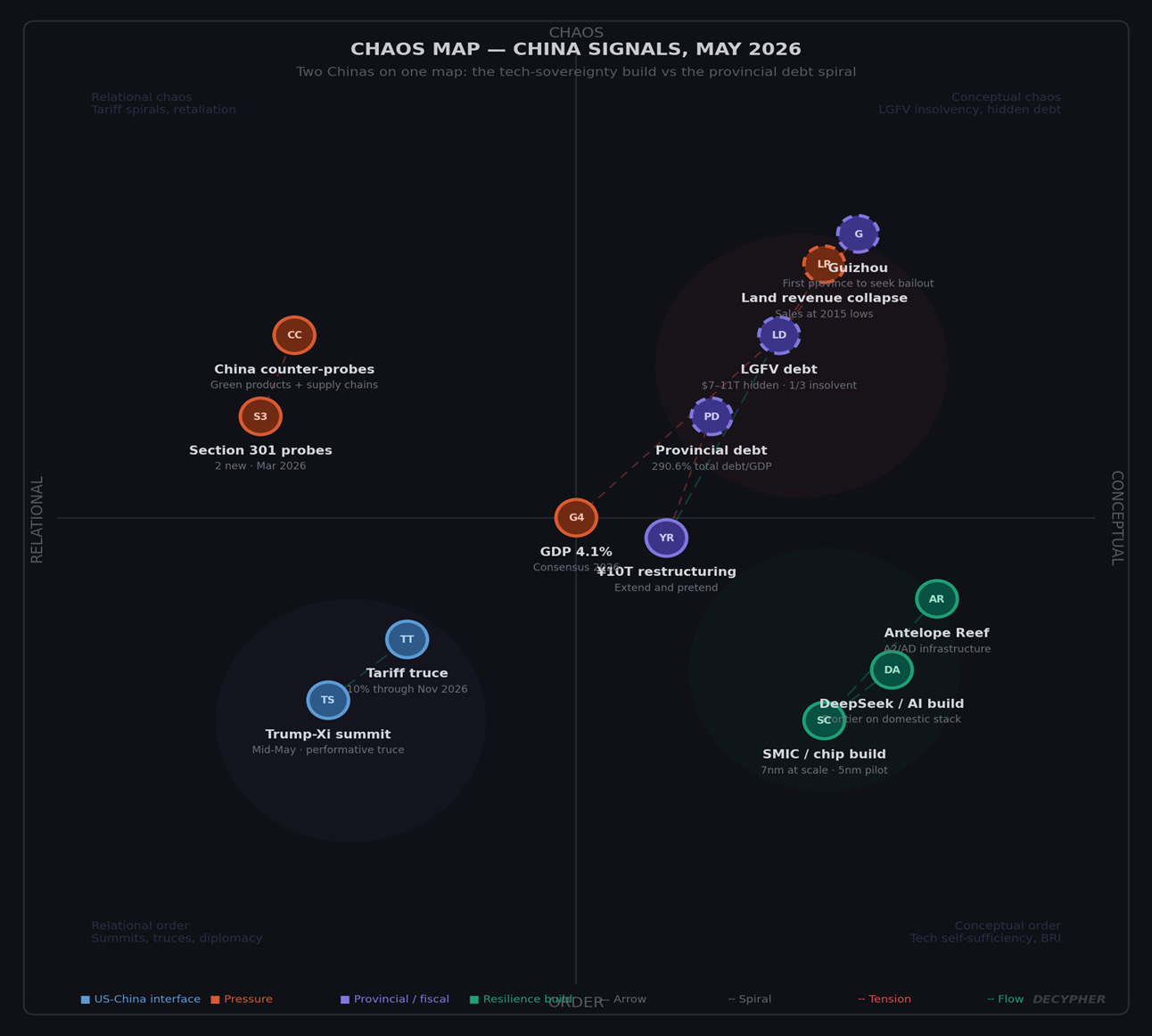
The tech-sovereignty cluster — DeepSeek, SMIC, Antelope Reef — sits in conceptual order with arrow motion: goal-directed, self-reinforcing, building toward endpoints. Each node makes the next one cheaper to build. The provincial debt cluster sits in conceptual chaos with spiral motion: unresolved, consuming resources, producing no stable architecture. The ¥10 trillion restructuring attempts to convert spiral into arrow — to impose order on the debt through institutional intervention — but the underlying problem (assets that produce no revenue, land sales at decade lows, 18,000 LGFVs that exist only to roll over debt) remains unaddressed.
The GDP forecast (consensus 4.1 per cent for 2026) sits at the exact centre of the map. That is not a metaphor. It is a structural description. China’s growth is the resultant of two opposing forces: the tech build pulling toward conceptual order and the debt spiral pulling toward conceptual chaos. The two Chinas share a GDP number but not a trajectory. Whether the number holds depends on which force is stronger — the arrow or the spiral.
The month-ahead read
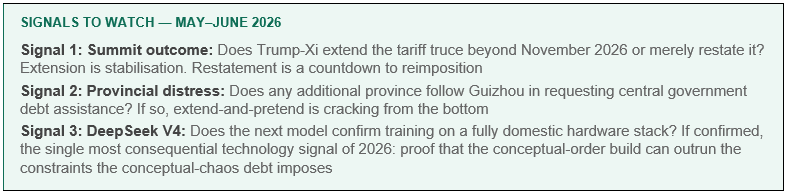
The two Chinas are real. One builds chips and reefs and frontier AI models. The other pays interest on empty roads in Guizhou. The question is not whether they can coexist with America. It is whether they can coexist with each other.

Beijing Sentences Two Former Defence Ministers in Corruption Crackdown
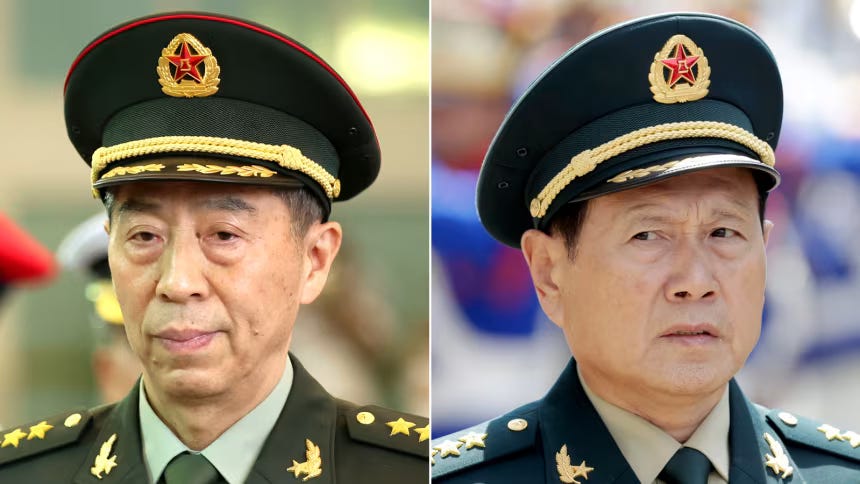
Two former Chinese defence ministers, Wei Fenghe and Li Shangfu, have received suspended death sentences after being convicted of corruption, according to China’s state news agency Xinhua. A military court found Wei guilty of accepting bribes, while Li was convicted of both taking and offering bribes. Both were sentenced to death with a two-year reprieve, after which the punishment will be commuted to life imprisonment without parole. They were also stripped of political rights for life and had all personal property confiscated.
Since Chinese President Xi Jinping began his extensive anti-corruption campaign in 2012, the decision represents one of the heaviest penalties meted out to senior military officers. Wei held the position from 2018 until 2023, while Li temporarily served as defense minister in 2023 before being ousted following an unexplained two-month departure.
Chinese authorities accused both men of causing significant damage to the military’s political environment. Wei was uniquely portrayed as having “lost his chastity” to the Communist Party, a word that frequently implies betrayal or hostility to the government. Meanwhile, Li has been accused of fraudulent actions in the military equipment sector.
Their downfall is part of a broader purge within China’s military leadership, with several top generals and Central Military Commission officials investigated in recent years as Xi tightens control over the People’s Liberation Army.

Bangladesh Signals It Won’t Wait for India on Teesta
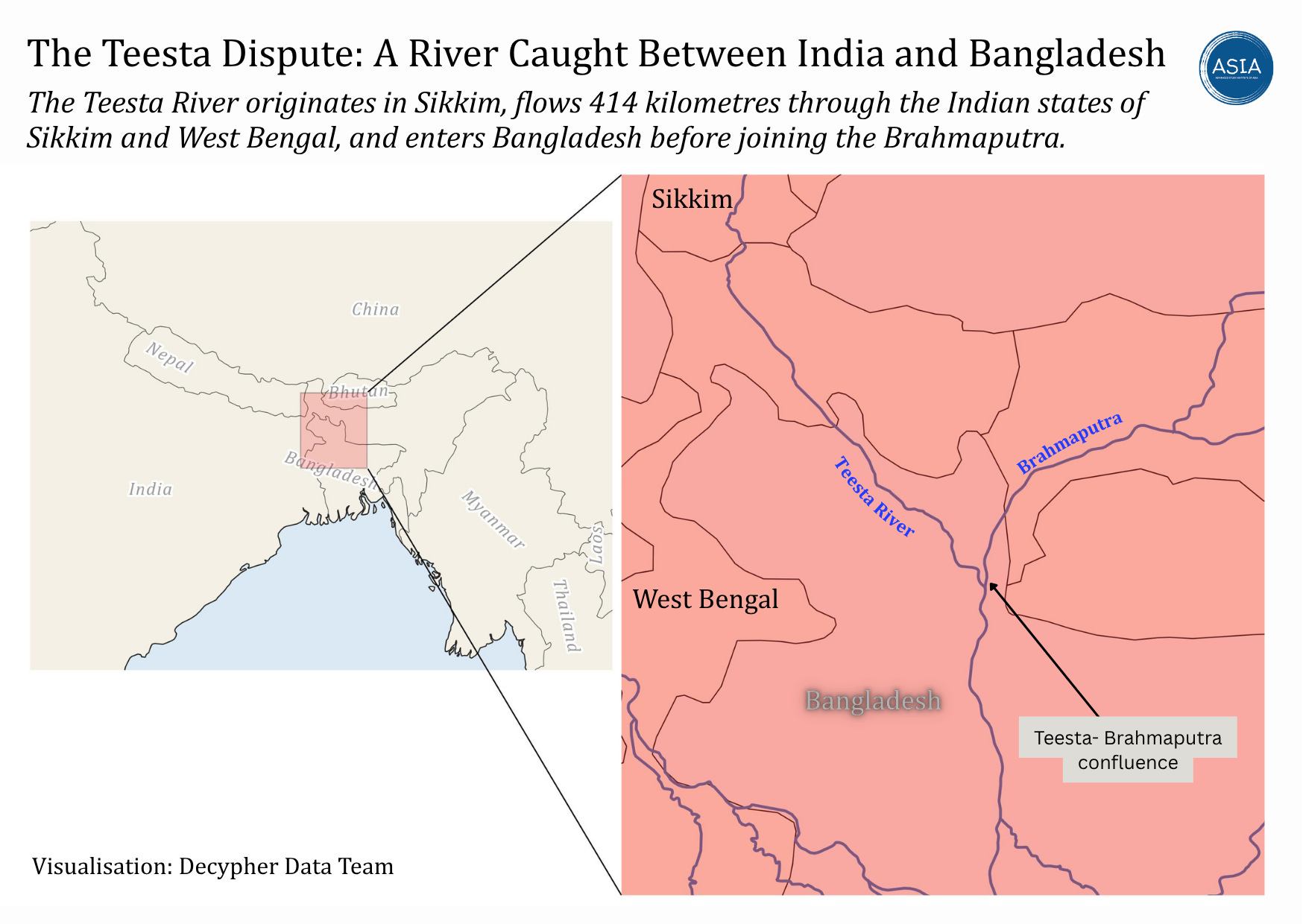
Bangladesh Tries to Say It Won’t Wait on Teesta to India. Bangladesh has already indicated that it cannot stand for waiting indefinitely for a Teesta River water-sharing agreement with India and that it is ready to strengthen its cooperation with China on river restoration and infrastructure projects. Dhaka “cannot just sit idle” while India is still grappling inside with deep-seated political disagreements over this issue,” said Bangladesh Foreign Minister Khalilur Rahman ahead of visit to Beijing.
The Teesta dispute has been unresolved for more than 40 years after several negotiations. A temporary settlement was given in 1983, but a formal treaty was repeatedly unsuccessful. In 2011, former Indian prime minister Manmohan Singh was set to seal an interim deal with Bangladesh, leading to an unsuccessful deal that was put on hold by the then chief minister, Mamata Banerjee, who believed the river was too small to keep a share. China’s role in the Teesta region has continually expanded since 2016.
Beijing sponsored technical studies and ultimately submitted a $1 billion or so restoration and management scheme, which included embankments, dredging, flood protection and water storage systems. Bangladesh has made a new deal with Beijing, and the government said it will fast-track the Chinese initiative because its government, described as “an extremely important friend” (Zhang, China). Major strategic implications flow from the dispute. Bangladesh charges India with diverting the dry-season stream through Gazaldoba Barrage, which could affect irrigation in northern districts relying heavily on Teesta. And both India and Bangladesh continue to be wary of China’s increasing upstream hydropower ambitions in Tibet, creating a broader geopolitical dimension to the river dispute.
— — —
Essay: Amogh Dev Rai- Research Director at the Advanced Study Institute of Asia (ASIA), affiliated with SGT University, Gurugram.
Postscript: Bhupesh and Neeti
Produced by Decypher Team in New Delhi, India
— — —