


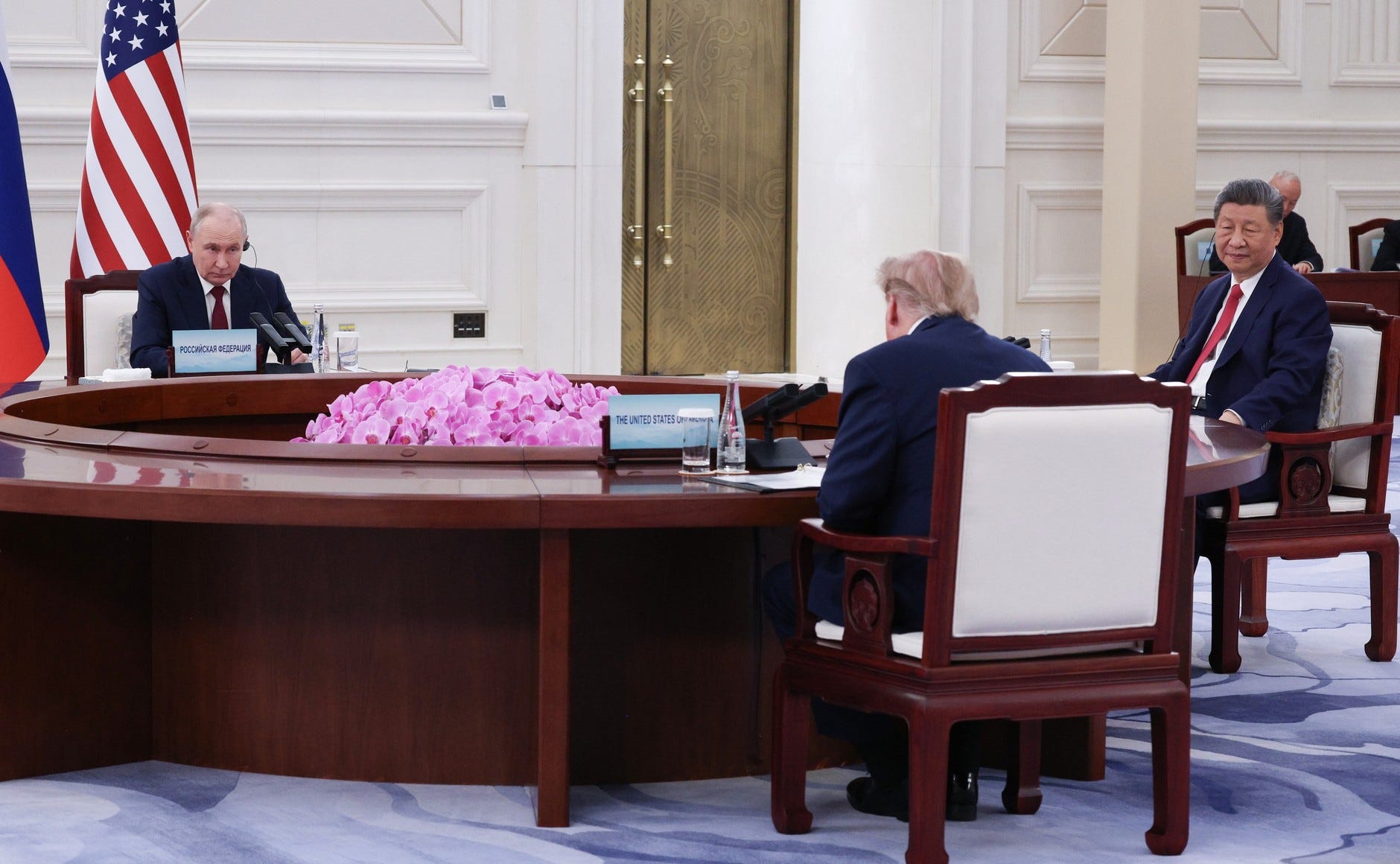
A table set for three
On 19 November the leaders of the world’s three largest nuclear powers met together, for the first time in any format, on the margins of the APEC summit in Shenzhen. Washington was explicit about its purpose. White House spokeswoman Olivia Wales said that the reduction of nuclear weapons would head the president’s agenda, and a senior official briefing the press described the meeting as China’s opportunity to “step up ... to the adult table”. The timing has a clear rationale. New START lapsed in February, and for the first time in more than five decades no treaty limits the size of the American and Russian strategic forces.
Narendra Modi spent the same week in Manila, attending the ASEAN-India and East Asia summits. India has never been a member of APEC, and his absence from Shenzhen involved neither a breach of protocol nor a slight. On 17 November he told his ASEAN counterparts that the world required “peace, stability and predictability”. Two days later three other leaders began a discussion of precisely that question, in which India’s deterrent figured only as a quantity for others to account for.
A US-China-Russia dialogue on “strategic stability” would treat India’s nuclear forces as an object of external management, although New Delhi has strong grounds for claiming a voice in how those forces are counted. Such a dialogue would extend a pattern of exclusionary arms-control regimes that India has resisted since the Non-Proliferation Treaty opened for signature in 1968. Beijing’s refusal to enter trilateral negotiations complicates matters further, given its implications for the chain of deterrence that runs from China to India and from India to Pakistan.
The Yalta lens
The comparison with 1945 preceded the meeting itself. Pyotr Tolstoy, chairman of the Duma’s foreign affairs committee, spoke of a possible new Yalta; a gallery in St Petersburg mounted an exhibition entitled Yalta 2.0; and Volodymyr Zelenskiy said he did not want “Yalta 2, 3, 4” to signify a redistribution of influence. Analysts at the Atlantic Council interpreted Putin’s proposal for the meeting as an attempt to recreate the conditions of 1945, in which the great powers determined the fate of smaller states. The Kremlin spokesman, Dmitry Peskov, rejected the analogy, arguing that nothing agreed in Shenzhen could be imposed on third parties.
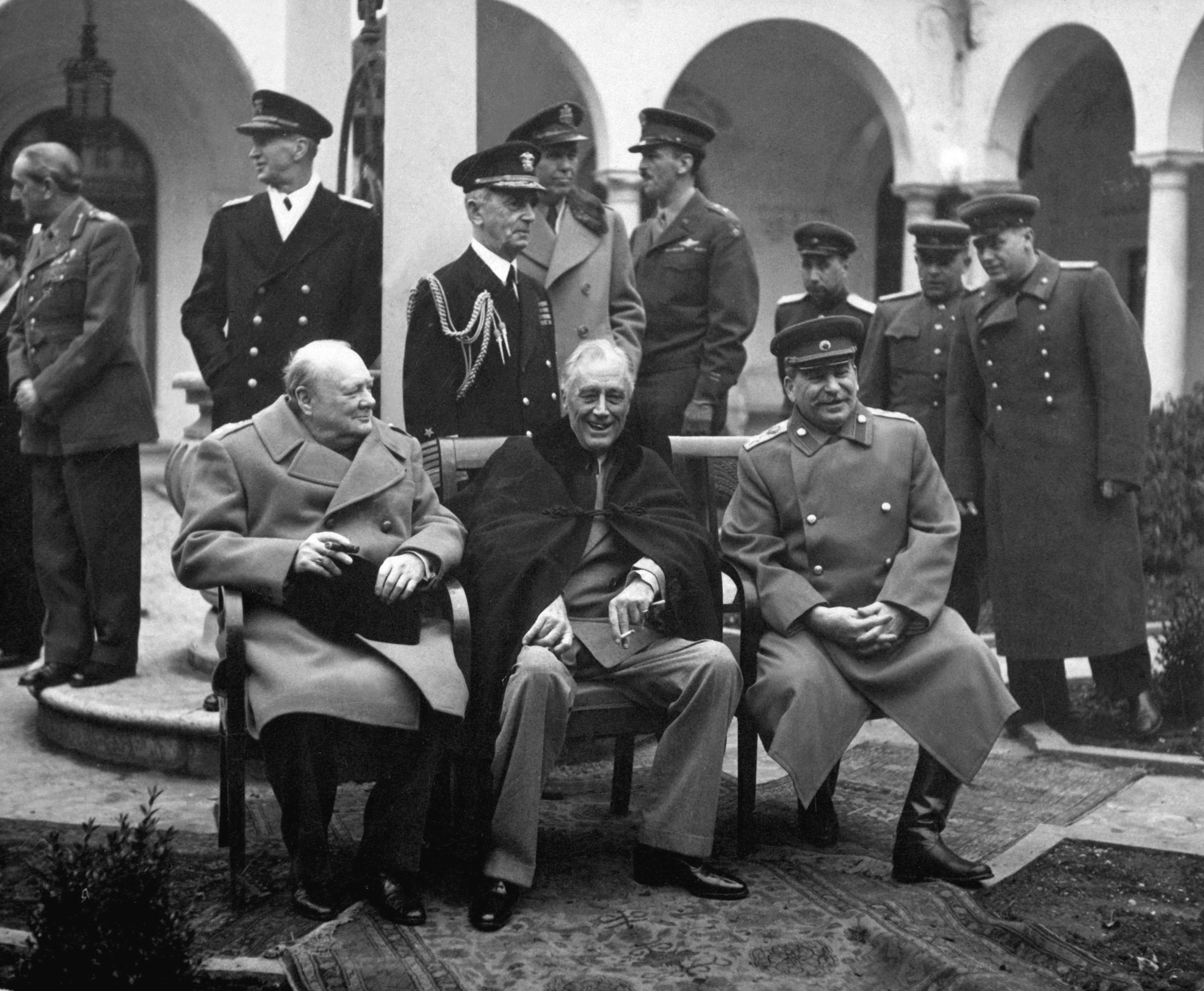
Yalta is usually remembered for its European provisions, Poland above all. Its Asian provisions offer the closer parallel. At the conference of 4 to 11 February 1945, Roosevelt and Churchill secured Soviet entry into the war against Japan by conceding Chinese interests: the lease of Port Arthur, a preferential position in Dairen, joint operation of the Manchurian railways, and recognition of the status quo in Outer Mongolia. China, which had been at war with Japan since 1937, was neither present nor consulted. Roosevelt undertook to obtain Chiang Kai-shek’s concurrence afterwards, and the Far East agreements were formalised only in the Sino-Soviet treaty of August 1945.
Chinese leaders are conscious of this history, and Xi was reported to be anxious to avoid the Yalta comparison for that reason. That the state excluded in 1945 should act as host in 2026 indicates how far China’s position has changed. The form of the settlement, however, is unchanged: an understanding reached among the strongest states defines the terms within which those outside the room must subsequently operate.
The analogy is offered here as an account of structure, and carries no prediction that Asia will be partitioned over a working lunch. Arms control is the field in which that structure transfers most readily, because its currency is numerical. A ceiling agreed among three states becomes, by default, the standard against which every other arsenal is measured, whatever the view of the state that owns it.
Strategic stability, for whom?
The American case for a trilateral format has been simple and consistent. On New START’s expiry, Under Secretary of State Thomas DiNanno argued that a bilateral treaty with a single nuclear peer was no longer appropriate. Trump declined Moscow’s offer to extend the treaty and called instead for a new agreement that includes China. The argument rests on the pace of China’s build-up: SIPRI estimates that Beijing now holds approximately 620 warheads, the fastest-growing arsenal in the world, and that it has added roughly a hundred a year since 2023.
The difficulty is that this reasoning does not terminate at three. If China must be counted because its arsenal now shapes American planning, India’s arsenal shapes Chinese planning in comparable fashion, if on a smaller scale. SIPRI estimates India’s stockpile at about 190 warheads, of which 12 are deployed, and observes that its modernisation is increasingly directed towards “reaching targets throughout China”. Moscow has for years advanced the equivalent argument with respect to British and French forces. Any ceiling Beijing might accept would be calculated with India in view. A trilateral framework therefore faces two options. It may leave Indian forces out of its calculations, in which case its Chinese figures will lack stability. Or it may incorporate them as an underlying assumption, in which case India’s deterrent is effectively priced in a forum where India has no representation.
India’s position should not be read as opposition to arms control as such. At the Conference on Disarmament in February, Foreign Secretary Vikram Misri described the expiry of New START as “a major setback”. The Indian objection is narrower and of longer standing. New Delhi has accepted forms of stability that it helped to define, and has for decades declined those defined on its behalf.
An old quarrel in a new room
India’s record on this question is long and notably consistent. It declined to sign the NPT in 1968 because the treaty fixed the category of nuclear-weapon states at those that had tested before 1 January 1967 and required all others to accept that line as permanent. In 1996 it blocked consensus on the Comprehensive Nuclear-Test-Ban Treaty at the Conference on Disarmament, objecting to a text that constrained the threshold states without obliging the nuclear powers to disarm. The objection in both cases was the same. These regimes were drafted by the armed for the unarmed, and they admitted India only as an object of regulation.
The tests of May 1998 produced the most direct attempt at great-power management of the Indian deterrent. The five permanent members of the Security Council met in Geneva on 4 June, and two days later the Council endorsed their joint communiqué in Resolution 1172, which condemned the tests and called on India and Pakistan to accede to the NPT. Atal Bihari Vajpayee told the Rajya Sabha that India’s non-proliferation record had been “impeccable and better than that of some” of the permanent members themselves. Jaswant Singh set out the fuller argument in Foreign Affairs that autumn, in an article entitled Against Nuclear Apartheid.
The closest precedent for Shenzhen followed three weeks later. On 27 June 1998 Bill Clinton and Jiang Zemin issued a Joint Statement on South Asia in Beijing, pledging to cooperate “to prevent an accelerating nuclear and missile arms race in South Asia” and declaring that India and Pakistan “do not have the status of nuclear weapons states.” A contemporary Outlook column described the statement as the most severe foreign-policy shock India had experienced in half a century, since Washington had invited China to resolve a problem to which China was itself a party. New Delhi’s response approached the limits of diplomatic language.
The subsequent course of events is instructive. India did not enter the nuclear order through the treaties it had rejected. It gained admission by exception, through the 2005 civil nuclear understanding with the United States and the Nuclear Suppliers Group waiver of 2008, while adopting restraints of its own design: a moratorium on testing, a no-first-use doctrine and a posture of credible minimum deterrence. In October, at the First Committee of the UN General Assembly, India renewed its offer to make no first use binding through a multilateral agreement and reaffirmed its support for disarmament that is “universal, non-discriminatory and verifiable”. The position is coherent. India accepts constraints in whose drafting it has taken part and resists those drafted elsewhere on its behalf.
Shenzhen reproduces the configuration of 1998 with an additional participant. China is again cast as co-manager of a nuclear order in Asia to which it is itself a party, and India’s forces enter the discussion only as a function of other states’ calculations.
Beijing’s “not yet” and the chain below it
China declined the invitation before it was formally extended. In February, when New START expired, foreign ministry spokesman Lin Jian stated that “China’s nuclear forces are not on the same level” as those of the United States and Russia. Last month the ministry went further, describing it as unfair and unrealistic to expect China to join trilateral disarmament negotiations “at this stage”. Washington has adjusted its expectations accordingly, and a senior official indicated before the meeting that no agreement was anticipated. Edgard Kagan of CSIS has argued that Beijing has no wish for arms-control talks with the United States in any form, and least of all in a trilateral setting that would present China as a major nuclear power subject to comparable limits.
At first sight the refusal works in India’s favour, since no ceiling will be agreed over India’s head in Shenzhen. The qualifying phrase “at this stage”, however, denotes a threshold. Analysts cited by Al Jazeera suggest that Beijing would consider a trilateral framework only once the United States and Russia had reduced their arsenals towards genuine parity with China’s. Parity can also be approached from below, through China’s own expansion, and every warhead China adds on the way to a table without an Indian seat is one to which India must respond.
This is how the chain of deterrence operates. SIPRI’s January 2026 estimates place China at about 620 warheads, India at 190 and Pakistan at 170. India plans against China, and Pakistan plans against India. India’s first flight test of a MIRV-equipped Agni-V in March 2024 was presented in Indian commentary as part of a technological competition with China. Pakistani analysts read it as directed at Pakistan, which has claimed MIRV capability for its Ababeel missile since 2017. Islamabad’s Centre for International Strategic Studies now characterises India’s programme as vertical proliferation that has outgrown its stated doctrine. An adjustment made in New Delhi with Beijing in view is received in Rawalpindi as escalation. Pressure is thus transmitted down the chain, and no link contains a mechanism capable of interrupting it. India and China conduct no substantive nuclear dialogue. India and Pakistan maintain only limited confidence-building measures, including the annual exchange of lists of nuclear installations and a 2005 agreement on the pre-notification of ballistic missile tests.
Superimposed on this chain, a US-China-Russia process could develop in one of two directions. Should it stall, as Beijing intends, China will continue to build towards the parity that would eventually justify its participation, and the chain beneath it will tighten. Should it succeed, Chinese force levels would be fixed at whatever figure Beijing considers sufficient against all its rivals, India included. India’s arsenal would then be constrained by inference, its requirements derived from a Chinese ceiling negotiated in its absence. In both cases the states of South Asia would bear the consequences without having shaped the outcome.
A chair of its own making
The appropriate Indian response does not lie in seeking a fourth chair at Shenzhen. A seat at a table organised around American, Russian and Chinese parity would be a subordinate one, and it would invite precisely the tiered bargaining that the NPT once imposed. The more useful lesson of 1998 is that India’s leverage has come from articulating its own standards and then adhering to them.
Several courses of action follow. At the Conference on Disarmament and the First Committee, India could press for any successor to New START to be negotiated in a multilateral forum, offering its standing no-first-use proposal as an initial contribution. With Beijing, it could propose the modest technical measures it already maintains with Islamabad, beginning with the pre-notification of missile tests. China may well decline. A refusal on the record would nonetheless expose the distance between Beijing’s professed doctrine of minimum deterrence and its unwillingness to discuss that doctrine with a neighbour. In Washington and Moscow, Indian diplomacy could state plainly that force levels bearing on Indian security cannot be settled without Indian participation. An understanding of the Yalta type depends on the acquiescence of those it excludes.
The Asian settlement reached at Yalta proved short-lived. Within a decade China had recovered Port Arthur and the Manchurian railways, having grown strong enough to reopen terms it had never accepted. States absent from a settlement can outlast it, provided they later return with proposals of their own. The absence of an Indian chair at Shenzhen is, for the present, a fact of diplomatic geography. Whether it becomes a strategic loss will depend on whether New Delhi allows the conversation to proceed as though its silence signified consent.
Essay: Maseera Shaik- Research Assistant (Security, Crisis and Strategy) at The Advanced Study Institute of Asia (ASIA)
Produced by Decypher Team in New Delhi, India