


Amogh Dev Rai | Research Director and researcher on China, and Chinese Geopolitics.
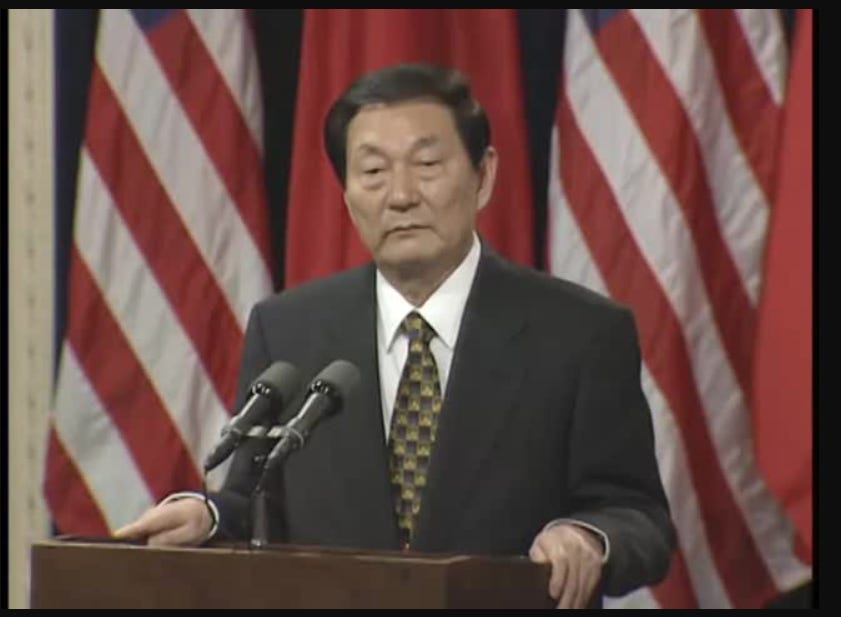
Zhu Rongji died this week in Beijing, 97 years old, and the Chinese papers are calling him all the respectful things now, statesman, revolutionary, loyal Party member till the end. None of that tells you much about what he actually did to the country. So let’s skip the tributes and go back to 1990 instead.
Zhu was on a tour of the US then, still just the mayor of Shanghai, and his American hosts kept calling him “China’s Gorbachev.” Meant as a compliment. He didn’t take it as one. “I’m not China’s Gorbachev,” he told them. “I’m China’s Zhu Rongji.”
Fair question, why did that comparison bother him so much. Gorbachev is shorthand for one specific kind of failure, an economy you open up faster than the political system underneath it can take, and the whole thing comes apart. For the next thirty years China’s entire bet was that this particular failure could be avoided, that you could let the market in and keep the Party’s grip on everything else. Zhu is a big part of why people believed that bet could work. And a big part of why, for a long time, it did.
He got there by a strange enough route. Orphaned young. Trained as an engineer. Denounced twice over, first as a “rightist” in the late fifties for saying Mao’s growth targets were irrational, which cost him his party card and five years doing menial labour in the countryside. Purged again in the Cultural Revolution, another five years, same story. Nobody rehabilitated him till 1979, once Deng was firmly in charge and pragmatism was briefly back in fashion. After that the rise was quick. Shanghai mayor in 1988, party secretary a year later. And it was as party secretary, in June 1989, that he did the thing that tells you almost everything about how he’d govern for the next fifteen years. Beijing was calling the massacre in Tiananmen “turmoil.” Zhu published something in the Shanghai papers that used neither that word nor any softer one, just that what had happened was a fact and facts don’t stay buried. Not defiance exactly. Not the official line either. Just the first sign of a talent he’d spend the rest of his career on, saying the true thing in a way the Party could still swallow.
By 1991 he was vice premier, and when Li Peng’s health gave out in 1993 he took the whole economy over. Two moves right away. As de facto central bank governor he cut off the credit that was pushing inflation towards 25 percent, and had it down to zero within two years, over howls from every state enterprise boss who’d gotten used to easy money. And separately, on the tax side, he centralised revenue collection so hard that provinces went from keeping most of what they raised to sending most of it to Beijing. That 1994 reform is probably the single biggest thing Zhu Rongji ever did. Worth remembering, because we’re coming back to it. It’s also the reform whose bill has come due.
But first, 1998, when the premiership he’d been circling since ‘93 finally landed, and he opened with a promise that was reckless even for him: fix the state banks in two years, fix the state enterprises in three, “minefield or bottomless abyss,” didn’t matter, he’d see it through. The banks took closer to ten. The enterprises never really got fixed, not the way he meant. Getting there meant laying off something like thirty million state workers, most of them in the old industrial northeast, and the welfare net he built to catch them was thin and mostly improvised. It didn’t catch everyone. Parts of that region never came back.
What he did land, on the outside-facing side, was the WTO. Six and a half years of negotiation, much of it face to face with the American trade rep Charlene Barshefsky, ending in December 2001 with China inside the global trading system just in time for a decade of double-digit growth. Barshefsky’s line on him, years later, was that he genuinely wanted China to look more like the West, more open, more market-run, bound by rules it hadn’t written alone. Someone at Goldman Sachs who dealt with him back then compared him to Ludwig Erhard, the West German technocrat who built that country’s postwar economy out of similar rubble, which is a big claim but not a crazy one.
He was, whichever way you look at it, a strange fit for running a one-party state. Loved sparring with reporters instead of reading off cards, which almost nobody at his level does. Fired an official on the spot once for showing up with a cigarette lighter he couldn’t have afforded on his salary. Had a favourite line, depending who’s telling the story, about a hundred bullets or a hundred coffins kept in reserve, ninety-nine for corrupt officials, one for himself. It didn’t win him friends inside the Party. He never built the patronage networks that might have gotten his pension reforms or his bad-debt cleanup through, and both quietly died on the table. He made enemies faster than allies and, from what I can tell, didn’t much care.
Here’s the part most of the tributes are skipping past. That 1994 tax reform, the one that made Beijing rich and left the provinces broke, it didn’t just fund the central government. It also left every province and city with exactly one lever left to raise money on their own: land. Sell it, lease it, borrow against selling more of it later. Three decades of Chinese growth ran, in part, on that lever. And so, it turns out, did the property slump China is still stuck in, and the something like 100 trillion yuan in local government debt that Xi’s government is now trying, slowly and half-heartedly, to unwind. Standard Chartered’s economists actually call Xi’s 2024 fiscal overhaul the third big tax reform of the reform era (Fortune, 2024), the first being Zhu’s, in 1994. Which is a polite way of saying Beijing just spent two years trying to fix a problem Zhu built into the machine thirty years ago.
None of this is really an argument against him, to be clear. You can’t blame someone laying pipes for a trillion-dollar economy in 1994 for not planning around the strains of one twenty times the size. But that’s the honest version of “the China he shaped.” Not a clean inheritance. A machine that’s still recognisably his, still running on the incentives he wired into it, debt and all.
Barshefsky said one more thing, the less flattering one, and it’s probably closer to the real epitaph (NPR, 2026). Zhu, she said, belonged to a China from a different time, one that wanted to become more like the West. Xi’s China wants something else, more state, more self-reliance, less of the outside world let in. Zhu spent his last years quiet, in a house in the hills west of Beijing, listening to Peking opera, and apparently still advising some of the younger technocrats running the place. Not all of them were listening, or so people say. Maybe that’s the real question here. Not whether China still needs someone like him. Whether it could still make room for one.
Produced by Decypher Team in New Delhi, India