


How the Houthi blockade of Saudi Arabia exposes the machinery behind Iranian power, from Quds Force handlers in Yemen to the Supreme Leader’s $95 billion holding company
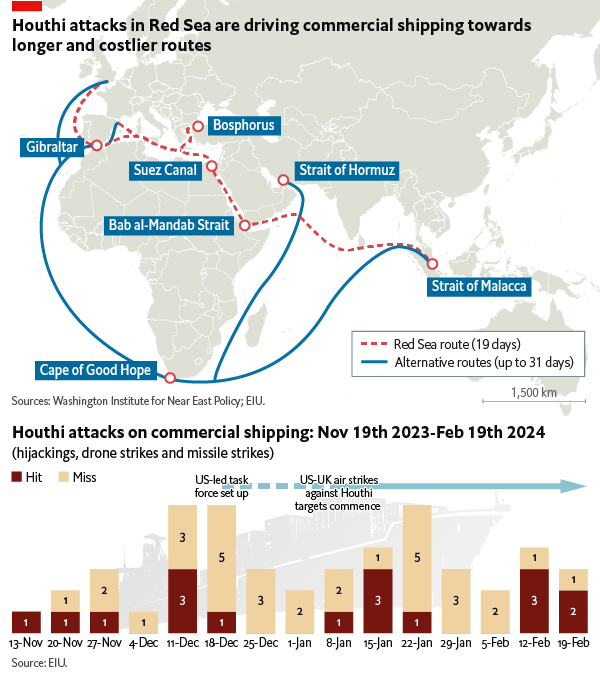
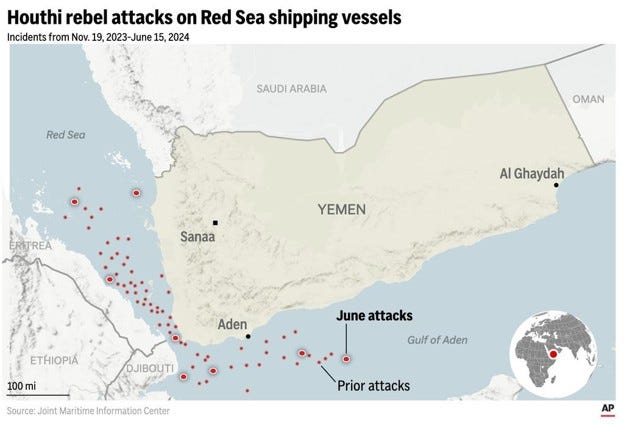
By late summer 2026, the fight between Yemen’s Houthi movement and Saudi Arabia had stopped looking like a sideline to the bigger regional war. On 13 July, Saudi jets bombed the runway at Sanaa’s airport, apparently to keep an Iranian flight from landing there, and within a week the Houthis answered with a naval blockade of the kingdom and a run of strikes on its oil infrastructure. Between 13 July and 14 August they carried out sixteen attacks on Saudi targets, seven of them oil facilities and six of them tankers, hitting Abqaiq, the world’s largest crude-stabilization plant, and forcing Aramco to halt operations at Jizan. The campaign killed dozens of Saudi-backed Yemeni troops in Marib and Hadramout, and on 11 August it killed four crew members of a cargo ship transiting the Bab al-Mandab strait. By late August, the Houthis were still hitting Saudi-linked tankers off Yanbu, and their military spokesman had already declared the de-escalation phase of Yemen’s war over. Riyadh answered with a fourteen-country maritime coalition and its own strikes on Houthi positions, and a separate attack in early August left eleven Saudi civilians wounded. None of this came out of nowhere. It followed almost four years of quiet de-escalation that had held since the UN truce lapsed in October 2022, and it broke down precisely as Tehran found itself fighting a much bigger war with the United States and Israel. The obvious question is who is actually running this war. The honest answer takes you further than the battlefield, from Revolutionary Guard officers stationed in Yemen down to a financial holding company in Tehran that Reuters first mapped out thirteen years ago.
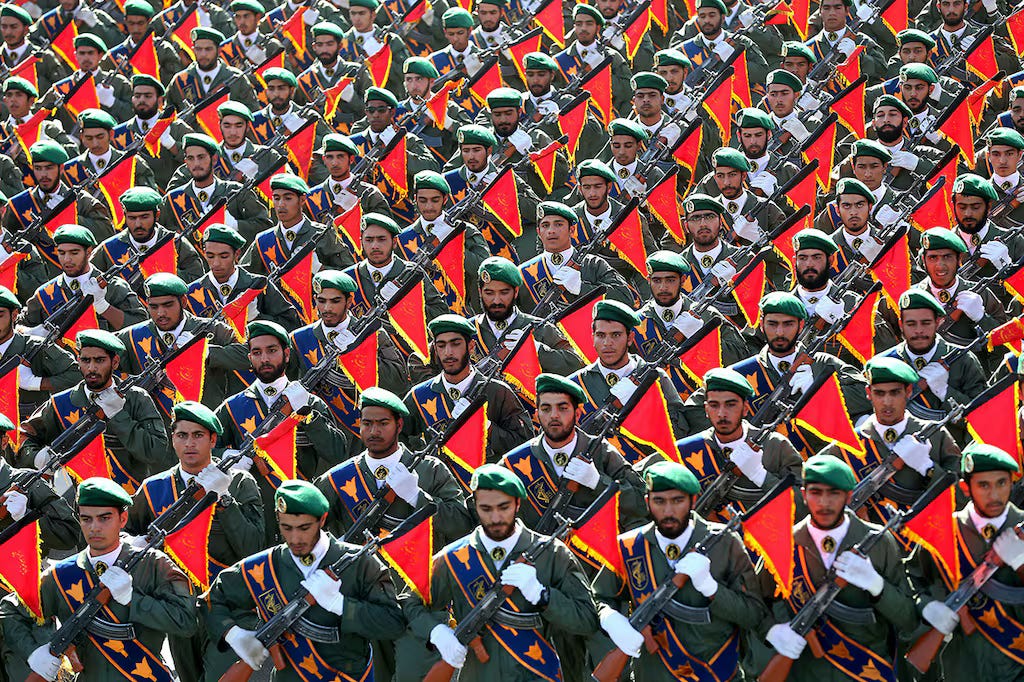
The immediate answer is the Islamic Revolutionary Guard Corps. Officers from the IRGC and from Hezbollah have been present in Yemen, helping direct Houthi attacks on shipping and supplying the targeting data that decides which vessels get hit. The Quds Force, through its deputy commander Abdul Reza Shahlai, oversees the flow of drones and cruise and ballistic missiles that turned the Houthis into a force capable of threatening the whole region, and reporting from inside Iran in 2025 claimed that Khamenei personally signs off on Houthi political and military decisions. By August 2026,Western and Gulf intelligence services were warning that the Houthis and Iraqi militias, working under IRGC coordination, might launch coordinated strikes on Saudi energy sites, ports, and airports at the same time. This is the Axis of Resistance doing what it was built to do: a set of armed groups managed by the Guard, answerable only to the Supreme Leader, used to project force that Iran cannot project on its own. Iran remains the Houthis’ main patron, supplying weapons, training, and intelligence, and the arrangement is close to a textbook case of what scholars call delegated deterrence: using non-state fighters as instruments of coercion so the costs of confrontation never land on Tehran directly. Yemen analysts increasingly rate the Houthis as a more useful partner for Iran than a battered Hezbollah, since they pair Iranian anti-ship missiles and long-range drones with a position straddling the Red Sea. The coordination is real but far from seamless. Since the war with Israel began, Tehran has tried to time missile launches from Iran, Lebanon, and Yemen together to overwhelm air defenses, even as Israeli intelligence penetration has repeatedly forced it to change how it does that.
But there is a second, financial answer to who controls this war, and it runs through the same man. The Supreme Leader who signs off on Houthi operations also controls a business empire that Reuters exposed in November 2013 in a series called “Assets of the Ayatollah.” The organization is Setad, short for the Execution of Imam Khomeini’s Order, founded in 1989 to manage property confiscated after the revolution, in theory for the benefit of the poor. Setad still describes itself that way, but the Reuters investigation found that under Khamenei it kept most of what it collected rather than passing it on. By 2013, Reuters put its holdings at roughly $95 billion: about $52 billion in real estate and $43 billion in corporate stakes, a sum around 40 percent larger than Iran’s entire oil exports that year and in the same range as the fortune of the Shah, who was overthrown in 1979. That empire was built by seizing thousands of properties belonging to religious minorities, including Baha’is, along with businesspeople and Iranians living abroad, often on the legal claim that the properties had simply been abandoned. Setad held a court-sanctioned monopoly on seizing property in the Supreme Leader’s name, and at one point auctioned off close to three hundred properties in a single month.
Setad’s relevance to the war in Yemen is indirect but decisive. Reuters found no evidence that Khamenei personally pockets money from the conglomerate, but through it he controls resources large enough to bypass parliament and the national budget entirely, which insulates him from factional politics and from rival branches of the Iranian state. The US Treasury sanctioned Setad in 2013, describing it as a sprawling network of front companies concealing assets on behalf of Iran’s leadership. Its revenues help fund the Leader’s compound and its staff, and just as important, they hand the IRGC a patron whose money does not depend on the state’s say-so. This is the material base underneath the proxy system: a leader with an independent war chest does not need permission from the government to arm the Houthis, and the IRGC, which reports to him rather than to any ministry, does the arming. The financial structure Reuters documented in 2013 is what makes the military structure visible in Yemen in 2026 possible in the first place.
Even so, the word proxy flattens what is actually happening, and the flattening matters if the goal is figuring out who is in control. The Houthis are closer to an informal partner of Iran than a puppet of it. They share Tehran’s ideology and its hostility to the regional order built by Saudi Arabia and the Gulf states, but they run their own leadership, hold their own territory, and pursue their own agenda. When the Houthis seized Sanaa in 2014, they inherited the conventional army of what had been North Yemen and now control territory holding roughly 80 percent of Yemen’s population, a combination of state institutions and geography that no other Iranian-aligned group can match. Iran’s approach across the Axis of Resistance gives each affiliate real latitude to chase local goals, which is why the relationship reads more like a strategic partnership than a chain of command running straight from Tehran. The Houthis themselves reject the label of proxy, and there is something to that: the blockade of Saudi Arabia serves grievances that are Sanaa’s own as much as it serves any Iranian strategy. A UN panel of experts has concluded that the Houthis could not build the weapons they now field without outside help, but that dependence has not translated into Iranian command over when and how they use them. Years of Hezbollah training have left the Houthis capable enough that they are now reportedly training allied fighters of their own, from Sudan to Iraq, a sign of how far the relationship has drifted from simple dependence. The collapse of the political track explains the timing: after more than four years of a de facto truce, negotiations with Riyadh stalled out, and Houthi leadership apparently concluded that military pressure on Saudi Arabia would get them further than talking would.
What makes this moment dangerous is that control and autonomy are running side by side, and each side is using the other. Iran reportedly asked its Houthi allies to act in its interest at the right moment, and an Iranian source has said that moment is now, with Tehran fighting the United States and Israel on a much larger front. With Hezbollah weakened and Hamas degraded, the Houthis have become Iran’s most capable remaining partner, and an Iranian ambassador along with a Quds Force representative have reportedly returned to Houthi territory to manage the relationship directly. But the Houthis are also riding Iran’s war to chase goals of their own, running what their spokesman calls a siege for a siege, meant to force Riyadh to lift its blockade of Yemen and negotiate on terms Sanaa can live with. Part of the strategy is clearly about establishing the Houthis as a regional actor in their own right, one capable of shaping events well beyond Yemen, not simply about supporting Iran. The group’s leadership has denied being anyone’s proxy and framed the campaign as a matter of Yemeni sovereignty, even while accepting Iranian weapons and coordination on the ground.
The war is directed but not owned. The IRGC supplies the weapons and the coordination, Setad supplies the money that keeps the whole system independent of the Iranian state, and the Houthis supply the will and the geography to fight. Each layer can push further than the layer above it would prefer. Saudi Arabia has responded with a maritime coalition and its own strikes, but neither has stopped the attacks, and the blockade has already forced Aramco to plan alternative export routes. The 2013 investigation into Setad was read at the time mostly as a story about one man’s wealth. It was really a story about how Iranian power is built. The Houthi war against Saudi Arabia is the same story, told this time in missiles rather than balance sheets, and it leaves an uncomfortable question hanging over the region: not whether Iran controls this war, but how much control anyone really has over a conflict where the commander, the banker, and the fighter each answer to a different master.
Essay: Maseera Shaik- Research Intern (Security, Crisis and Strategy) at The Advanced Study Institute of Asia (ASIA)
Produced by Decypher Team in New Delhi, India