

By Amogh Dev Rai | Research Director and researcher on China, and Chinese Geopolitics.
Watch what Pakistan has done, not what it has said, because the two are pulling in opposite directions and the gap between them is the relay that the Pakistani state has been participating in.
What it has said is loud. On 9 September, Defence Minister Khawaja Asif warned that Houthi attacks on Saudi Arabia could activate the Makkah pact. Turkish media reported Islamabad was weighing airstrikes against the Houthis. The ISPR said Pakistan “stands with Saudi Arabia.” Sharif condemned the attacks. Saudi Arabia formally requested military support. The words are the words of an ally about to fight.
What it has done is nothing. On 10 September, one day after Asif’s warning, Pakistan said there were no talks on military action, and that it would act “when the time comes.” That phrase is worth bearing in mind because it is not a commitment. It is the sound a state makes when it wants credit for a promise it does not intend to keep. The time, one suspects, is always coming and never quite here.
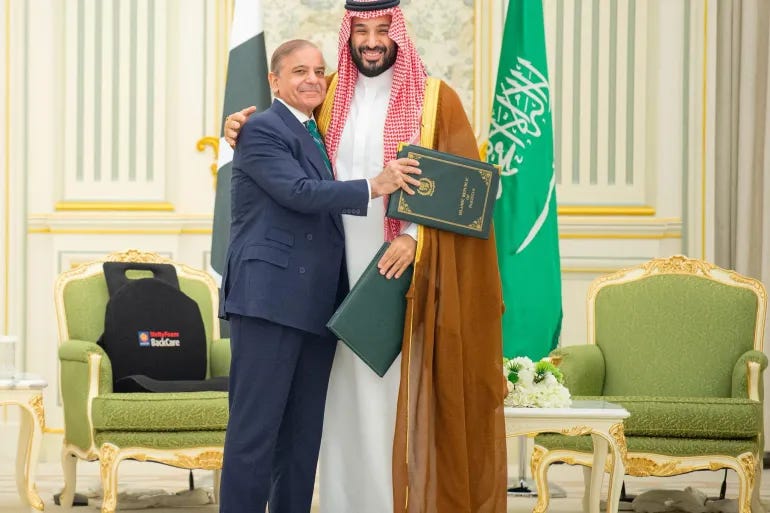
Understand the position Pakistan is actually in, and the hedge stops looking like weakness and starts looking like the most disciplined play on the board. Islamabad shares a long border with Iran. It has a large Shia population it cannot afford to inflame. It fought the Iran war of this year not as a combatant but as a mediator, the one actor who hosted the ceasefire talks and came out with its standing improved. And it signed, first in September 2025 and then in expanded form at Mecca in August 2026, a mutual-defence agreement that treats an attack on Saudi Arabia as an attack on itself. Pakistan has promised to defend a kingdom against an axis that operates on Pakistan’s own doorstep, and it has no intention of doing the defending if it can possibly avoid it.
The guarantee is an asset. Firing it would be spending the asset. Pakistan would rather hold it forever.
This is not hypocrisy. It is arbitrage. Pakistan has worked out that the value of a defence guarantee lies almost entirely in its being believed, and hardly at all in its being used. So it collects the returns of the promise, the Saudi money, the strategic prestige of being the Muslim world’s nuclear guarantor, the 13,000 troops stationed in the Kingdom since the spring drawing Saudi gratitude and Saudi funds, while paying none of the costs, which would be a war against the Houthis that it cannot win, cannot end, and cannot survive politically at home.
The nuclear point
The nuclear question is where this reaches its finest point, and it is worth being precise, because the ambiguity is not accidental. Asif said Pakistan’s capabilities “will be made available” to Saudi Arabia under the pact. Days later he said nuclear weapons were “not on the radar.” Read together, the two statements cancel out, and the cancellation is the product. Chatham House called it a precedent for extended deterrence by a nuclear-armed state outside the treaty. But an explicit umbrella would be a catastrophe for Pakistan. It would force Islamabad to own, in writing, a commitment to risk nuclear war for Riyadh, and it would set off the proliferation cascade across the Gulf that everyone has feared for a generation. So Pakistan says the umbrella exists and does not exist in the same breath, and Iran is left to guess, and the guessing is worth more than any signed clause, because it deters without ever obliging Pakistan to act.
Reading the map
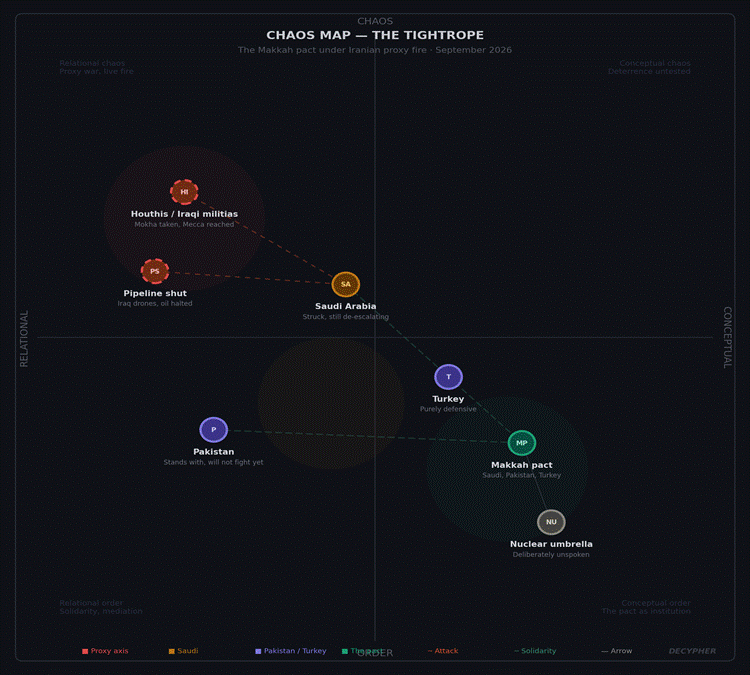
The whole structure works only as long as no one forces the question. That is the tightrope. Saudi Arabia built this alliance to deter exactly the attacks it is now absorbing, and the attacks arrived before the deterrent could set, which means the pact is being tested in its infancy, before anyone wants to find out what it is worth. The Israeli press has already called the strikes near Mecca an exposure of the pact’s limits. If the Houthis land a blow catastrophic enough, a mass-casualty strike on a Saudi city, a hit on Mecca itself, Pakistan’s ambiguity collapses into a choice, and every choice is bad. Fight, and it is in a war it dreaded. Refuse, and the guarantee it has traded on is revealed as paper, and the asset is worth nothing the moment it is seen not to work.
So the war, from Pakistan’s vantage, unfolds along the one path Islamabad will do everything to hold open: the middle. Condemn the attacks, stand in solidarity, station the troops, invoke the pact rhetorically, and never once send a jet against the Houthis. Deter by ambiguity. Profit by restraint. Keep the promise unspent. It is the cleverest position in the region and also the most fragile, because it depends on an adversary choosing never to call the bluff, and adversaries, in the end, are not in the business of leaving bluffs uncalled.
Pakistan has spent a year turning proximity to a war into a source of profit, first as the mediator who ended the fighting, now as the guarantor who need not fight. It is a remarkable trick. The question is not whether it is clever. It is how long a state can be paid for a promise it is arranging, with great skill, never to honour, and what happens on the morning someone finally presents the bill.
Produced by Decypher Team in New Delhi, India