


The Spiral at the Centre
Indonesia’s multi-alignment strategy is the most creative middle-power positioning on the global map. It is also the most exposed to collapse under forced-choice pressure.
Context
On April 13, Indonesia staged an act of diplomatic simultaneity that deserves to be studied as statecraft. At the Pentagon, Defence Minister Sjafrie Sjamsoeddin signed the Major Defense Cooperation Partnership with US Secretary of War Pete Hegseth. At the Kremlin, at the same hour, President Prabowo Subianto sat down with Vladimir Putin for what was reported as a five-hour working session. The synchronisation was not a scheduling accident. Asia Times, which broke the analysis, called it “a deliberate expression of Indonesia’s multi-alignment doctrine.” The Moscow meeting had a specific purpose: securing Russian crude oil at an estimated $59 a barrel, a discount made urgent by the Strait of Hormuz closure that had sent global energy prices into a second spike since February.
That single day tells you everything about what Prabowo’s Indonesia is trying to do — and everything about why it might not work.
The four-sided game
Indonesia under Prabowo has abandoned the language of non-alignment without quite admitting it. The old doctrine, known as bebas-aktif — free and active — prohibited close alignment with any great power. Prabowo has reframed it. In a speech to thousands of governors and mayors, he argued, according to the Lowy Institute’s account, that “if we want to be truly non-bloc, if we want to befriend everyone, that means we are on our own. If we are threatened or attacked, nobody is going to help us.” The implication is plain: non-alignment is a luxury Indonesia can no longer afford. What it can afford, in Prabowo’s calculation, is multi-alignment — simultaneous engagement with every major power, commitment to none.
The results of this strategy are already visible. With the United States: the MDCP grants Indonesia access to subsurface technology, autonomous systems, and advanced asymmetric capabilities that Asia Times notes are “privileges typically reserved for America’s closest treaty allies.” A reciprocal trade agreement signed on 19 February cut US tariffs on Indonesian goods from 32 per cent to 19 per cent, according to East Asia Forum. With China: a 2+2 foreign and defence ministers’ dialogue was inaugurated in April 2025. Indonesia purchased 42 Chinese-made J-10 fighter jets in October 2025, according to Brookings. An integrated EV battery manufacturing centre was opened with Chinese partners. With Russia: discounted oil at $59 during the Hormuz crisis. With Japan and South Korea: working visits at the end of March yielded 575 trillion rupiah ($33 billion) in investment commitments, providing what Asia Times called “the fiscal space to finance procurement of advanced defence hardware compatible with Western technological ecosystems.” Indonesia also joined BRICS, participated in Trump’s Board of Peace initiative on Gaza, and signed up for the potential deployment of up to 8,000 peacekeepers to the International Stabilisation Force.
No other middle power maintains active engagement of this intensity across so many contradictory partnerships simultaneously.
The fracture lines
The strategy’s vulnerability sits in the fine print. Article 5.1 of the February trade agreement with Washington requires Indonesia, as Asialink documented, to “adopt a measure with an equivalent restrictive effect as the measure adopted by the US towards third countries that could harm US economic or national security.” In practice, that means mirroring US restrictions on China. Asialink’s assessment is blunt: the clause “seriously undermines Indonesia’s ‘free and active’ foreign policy principle” and, on some readings, “effectively makes it a US ally.” That the same government that signed this clause also purchased 42 Chinese fighters and opened a joint EV battery facility with Chinese capital is not a contradiction Prabowo fails to see. It is the contradiction on which the entire strategy rests.
A second friction has emerged within the MDCP itself. A classified Pentagon document, reported by Asia Times, titled “Operationalizing US Overflight,” sought blanket military transit rights through Indonesian airspace. Indonesia’s Foreign Ministry voiced concerns about an “alliance trap.” The Defence Ministry maintained that airspace permissions are granted case by case. The Defence Post’s assessment captures the structural tension: the MDCP is “cooperation designed to stop short of integration.” That is the boundary the strategy depends on — close enough to access technology, distant enough to avoid obligation. Whether the boundary can be maintained under operational pressure is untested.
The South China Sea compounds the problem. Indonesia’s Foreign Minister Sugiono signed a controversial joint statement with China during an early visit to Beijing that, according to the Lowy Institute, “tacitly acknowledged Beijing’s maritime territorial claim in the South China Sea.” Yet China’s assertiveness in the North Natuna Sea — where Indonesian sovereignty is directly at stake — continues. The MDCP’s emphasis on underwater sensor networks and maritime domain awareness is aimed squarely at this threat. Indonesia is buying the tools to resist Chinese pressure from the United States while buying the fighters to equip its air force from China. Both transactions are rational in isolation. Together, they produce a strategic architecture that works only as long as neither side forces a choice.
The Chaos Map
The Chaos Map framework — which plots actors between order and chaos (vertical) and relational and conceptual pattern-making (horizontal) — places Indonesia at the exact centre of the grid. That position is not a default. It is the spatial expression of a strategy designed to maintain connections to all four quadrants without settling in any one.
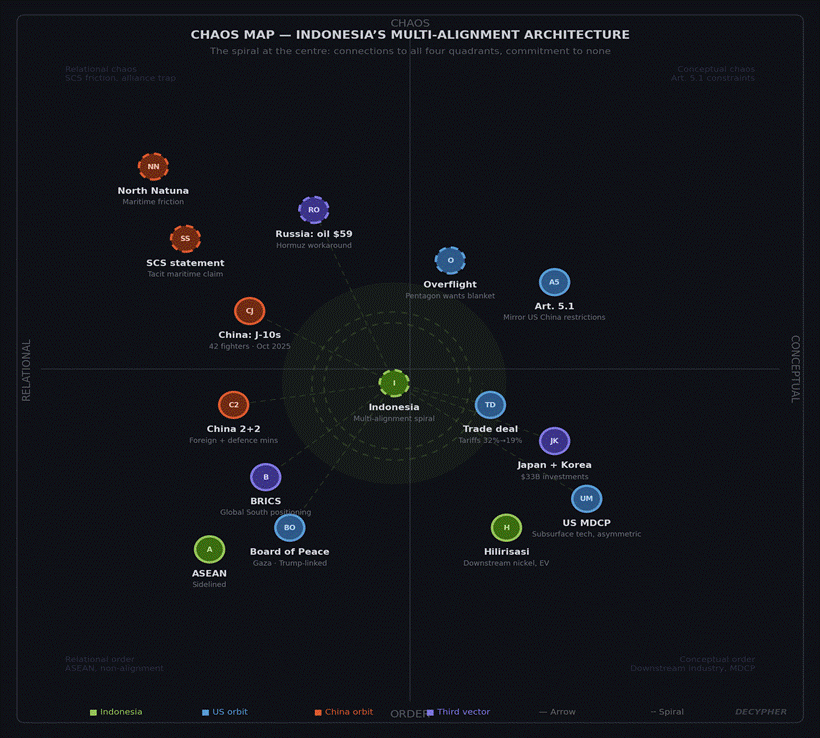
Indonesia’s motion type is spiral, not arrow. Arrow-motion states build toward defined endpoints: the United States constructs alliance architecture, China builds infrastructure networks, Japan is pivoting to defence exports. Indonesia spirals — it moves toward whichever partner offers the most for the immediate need, engages intensely, then rotates to the next. The spiral is visible in the April 13 choreography: Pentagon in the morning, Kremlin in the afternoon. It is visible in the February sequence: US trade deal one week, BRICS membership the next. The pattern is not incoherence. It is the spiral’s operating logic: never commit to an endpoint, always keep the next partner in play.
The green lines radiating from Indonesia’s centre position trace the multi-alignment architecture. Each connects to a different quadrant: the MDCP and downstream industrialisation programme (known as hilirisasi) in conceptual order; China’s 2+2 dialogue and J-10 deal in relational space; Russia’s discounted oil and BRICS in the third-vector cluster; Japan and South Korea’s $33 billion in the economic build. The structural risk sits in the upper half of the map — conceptual chaos — where Article 5.1, the overflight dispute, and the North Natuna friction all represent commitments that contradict other commitments.
The ASEAN cost
The strategy has a price, and the price is institutional. Brookings notes that Prabowo “is unlikely to invest significant political capital in ASEAN.” The organisation’s inability to resolve the Myanmar crisis or produce a binding South China Sea code of conduct has reinforced what Brookings calls “perceptions of institutional paralysis.” Prabowo has chosen bilateral great-power engagement over multilateral institution-building. That is a structural choice with consequences. ASEAN was the framework that gave Indonesia’s non-alignment institutional legitimacy — it was the system within which Indonesia’s refusal to align was a principle, not a convenience. Without it, multi-alignment looks less like strategic autonomy and more like what Asialink calls the risk of becoming “a pawn, not a peer” of the great powers.
Forecast
Indonesia’s spiral grand strategy is the most consequential middle-power experiment of this decade. Its success or failure will determine whether multi-alignment is a viable posture in a multipolar order or whether it is a transitional state that collapses into forced alignment under pressure.
Three things determine the outcome. First, whether Indonesia converts the spiral into institutional nodes — downstream manufacturing capacity, defence maintenance and repair capability, CPTPP membership (which Asialink identifies as a concrete pathway to a “third path” alongside the EU) — that persist regardless of which great power applies pressure. Spiral motion produces flexibility but not infrastructure. Relationships can be withdrawn. Factories cannot.
Second, whether Article 5.1 is ever invoked. If Washington demands that Indonesia restrict a specific Chinese import or technology partner, the clause forces exactly the binary choice the entire strategy is designed to avoid. The clause is dormant. Its activation would be the structural test.
Third, whether a North Natuna incident occurs during a period of US distraction. The MDCP grants Indonesia the technology to monitor Chinese activity. It does not guarantee US intervention if that activity escalates. Indonesia is building the sensors to see the threat. Whether anyone answers the alarm depends on a carrier rotation schedule that, as the Iran war demonstrated, is a scheduling problem with no guaranteed solution.
The spiral works as long as no partner forces a binary. The map shows an architecture of extraordinary breadth — connections to every quadrant, engagement with every power. What the map also shows is that the architecture is built on relationships, not on concrete. Prabowo’s wager is that the rotation can continue indefinitely, that no partner will force a choice, and that the spiral will accumulate enough institutional mass to survive the moment when one does. It is the boldest bet in Asian statecraft. Whether it pays depends on whether the world gives Indonesia the time the spiral requires.

The Cost Curve and Asymmetry of Drone Warfare
The strike on Sayed Jamaluddin Afghani University in Kunar is useful because it shows how drone-enabled force operates in fragile border conflicts. Students described shattered windows, broken electricity and an attempt to leave classrooms one by one to avoid a stampede. Witnesses attributed the attack to a military drone. The accused state denied responsibility and insisted its targeting remained precise and intelligence-based.
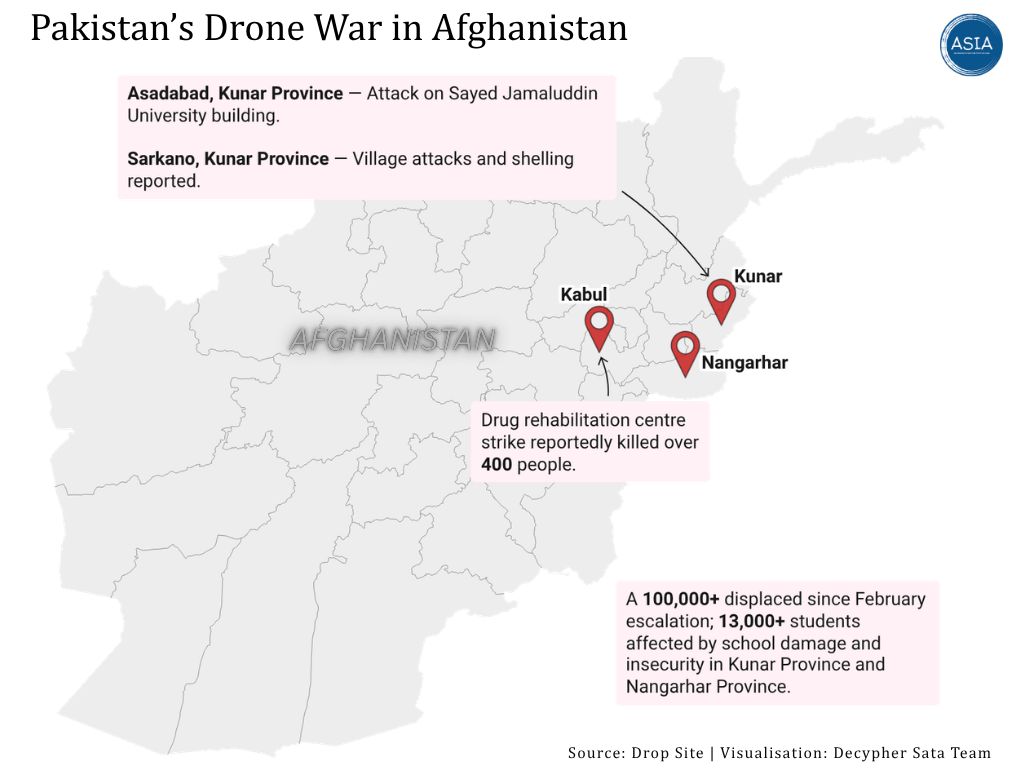
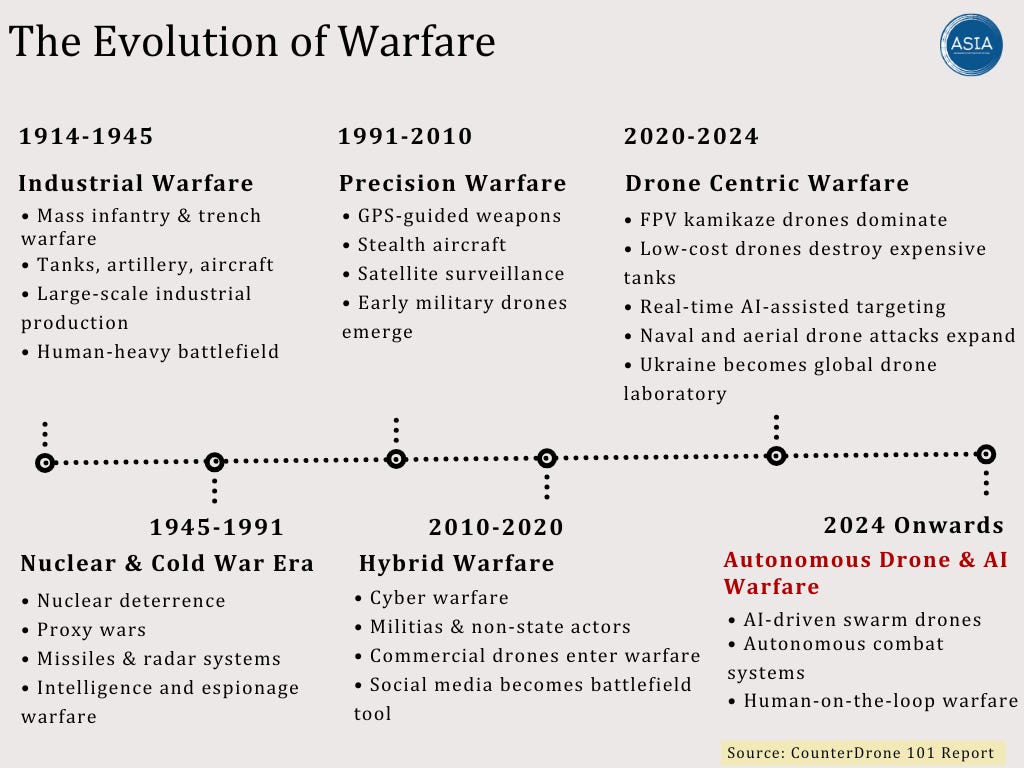
Drone warfare sits inside this ambiguity. It allows force to be used across contested terrain without the visible signal of conventional mobilisation. A strike can be framed as counterterrorism, precision targeting or border management, even when its effect exceeds the declared target: schools stop functioning, homes are damaged, and civilian life is pulled into military pressure. Drones did not invent civilian harm. They have made certain forms of coercion easier to repeat, sustain and deny. The technology matters because it has created a cost-cycle asymmetry: cheap aerial systems can be produced, modified and expended faster than expensive defence systems can be procured, integrated and replenished. This is both a price imbalance and a time imbalance. One side generates pressure quickly; the other answers through slower, costlier systems.
The numbers clarify the logic. Armed FPV drones can cost roughly $400 to $1,000. Weaponised commercial quadcopters sit around $1,000 to $3,000. Shahed or Geran-2 one-way attack drones sit around $20,000 to $50,000. Many traditional interceptors cost hundreds of thousands or millions of dollars. Any architecture dependent on a multi-million-dollar interceptor to defeat a $30,000 platform is, over time, mathematically defeated.
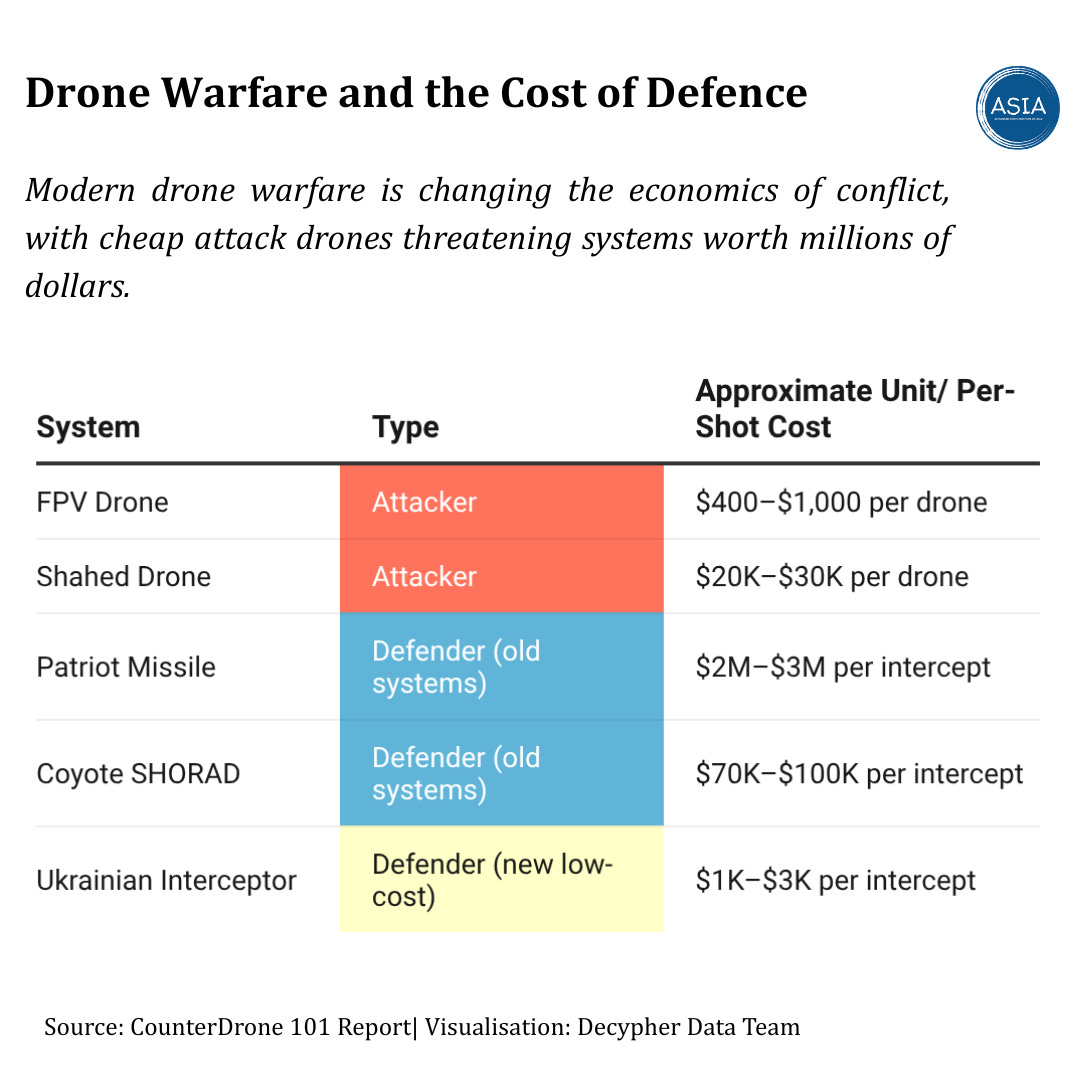
The question is not simply whether a drone can be shot down. It is whether it can be shot down at a sustainable cost. If the attacker generates cheap pressure repeatedly while the defender answers expensively, the attacker gains even when individual drones fail. A drone’s value lies not only in impact, but in the reaction it forces sensors activated, interceptors spent, crews exhausted, batteries relocated.
Older measures of power struggle here. Tanks, aircraft, missile batteries and troop numbers still matter, but they no longer settle endurance. A military built around expensive, slow-replenishment platforms is vulnerable if it faces an adversary able to produce cheap aerial threats faster than they can be intercepted or replaced. The contest is increasingly between procurement cycles and production cycles. Ukraine has made this visible by compressing innovation time. Fibre-optic FPV drones spool a thin glass fibre from the airframe to the operator, emit no radio signal and do not depend on GPS. Radio-frequency detection becomes ineffective. Jamming and spoofing do not work. A defensive system built around yesterday’s assumptions can become insufficient because the threat has changed category.
Domestic innovation therefore becomes a strategic capability. A state that imports finished systems may possess high-end equipment, but not adaptation. It waits on contracts, export permissions, delivery schedules and vendor upgrades. A state with domestic design, testing, software, optics, batteries, small manufacturing and operator feedback loops can shorten the distance between observation and response. In drone warfare, that timeline is itself power.
Air defence must be rebuilt around the same logic. It cannot remain a prestige purchase or a single-platform solution. Radar can miss what does not present cleanly. Radio-frequency detection fails against drones that do not emit. GPS jamming fails against drones that do not need satellite navigation. Expensive interceptors may succeed tactically while failing economically. Serious counter-drone defence must become layered: different sensors, different effectors, and command software able to decide which response is adequate at which cost. The outer layer filters and detects. The middle layer uses kinetic interceptors. The inner layer relies on acoustic detection, visual AI, automated turrets, lasers and high-power microwave systems. The system works when it sees, classifies, assigns and defeats the target without wasting the most expensive response on the cheapest threat.
Detection is the hard bottleneck. Small drones are low, slow, numerous and difficult to distinguish from birds, clutter or friendly systems. Once drones become fibre-optic, autonomous or GPS-independent, the easiest forms of detection and disruption weaken. AI matters because it can fuse acoustic, visual, radar and radio-frequency inputs into a track fast enough to close the kill chain. For Indian strategic thinking, the implication is direct. Security cannot be measured only by inherited inventories or imported high-end platforms. Those remain necessary, but not sufficient if the most frequent threat is cheap, numerous and rapidly modified. The harder questions are industrial and architectural: can drones be produced at scale, can critical infrastructure be defended against saturation, can air-defence layers be integrated, and can doctrine change as quickly as the threat?
The Afghanistan-Pakistan frontier shows the political use of drone-enabled coercion. Ukraine shows the speed of battlefield adaptation. The counter-drone problem shows the cost of defending badly. Together, they point to a clear conclusion: military power is moving from possession alone to replenishment, integration and adaptation. The state that matters will not simply be the one with the largest arsenal. It will be the one that can keep changing the arsenal while the conflict is still being fought.
— — —
Long View: Amogh Dev Rai- Research Director at the Advanced Study Institute of Asia (ASIA), affiliated with SGT University, Gurugram.
Essay: Preksha Jalan
Data: Bhupesh
Produced by Decypher Team in New Delhi, India
— — —