


India’s proposed seed law is not only about fake seeds. It is about who gets to organise agricultural trust in a federal system. The seed market has changed sharply since the Seeds Act, 1966. Private hybrids, nurseries, interstate distribution, biotechnology and digital traceability now shape what farmers buy. The Centre’s answer, outlined in its official response on the Seeds Bill, is to create a more legible national seed economy through compulsory registration of varieties, registration of producers, processing units, dealers and nurseries, compulsory performance labelling, onboarding on the SATHI portal and price regulation in emergent situations. The problem is real. But the Bill’s deeper question is federal: can the Centre centralise the authority to define a trustworthy seed while states remain responsible for dealing with seed failure?
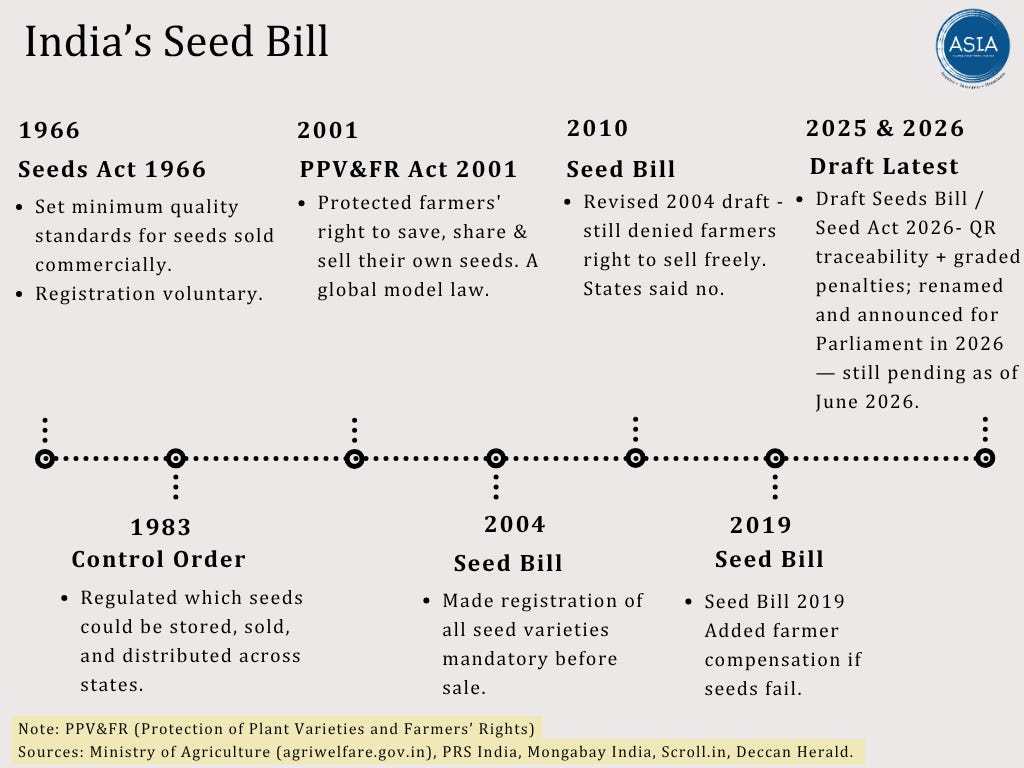
The cost of a failed seed is not the cost of the seed. It is the cost of the season organised around it. A farmer may discover seed failure only after spending on land preparation, sowing, irrigation, fertiliser, pesticides, hired labour and credit. By then, the loss is no longer confined to a packet bought from a dealer. It includes the crop window that has passed, the debt that remains and the alternative crop that may no longer be possible. Seed failure is therefore not ordinary product failure. It is a delayed loss that becomes visible only after the farmer has already paid for the season.
The scale of the problem makes regulation necessary. Seed inspectors drew 2.53 lakh samples across 24 states and Union Territories in 2024–25; 32,525 were found sub-standard. West Bengal alone accounted for 24,460 sub-standard samples, followed by Tamil Nadu with 1,565 and Madhya Pradesh with 1,438. The first phase of SATHI was launched in April 2023 and implemented in 23 states and Union Territories, while the second phase is expected to include registered dealers and recipient farmers. QR-coded seed packets are meant to allow farmers to verify origin and traceability. These figures do not merely show that poor-quality seeds circulate. They show that seed failure is unevenly distributed, locally felt and enforcement-heavy. A national registry may define a seed as compliant, but the loss appears in a field, a district and a crop cycle.
The geographical indication issue makes the same point on a wider scale. In crops such as Basmati, counterfeit or uncertified seeds not only affect individual yield. They can weaken a place-linked reputation built through grain quality, aroma, geography and export credibility. Reports on Basmati’s GI status being threatened by seed players flouting norms show why seed authenticity cannot be separated from place-based value. But this does not make the case for central traceability alone. It makes the case for regulation that can connect seed origin with local testing, dealer liability, regional crop knowledge and state enforcement. A GI crop is protected not only by a label but by the institutions that prevent that label from being diluted in the field.
This is where the government’s PIB release on seed regulation becomes more revealing than reassuring. The release says state governments appoint seed inspectors, inspect seed outlets, draw samples and act through licence cancellation, seizure, stop-sale orders and prosecution. It presents this as evidence that the current framework protects farmers. Yet this admission exposes the central tension in the proposed reform. The most important acts of remedy are still state-facing. The state inspector collects the sample. The state machinery acts against the dealer. The state government faces the farmer’s complaint, protest, compensation demand and political pressure. If the new Bill shifts greater authority over registration, traceability and price intervention upward, it changes the balance between who defines legitimacy and who bears responsibility.
The Centre has a valid reason to want uniform standards. Seed companies sell across states, spurious seeds can move through interstate chains, and farmers need protection from opaque markets. But uniformity is not neutral in a federal system. It can improve accountability if it strengthens state enforcement. It can weaken accountability if it turns states into implementing arms of a centrally designed architecture. The question is not whether India needs traceable seeds. It is whether traceability will give states more power to verify failure, act against violators and secure remedy, or whether it will mainly give the Centre a cleaner map of the seed market.
This matters because seed regulation has already been shaped by state-level crises. Andhra Pradesh’s Cotton Seeds Act, 2007 and Maharashtra’s Cotton Seeds Act, 2009 were not abstract regulatory exercises. They emerged from conflicts over private hybrids, pricing, farmer distress and accountability. They show that seed governance in India has not been only a central quality-control question. It has also been a state response to crop-specific risk. Cotton, paddy, vegetable seeds and GI-linked crops do not produce identical problems. A law that treats uniformity as the primary route to order may reduce the flexibility that states need to respond before local distress becomes a national crisis.
Price regulation shows the same problem. The Bill allows price regulation in emergent situations. But seed prices do not matter only in emergencies. In crops dominated by hybrids, technologies or a small number of firms, pricing can become a routine farmer-protection question. States may need to intervene before scarcity, cartelisation or profiteering reaches a centrally recognised threshold. If price control becomes primarily an exceptional central power, it risks narrowing state flexibility at precisely the point where early intervention matters.
The farmer-protection claim also needs to be read critically. The same PIB release says traditional and farmers’ varieties are protected under the Protection of Plant Varieties and Farmers’ Rights Act, 2001 and the Biological Diversity Act, and that farmers retain the right to save, use, sow, re-sow, exchange, share or sell farm-saved seeds. It also cites support for seed distribution, production incentives, community seed banks and conservation of traditional varieties. These protections matter, but they answer the legal question more than the accountability question. They show that rights and schemes exist. They do not show that a farmer facing seed failure can secure timely verification, compensation or remedy.
Legal protection is not the same as market power. A farmer’s variety may be legally protected and still become marginal in a market where trust is increasingly produced through registration, QR codes, performance labels and digital traceability. A community seed bank may exist without having the distribution, visibility or official legitimacy of a registered commercial packet. If the Bill builds confidence mainly around formal, digitally traceable seeds, farmer-managed systems may survive as exceptions rather than as equal sources of agricultural resilience.
India needs a new seed law. But a good law must recognise that seeds are governed not only through standards, but through cost, local knowledge, state capacity and political accountability. The Centre can define a national architecture for seed quality, but the route from failure to remedy still runs through the state. Traceability should strengthen that route, not replace it. If the Bill makes the market more visible to the Centre without strengthening the state-level machinery of inspection, compensation, pricing and crop-specific response, it will centralise trust without delivering accountability.
— — —
Essay: Preksha Jalan- Assistant Program Officer in the Digital History Lab at The Advanced Study Institute of Asia (ASIA), affiliated with SGT University, Gurugram.
Produced by Decypher Team in New Delhi, India
— — —