


In the villages around Dawei, Myanmar’s latest development push has begun with soldiers. Since July, hundreds of troops have advanced through the area surrounding the long-stalled special economic zone on the Andaman coast, supported by air and naval units. Resistance fighters and local activists have reported burned villages, displacement and restrictions around the proposed industrial zone. Their accounts are difficult to verify independently amid active fighting, but the military’s priorities are clearer: shortly before the operation intensified, its deputy commander instructed forces in southern Myanmar to protect strategic projects. On 21 August, Reuters linked the offensive directly to efforts to revive the Russia-backed Dawei project, which includes plans for a deep-sea port and power station.
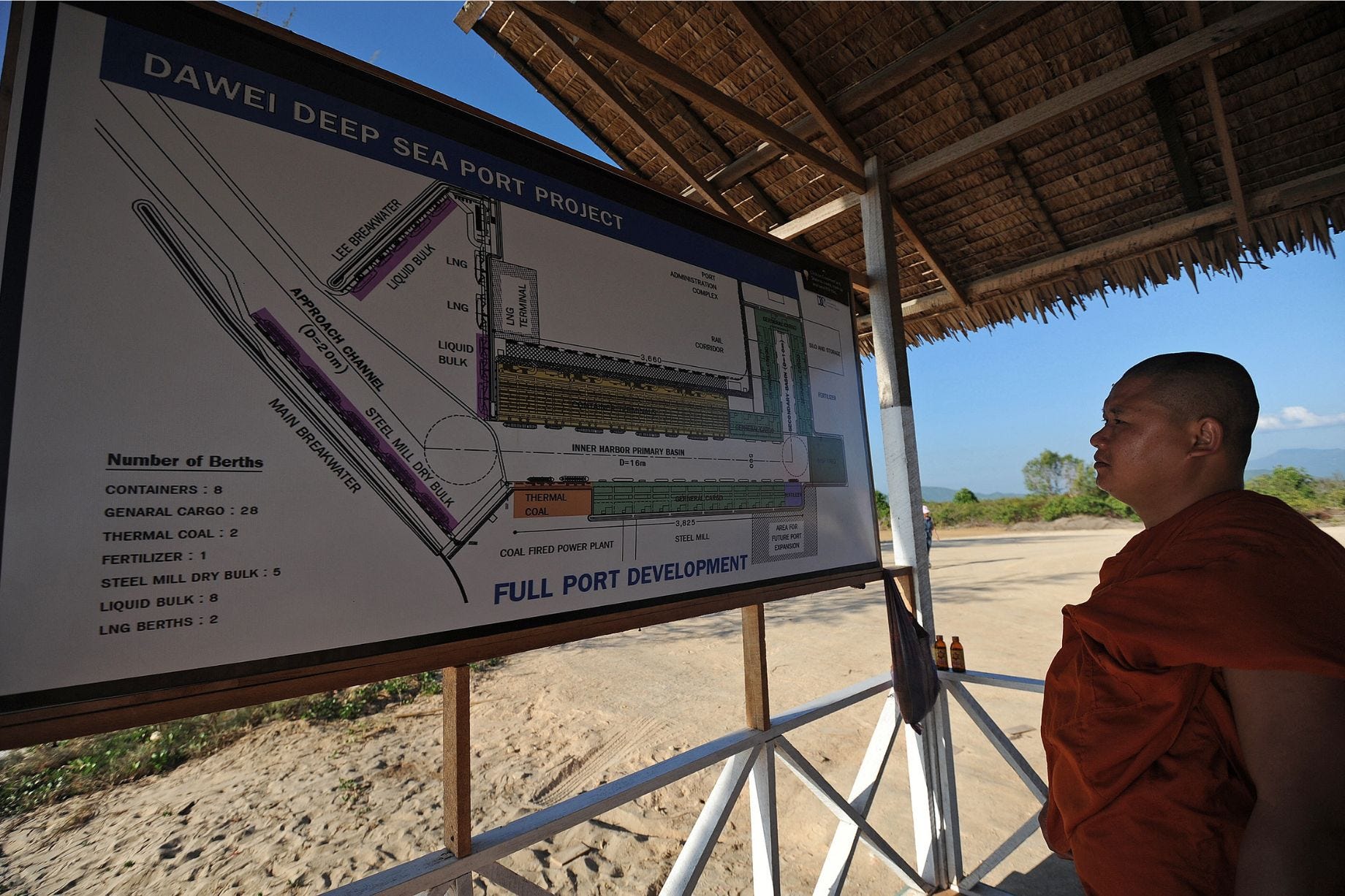
Dawei is an odd place to look for the next stage of Myanmar’s civil war, as the project predates the conflict by more than a decade. Myanmar and Thailand began pursuing a deep-sea port there in 2008. The plan was to combine a port, industrial estates and an overland connection to Thailand, giving Bangkok’s manufacturing economy a western outlet to the Indian Ocean and potentially reducing dependence on routes through the Strait of Malacca. The Myanmar Port Authority records the original 2008 agreement and the Thai developer’s subsequent failure to secure sufficient financing. Development plans were repeatedly revived, including through Thai and Japanese participation, but the port remained more convincing on maps than on the ground.
Finance was only one obstacle. Dawei also tested the political opening that began under President Thein Sein. Residents faced land loss, relocation and uncertainty over compensation, while local organisations complained that communities had little reliable information about a project expected to transform agriculture, fishing and village life. Research by EarthRights International documented disputes over consent, compensation, housing and livelihoods across affected villages. The politics surrounding a proposed 4,000-megawatt coal plant became particularly significant. Local campaigners distributed information, used the expanding media space and organised opposition; in January 2012, the government cancelled the plant, citing environmental concerns. A Cambridge study of advocacy around Myanmar’s special economic zones treats that campaign as evidence that organised communities had acquired some ability to alter large development projects.
The earlier Dawei struggle was hardly a story of communities controlling development. Land was still taken, compensation remained uneven, and residents rarely set the terms of the project. What they did possess was some capacity to contest those terms before they hardened into fact. Campaigns could delay construction, force environmental questions into public debate, and, in the case of the coal plant, alter what developers could build. In 2026, that space has narrowed further. The argument is no longer only about what kind of development Dawei should bring, but about who controls the territory on which any such argument can take place.
The February 2021 coup altered Dawei’s political context by reshaping Myanmar’s territorial character. Armed resistance spread well beyond the ethnic borderlands where insurgency had historically been concentrated. Ethnic armed organisations and newer resistance forces captured towns, roads and administrative space, while parallel forms of taxation and governance developed in areas outside effective military control. The humanitarian consequences remain enormous: the UN’s 2026 planning documents project more than four million internally displaced people and 16.2 million people requiring humanitarian assistance. The military’s election at the end of 2025 did not restore the lost territorial unity. According to International IDEA, voting was held in only 236 of Myanmar’s 330 townships, overwhelmingly in areas where the military could administer the process. The military-backed Union Solidarity and Development Party dominated the resulting parliament, which elected Min Aung Hlaing president in April. His opponents widely rejected the exercise, but its utility did not depend entirely on persuading them. It created a parliament, ministries operating under a formally civilian constitutional order, and a president whom foreign governments could receive as a head of state.
The election therefore offers a useful lens for understanding Dawei. The military did not need to restore uncontested sovereignty across all 330 townships before reconstructing some state institutions. Dawei applies a similar logic to economic geography. The government does not need to restore effective control across all of Myanmar before Dawei can function. It needs something more geographically limited: secure control over the port, its connecting roads and energy infrastructure, and the surrounding territory through which workers, goods and investment must move. A state that remains territorially fragmented can therefore still create economically viable corridors in the areas it can hold. These are corridors of governability rather than the recovery of uniform national control.
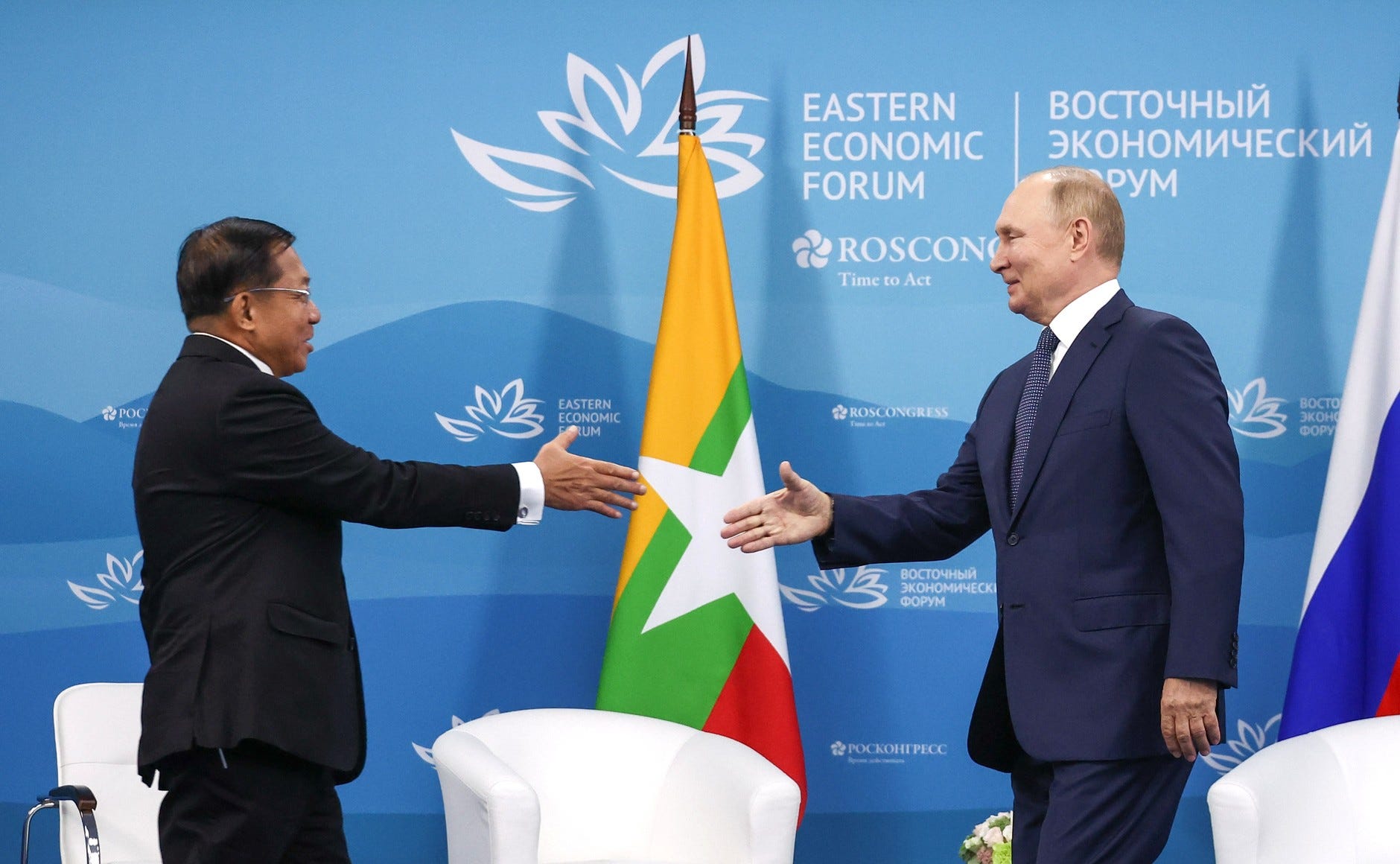
Russia has become a prospective partner in constructing one of them. Its post-coup importance to Myanmar began with arms, diplomatic protection and military cooperation, but the relationship has steadily widened. In February 2025, Myanmar and Russia signed an investment memorandum covering Dawei and surrounding areas. In June this year, Russian company Inter RAO and a Myanmar partner signed an MOU for a power station at the Dawei deep-sea port. A month later, Myanmar’s Commerce Ministry said procedures were under way to revive the SEZ and explicitly described Dawei as strategically important for the Thailand–Indian Ocean trade route. Those agreements should not be confused with a fully financed Russian takeover of Dawei. The project has disappointed too many previous promoters for another memorandum to be treated as a construction project. At this stage, Moscow is better understood as a prospective investor within an increasingly dense strategic relationship. When Vladimir Putin met Min Aung Hlaing on 18 August, discussions ranged from hydrocarbons and offshore exploration to a possible oil refinery and LNG supplies. Russia now offers Myanmar not only diplomatic backing but also the possibility of energy and infrastructure relationships that extend beyond the immediate requirements of war.
Naypyidaw has strong reasons to seek them. Myanmar’s economy remains far from recovery. The World Bank’s June economic monitor estimated that real GDP contracted by 2 per cent in FY2025/26 and that inflation reached 24.6 per cent in April. Electricity shortages, weak demand, rising costs and uneven implementation of government rules continue to constrain firms; many businesses remain focused on survival rather than expansion. Even the World Bank’s projected 2 per cent growth for the current fiscal year represents tentative stabilisation after a deep rupture rather than a restoration of the pre-coup economy.
A functioning port or industrial estate cannot reverse those conditions nationally. Its political value lies partly in its narrower scope. Dawei could create a visible enclave of investment, electricity, transport and foreign cooperation even while much of Myanmar remains economically damaged or militarily contested. The regime does not have to demonstrate that the national economy has recovered if it can point to places where long-term projects are restarting. The distinction between national recovery and investible enclaves matters because war itself changes the value of infrastructure. A village on a contested road is one kind of military problem. The same village beside a proposed port corridor becomes part of an asset whose security affects foreign investors, customs revenue and bilateral relationships. Territorial control becomes more valuable because capital is expected to follow it.
That does not make every operation around Dawei merely an infrastructure-clearing exercise. Tanintharyi has been an active theatre of armed resistance, and the military has independent reasons to regain routes and territory there. But the Dawei offensive shows counterinsurgency and economic planning beginning to converge on the same geography. Approximately 700 troops were involved in the recent push, according to Reuters, while the project’s revival was already under discussion with Russian partners and Thai officials. Investment is no longer imagined only after control is restored. The prospect of investment helps determine which spaces the state has particular reason to reassert control over.
Thailand makes Dawei more than a bilateral Myanmar–Russia story. Bangkok’s engagement with Naypyidaw follows from concrete economic dependencies that existed before the coup and survived it. Myanmar has been an important source of natural gas to Thailand for almost forty years; gas from the Yadana and Zawtika fields once supplied 15–20 per cent of Thailand’s total natural-gas demand, according to the Thai government. The two governments are now discussing extensions to gas contracts, new petroleum blocks and electricity-grid interconnection. For Thailand, relations with Myanmar therefore touch on electricity prices, industrial costs, and energy security at home.
Dawei would add another layer to that dependence. Its original economic logic was as much Thai as Myanmar: connect the Andaman coast to Kanchanaburi and onward to Bangkok’s industrial system. When Min Aung Hlaing arrived in Thailand for an official visit on 6 August, the relationship was no longer presented simply as crisis management at a difficult border. Thailand formally welcomed him as president, discussed trade, investment, energy and connectivity, and said it was ready to support Myanmar’s fuller participation in ASEAN.
It would be too simple to interpret that engagement as Thailand deciding that the coup no longer matters. Prime Minister Anutin Charnvirakul has instead called for “calibrated re-engagement” with Myanmar. Bangkok has also been involved in efforts to create space for talks as battlefield conditions shift. Earlier this month, Reuters reported tentative movement towards what might become talks about talks, with opposition actors signalling willingness to explore a political process even while the military had not recognised them as negotiating counterparts. Engagement may therefore serve mediation as well as commerce. But re-engagement also alters the sequence ASEAN originally envisaged after the coup. The bloc’s Five-Point Consensus presumed that reduced violence and political dialogue would pave the way for normal diplomatic participation. Myanmar’s government is now trying to reverse that order. Having held elections and installed Min Aung Hlaing as president, it has argued that ASEAN’s special envoy is no longer necessary, even though fighting continues and Aung San Suu Kyi remains detained.
The argument, then, is not simply that neighbours are abandoning democracy for business. Thailand cannot choose whether Myanmar exists on its border, supplies its energy or sends conflict and migration across it. Nor does speaking to Naypyidaw necessarily foreclose speaking to resistance actors. The more consequential possibility is that economic and diplomatic normality can accumulate before political normality does.
Dawei gives that accumulation a physical form. A port concession identifies the ministry authorised to sign it. A road identifies the authority expected to protect traffic. A power station creates an asset whose continued operation depends on specific security arrangements. A foreign investor begins planning on the assumption that those arrangements will persist. Infrastructure therefore does more than follow political order. When built during a civil war, it can embed one version of that order in land, contracts and cross-border relationships before a peace agreement determines how authority ought to be distributed. That is particularly important in Myanmar because the eventual political dispute is likely to be about federalism, not merely who occupies Naypyidaw. Ethnic armed organisations and newer resistance administrations have spent the post-coup years building their own institutions. International IDEA describes a country in which governance has become fragmented alongside military control. A future settlement would therefore have to negotiate not only elections but the distribution of fiscal power, natural resources, security authority and administration among multiple centres. Large infrastructure projects can pre-empt parts of that negotiation. A concession signed today can determine land use for decades. A gas or power arrangement can shape which level of government receives revenue. A corridor protected and taxed by one authority becomes harder to redistribute politically later. None of this means contracts signed by the present government will necessarily survive a settlement. It means the economic terrain over which federalism will eventually be negotiated is already shifting.
Dawei’s older history makes this especially clear. Communities around the project were never simply anti-development. EarthRights’ research on local views recorded demands for information, proper compensation, livelihood protection and meaningful participation. Residents could want roads and jobs while opposing the terms on which land was taken. The political question was not port or no port; it was who possessed bargaining power over the transformation that the port would bring. That bargaining space has shifted. During the reform period, even an unequal political system sometimes allowed communities to impose costs on developers and alter projects. In the present conflict, the question around Dawei is increasingly about who will control the land and guarantee access to it: which armed authority will do so? Once development becomes attached to a military corridor, a farmer resisting relocation, a resistance force contesting territory and a company seeking secure investment can all encounter the same landscape while asking entirely different questions of it.
Myanmar is therefore not moving through a conventional sequence from war to peace and then reconstruction. Elements of all three are now occurring together. The state is holding elections in territory it controls, seeking foreign investment in strategic corridors and rebuilding diplomatic relationships while fighting continues elsewhere. Resistance authorities are consolidating their own forms of governance. Regional states are experimenting with re-engagement even as formal peace mechanisms remain unsettled. The danger in describing this merely as “legitimising the junta” is that the phrase makes normalisation sound like a single diplomatic gift. What is happening is more gradual and material. Normality can be assembled through institutions and infrastructure: a presidential title, a bilateral energy agreement, an ASEAN meeting, a functioning road, a port concession. None of those acts ends the war. Together, however, they change the state that will eventually emerge from it.
Dawei matters because it shows how. The military-backed government is trying to make a contested territory investable before the country is politically settled. Russia offers a prospective partner; Thailand supplies an economic hinterland and an enduring energy relationship; the state supplies military control where it can. If the project advances, the port will not simply be evidence that Myanmar has begun rebuilding. It will become part of the institutional and territorial structure through which the government enters whatever political negotiation follows.
A port can be built before peace. The question is what happens when, by the time peace is finally negotiated, its roads, contracts, energy links and security perimeter are already shaping the country. Dawei once tested whether Myanmar’s political opening would allow communities to renegotiate development. Its revival now raises the reverse problem: whether development undertaken during civil war can begin to determine the political settlement that is supposed to come after it.
Essay: Preksha Jalan- Associate Fellow, Digital History Lab at The Advanced Study Institute of Asia (ASIA).
Produced by Decypher Team in New Delhi, India