

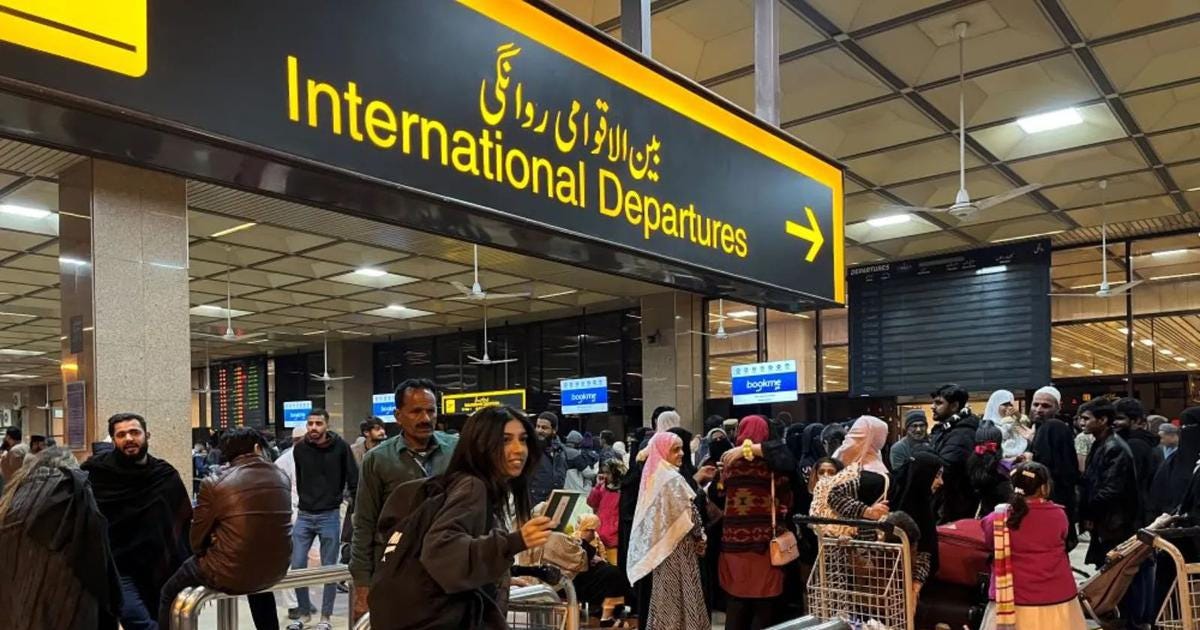

Two of Pakistan’s clearest youth pathways now point in opposite directions. One is formal, routine and outward: the state’s foreign-jobs portal, where vacancies appear for drivers, warehouse workers, labourers, technicians, house workers, loaders and programmers across Gulf destinations. The other is meant to keep young people inside Pakistan while connecting them to the world: IT services, freelancing, remote work, online classes and platform income. Yet this second route is repeatedly weakened by the state’s own security reflex. In 2024, Reuters reported that Pakistan’s software industry warned firewall-related disruptions could cost the economy up to $300 million, while The Guardian reported that internet speeds had fallen by 30 to 40 per cent, disrupting online classes, IT firms, freelancers and client deadlines.
The contradiction is not incidental. Pakistan tells its young to become global digital workers, then throttles the connectivity that turns that work into income. At the same time, one of its most functional youth institutions is the machinery that sends workers abroad. The problem is therefore not that Pakistani youth lack ambition, attachment or adaptability. It is that the country’s strongest pathways either bypass the domestic economy or depend on infrastructures that the state itself undermines.
This is the Pakistan its youth inherit: a state that has become better at building exits than ladders. The migrant worker and the digital freelancer may look like opposite figures, one leaving home and the other working from it. But both reveal the same institutional weakness. Pakistan has not built enough ordinary domestic routes from education to income, from work to security, or from citizenship to voice. Where young people find movement, it often takes the form of external labour markets, foreign clients, remittance circuits, or family-financed mobility. Where a home-based pathway begins to emerge, the state’s suspicion of political communication cuts into economic possibility.
This is also why Stephen Philip Cohen’s ‘The Idea of Pakistan’, published in 2004, remains useful. Cohen wrote about Pakistan as a country suspended between strategic necessity and internal fragility. He distinguished between the idea of Pakistan, the founding claim of a homeland for the Muslims of the subcontinent, and the state of Pakistan, which had become military-dominated, nuclear-armed, regionally insecure, politically uneven and economically fragile. His warning was not simply that Pakistan would collapse. More interestingly, he allowed for slower and partial forms of failure: institutions that survive, even manage, but do not provide enough education, health, governance or opportunity.
Two decades later, that is closer to the visible condition than the language of collapse. Pakistan has not failed in one dramatic event. It has survived, repeatedly. It remains strategically useful. It returns to IMF programmes, negotiates with lenders, manages regional crises and re-enters diplomatic conversations when conflict gives it relevance. In June, Reuters noted that Pakistan’s role in the Iran crisis had drawn renewed diplomatic attention, even as analysts doubted that diplomatic goodwill could overcome weak exports, a narrow tax base, high debt, and repeated dependence on the IMF. In the same month, its budget was shaped by oil-price pressures and IMF discipline, with Reuters reporting that the burden would fall heavily on the middle class and formal businesses.
This contrast matters because Pakistan’s external relevance has often outpaced its domestic settlement. Cohen’s Pakistan was already viewed through the dual lenses of danger and usefulness. Today, the script has been updated rather than discarded. Pakistan can be useful to the Gulf, relevant to China, necessary to Afghanistan policy, important to the United States at certain moments, and disciplined before the IMF. None of this automatically answers what a twenty-three-year-old Pakistani can do with a degree, a phone, a family obligation and an unreliable labour market.
The answer changes sharply by gender, class, province, language and access. That is why youth surveys should not be read as a contest between optimism and despair. The British Council’s 2023 Next Generation Pakistan brief found that 68 per cent of young respondents wished to stay in Pakistan and 69 per cent were optimistic about Pakistan’s future. The same brief found that 57 per cent had little or no trust in the political system. That is not a contradiction, but confusion. It is a contradiction as a social condition: attachment without institutional confidence.
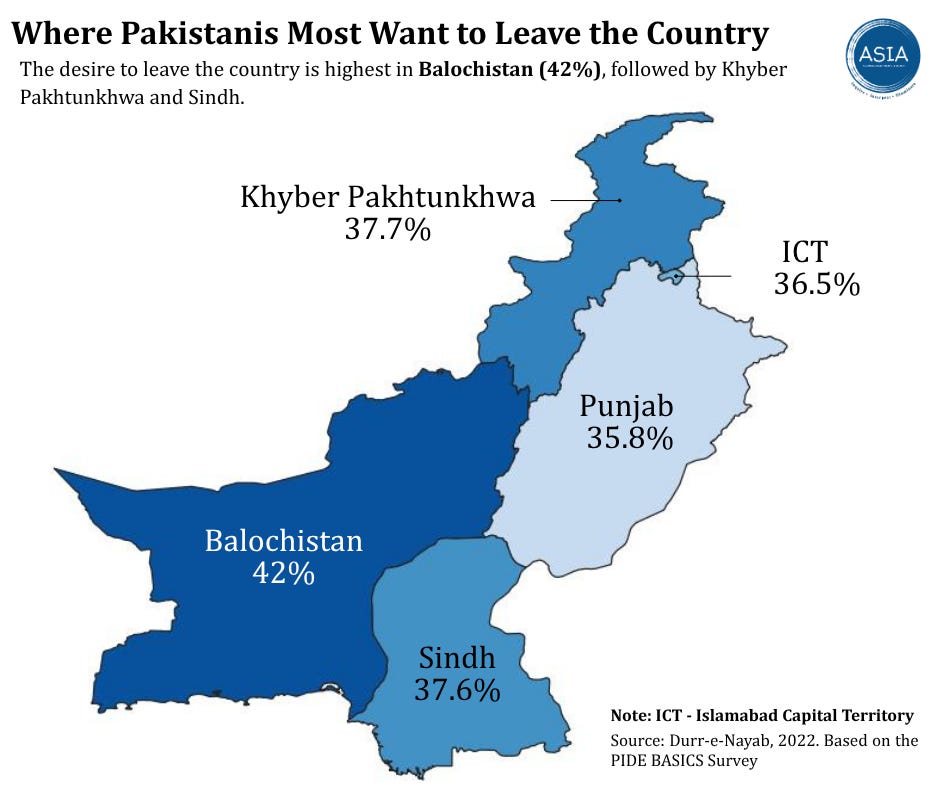
Migration data sharpens the same point. PIDE’s survey found that 37 per cent of Pakistanis would leave if given the opportunity, rising to 62 per cent among males aged 15 to 24. Its provincial pattern is equally important: the desire to leave was highest in Balochistan, at 42 per cent. Yet Ipsos Pakistan’s 2024 survey found that 74 per cent of youth were not inclined to leave, while 26 per cent said they would leave if given the chance. These figures do not cancel each other. They show why leaving and staying are no longer opposites. A young Pakistani may want the country to work, but also wants a foreign degree, a Gulf contract, a remote client, or a passport that keeps the future from closing. In a remittance economy, departure is often not abandonment. It is a responsibility reorganised through mobility. The young man who leaves for Saudi Arabia may not be rejecting the household; he may be becoming its financial plan. The student who seeks a scholarship abroad may not be disavowing Pakistan; she may be seeking training, supervision, or recognition unavailable at home. The freelancer who is physically present in Pakistan may still depend on a labour market outside Pakistan. The emotional geography of staying and the economic geography of earning have come apart.
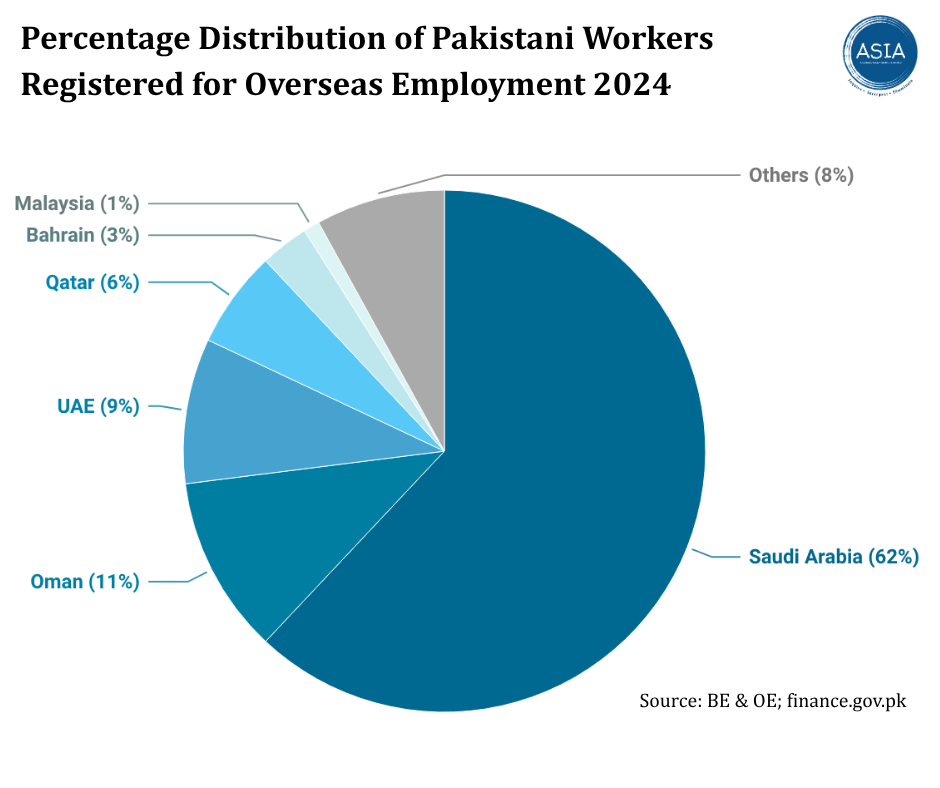
This is why the migration machine is analytically central. The official Bureau of Emigration and Overseas Employment says that more than 10 million registered emigrants have obtained overseas employment since 1971, including nearly 687,000 Pakistanis who proceeded abroad for work in 2025 up to November. That is not marginal movement. It is a developed institution: recruiting agents, protectorates, documentation, Gulf corridors, family loans, remittance expectations and an entire language of foreign placement. Pakistan’s most reliable youth institution may be the machine that removes its youth from the country.
That line is severe, but it names something the softer language of “mobility” can hide. Labour export works. It does not work without exploitation, debt, vulnerability or distance, but institutionally it exists in a way many domestic pathways do not. Pakistan produces workers more reliably than it produces work. Remittances then soften the social cost of this failure by turning absence into household survival. The state benefits, families adapt, and exit becomes normalised as a matter of prudence.
Education was meant to be the ladder that would make such exits optional rather than structural. The UNDP’s youth report framed Pakistan’s challenge in terms of education, employment and meaningful engagement, warning that a country with about two-thirds of its population under 30 could turn its youth bulge into either a dividend or a disaster. The sequence is still the right one: education should produce capability, employment should produce security, and engagement should produce voice. In Pakistan, the links remain weak.
The scale of expansion is real. Pakistan’s Economic Survey education chapter lists 269 universities, higher-education enrolment of about 1.94 million in FY2023, and 4,563 technical and vocational institutes. Yet spread is not alignment. A labour market does not absorb degrees simply because universities multiply. It needs industrial demand, technical training, credible hiring systems and sectors capable of turning qualification into income. Pakistan has expanded the promise of education faster than it has built the economy to redeem that promise.
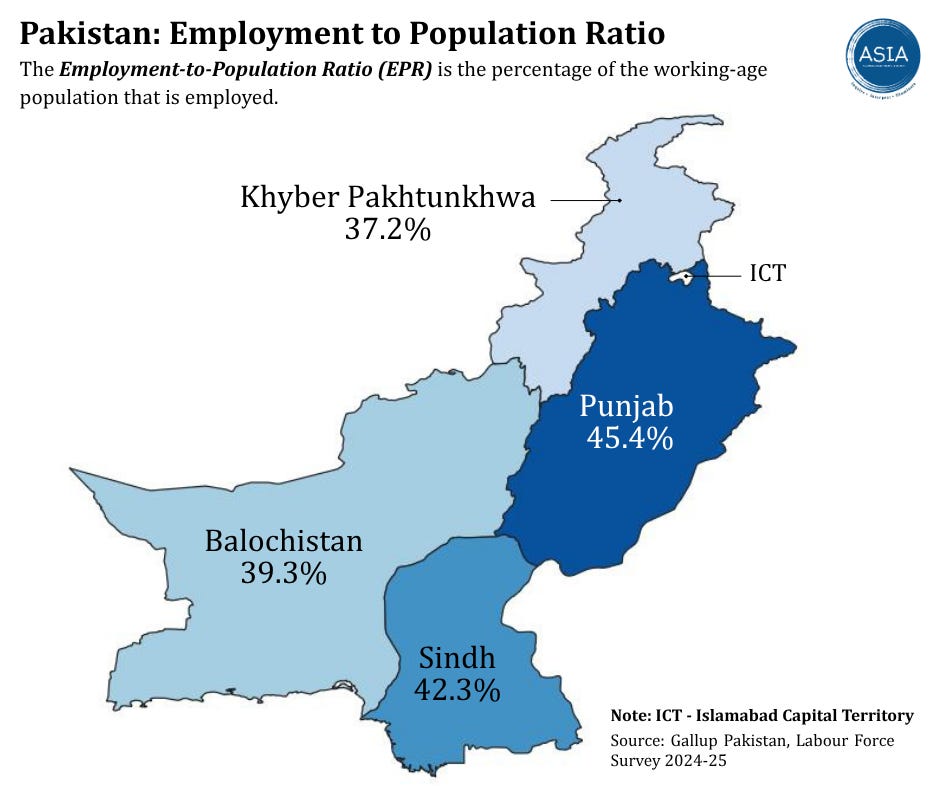
The labour data shows the cost. Gallup Pakistan’s analysis of the latest labour-force data places unemployment among 15 to 24-year-olds at 12.5 per cent, with urban women facing unemployment of 17 to 18 per cent. The official Labour Force Survey 2024–25 places youth NEET, those aged 15 to 24 not in education, employment or training, at 28.4 per cent, down from 32.5 per cent in 2020–21. But the improvement hides a sharper rupture: 45.4 per cent of young women are NEET, compared with 13 per cent of young men. In Balochistan, female NEET youth reach 60.5 per cent.
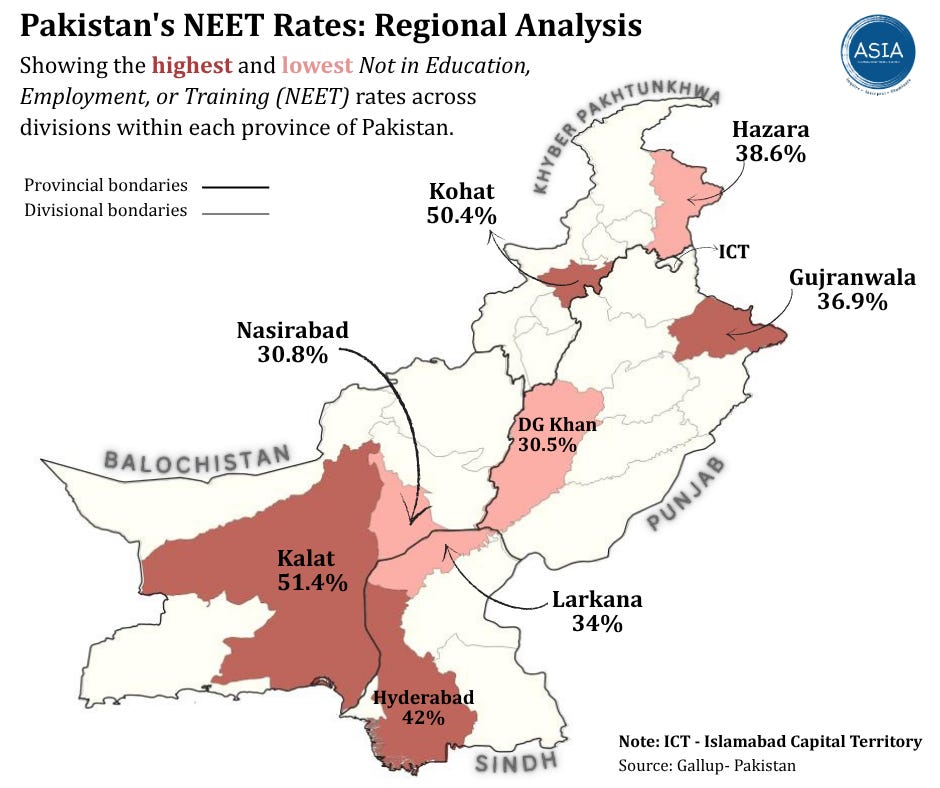
That gender divide changes the entire profile. “Pakistani youth” is too clean a category. For many young men, the crisis manifests as unemployment, underemployment, delayed adulthood, pressure to migrate, or the inability to marry and establish an independent household. For many young women, exclusion often begins before the labour market: permission to travel, safety, transport, unpaid care, marriage expectations, family reputation, and the assumption that education need not translate into income. A woman can hold a degree and still remain economically invisible. Pakistan’s demographic dividend is therefore gendered before it is demographic.
The old economy cannot absorb the pressure alone. Textiles still anchor Pakistan’s exports: Pakistan Business Council’s FY2025 goods data puts the textile group at $17.89 billion, or 55.83 per cent of total goods exports. This matters because textiles still employ, export and sustain industrial capacity. But survival is not transformation. A sector can remain essential and still fail to carry the ambitions of a young, urbanising, more educated population. Energy costs, productivity constraints and competition keep textiles important but insufficient.
Manufacturing gives the same mixed signal. Pakistan Bureau of Statistics reported 6.44 per cent growth in large-scale manufacturing during July-April 2025–26 compared with the same period a year earlier, while April output fell 8.32 per cent from March. For firms, that is volatility; for young people, it is waiting. Recruitment becomes uncertain, informal work absorbs pressure, public-sector exams regain attraction, and family dependence lengthens. The economy is moving, but not with enough credible ladders.
Digital work appears to offer the alternative. Dawn reported that recorded IT exports reached $3.8 billion in FY2024–25, while reported freelance and remote-work earnings rose to $779 million. These figures need care. They are recorded inflows, not the full scale of Pakistan’s informal digital labour economy; platform income, retained foreign balances, and underreported earnings may not fully appear in official counts. Still, the direction is clear. IT and freelancing are among the few sectors that allow young Pakistanis to earn globally while staying at home.
That makes the internet contradiction more damaging. A digital pathway depends on trust: stable connectivity, predictable platforms, reliable payments, client confidence, and consistent deadlines. Firewall anxieties and slowdowns are therefore not merely free-speech questions, though they are that too. They are labour-market shocks. They tell a young freelancer that the state may promote digital exports in one speech and damage the infrastructure of digital earning in the next. The same internet is treated as a foreign-exchange engine and a political threat.
The startup ecosystem shows a related narrowing. Data Darbar’s 2025 review found that equity funding recovered to $36.6 million from $22.5 million in 2024, but deal flow edged down from 15 to 14 transactions and remained concentrated in a few larger rounds. The ecosystem has not vanished. It remains real, but thin. It rewards English, urban networks, access to capital, and regulatory confidence. It offers a possible home build, not a mass settlement.
Rural Pakistan keeps the picture from becoming too urban. Agriculture is land, debt, water, climate exposure, family labour and local hierarchy, not simply a sector. Pakistan’s Economic Survey recorded agriculture growth of only 0.56 per cent in FY2025, constrained by a significant decline in major crops. When agriculture weakens, rural youth do not encounter it as an abstract growth number. They encounter it as a narrowing of adulthood: city work, informal labour, a government exam, a migration broker, or an unpaid household contribution.
This is where Cohen’s projected Pakistan and contemporary youth evidence meet. In 2004, the danger lay in the combination of demography, poor opportunity, weak education, security-centred politics and institutions that could manage but not transform. In 2026, that danger has not produced one dramatic youth revolt or national rupture. It has produced a quieter and more durable arrangement. The country survives by letting different groups find different exits from the same unresolved state. One exit is overseas employment. It moves labour out, sends remittances in, and turns domestic under-absorption into household survival. Another is digital work. It allows a narrower, connected class to earn income abroad while remaining in Pakistan, but only as long as the state does not cut the road beneath them. A third is waiting: exams, informal work, underemployment, unpaid care, political passivity and delayed adulthood. This waiting is not empty. It is produced by institutions that do not connect effort to outcome.
Pakistan is therefore not heading simply toward collapse or recovery. It’s more likely direction is a hardened system of partial exits. The state will remain externally relevant. It will continue to matter to Gulf labour markets, China, Afghanistan policy, the United States in moments of crisis, and the IMF as a debtor state that must be stabilised rather than ignored. But this does not mean its youth will experience recovery as a domestic future. At present, the evidence points elsewhere. Fiscal stabilisation has not become a youth settlement. Export survival has not become industrial transformation. IT growth has not become secure digital access. Education has not become assured employability. Women’s schooling has not become an equal economic presence. Migration is no longer an exception to the domestic economy; it is one of its most dependable extensions.
Pakistan’s youth are not simply abandoning the country. Many still want to stay, contribute, work, support families and claim dignity at home. But the country increasingly asks them to solve institutional failure privately: through migration, family networks, unpaid labour, digital hustle, foreign credentials, exam persistence or silence. That is the deeper crisis. The state has not lost its young all at once. It has made their futures conditional on the exits they can access. Cohen asked whether Pakistan could escape the futures shaped by weak institutions, poor education, demographic pressure, and a security obsession. Two decades later, the answer is not that Pakistan failed spectacularly. It has survived by exporting, delaying, underusing and selectively globalising its young. That is not a collapse. It is not a recovery either. It is a country building escape routes faster than domestic ladders.
Reading the Chaos Map
By Amogh Dev Rai | Research Director and researcher on China, and Chinese Geopolitics.
The state’s instruments cluster top-left: the security establishment, the firewalls, and the energy of a politics it keeps suppressing. Each is coercive, each eats bandwidth, none lays down a path. This is the quadrant Cohen warned about, a state that manages society more ably than it absorbs it. It can demand loyalty, invoke sacrifice, mobilise religion and secure outside money. It is far weaker at turning schooling into work or citizenship into voice. The passivity the youth surveys keep finding is not absence. The energy has been pushed off the formal board. The mobilisations of May 2023 and the vote of February 2024 were young and loud. They ran around the institutions, not through them.
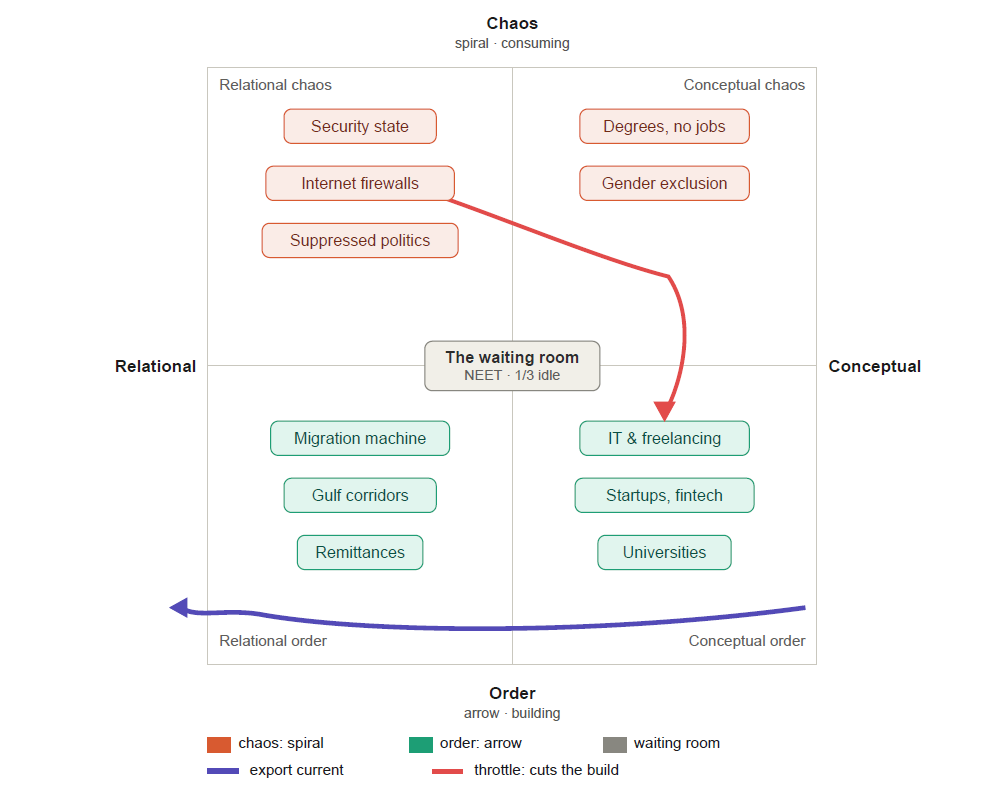
The segmented-survival reading is right but soft. The map hardens it. Fiscal stabilisation has not become a youth settlement. Export survival has not become industrial transformation. IT growth has not become universal access. Women’s schooling has not led to equal economic standing. Migration is no longer the exception. It is the plan. That is the Pakistan its young inherit: not a country emptied of hope, but one where hope is restored. The connected move out or online. The poorer move through the corridors. Many women are kept inside. Those without access wait. The instrument earns its place by naming the two moves the prose leaves implicit, the one self-inflicted cut and the one quiet transfer, and showing them on a single page.
Essay: Preksha Jalan- Associate Fellow, Digital History Lab at The Advanced Study Institute of Asia (ASIA), affiliated with SGT University, Gurugram.
Produced by Decypher Team in New Delhi, India