


By Amogh Dev Rai- Research Director at the Advanced Study Institute of Asia (ASIA), affiliated with SGT University, Gurugram.
On the shift of civilisational gravity, the lesson of the Ming withdrawal, and what the Chaos Map tells us about who inherits the order that is ending.
The most important thing about a world map is not what it shows. It is what it assumes. A map drawn with Europe at the centre does not merely place Europe in the middle of the page. It places Europe at the middle of the story. The projection, the naming conventions, the orientation, the zero meridian — all of it is a statement about who the protagonist of history is. For five centuries, the answer has been Europe and its civilisational extension, the United States. The map said so. The institutions said so. The textbooks said so. But maps can lie by omission. And the omission that is now being corrected — not by polemic but by the sheer gravitational weight of economic, technological, and strategic reality — is the absence of Asia from the centre of the story it was always at the centre of.
Sheng-Wei Wang’s research on the Kunyu Wanguo Quantu — the 1602 world map published by Matteo Ricci in Beijing — makes a provocative cartographic claim: that Chinese explorers mapped the world before the European Age of Discovery, and that Ricci’s map was not a European gift to China but an editorial reworking of Chinese source maps with European names layered on top. The mainstream academy has treated this with scepticism, and some of Wang’s evidentiary chains rely on secondary sources and archaeological claims that have not been independently verified. That matters. Analytical honesty requires saying so.
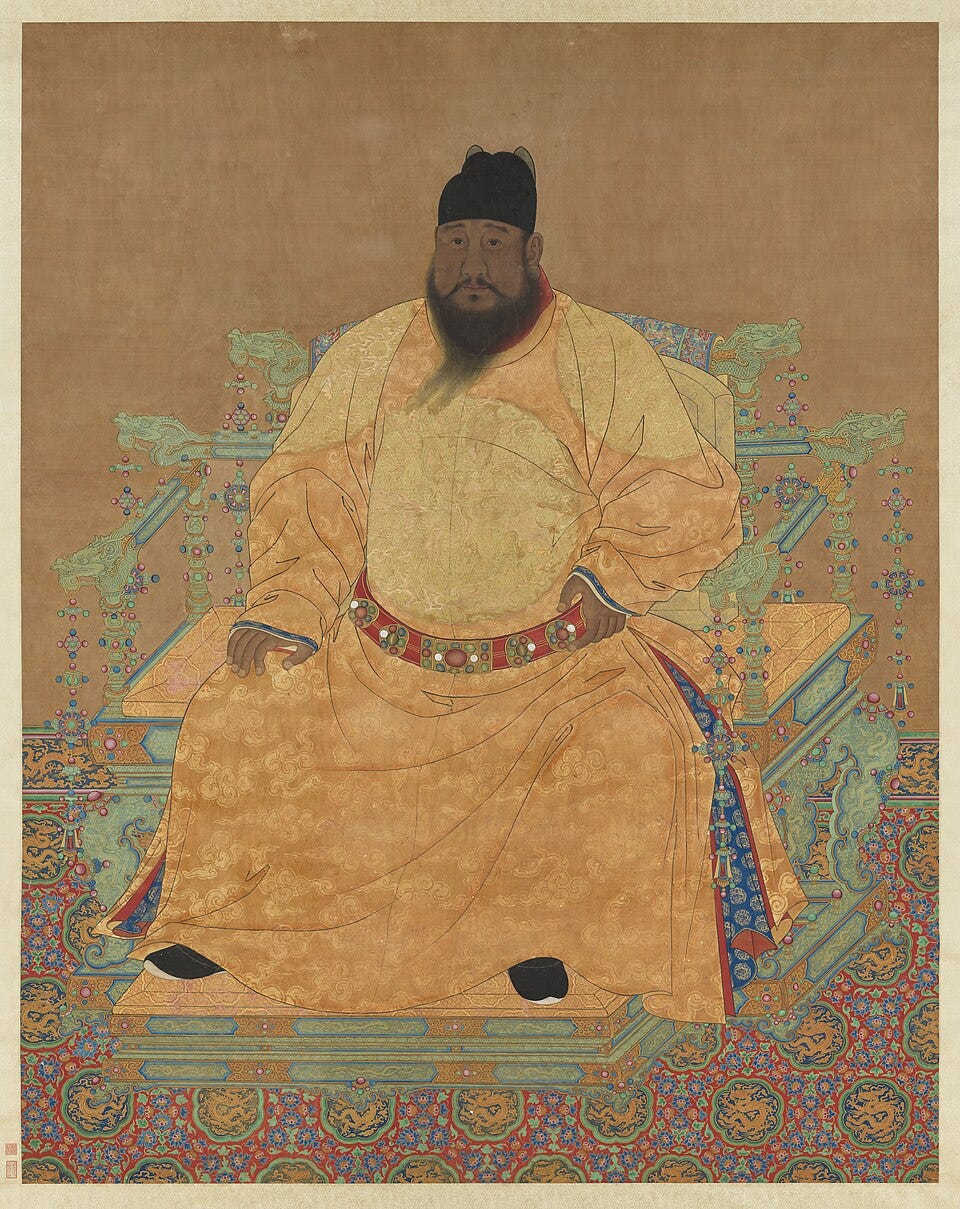
But what also matters — and what the sceptics rarely engage with — is the structural question Wang’s work opens up. Even if one sets aside the strongest versions of her claim, the underlying fact is not in dispute: in the fifteenth century, China possessed the world’s largest navy, roughly a third of global GDP, the most advanced navigational technology, and the institutional capacity to project power across oceans. It chose not to. The Xuande emperor burned the ships, burned the records, and withdrew. Europe, emerging from the Dark Ages with Chinese-origin technology in hand, filled the vacuum. That sequence — withdrawal, vacuum, replacement — is not an argument about maps. It is an argument about the structure of civilisational transition. And it is happening again.
The spiral and the arrow
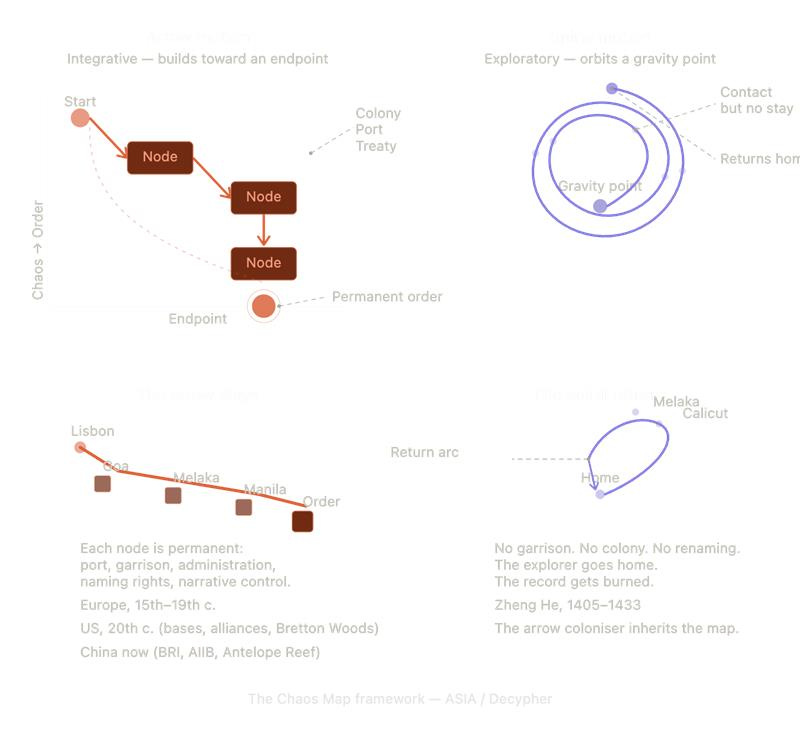
The framework I have been developing at ASIA — the Chaos Map — distinguishes between two kinds of motion through which actors bring chaos to order. Arrow motion is integrative: it aims at a specific endpoint and builds infrastructure to reach it. Spiral motion is exploratory: it follows what seems timely, hones in on what sparks attention, and moves on without necessarily integrating what it found into a lasting system.
Zheng He’s Treasure Fleet was spiral motion at civilisational scale. It explored, traded, made contact, mapped — and returned home. It left no colonies, no garrisons, no permanent administrative infrastructure. Wang frames this as a virtue: Zheng “emphasised peace, trade and diplomacy.” That is true. But it is also the reason China lost the cartographic and narrative contest that followed. The spiral explorer produces voyages. The arrow coloniser produces order. When the spiral explorer withdraws, the arrow coloniser inherits the map — literally, in Wang’s account — and writes the story.
Europe’s post-Columbian expansion was arrow motion. Vasco da Gama did not arrive in Calicut to look around and go home. He arrived to establish a node in a commercial and military network that would eventually span the globe. The Portuguese in Melaka, the Spanish in Manila, the Dutch in Batavia, the British in Calcutta — each was an arrow aimed at a specific endpoint: permanent extraction, permanent control, permanent narrative authority. The names they gave to places were not labels. They were title deeds. To name a place is to claim the conceptual order over it. Europe did not discover Asia. It overnamed Asia. And for five centuries, the overwriting held.
The spiral explorer produces voyages. The arrow coloniser produces order. When the spiral explorer withdraws, the arrow coloniser inherits the map and writes the story.
The Chaos Map clarifies why. Conceptual order — the lower-right quadrant, where institutions, law, naming systems, and knowledge infrastructure sit — is the quadrant that persists. Relational chaos — the upper-left, where wars, revolutions, and disruptive contact happen — is the quadrant that burns itself out. Europe’s genius, if that is the word, was not exploration. It was the conversion of exploration into conceptual order: maps, treaties, legal doctrines (terra nullius, the Doctrine of Discovery), institutional architectures (the East India Companies, the colonial civil service), and narrative monopolies (the textbooks, the museums, the Mercator projection). China explored in the chaos quadrant and withdrew. Europe built in the order quadrant and stayed. That is why Europe wrote the story.
The pattern repeats
The reason Wang’s interview matters for Decypher’s readership is not antiquarian. It is structural. The pattern she describes — a dominant power withdraws or overextends, a vacuum opens, a rising power fills it with a different motion type — has repeated three times in six centuries. We are inside the third repetition.
The first cycle ran from the fifteenth century to the nineteenth. China withdrew from maritime exploration. Europe filled the vacuum in arrow motion and built the colonial order. That order lasted roughly four centuries. The second cycle ran from the early twentieth century to the early twenty-first. The European colonial order collapsed through two world wars and decolonisation. The United States filled the vacuum — again in arrow motion: NATO, the Bretton Woods system, the hub-and-spoke alliance architecture in Asia, the forward-deployed carrier groups, the institutional grammar of the “rules-based international order.” That order lasted roughly seventy-five years. The third cycle is the one we are living inside. The American order is not collapsing. It is overextending. The distinction matters. Collapse is sudden. Overextension is gradual, and it is compatible with continued strength in individual theatres. The US can still destroy Iran’s military in thirty-eight days. It simply cannot do that and maintain carrier presence in the western Pacific at the same time. The order is intact in its parts. It is failing in its simultaneity. And that failure of simultaneity is the vacuum that the next order is being built inside.
The American order is not collapsing. It is overextending. Collapse is sudden. Overextension is gradual, and it is compatible with continued strength in individual theatres.
The lesson China learned
Here is where the Wang interview becomes genuinely illuminating, rather than merely interesting. She notes that contemporary Chinese interest in Zheng He and the Ming maritime legacy is partly nationalist and partly a “historical awakening.” She frames the Belt and Road Initiative as a modern continuation of Zheng’s peaceful voyages. That framing is politically convenient and analytically incomplete. But it contains a structural truth that is worth extracting.
The structural truth is this: China has changed its motion type. Zheng He was spiral. Xi Jinping is arrow.
The Belt and Road Initiative is not exploration. It is infrastructure. Ports, railways, fibre-optic cables, industrial parks, development finance institutions — each is an arrow aimed at a specific endpoint within an integrative system. Antelope Reef — 1,490 acres of reclaimed land in the Paracels, built in five months while the world watched Tehran burn — is not a voyage. It is a runway, a radar platform, and an area-denial node designed to persist. China’s mediation of the Afghanistan-Pakistan conflict through the Urumqi talks is not disinterested benevolence. It is the construction of a diplomatic architecture in which China is the indispensable broker — a permanent institutional position, not a one-off intervention. The BRICS expansion, the Asian Infrastructure Investment Bank, the internationalisation of the renminbi — all arrow motion, all aimed at endpoints, all building conceptual order.
The lesson China drew from the Ming withdrawal is the lesson the Chaos Map makes legible: spiral motion creates beautiful histories but no lasting authority. The explorer who returns home gets written out of the record by the coloniser who stays. If China wants to avoid a second overwriting, it must not merely explore or trade or mediate. It must build the institutional architecture — the conceptual order — that makes its presence the operational reality rather than a historical footnote. That is what it is doing. Whether it is doing it well, or justly, or sustainably, is a separate question. That it is doing it structurally is not.
The gravity shift
The shift of civilisational gravity from the Atlantic to the Indo-Pacific is not a prediction. It is a measurement. The arithmetic has been visible for two decades: the share of global GDP generated east of the Urals, the share of global manufacturing, the share of global R&D output, the share of global patent filings, the share of global internet users. By every material metric, the centre of gravity has already moved. What has not yet moved is the narrative. The institutions of global discourse — the major wire services, the prestige media, the university ranking systems, the Nobel committees, the Bretton Woods architecture, the UN Security Council’s permanent membership — still reflect the distribution of power as it existed in 1945. The map still has Europe at the centre.
Wang’s argument, stripped of its most speculative claims, is that this has happened before. There was a period when China was the world’s leading maritime, economic, and technological power, and the maps of the world reflected that knowledge. Then China withdrew, Europe took the maps and the narrative, and for five centuries the story was told as though Europe had discovered a world that was already known. The correction of that story is not merely an academic exercise in Asian self-regard. It is a re-reading of the structural pattern by which civilisational orders rise, overextend, withdraw, and get replaced.
The West-centric world is not ending because the West is weak. It is ending because the structural conditions that produced it — European technological monopoly in the sixteenth century, American industrial and military supremacy in the twentieth — no longer hold. What holds instead is a world in which multiple civilisational centres possess advanced technology, significant military capability, large consumer markets, and the institutional ambition to build their own versions of conceptual order. China is the most consequential of these, but India, Indonesia, the Gulf states, and a consolidating ASEAN are all part of the rebalancing. The shift is not from West to East. It is from a unipolar centre to a multipolar field. The map is being redrawn not because the old centre was wrong, but because it was a centre, and centres do not survive the diffusion of the capabilities that created them.
The West-centric world is not ending because the West is weak. It is ending because the structural conditions that produced it no longer hold.
What the map warns
The Chaos Map tells us one thing about transitions between orders that no amount of diplomatic optimism can override: they are dangerous. The transition from Ming maritime supremacy to European colonial order produced centuries of imperial violence, the Atlantic slave trade, and the near-total subjugation of the Global South. The transition from European colonialism to the American order produced two world wars, the Holocaust, and the nuclear threshold. Every transition between dominant orders has been catastrophic for the people caught in the gap between the old arrow and the new one.
The current transition has, so far, been less violent than its predecessors. That is partly because nuclear deterrence constrains the upper end of escalation and partly because the economic interdependence between the declining and rising orders is deeper than in any prior cycle. But it is also true that the Iran war has just demonstrated what American force projection looks like under stress, that Antelope Reef has just demonstrated what Chinese infrastructure-building looks like inside the vacuum, that the Af-Pak border war is killing civilians on an unfinished frontier while China mediates and the world looks elsewhere, and that the European order is fragmenting under the weight of a land war it cannot end. The transition is not hypothetical. It is underway.
Wang ends her interview with a hopeful note about outer space, shared rules, and the possibility of a more cooperative global order. I would like to share that optimism. But the Chaos Map is not an optimistic framework. It is a structural one. And structurally, what it shows is that the period between orders — when the old arrow has lost coherence but the new arrow has not yet established its endpoint — is the period when the world is most fragile. We are in that period now. The maps are being redrawn. The question is not whether the centre of gravity will shift. It already has. The question is whether the shift can complete itself without the catastrophe that has accompanied every prior completion.
The Kunyu Wanguo Quantu, if Wang is right, was a Chinese map that an Italian priest Ricci renamed and published as his own in 1602. Four centuries later, the renaming is being reversed. Not on parchment but in steel, concrete, fibre optics, and institutional architecture. The eastern horizons are not rising. They have been there all along. What is changing is who gets to draw the map.
Read the original: What an ancient Chinese map reveals about global history and modern power: Sheng-Wei Wang
Produced by Decypher Team in New Delhi, India