

Calling Taiwan
Before today's briefing
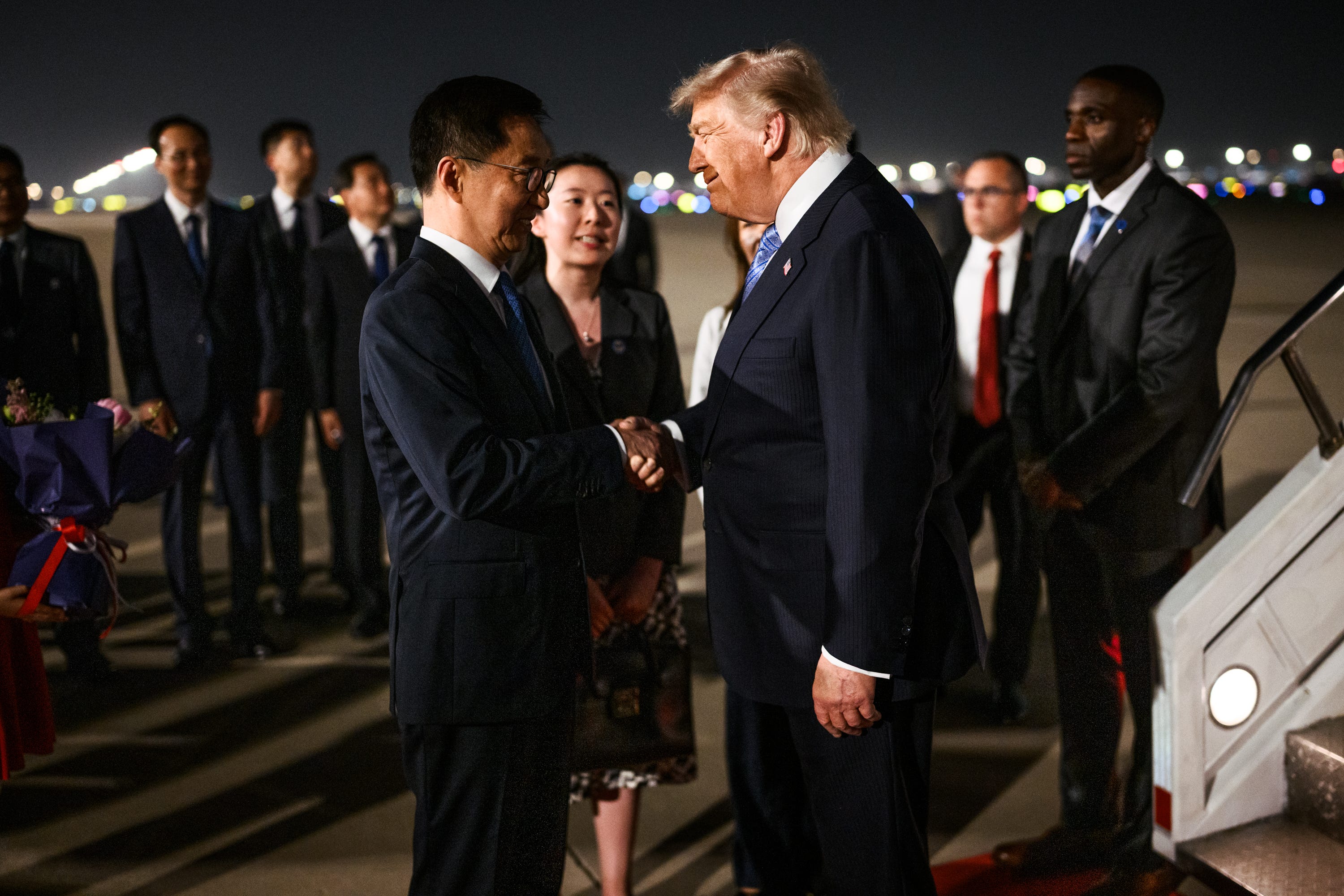
The president said he would call. He says that about a lot of people. He said it at Joint Base Andrews, walking off Air Force One, still wearing the suit he wore in Beijing seven days earlier. A reporter asked about Taiwan. He said, "I'll speak to him. I speak to everybody." The way you might say you'll return a library book. The way you might say you'll fix the screen door.
The last time an American president spoke to a Taiwanese president was 1979. Carter was in the White House. Deng Xiaoping was consolidating power. The agreement was simple: America would pretend Taiwan did not exist as a state, and in exchange, the state that did not exist would receive enough weapons to ensure it continued not existing in a manner convenient to everyone. The arrangement held for forty-seven years. It held through six wars, four Taiwan Strait crises, and the entirety of China's rise from poverty to the second-largest economy on earth. It held because no one picked up the phone.
Trump picked up the phone once before. December 2016. Tsai Ing-wen called, or he called, or someone arranged for someone to call someone. Beijing issued a protest. The White House had not been told. The State Department was not consulted. It was ten minutes. It nearly unmade a half-century of diplomatic architecture. Then everyone pretended it had not happened, and the architecture repaired itself, the way a cracked windshield holds together until the next pothole.
This time the context is different. One week ago, Xi Jinping sat across from Trump in the Great Hall of the People and warned him, in language the readout made no effort to soften, of "clashes and even conflicts" over Taiwan. Seven days later, Trump said he would call Lai. That is not diplomacy. That is a man walking out of a negotiation and immediately phoning the other side's ex. The purpose is not the conversation. The purpose is the knowledge that the conversation could happen.
Lai Ching-te, for his part, has welcomed the idea. Taipei issued statements about deepening cooperation and defending democratic values. The statements were correct and irrelevant. A Taiwan analyst named Lev Nachman offered the honest reading: Trump has adopted Xi's framing. Taiwan is now "a problem that needs to be solved." Lai would be calling not as an ally but as a supplicant, trying to convince a man who just blocked $400 million in military aid that the island is still worth defending. The arms sale Congress approved sits unsigned on a desk somewhere. The call, if it happens, would be the most consequential phone call in Asia since 1979. If it does not happen, the signal has already done its work.
Here is what the signal does. It tells Beijing: the Taiwan card is still in the deck. It tells Taipei: your security guarantee is a function of our trade negotiations, and trade negotiations change with the weather. It tells the region: the thing you built your defence planning around — American commitment to the western Pacific — is a variable, not a constant. The aircraft carriers are in the Gulf. The reef is in the Paracels. The phone call is in the air. Only one of those three things is made of something solid.
China built an island while America was busy. Now America is floating a phone call while the arms sale gathers dust. The island will be there in ten years. The phone call will be forgotten in ten days. That is the difference between a country that builds and a country that signals. One pours concrete. The other pours words into a receiver and waits to see who flinches.
Taiwan is the smallest actor in this scene and the one with the most to lose. It did not ask to be a bargaining chip. It did not ask to be a problem to be solved. It asked for submarines and missile defence systems and the quiet assurance that someone would answer if the phone rang at three in the morning. What it got instead was a president who said he might call, the way you might say you will call, standing on the tarmac, still in the suit, already thinking about something else.
The phone has not rung yet. But everyone heard it.

The Innovation Cold War
The framing
The innovation contest between the United States and China is usually told one of two ways: as a decoupling, or as a managed competition that will eventually settle. Neither fits. The two economies are not separating cleanly and not stabilising. They are locked in an oscillating rivalry — escalating to the edge of rupture in one technology while signing a truce in another, and reversing both inside a year.
This instrument maps that rivalry across three domains where innovation and security now meet: semiconductor and critical-mineral supply chains, artificial intelligence, and quantum technology. It uses the Chaos Map framework — two opposing force-fields, no equilibrium, a volatile dominant variable — and adds the question the series exists to answer: where does cooperation survive, and why.
The finding, stated first. Cooperation between the two powers tracks mutual vulnerability, not goodwill. It persists exactly where neither side can decouple without hurting itself, and collapses where decoupling is cheap. The limit of cooperation is structural. Diplomacy operates inside it; it does not set it.
The Chaos Map
The system has no stable point. Two force-fields pull on every technology relationship at once. They are not the same kind of force, and they do not cancel.
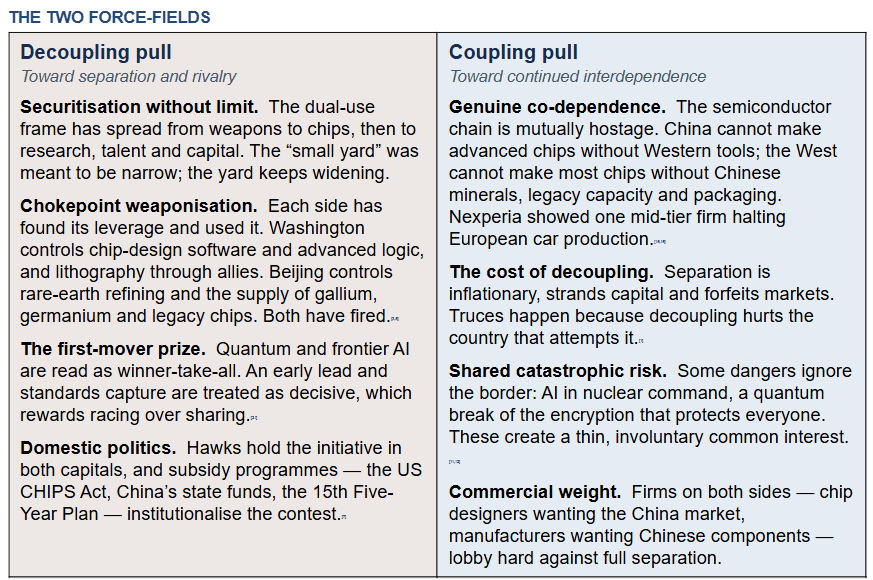
The chaos generator. Each side’s best move is the same: tighten its own chokepoint while keeping the other’s open. Both play it, so the system never settles. It escalates until the cost of escalation lands at home, then retreats, then escalates again. The dominant volatile variable is the choice, remade every few months, between decouple and deal. The map does not predict a settling point because there is none. It shows where the oscillation is violent and where it is not.
Cooperation tracks interdependence
The instrument’s central claim is plain. Cooperation between the United States and China is a function of interdependence. Where the two are deeply entangled, cooperation survives even amid open hostility, because the alternative is shared damage. Where they are barely entangled, cooperation collapses, because nothing forces it. Summitry and dialogue operate inside that constraint. They do not loosen it.
Brinkmanship is the steady state. The rare-earth episode of 2025 is the template. In October Beijing announced sweeping export controls on rare earths and related materials. Within weeks a Trump–Xi meeting produced a one-year truce: China suspended the controls and issued general licences for rare earths, gallium, germanium, antimony and graphite, and the United States suspended in parallel its rule extending controls to affiliates of listed entities. Both sides escalated to the edge, both retreated, and both kept the weapon. The truce is a pause for recalibration, not a settlement, and it expires in November 2026.
The counter-case. The Nexperia dispute shows what happens without a path to retreat. The Dutch government seized the Chinese-owned chipmaker in late 2025 on security grounds; Beijing blocked exports from its Chinese plant; European car production was disrupted, and the dispute was still live months later. Where the rare-earth fight reached the summit table, the Nexperia fight did not, and it festered. The lesson: brinkmanship is stable only while both sides keep a clear path to retreat. Remove the path and the damage compounds.
Three domains, three positions
The three domains sit at different points on the spectrum, and the reason is interdependence. The more entangled the domain, the more cooperation survives — and the more violent the oscillation around it.

Supply chain — contested entanglement
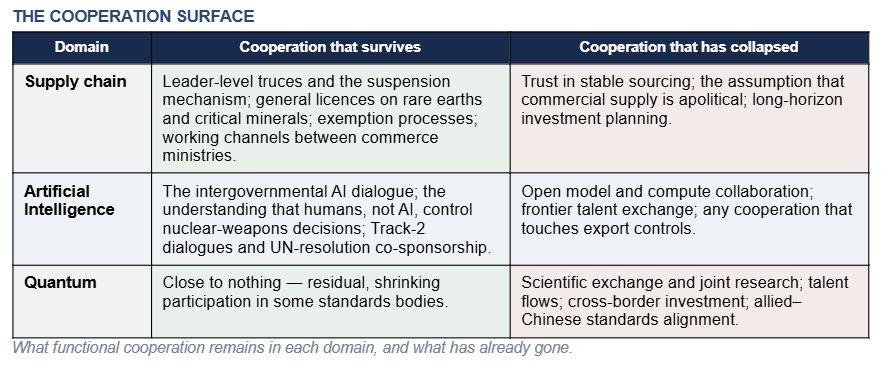
This is the most entangled and the most weaponised domain. Washington’s chokepoints are chip-design software, advanced processors and lithography held through ASML, enforced by the entity list. Beijing’s chokepoints are the refining of rare earths — more than 80 per cent of the global total — and the supply of gallium, germanium, antimony, graphite, and the legacy chips and packaging on which the world’s electronics depend. In 2025 both fired. The cooperation that survives is crisis management: general licences, exemption processes, the truce mechanism itself. It is thin, but it is constant, because the chokepoints are symmetrical enough that a full exchange would damage both. Entanglement here does not prevent conflict. It caps it.
Artificial intelligence — competition with a safety floor
In AI the competition is close to total — on compute, models, talent and standards — and the US diffusion framework rations the chips. Cooperation is confined to a narrow floor. The intergovernmental AI dialogue opened in Geneva in May 2024; in November 2024 the two presidents affirmed that humans, not AI, must control nuclear-weapons decisions; Track-2 dialogues and UN-resolution co-sponsorship continue. But the floor is deliberately narrow. It covers the applications that could kill both sides, and it is walled off from export controls by design; one school in Washington argues for exactly this — a narrow safety dialogue alongside maximum pressure. The dialogue’s standing under the current US administration is uncertain. The limit is set by a moderate interdependence: enough shared exposure to catastrophic risk to sustain a floor, not enough to restrain the race.
Quantum — clean decoupling
Quantum is the domain of near-total competition and almost no cooperation, and the reason is that decoupling is cheap. The technology is pre-commercial, so separating now costs little. The United States and its allies have built a coordinated control regime — a “Wassenaar minus one” coalition in which the UK, France, Japan, Canada and the EU enacted parallel controls on quantum computers, cryogenics and control electronics, backed by an outbound-investment ban and, in 2026, a move to cover cloud access. China has answered with state-coordinated self-sufficiency: quantum is named first among the future industries of the 15th Five-Year Plan, a guidance fund above 120 billion yuan is deployed, and domestic firms now build their own cryogenics. The cooperation that survives is close to nothing — scientific exchange severed, talent flows restricted, standards venues splitting. The recorded paradox: controls on an immature technology have accelerated Chinese self-sufficiency rather than contained it. Quantum decouples cleanly because, for now, neither side loses much by it.
The instrument
The domain scorecard places the three on four dimensions that explain their positions. Interdependence is the degree of mutual co-dependence. Securitisation is how completely the domain is framed as national security. Residual cooperation is how much functional cooperation survives. Escalation volatility is how sharply the domain swings between truce and escalation.
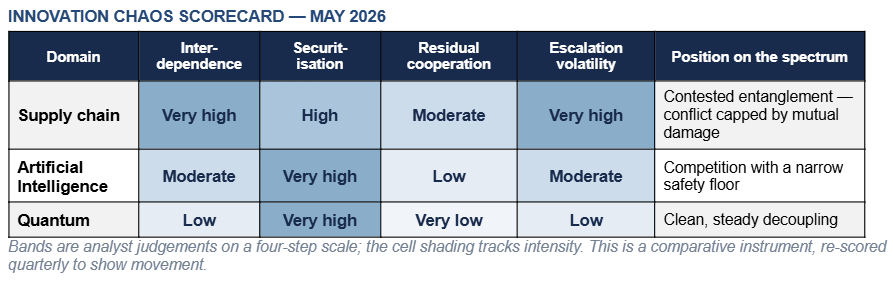
Reading the scorecard. Two patterns hold. First, residual cooperation rises with interdependence: highest in the supply chain, lowest in quantum. Cooperation is bought by mutual vulnerability, not chosen. Second, escalation volatility also rises with interdependence: the supply chain swings violently between truce and escalation, while quantum decouples in a straight line. Entanglement creates the chaos — the leverage to escalate and the incentive to retreat both come from it. Securitisation, notably, does not differentiate the domains: it is high to very high across all three. What varies is entanglement, and entanglement is what sets cooperation.
What moves the system
The map is a snapshot. Five developments would shift it.
The November 2026 truce expiry. If the truce is not renewed, the rare-earth controls and the affiliate rule return, and the supply-chain domain re-escalates from a higher base.
A Taiwan contingency. The single event that would collapse all three domains at once, converting managed rivalry into rupture and ending the brinkmanship game.
A quantum cryptographic breakthrough. A machine able to break current encryption would create interdependence-by-threat overnight and force the quantum domain toward either cooperation or panic.
An AI safety incident. A visible failure in a military or frontier system would test whether the thin AI floor holds or breaks under pressure.
A minerals shock outside the truce. An export halt or a second Nexperia would show whether crisis-management cooperation scales, or only works when a summit is scheduled.
The closing point. The instrument’s value is the same as the rest of the Chaos Map series: it tells the reader where to watch. The supply-chain domain is where the oscillation is loudest and a quarterly re-score will move most. Quantum is where the decoupling is quiet, steady and unlikely to reverse. AI is where a single incident could break a floor that currently holds. India’s task is not to pick the winner of the innovation contest. It is to position for a rivalry that will neither end nor settle.

The Beijing Meetings
A piece in The Telegraph this week raises major concerns about the UK’s relationship with Beijing. In October 2025, Stephen Lillie, the Foreign Office’s former head of defence and international security, met privately with the Grandview Institution, a Beijing-based think tank that Western analysts say has links to China’s Ministry of State Security, the country’s main foreign intelligence agency.
The influence of the Beijing-based think tank has come under scrutiny since it emerged that Jonathan Powell flew to China for several meetings with the organisation before being appointed Sir Keir Starmer’s national security adviser. A week before Lillie’s visit, Grandview officials had lunch with Sir Olly Robbins, the Foreign Office’s recently dismissed top civil servant. All of this took place amid a deliberate thawing of UK-China relations, culminating in Starmer becoming the first British prime minister to visit China since 2018.
The British government has defended such engagements as necessary for understanding global developments and protecting British interests. Critics, however, argue that Grandview functions less like an independent think tank and more like a platform with intelligence-linked connections. Some former Western intelligence officials have described the repeated interactions as potentially risky.
The issue has added to political pressure on Starmer’s government, following earlier controversies involving senior appointments and vetting concerns. At the centre of the debate remains a key unanswered question: what exactly was discussed during the private meetings, and whether sensitive information about Britain’s nuclear deterrent may have been exposed.
— — —
Editorial and Essay: Amogh Dev Rai- Research Director at the Advanced Study Institute of Asia (ASIA), affiliated with SGT University, Gurugram.
Postscript: Bhupesh
Produced by Decypher Team in New Delhi, India
— — —