


The Himalayan Knowledge Gap
Ni Feng is not a household name outside Chinese academic circles, and his latest paper in the Journal of the University of the Chinese Academy of Social Sciences will not be excerpted on cable news. That is part of his point. China’s America experts, he argues, are not producing work that matters. They follow research agendas set in Washington. They describe rather than diagnose. They cannot translate what they know into policy. They do not understand the internal fractures — racial, fiscal, populist, institutional — that are remaking the United States from the inside. And the system that produces them (siloed departments, no movement between academia and government, no mechanism for converting research into strategic advice) ensures the failures reproduce themselves.
The argument is unusual not because it is harsh but because of where it is published. CASS is not a dissident institution. It is the party-state’s premier research body. A paper in its house journal calling the national America-knowledge infrastructure inadequate has been cleared at a level that makes it more than one professor’s frustration. It is a signal that Beijing considers its own analytical capacity insufficient for the competition it is in. That self-diagnosis deserves attention — not because China’s problems are our problems, but because India’s version of the same failure is worse, less diagnosed, and further from correction.
Start with what Ni actually identifies. His complaint is not that Chinese scholars lack data on the United States. It is that they lack an autonomous framework for interpreting it. Since the reform era, Chinese America-watchers have operated as translators: they read American sources, attend American conferences, publish in formats legible to American peer review, and report back to Beijing what Washington thinks about itself. That was useful when the relationship was cooperative. It is useless when the relationship is adversarial. You cannot understand a competitor’s structural vulnerabilities using the competitor’s own analytical categories, because those categories are designed to make the vulnerabilities invisible. (No American political scientist publishes a paper titled “The Structural Unsustainability of the American Fiscal Model.” They publish papers about “debt sustainability challenges” — the same content, stripped of strategic implication.) Ni is calling for a framework that starts with Chinese questions, not American ones.
Now transpose the diagnosis to India.
Indian China studies is in a worse position than Chinese America studies, and for deeper reasons. China has at least built the volume: 450 regional studies centres, 20,000 faculty, CASS, Peking University’s School of International Studies, Fudan, Tsinghua’s Institute of International Relations. The analytical output may be derivative — that is Ni’s complaint — but the institutional infrastructure exists. India has almost nothing comparable. There is no major Indian university with a dedicated China studies department that combines language training, political economy, strategic analysis, and field research into a single programme. The handful of scholars who do serious China work are scattered across JNU, ICS Delhi, and a few think tanks, operating without the institutional mass to sustain a research agenda across decades. Most of what passes for China analysis in Indian policy circles is produced by retired military officers, former diplomats, and journalists — people with experience but without the analytical infrastructure to convert experience into structural insight.
The result is that India’s China knowledge is almost entirely borrowed. Indian analysts read American China-watchers (Brookings, CSIS, RAND, the Council on Foreign Relations) and apply their frameworks to Indian strategic questions. The problem is that American frameworks for understanding China are designed to answer American questions: Can China challenge US primacy? Will China invade Taiwan? Is the Chinese economy slowing? These are legitimate questions. They are not India’s questions. India’s questions are different: What does China’s infrastructure build in the Indian Ocean mean for Indian maritime strategy? How does the BRI reshape the political economy of India’s neighbours in ways that constrain Indian influence? What are the structural vulnerabilities of the Chinese economic model that Indian trade policy could exploit? How does China’s party-state make decisions about the LAC, and what does the decision-making architecture tell us about escalation risk?
No American think tank is optimised to answer these questions. They are not paid to. India needs its own China-knowledge infrastructure — original frameworks, original data, original analytical categories — built from Indian strategic questions and staffed by scholars who read Chinese, do fieldwork, and move between academia and government. Ni’s revolving-door proposal for China applies with even greater force to India, where the gap between the academy and the policy establishment is not a crack but a canyon. Indian diplomats who have served in Beijing retire with deep practical knowledge that never enters the academic literature. Indian scholars who study China publish in journals that no policymaker reads. The two populations do not meet, do not exchange methods, and do not build on each other’s work.
This is the problem ASIA was built to address — not for China studies alone, but for the broader project of Indian strategic knowledge production. The Chaos Map framework, the annual foreign policy audit, the work on Pakistan’s fiscal architecture, the VC Discipline Index — all of these are attempts to build original analytical instruments from Indian (and Asian) questions rather than importing frameworks designed for different purposes by different powers. The principle is the same one Ni articulates for Chinese America studies: know who you are, know why you are studying the subject, and let your research agenda be driven by your own strategic requirements rather than by the topics set by someone else’s academy.
But principles are cheap. Institutions are expensive. What would an Indian China studies infrastructure actually require?
First, language. There is no serious China analysis without Mandarin, and India produces almost no Mandarin-competent strategic analysts. The handful who exist are products of individual initiative, not institutional design. A national programme to train fifty Mandarin-proficient China analysts per year — embedded in strategic studies programmes, not language departments — would cost less than a single defence procurement deal and would produce more bang for the buck.
Second, fieldwork. Indian scholars do not go to China. (Chinese scholars, for that matter, rarely come to India for research purposes.) The result is that both sides study each other through texts, satellite imagery, and American intermediaries. A bilateral academic exchange programme — even a modest one, even one that operates under the political constraints of the current relationship — would produce more structural insight in five years than the current system produces in twenty.
Third, the revolving door. Ni’s proposal should be stolen wholesale. Indian Foreign Service officers who have served in Beijing should spend two years at a research institution after their posting, converting operational knowledge into publishable analysis. Scholars who produce policy-relevant China research should spend time inside MEA’s East Asia division or the NSCS. The rotation need not be permanent. It needs to exist.
Fourth, frameworks. India does not need more papers describing what China is doing. It needs analytical instruments that explain why China does what it does, predict what it will do next, and identify the structural pressure points where Indian policy can be effective. The Chaos Map is one such instrument. There should be others — a Chinese decision-making model for LAC escalation, an Indian Ocean infrastructure index tracking BRI port capacity against Indian naval reach, a technology-dependence matrix mapping where Indian supply chains run through Chinese chokepoints. These are the equivalents of what American China-watchers have built over decades. India has not built them because it has not built the institutions that would produce the people who would build them.
Ni Feng’s paper is addressed to Chinese scholars. Its real audience is anyone running a strategic knowledge system that depends on borrowed frameworks to understand an adversary it cannot afford to misread. India is in that category. The gap is not one of talent. Indian analysts are as intelligent as any in the world. The gap is institutional: no language pipeline, no fieldwork infrastructure, no revolving door, no original frameworks, no sustained funding for the kind of deep structural work that converts information into strategic advantage.
China has diagnosed its own knowledge failure and is mobilising resources to fix it. India has not yet diagnosed the equivalent failure. This editorial is the diagnosis. What follows from it depends on whether anyone with institutional authority reads it and decides that understanding China through American intermediaries is a luxury India can no longer afford. The intermediary’s interests are not India’s interests. The intermediary’s questions are not India’s questions. And the intermediary, as the Iran war and the Pacific carrier gap have demonstrated, has its own problems to attend to.

The Hormuz Blockade Is a China Problem. Here's Why.
The current conflict involving Iran and the blockade of the Strait of Hormuz has transcended a mere regional issue; it poses a significant shock to the global economic framework, with China being a key player.
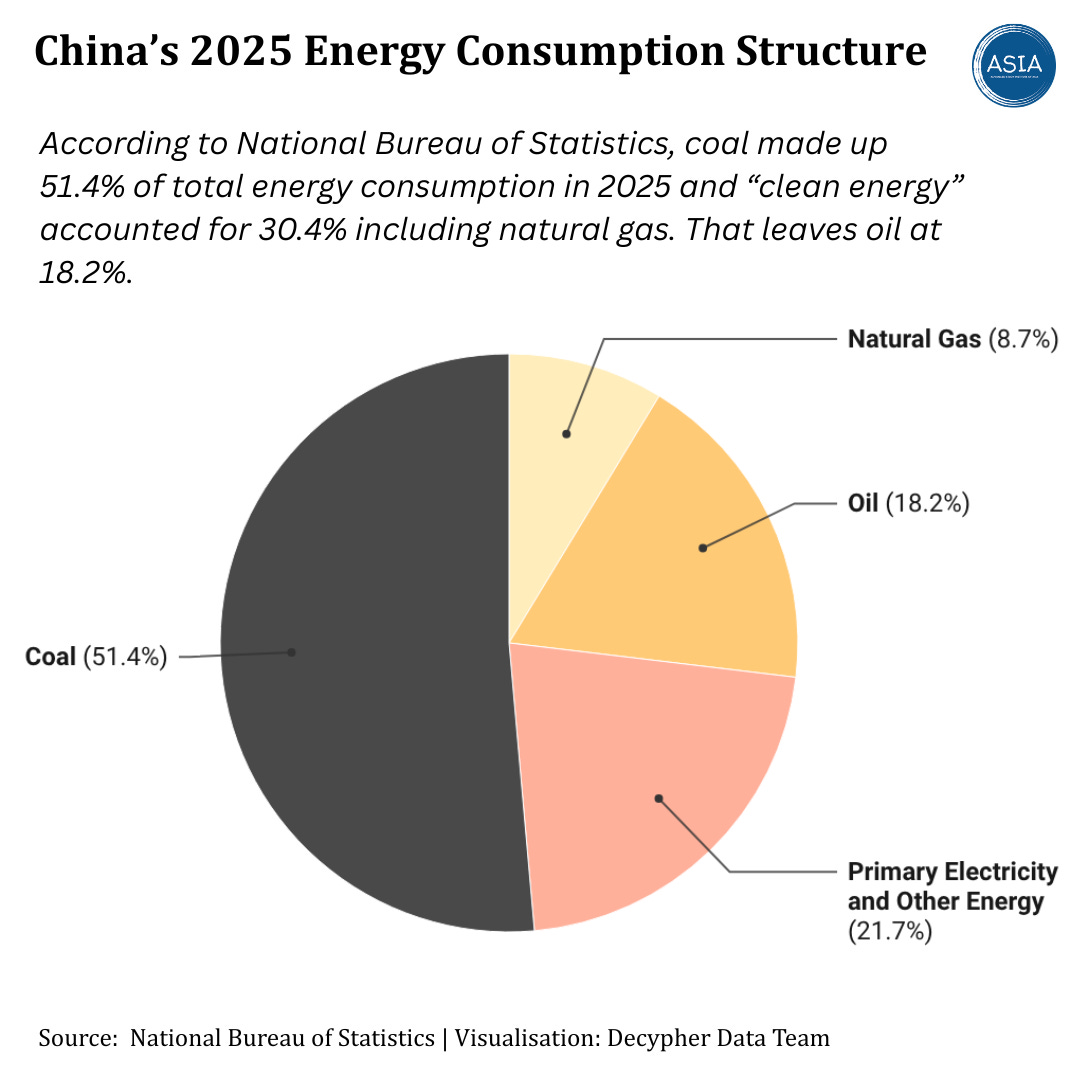
At the core lies energy dependence. Approximately 38% of China’s crude oil (1.38-1.55 million barrels per day) imports pass through Hormuz, rendering it the most vulnerable major economy to any disruptions in this shipping route. However, since 2022 Beijing has not disclosed its oil imports from Iran, the data is from the third-party sources. Also, 90 percent of Iran’s crude oil exports ends up in China. When hostilities compromised shipping safety and the United States enforced a blockade, oil supply significantly contracted, resulting in prices surging above $120 per barrel and instigating inflationary pressures across the globe.
Escalating energy expenses directly impact China’s industrial sector & manufacturing sector by raising production costs and diminishing its export competitiveness. As the largest manufacturing nation worldwide, disruptions within China reverberate throughout international supply chains, exacerbating inflation and decelerating growth well beyond Asia. On the other hand, the 14th 5-year plan of China claim country’s energy self-sufficiency is as high as 80 percent. Also, it produces 30 percent of crude oil which China consumes at domestic level. To note, the China also rapidly moving towards reducing its reliance on imported oil and expanding its use of renewable and electrification.
However, the war crisis highlights an underlying structural weakness: China’s dependence on foreign maritime security. Despite its economic supremacy, China lacks sufficient naval capability to ensure critical shipping routes during high-intensity conflicts independently. The blockade illustrates that control over trade routes is fundamentally a geopolitical issue rather than solely an economic one.
Moreover, there exists a strategic paradox. China heavily relies on Iranian oil often obtained through indirect or less transparent methods like reflagged ships, disguised cargos, ship to ship sea transfers (shadow networks) even as U.S. pressure mounts and these supplies grow riskier. This creates dual vulnerabilities involving exposure to geopolitical instability and sanctions.
Ultimately, this crisis reflects a broader transformation. The global economy, previously thought to be robust due to interdependence, is revealing its fragility when crucial chokepoints are threatened. With nearly 87% of oil from Hormuz heading towards Asia, such disruptions have an outsized effect on Asian economies, particularly affecting China questioning its open and predictable global trade.

The Stockpile That Started a War
From the Treaty of Non-Proliferation of Nuclear Weapons (NPT) in 1968 to the Joint Comprehensive Plan of Action (JCPOA) deal, Trump’s exit, Soleimani’s killing, and the February 2026 attack.
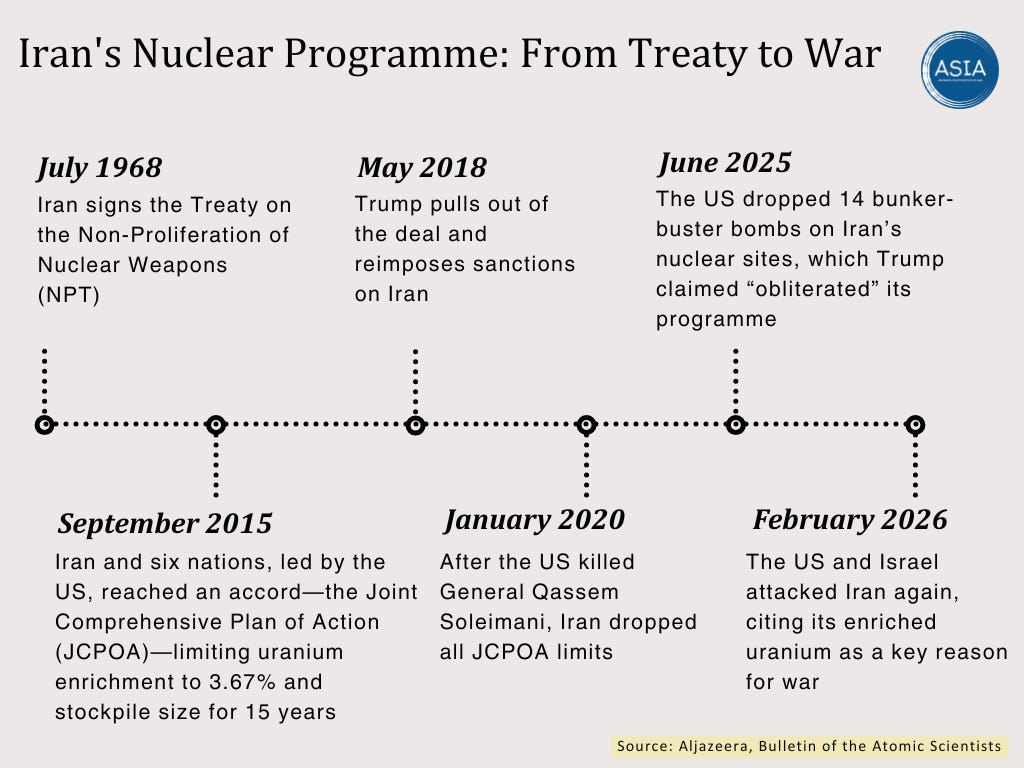
Uranium can light cities or destroy them. That duality is the core of Iran’s nuclear story.
2006 — Iran began enriching uranium on an industrial scale, claiming peaceful purposes. The stockpile kept growing.
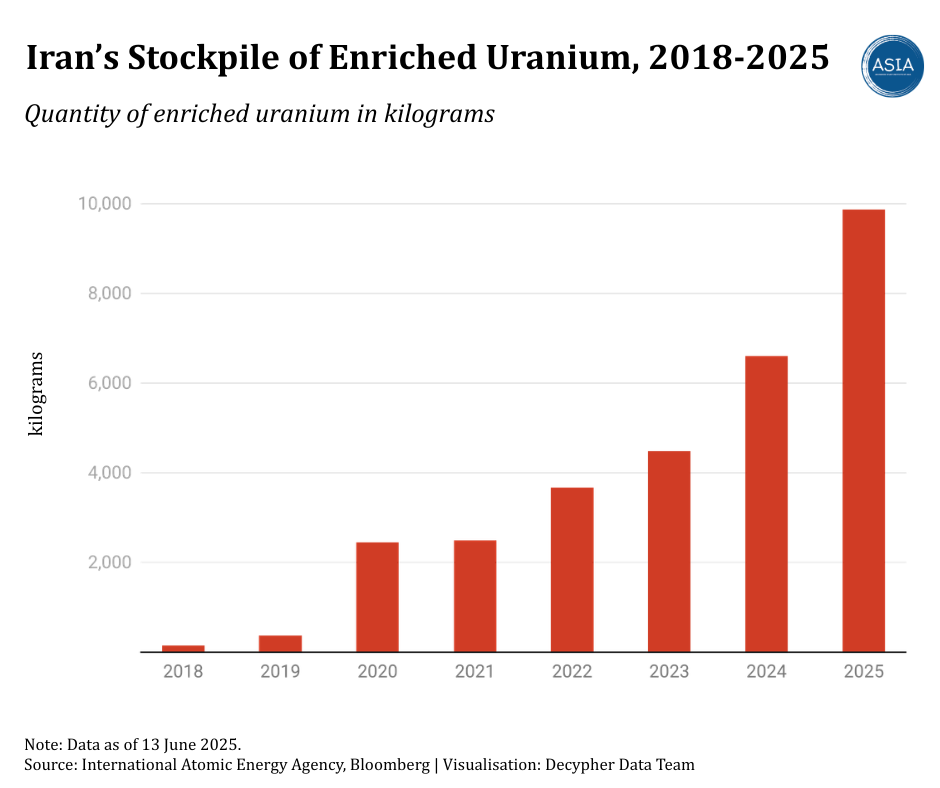
The 60% question — why it alarmed the world
The hardest step in enrichment is reaching 20%. After that, going to 60% — or even 90% weapons-grade — becomes much faster. Between February and June 2025 alone, Iran increased its stockpile of 60% enriched uranium by 166.1 kilograms.
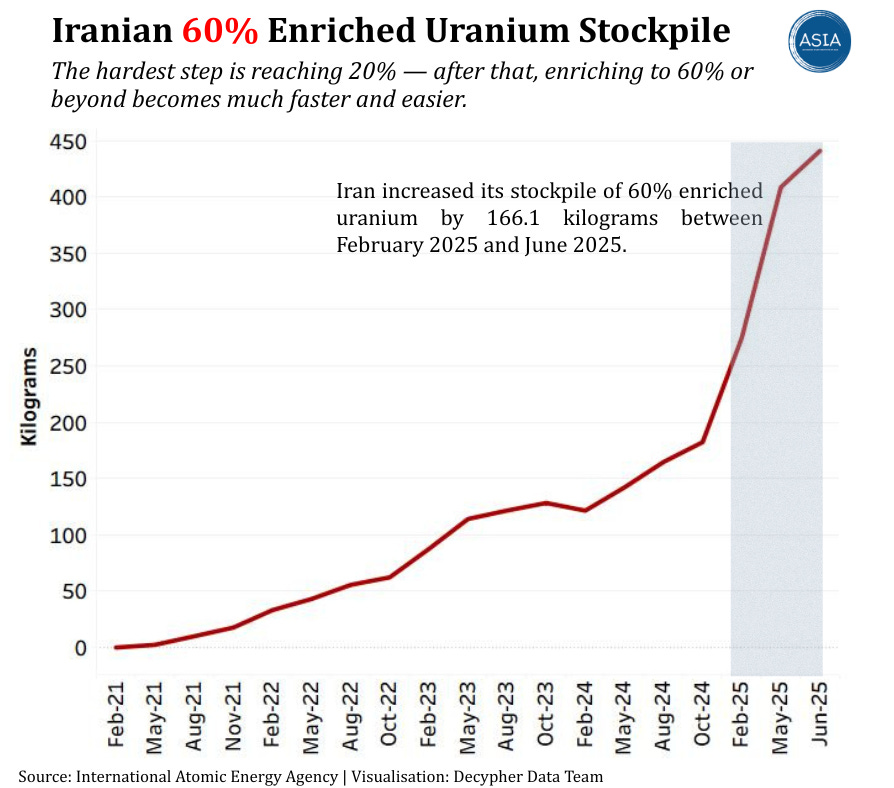
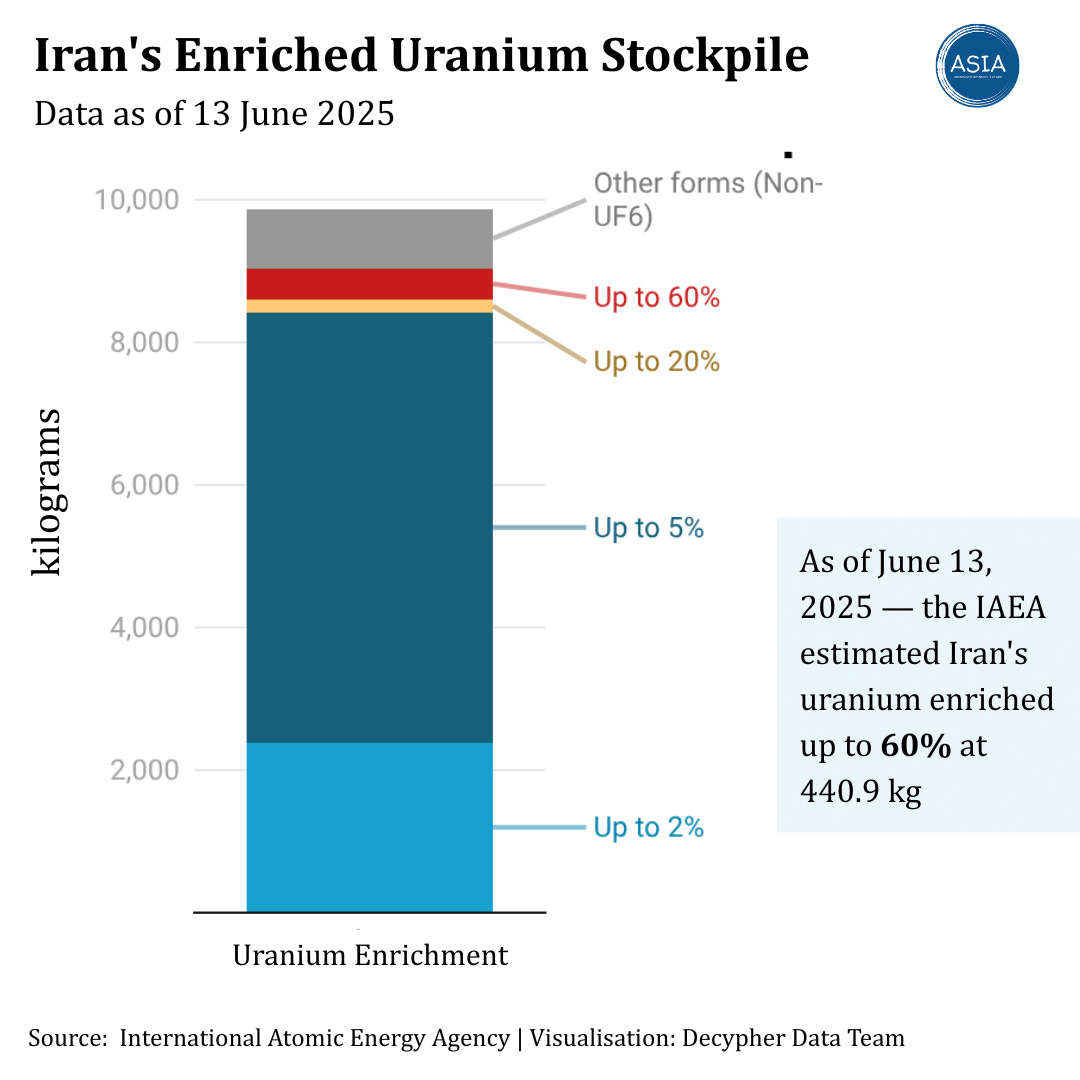
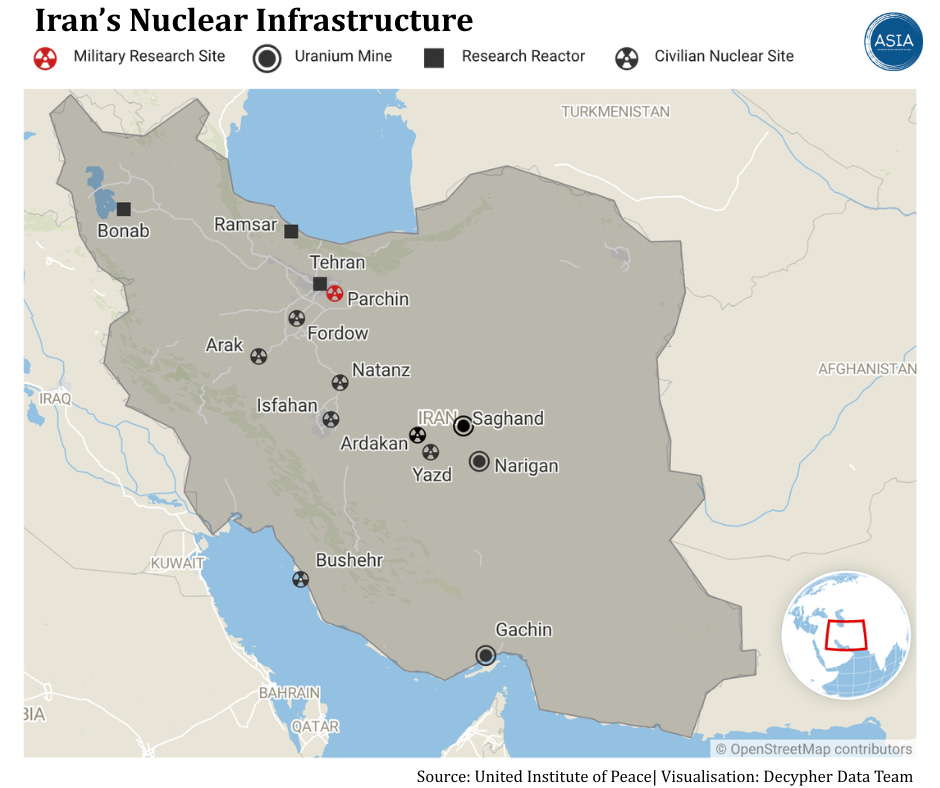
June 2025 — The US bombed Natanz, Fordow, and Isfahan. One month later, Iran suspended IAEA access.
— — —
Essay: Amogh Dev Rai- Research Director at the Advanced Study Institute of Asia (ASIA), affiliated with SGT University, Gurugram.
Postscript: Neeti
Data: Bhupesh
Produced by Decypher Team in New Delhi, India
— — —