


By Amogh Dev Rai | Research Director and researcher on China, and Chinese Geopolitics.
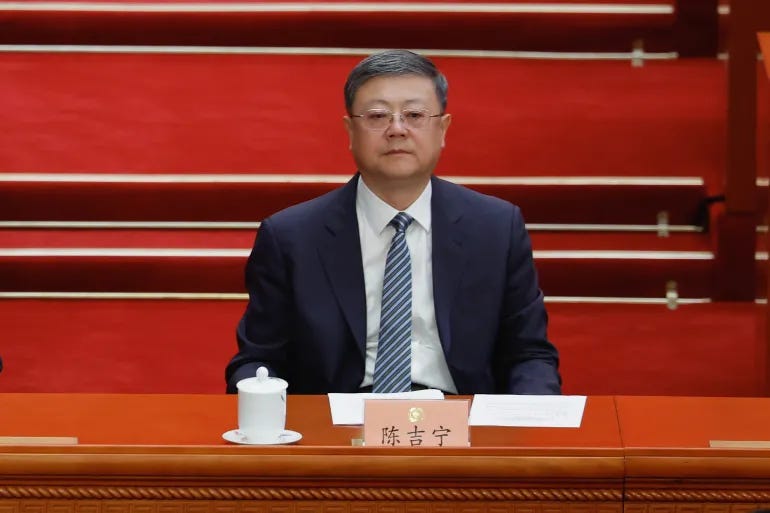
The last week of Chen Jining’s public life looks, in hindsight, almost ordinary. He went to inspect COSCO, the big state shipping group, and said something about digital transformation. He sat with the chairman of Roche. Ordinary things, the things a Shanghai party secretary does in a week and then four days later on a Tuesday a two-line bulletin on Xinhua and it was over, “serious violations of discipline and law,” no sums, no specifics, nothing at all. The fourth Politburo member to go this cycle. The first sitting Shanghai boss since Chen Liangyu in 2006. By Wednesday morning the hashtag had two hundred and forty million views and people writing, over and over, that they were stunned.
We were a little stunned too, and it is worth asking why? Chen was the accessible one. A decade in Britain, good command of the English language, he hosted Musk a couple of years back and Tim Cook only last month, he stood next to Blinken, he put Geoffrey Hinton on a stage at the AI conference and told the world Shanghai wanted the world’s best minds. Foreign investors liked him. They found the city easier to work with, with him in the chair, and that counted for something after the lockdowns had frightened everyone. He was, in the vocabulary of these things, a reformer. And now he is in the deep trenches of party discipline, from where, as anyone who has watched this before knows, you rarely come back, if at all.
Here is the thing we keep getting wrong about China. When we think of its rulers we picture discipline, control, the man at the top, the machine that does what it is told. But the men who actually ran China’s rise were not like that, or not only like that. They had autonomy. A provincial secretary, a city boss, a district chief, they governed their patch with real latitude, they experimented, they competed with the next province over, they cut deals and courted capital and took the credit, all of it in the name of the people and the party, and that latitude, that messy, half-accountable, faintly unseemly autonomy, is what made China the wonder of the modern economy. Not the plan. The autonomy underneath the plan. Chen coaxing LVMH to open its ship-shaped thing on Nanjing Road, Chen promising the AI start-ups the city’s full backing, that is the engine, that is how it actually worked.
Or should we say worked. Because the idea is now under constant attack. The party keeps its officials under what we might as well call constant surveillance of their strategic doctrine, are you loyal, are you disciplined, are you a little too visible, are you building something that is starting to look like your own power base. And the answer that ends a career is almost always the last one. What Chen actually did, if he did anything in the ordinary grubby sense, we do not know, nobody does, that is the whole function of a two-line bulletin. But the pattern is not hard to see. The accessible get disciplined. The army has gone the same way, the Central Military Commission cut from seven men down to two, Xi’s own hand-picked loyalists pulled under the water one after another. The latitude, the charisma, the openness, the very things that made an official useful to the economy, are now the things that make him a suspect.
And this is where the easy story, Xi the paranoid emperor purging his way to a fourth term, stops being enough. Because the muddle the party-state is grappling with is its own, and it is older than Xi. He did not invent the problem. An official loyal enough to trust is rarely capable enough to matter, and an official capable enough to matter is rarely loyal enough to trust, and that contradiction was baked into the thing from the start. Decentralise to grow and you breed power centres. Recentralise to control them and you strangle the growth. Xi did not create that muddle, he inherited it. What he has done is choose, hard, one side of it. Discipline over latitude. Loyalty over the wonder.
So what does an economy lose when it disciplines away the autonomy that made it rich. We are going to find out, slowly, not in a crash, the markets barely twitched, but in the thousand small decisions a frightened official quietly stops taking, the foreign executive who is no longer called back, the clever ambitious man who learns to be a little less accessible, a little less interesting, a little safer. Chen had a successor-shaped career, people used to say so openly. Now there is talk of some vice-premier sliding into the Shanghai chair, and nobody, anywhere, even pretends to know who comes after Xi. The wonder was the autonomy. The autonomy is the thing being disciplined. You can see why they would want to, a party fears nothing so much as a rival it built itself. Whether you can have the one without the other, well, that is the question, and I am not sure they know either.
Wang Wei, the great Tang poet, an early Buddhist poet who perhaps we can turn to today to make sense of the conundrum of modern Chinese politics,
“I will walk till the water checks my path,
Then sit and watch the rising clouds” like Wang Wei we can only watch.
Produced by Decypher Team in New Delhi, India