

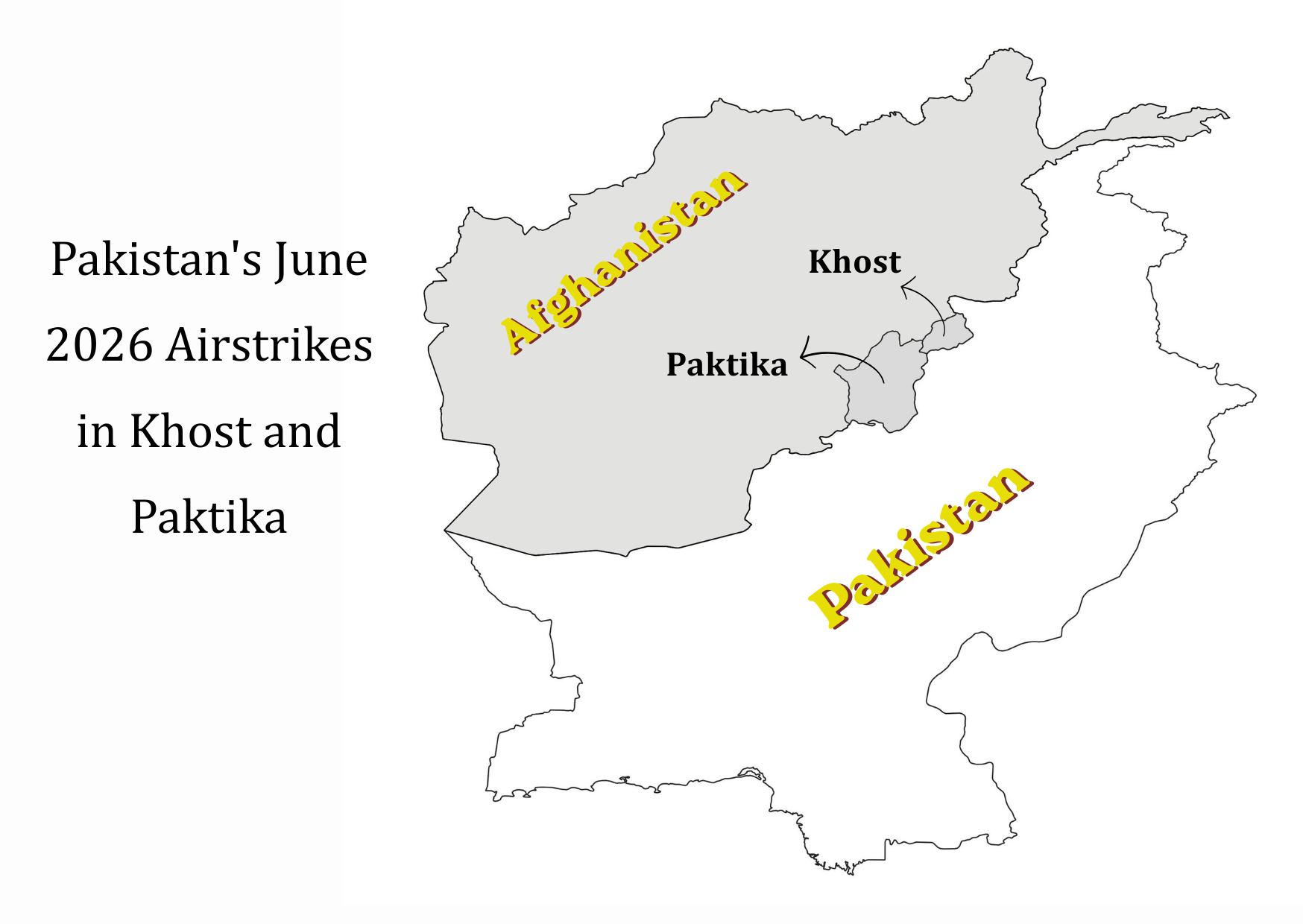

June did not bring a new Afghanistan-Pakistan crisis as much as strip away the fiction that the old one had been settled. On 10 June, Pakistani airstrikes hit Kunar, Khost and Paktika. The Taliban government said at least 13 people were killed, including 11 children, and accused Pakistan of bombing civilian homes; Pakistan said it had targeted TTP camps and hideouts across the border. Later in the month, another round of Pakistani air operations along the Afghan border killed at least 28 civilians and injured 49, according to UNAMA; Pakistan said it had killed militants and destroyed weapons caches, while the Taliban put the civilian toll higher. By 1 July, Kabul said it had launched strikes into Pakistani territory, and Islamabad said it had shot down four rudimentary drones in Balochistan.
The fighting had been paused before it returned. After earlier clashes, Pakistan and Afghanistan entered talks in Urumqi under Chinese mediation. Reuters reported that the agenda included a ceasefire, the reopening of border crossings, and trade and security cooperation; China said it was providing a platform for talks between the two sides. The language was diplomatic, but the bargain underneath remained unfinished. Pakistan wanted visible, verifiable Afghan action against militants using Afghan territory. Kabul wanted Pakistani strikes to stop and its sovereignty to be treated as more than a formality.
That gap has been present since 2021. Pakistan once expected a Taliban-ruled Afghanistan to make its western frontier easier to manage. The Taliban’s return was imagined in Islamabad as the defeat of hostile influence in Kabul and a possible route to restraining anti-Pakistan militancy. The outcome has been less obedient. The Taliban became a government with its own sovereignty claims, internal factions and memories of fighting foreign pressure. The TTP, meanwhile, found space in Afghanistan after the very political change Pakistan had once expected to benefit from.
The TTP sits awkwardly between the two states. It is Pakistani in target and origin, but Afghan territory has become central to Pakistan’s accusation of sanctuary. A UN sanctions monitoring assessment reported by VOA described the TTP as the largest terrorist group in Afghanistan. It said it was receiving growing support from Taliban rulers. At the same time, Kabul rejects the charge that it shelters militants and argues that Pakistan is displacing its own internal failures onto Afghanistan. The dispute is not only over evidence. It is over jurisdiction. Pakistan sees a cross-border war being protected by Afghan soil. The Taliban sees Pakistani airpower crossing a border that Kabul insists must mean something.
The Taliban cannot easily act like Pakistan’s border police. Its authority rests partly on the claim that it ended foreign control over Afghanistan. A visible crackdown on the TTP at Islamabad’s demand would look less like counterterrorism and more like subordination. There are also older militant bonds, battlefield debts and ideological proximities that make a clean break costly. Moving too hard against the TTP risks internal dissent and possible defections towards more hostile formations, including IS-K. Letting the TTP operate too freely invites Pakistani strikes. Kabul has tried to live in the space between those costs.
Pakistan has less room to wait than it once did. Militant violence has concentrated in the frontier provinces of Khyber Pakhtunkhwa and Balochistan, and ACLED reported that Pakistan’s security situation deteriorated further in 2025, surpassing 2024 levels in those regions. The TTP’s return to strength after 2021 has made the Afghan question a domestic security question for Pakistan again. Airstrikes across the border are not only attempts to hit militants. They also tell a Pakistani audience that the state will not remain passive while Kabul denies responsibility.
Each side’s signal worsens the other’s position. Pakistani strikes may satisfy the immediate demand for action, but civilian deaths give the Taliban the language of violated sovereignty and foreign aggression. Taliban retaliation restores dignity before its own constituencies, but confirms Pakistan’s fear that Kabul is unwilling or unable to separate itself from the militants Pakistan is targeting. Mediation can stop fire for a few weeks. It cannot manufacture trust where verification is absent.
Verification is the unbuilt part of every ceasefire. Pakistan wants arrests, relocations, restrictions on TTP leaders, dismantled camps and credible border controls. The Taliban wants an end to airstrikes, recognition of Afghan sovereignty and relief from being treated as a subcontractor for Pakistani security. These demands do not meet in the middle. They pass each other. A pause can hold only until the next major attack inside Pakistan or the next strike inside Afghanistan makes restraint politically expensive.
The humanitarian cost then becomes part of the strategic exchange. Civilian casualties in Kunar, Khost, Paktika or Paktia are not collateral only in the narrow military sense. They change the terms on which Kabul can remain quiet. Border closures are not merely customs interruptions; they punish traders, families, patients and refugees whose lives run across the Durand Line more easily than the two states admit. The Af-Pak frontier is not a clean line separating two sealed political communities. It is a lived border, and every round of coercion turns that social geography into a form of pressure.
The external environment now tilts slightly towards Islamabad without solving its problem. The United States said it supports Pakistan’s right to defend itself against terrorist attacks. China has an interest in keeping both sides talking, not least because instability touches corridor politics, trade and regional security. But neither Washington’s sympathy nor Beijing’s mediation can produce the one thing Pakistan wants most: a Taliban government willing and able to discipline the TTP in ways Islamabad can verify.
The June fighting shows where the conflict is headed. Not toward a full conventional war; Pakistan has stronger airpower, Afghanistan remains economically weak, and both sides suffer from closed crossings and prolonged escalation. Not toward settlement either. The more likely pattern is intermittent coercion: Pakistani strikes, Taliban retaliation, drone claims, border closures, mediator-led pauses, and renewed escalation after the next TTP-linked attack. The shooting stops, the bargain remains absent, and the border returns to violence.
Pakistan wanted the Taliban’s victory to secure its western frontier. It now faces a Taliban state defending sovereignty and a Pakistani Taliban using Afghan space against Pakistan. The June strikes did not restart the war; they revealed the pause’s weakness. Afghanistan and Pakistan had stopped fighting without deciding who controls violence across the Durand Line.
Essay: Preksha Jalan- Associate Fellow, Digital History Lab at The Advanced Study Institute of Asia (ASIA), affiliated with SGT University, Gurugram.
Produced by Decypher Team in New Delhi, India