


Thailand’s latest attempt to revive its economy arrives in two halves. One is meant to soften higher fuel and living costs through consumer support. The other is supposed to finance a cleaner energy system that would make the country less vulnerable during the next oil shock. On 9 July, the Constitutional Court cleared Prime Minister Anutin Charnvirakul’s government to borrow 400 billion baht for both. The accounting is neat; the economic problem is not. A payment can ease next month’s bill. An energy transition must survive several governments.
Before the ruling, Rungthiwa Pimphanit was waiting for an earlier promise of immediate movement. The government employee in northeastern Nong Bua Lam Phu had expected Pheu Thai’s 10,000-baht digital-wallet payment to cover her son’s school supplies. Tens of millions of people had been promised money that had to be spent near home and within six months, pushing cash through local shops before it could settle into savings. By June 2025, Rungthiwa was still waiting and said she would not vote for the party again. When the wallet stalled, its unspent money revealed what the promise had obscured. After distributing only part of the programme, the government redirected 157 billion baht towards water systems, infrastructure, productivity measures and local businesses. Money designed to circulate had ended by financing the systems that allow circulation to become income. The reversal did not show that households needed no relief. It showed that spending and productive capacity were never interchangeable.
The same distinction runs through the political tradition from which the wallet emerged. Yingluck Shinawatra’s first-car tax rebate encouraged households in 2011 and 2012 to bring forward a major purchase. Vehicle sales rose, but research using national credit-bureau records later found higher loan delinquency among participants and less access to other borrowing. The car arrived early; the instalments remained. A decade earlier, Thaksin Shinawatra’s 30-baht healthcare programme had also moved with political speed. Introduced in 2001, it helped Thailand achieve universal health coverage in 2002 by extending protection to people excluded from existing schemes. The announcement passed; the institution remained. One programme shifted demand from the future into the present. The other changed what citizens would encounter in the future.
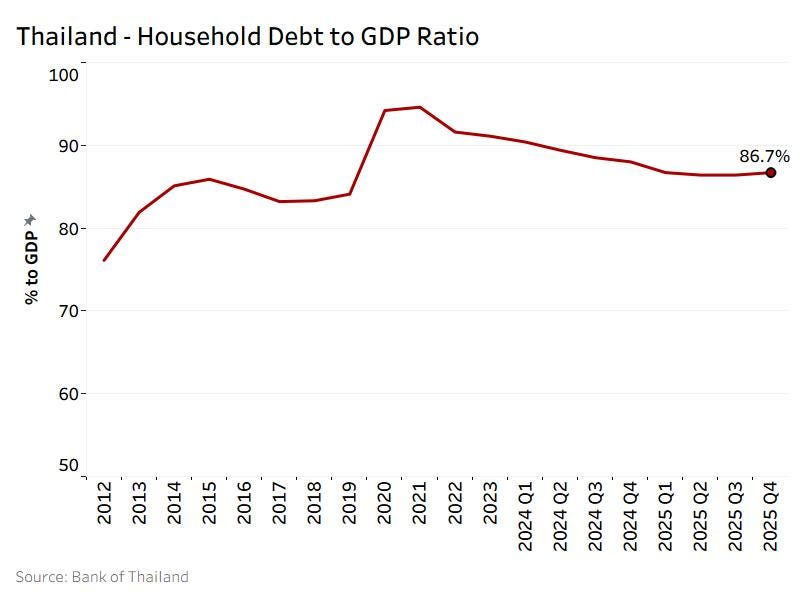
That difference has become more consequential as Thai households and firms lose room to absorb another accelerated purchase. Household debt stood at 86.7 per cent of GDP at the end of 2025, while more than half of workers remained in informal employment. Relief entering such an economy meets vehicle instalments, mortgages, farm loans and incomes too uncertain to support affordable credit. A household may sensibly use a payment to keep up with old obligations. A small shop may enjoy a temporary rise in sales without gaining the finance, equipment or trained workers needed to produce more the following year. None of this makes Thailand an incapable economy. It remains a sophisticated centre for manufacturing, exports and tourism. The difficulty is that these strengths no longer translate easily into broadly rising incomes. The IMF now expects growth of only 1.9 per cent in 2026. When the slowdown comes from weak productivity, uneven firm capability and indebted households, another burst of consumption treats the point at which the problem becomes visible rather than the machinery producing it.
Economics alone, however, cannot explain why the same remedy keeps returning. Since Thaksin’s removal in 2006, governments and successful parties have repeatedly been interrupted by coups, court decisions, dissolutions and unstable coalitions. Reforms to education, competition or industrial capability may mature under somebody else’s administration. A transfer reaches an identifiable beneficiary before the next rupture. Rungthiwa revealed the other side of that bargain: once relief becomes an electoral contract, voters remember precisely who failed to deliver it.
The July loan returns Thailand to this choice. Immediate support is defensible because families facing higher food, fuel or fertiliser costs cannot live on a promise of future productivity. Yet the subsidy will be visible first. The energy transition will require grids, investment, regulation and years of implementation after prices stabilise. Borrowing can bridge the interval between the two, but it cannot repeatedly substitute for what is supposed to happen during that interval.
Thailand’s warning to other slow-growing economies is not against acting quickly. Its universal health system demonstrates how rapid action can create lasting capacity. The test is what remains when the immediate benefit has been spent. The car rebate left repayments. The digital wallet left disappointed voters and a budget redirected towards the infrastructure it had initially tried to bypass. The present loan may leave a less vulnerable energy system, but only if its quieter half survives the political success of the subsidy. A quick intervention buys time for change. A quick fix asks the next payment to buy the same time again.
Essay: Preksha Jalan- Associate Fellow, Digital History Lab at The Advanced Study Institute of Asia (ASIA).
Produced by Decypher Team in New Delhi, India