


Amogh Dev Rai is a Research Director and researcher on China, and Chinese Geopolitics.
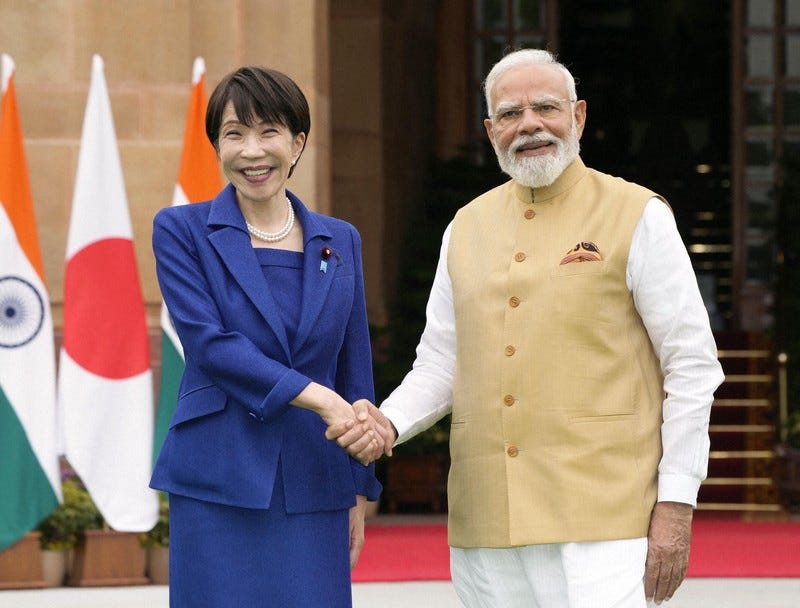
Beijing’s press did not cover Sanae Takaichi’s first visit to India as an India story at all, and that refusal is what makes the story interesting. Prime Minister Takaichi landed in New Delhi on 1 July and sat with her Indian counterpart Prime Minister Narendra Modi on 2nd July for the sixteenth India-Japan annual summit, and the deliverables were aplenty: roughly ¥2 trillion, some $13 billion, in fresh corporate commitments layered on the standing ¥10 trillion, $61 billion decade pledge from last August; around 120 memoranda and agreements; a first-ever defence co-development project signed between two members of the Quad; an artificial-intelligence and large language model partnership that lifted the two countries to the status of “strategic research & development partners”; a five basket economic security package running across rare earths, critical minerals and semiconductors; even a local currency settlement mechanism designed to route bilateral trade around the dollar.
Every one of those items points, at least partly, at the same country, and the Chinese commentariat said so without embarrassment, because the entire apparatus of the coverage collapsed the trip into a single question. Who’s this aimed at? and then answered it in one word. China.
The official answer came at the foreign ministry’s 2nd July briefing, where spokesman Guo Jiakun was asked about Takaichi restating her “free and open Indo-Pacific” line on Indian soil, and gave the sentence every outlet then carried:
嘴上喊着自由开放,心里想着对立对抗。
“They shout ‘free and open’ with their mouths while their hearts are set on opposition and confrontation.”
— Guo Jiakun, Chinese foreign ministry spokesman, 2 July 2026
Guo went on to say that a concept so ill-matched to its name runs against the shared wish of regional states for peace, development and cooperation, and is destined to win no genuine acceptance, and he closed on the formula Beijing now reaches for whenever the Quad is mentioned: that the Indo Pacific needs stability rather than turmoil and cooperation rather than division, and that upholding the postwar order and the UN Charter is the region’s common foundation.
Notice what the answer went after the concept, and the prime minister who is now primary antagonist and what it left alone. India is not named in the remarks Beijing put on the record, and the omission is the point, because to name India as the target would be to concede that a country China still files under “Global South partner” had just spent three days building a hedge.
You cannot read the coverage without holding the backdrop in view, because this summit did not land in business as usual week. It is happening in the middle of the worst rupture between Beijing and Tokyo since the two normalised relations in 1972.
PM Takaichi’s remark in the Diet last November that a Chinese attack on Taiwan could constitute a “survival-threatening situation” for Japan, one capable of triggering collective self-defence detonated a campaign of Chinese retaliation that has not eased since: a travel advisory, a suspension of seafood imports, severed flights and cultural exchanges, and, from 6 January, export controls on dual-use goods and rare earths aimed squarely at Japan’s defence supply chain, followed in February by named firm blacklists and, through the winter and spring, sanctions on individual Japanese politicians.
The pressure was still visibly running while Takaichi is in Delhi. The China Coast Guard ordered a Japanese survey ship to halt work near the Senkakus on two consecutive days, and the Chinese consul-general in Osaka, Xue Jian the same diplomat who last year floated a “beheading” against Takaichi online told an audience on 1 July that relations were at their most severe and complex since normalisation and that Japan must “fundamentally correct its view of China.”
So the mainland press did not file Delhi as diplomacy. It filed Delhi as the next frame in a running confrontation, one more instance of a right-wing Japanese prime minister assembling what the ministry has spent eight months calling anti-China “small circles.”
A widely shared essay on Sohu mapped Takaichi’s whole China strategy as a scorpion closing around Beijing:
以台海为”蝎嘴”直接挑衅,南海和东北亚为”双钳”牵制,再拉拢中亚、印度形成”蝎尾”施压。
“Taiwan as the scorpion’s mouth for direct provocation, the South China Sea and Northeast Asia as the two pincers, and the courting of Central Asia and India to form the scorpion’s tail.” — Sohu commentary
Modi’s unusually warm welcome, in this telling, was a transaction and not an affection, and the NetEase commentators were blunt about the arithmetic behind it:
印度……亟需引入外部支点以平衡战略压力。
“India urgently needs to bring in an external fulcrum to balance the strategic pressure [on its border].” — NetEase commentary
The state tabloid press, meanwhile, kept its fire where it has kept it since winter, on the bilateral squeeze rather than the Delhi optics, running the by-now-familiar genre of Takaichi is flailing commentary one mainland headline had her “starting to wobble” while the party adjacent line preferred to let a critic from inside Japan carry the argument against the “free and open Indo-Pacific” itself, citing the former senior diplomat Tanaka Hitoshi’s warning that the slogan only drags in Washington and courts Canberra and Delhi while deepening the region’s divisions.
Which leaves the tell, and the tell is the restraint. A government that has spent eight months escalating against Takaichi in every chord of discord available to it, that will lodge a démarche over a survey ship and a sanctions list over a single legislator, met her arrival in a rival capital to sign a rare earth hedging, semiconductor-building, defence co-developing package aimed in large part at China with one spokesman’s one liner and a scatter of nationalist commentary, and no sustained state campaign at all. The muted official reaction is not indifference; it is calculation. To make Delhi a story would be to admit that the encirclement Beijing keeps warning about is being built by willing hands, and that one pair of them belongs to a country China would still rather flatter than fight, India.
Sources
The visit and its deliverables
India-Japan 16th Annual Summit, dates and agenda: India.com, 1 July 2026 — https://www.india.com/news/india/japan-pm-japanese-prime-minister-sanae-takaichi-narendra-modi-indian-pm-indian-economy-security-defence-metro-bullet-train-jaishankar-mea-foreign-ministry-global-partnership-8462254/
Visit dates, Japanese readout: Ministry of Foreign Affairs of Japan — https://www.mofa.go.jp/s_sa/sw/in/pageite_000001_01705.html
¥2 trillion investment, five economic-security baskets, first Quad defence co-development project, biogas initiative, FY2025–26 trade figure: HK01, 2 July 2026 — https://www.hk01.com/即時國際/60366063/
~120 cooperation documents, ¥2 trillion business plans: China Times, 2 July 2026 — https://www.chinatimes.com/realtimenews/20260702002833-260408
“Strategic R&D partners,” AI/LLM cooperation, local-currency settlement, ~$12.3bn / 100+ private agreements, ¥10 trillion ($61bn) decade pledge: cnyes (鉅亨網), 2 July 2026 — https://m.cnyes.com/news/id/6520255
¥10 trillion / $61bn decade pledge (context): NTDTV, 2 July 2026 — https://www.ntdtv.com/b5/2026/07/01/a104111408.html
The 2 July MFA briefing (Guo Jiakun)
Verbatim remarks on “free and open Indo-Pacific”; China Coast Guard warning to survey vessel Koyo; Xue Jian’s 1 July remarks: United Daily News (聯合新聞網), 2 July 2026 — https://udn.com/news/story/7331/9603097
Verbatim remarks, corroborating: HK01, 2 July 2026 — https://www.hk01.com/即時國際/60366063/
Confirmation the 2 July 2026 briefing was held and chaired by Guo Jiakun: Chinese Embassy in Japan, statements index-https://jp.china-embassy.gov.cn/
The China–Japan crisis backdrop
Overview and timeline of the 2025–2026 crisis, individual sanctions, Xue Jian episode: Wikipedia, “2025–2026 China–Japan diplomatic crisis” — https://en.wikipedia.org/wiki/2025%E2%80%932026_China%E2%80%93Japan_diplomatic_crisis
6 January dual-use and rare-earth export controls: CNN, 6 January 2026 — https://www.cnn.com/2026/01/06/business/china-japan-export-controls-intl-hnk
Rare-earth campaign analysis: CSIS, 25 February 2026 — https://www.csis.org/analysis/chinas-rare-earth-campaign-against-japan
24 February firm blacklists (two lists of 20); coercion assessment: East Asia Forum, 11 March 2026 — https://eastasiaforum.org/2026/03/11/chinas-economic-coercion-strengthens-takaichis-hand/
Verbatim Diet quote (”存立危机事态”) in an MFA briefing: fmprc.gov.cn, 7 May 2026 briefing — https://www.mfa.gov.cn/fyrbt_673021/202605/t20260507_11906358.shtml
Chinese-press framing pullouts
“Scorpion-shaped encirclement”: Sohu, 3 January 2026 — https://www.sohu.com/a/972026577_122471293
Modi’s welcome as transactional / “external fulcrum”: NetEase (163.com), 9 February 2026 — https://c.m.163.com/news/a/KLBVPAQ90556818Z.html
“Small circles” (拼凑反华”小圈子”), MFA via Tencent: news.qq.com, 18 June 2026 — https://news.qq.com/rain/a/20260618A07N6000
“Starting to wobble” headline: Sina, 1 July 2026 — https://news.sina.com.cn/w/2026-07-01/doc-iniffysy4342611.shtml
Tanaka Hitoshi’s critique of “free and open Indo-Pacific”: NetEase (163.com) — https://m.163.com/dy/article_cambrian/KJJHGIFU0514R9P4.html
Produced by Decypher Team in New Delhi, India