


Taiwan in the World
Taiwan is not absent from the world. It is present everywhere that matters, but rarely on its own terms. Its chips sit inside the global economy. Its democracy shapes the political imagination of the Indo-Pacific. Its security affects Washington’s calculations, Beijing’s red lines and the strategic anxieties of states watching the Taiwan Strait. Yet its president’s aircraft can still become a diplomatic problem before it reaches one of Taiwan’s few formal allies.
Taiwan’s condition is not isolation. It is conditional presence.
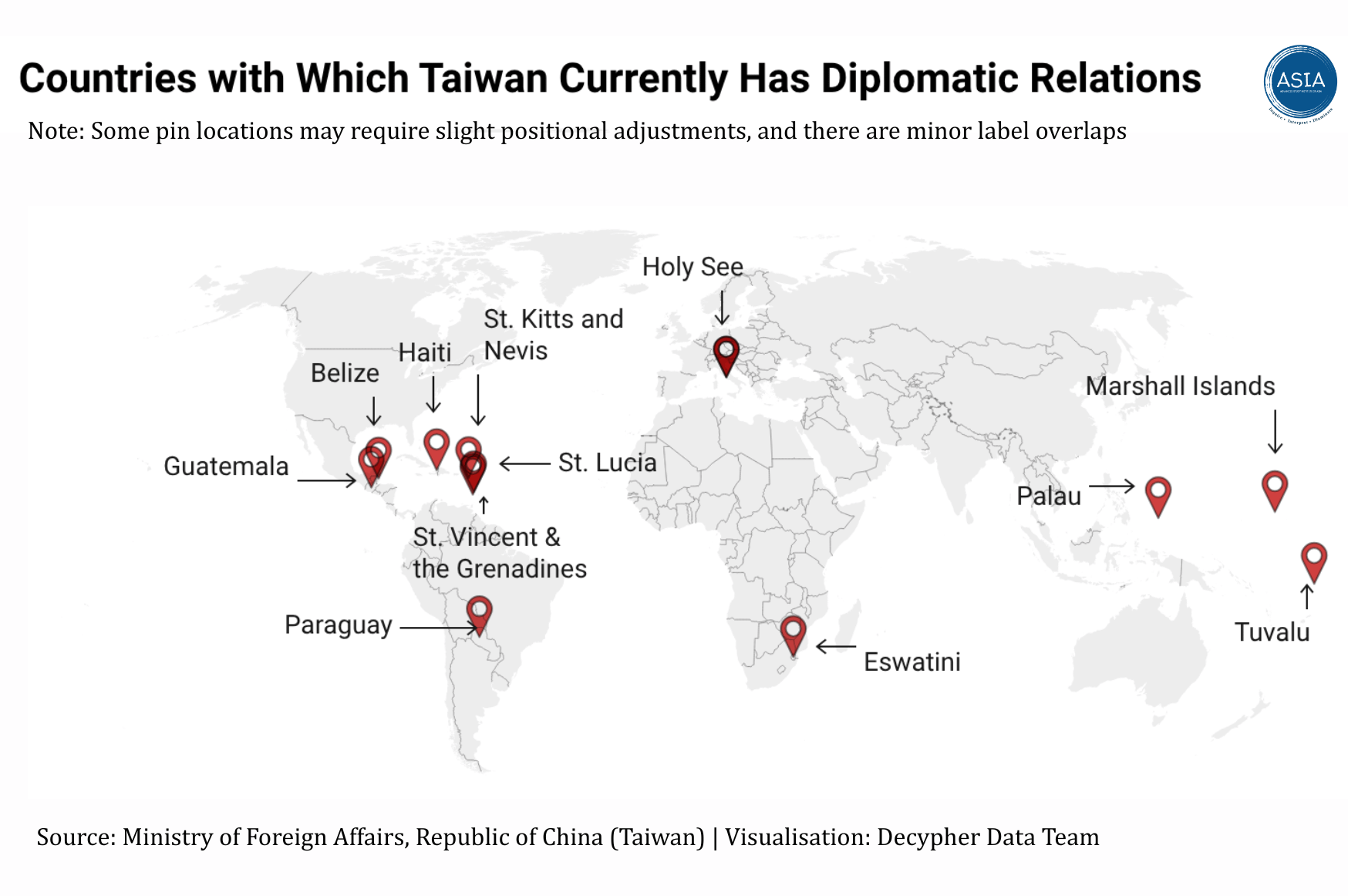
President Lai Ching-te’s delayed visit to Eswatini should be read through that condition, not as a travel story. Eswatini is Taiwan’s last formal ally in Africa and one of only 12 states that still maintain diplomatic relations with Taipei. The visit mattered less because Eswatini can alter the balance across the Taiwan Strait, and more because formal recognition has become scarce enough that every remaining ally carries symbolic weight. When Taiwan accused Seychelles, Mauritius and Madagascar of denying overflight permissions under Chinese pressure, the issue was not simply airspace. It was whether Taiwan could move through the world as a political actor without Beijing’s consent.
China has narrowed Taiwan’s diplomatic map, but it has not reduced Taiwan’s strategic relevance. That gap defines Taiwan’s present global position. Beijing’s pressure works through recognition, but also through smaller acts of international discipline: which officials can travel, which names can be used, which forums can include Taiwanese representatives, which companies mark Taiwan separately, which countries host visits, which routes remain open. The aim is not only to isolate Taiwan. It is to make Taiwan’s external life conditional on Chinese approval. A flight path can therefore become a test of statehood. Sovereignty is usually discussed through territory, armies, constitutions and recognition. Taiwan’s case shows another layer: the ability to move. If a president cannot travel normally to a formal ally because third countries fear Chinese retaliation, then Taiwan’s diplomatic problem is not only the shrinking number of embassies. It is the conversion of ordinary international movement into a political negotiation.
Formal recognition still matters because it remains the hardest form of diplomatic presence. Eswatini’s value to Taiwan is not economic scale or military weight. Its value is that it continues to recognise Taiwan as a state when most of the world engages Taipei without saying so. In that sense, small allies carry a burden larger than their material power. They preserve the claim that Taiwan can still be treated as a sovereign actor by another sovereign actor. Yet recognition is no longer the only measure of Taiwan’s world. If it were, Taiwan would look close to disappearance. In practice, it remains deeply embedded. It is central to semiconductor supply chains, important to U.S. strategic planning, and increasingly present in democratic and parliamentary networks that stop short of formal recognition. The United States remains Taiwan’s most important security backer despite not recognising it as a sovereign state; European and Asian partners deepen trade, technology and political contact without crossing Beijing’s formal red lines.
Taiwan’s diplomacy has therefore moved into the space between legality and relevance. It cannot rely on recognition alone, so it builds presence through technology, investment, security cooperation, public health advocacy, legislative exchanges and democratic symbolism. That strategy gives Taiwan resilience, but not normalisation. Many states want access to Taiwan’s chips, goodwill and strategic value. Far fewer are willing to absorb the cost of treating it like a normal state.
China’s pressure on Taiwan also reveals a limit in Beijing’s own position. If Taiwan were merely a settled domestic question, so much effort would not be needed to block its movement, rename its participation or punish its partners. The work of constraining Taiwan shows that Taiwan continues to act internationally. Beijing is not managing absence. It is managing an inconvenient presence. The same logic appears in Taiwan’s exclusion from international bodies. Ahead of the World Health Assembly, China again said it would not allow Taiwan to participate, arguing that Beijing represents the island internationally. Taiwan rejects that claim and argues that China cannot speak for its 23 million people. The dispute is often presented as procedural, but it is not. Global health, aviation and trade forums decide how societies are seen, counted and represented. Exclusion is another way of making Taiwan’s presence conditional.
The risk for Taiwan is that visibility without normalisation can become a trap. The island may be too important to ignore, but still too costly for many states to recognise. It may be welcomed in supply chains but excluded from institutions. It may be defended rhetorically but constrained diplomatically. It may be treated as indispensable in crisis and inconvenient in routine politics. Taiwan’s world is therefore smaller than its reach. China has succeeded in narrowing the island’s formal diplomatic space. It has not succeeded in making Taiwan strategically irrelevant. The contest now lies in the space between those two facts: a democracy that moves through the world without full statehood, and a rising power determined to make even that movement feel temporary.

How the Iran War Is Shaking a Global Energy Giant
Qatar’s economy has been severely impacted by the Iran War, revealing the weaknesses of one of the richest countries in the world. Liquified natural gas (LNG), which Qatar exports to Asia and Europe for billions of euros across the Strait of Hormuz, is the foundation of its enormous wealth. The $600 billion sovereign wealth fund, luxury complexes, the 2022 World Cup, and extensive infrastructure projects were all made possible by gas earnings, which turned the nation from a tiny desert peninsula into a major international financial and tourism destination.
However, Qatar’s economic lifeline was essentially cut off when the Strait of Hormuz closed in February. Qatar’s primary gas hub, Ras Laffan, has stopped producing LNG as nearly no gas has been leaving the nation for more than two months. Key infrastructure was also damaged by Iranian drone and missile attacks, which resulted in a 17% reduction in manufacturing capacity. Even if the strait reopens soon, analysts caution that it might take years to return to prewar production levels.
Almost every economic sector has been negatively impacted by the crisis. Hotels, ports, and retail areas are still remarkably quiet, tourism has dropped, and foreign companies are moving their employees. Due to the fact that these industries mainly depend on views of regional stability, Qatar’s attempts to diversify beyond fossil fuels into banking, tourism, and international events have also suffered.
Qatar is utilizing its large financial reserves and government subsidies to sustain stability, manage inflation, and maintain public services in spite of the economic hardship. However, experts caution that a protracted conflict might put Qatar’s long-term economic model in jeopardy by increasing fiscal pressures and causing a migration of foreign workers and companies.

Drone Hits Near UAE Nuclear Facility
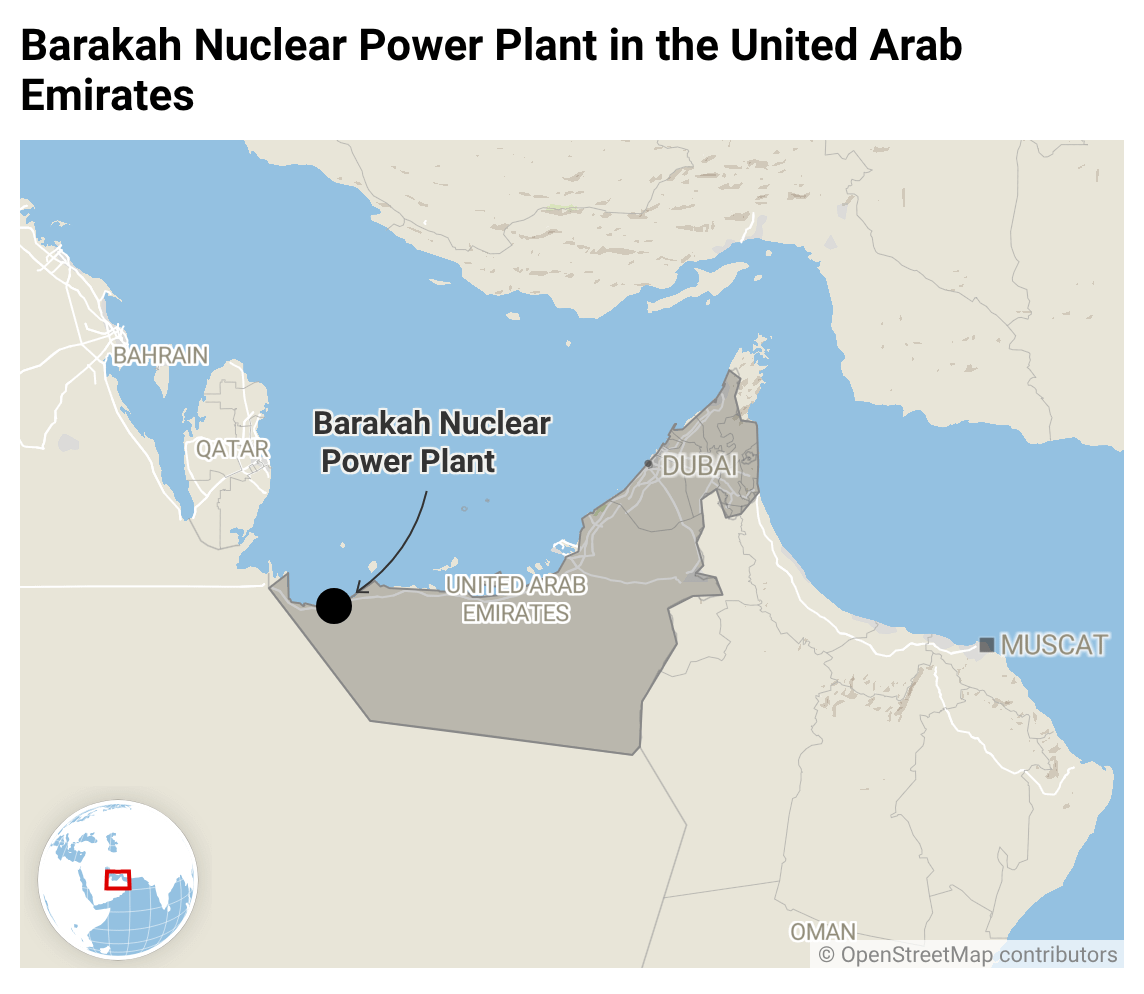
A drone strike caused a fire close to the Barakah Nuclear Power Plant in Abu Dhabi, United Arab Emirates, which authorities described as a “dangerous escalation.” Two of the three drones that entered UAE airspace from the western border were intercepted, while the third struck an electrical generator that was located just beyond the inner perimeter of the plant. Radiological safety was unaffected, and there were no injuries.
The foreign ministry of the United Arab Emirates denounced it as a “unacceptable act of aggression,” claiming that it is against international law and the UN Charter to strike civilian nuclear installations. The ministry of defense promised to take on any threats to the security of the country. Although the UAE has repeatedly accused Iran of targeting its energy infrastructure since regional unrest began in February, authorities have not formally identified the attack’s origin.
The IAEA, the UN’s nuclear inspector, stated that it was keeping a careful eye on the situation. Director General Rafael Grossi voiced “grave concern,” deemed military action endangering nuclear security “unacceptable,” and called for the utmost caution.
Three drones that had entered Saudi Arabia’s airspace from Iraq were also intercepted on Sunday, indicating a broader pattern of regional strikes.
The larger background dates back to February, when Iran started carrying out counterattacks throughout the area in response to attacks by the United States and Israel. The UAE disputes Iran’s accusation that Gulf nations, including the UAE, were complicit in those assaults.
Despite a cease-fire between the US and Iran in April, hostilities have occasionally persisted. The truce is on “massive life support,” according to President Trump, severely undermining hopes for long-term calm in the area.
— — —
Long View: Preksha Jalan- Assistant Program Officer in the Digital History Lab at The Advanced Study Institute of Asia (ASIA), affiliated with SGT University, Gurugram.
Postscript and Data: Bhupesh
Produced by Decypher Team in New Delhi, India
— — —