


When states collapse, they do not usually get to begin again. They stagger forward through the ruins of legitimacy, trying to make continuity look like recovery. Sri Lanka has attempted something rarer: to convert collapse into a democratic rupture. The old political order was discredited by the 2022 economic meltdown, shortages, and mass protests. In its place emerged Anura Kumara Dissanayake and the National People’s Power, carrying not only an electoral mandate but a moral one: a promise to break with a style of rule associated with dynastic power, elite insulation, and the habits of a state that had finally exhausted public patience. That is what makes Sri Lanka’s moment feel like a hard reset. But hard resets in politics are never clean. A government can change faster than a governing system, and the public can vote out an order without yet escaping the structures that sustained it.
The temptation is to read Sri Lanka’s recent political change as the resolution of a crisis. It is better understood as the opening of a more difficult argument. The Crisis Group’s report is clear on this point: the country has achieved a political reset, but the path ahead remains bumpy because the new leadership must govern through inherited constraints: an IMF-backed recovery framework, debt restructuring, institutional weakness, and unresolved ethnic and constitutional questions. In other words, the reset is real, but it is political before it is structural. What changed decisively was the source of legitimacy. What did not change nearly as quickly was the architecture of power through which legitimacy must now operate.
The distinction matters because the 2024 mandate was not simply a vote for better management. It was a repudiation of an entire political grammar. For years, Sri Lanka’s public life had been shaped by a combination of familial dominance, patronage, corruption, and a deepening distance between rulers and ruled. The economic collapse of 2022 did not create those pathologies, but it stripped them of any remaining protective language. Once the crisis translated into ordinary humiliation, queues, shortages, unaffordable living, and institutional paralysis, the political class could no longer pretend that misrule was survivable. Dissanayake’s rise mattered because he appeared to stand outside that exhausted world. His victory signalled that Sri Lankan voters were not only punishing failure. They were demanding a different basis for the rule.
However, protest legitimacy and governing capacity are not the same thing. It is always easier to mobilise public anger than to turn that anger into administrative coherence. This is the first major test of the hard reset. The new government must demonstrate that anti-elite politics can survive contact with the state. It means maintaining economic credibility while trying not to appear as the latest custodian of pain. It means working inside an IMF-supported recovery process without allowing that process to define the entirety of political imagination. It means governing in a way that convinces people the sacrifices demanded by stabilisation will not once again be distributed downward while protection and opacity travel upward. The problem is not simply that the state is weak. It is that the state has to regain moral intelligibility while still asking for patience.
This is why the language of “reset” has to be handled carefully. In a machine, a hard reset wipes the visible malfunction and restarts the system; in politics, no such purity exists. Debt survives. Bureaucracies survive. Centralised habits of rule survive. So do the expectations of an electorate that wants relief, dignity, and proof that the old culture of impunity has genuinely been broken. Sri Lanka’s new government, therefore, inherits a paradox: it was elected because it seemed different from the old order, yet it must govern through institutions and constraints largely made by that old order. The result is a dangerous compression of time. Public expectations move quickly; institutional change moves slowly. If the gap between the two widens too far, disillusionment can arrive faster than reform.
The economy is the most immediate site of that pressure, but it is not the only one. Much of the international conversation about Sri Lanka now treats the country through the grammar of stabilisation: debt deals, IMF reviews, fiscal discipline, signs of renewed growth, the return of tourism, and the possibility that the worst has passed. Those things matter, and the report does not deny them. But a country can regain macroeconomic footing without yet rebuilding the political trust that makes recovery durable. Sri Lanka’s crisis was never only fiscal. It was also a crisis of representation, of institutional credibility, and of whether the state could still appear to ordinary people as something other than an extraction machine for the connected. A hard reset that ends at macroeconomic repair will therefore remain partial. The old order did not fail only because it mismanaged money. It failed because it hollowed out legitimacy.
The report’s warnings about minority relations become especially important at this juncture. It notes that distrust among Tamils and Muslims toward the new administration remains significant and argues that Dissanayake’s government will need to address long-standing grievances to build a durable new order. This matters because Sri Lanka’s political crisis cannot be separated from the longer afterlives of majoritarianism and postwar centralisation. For decades, Sri Lanka’s democracy has been burdened by a concentration of power at the centre that outlives particular governments and reproduces crises across political cycles. The issue is not only whether Dissanayake governs more honestly than his predecessors. It is whether Sri Lanka can begin to loosen the deeper architecture that made the old order so durable: the overcentralized executive, weak accountability, and the asymmetry between democratic mandate and executive control. A hard reset that leaves that structure substantially intact risks becoming little more than elite replacement under a new moral vocabulary. The personnel change; the grammar of the rule survives. A new ruling coalition can inherit democratic energy and still leave intact the structures through which minorities have historically experienced the state as distant, coercive, or exclusionary. Anti-corruption alone will not solve that problem, nor will administrative efficiency. If the hard reset is to mean more than a turnover of elites, it has to alter not only who governs but the terms on which belonging, representation, and state power are organised.
That is why this moment is so difficult to narrate. Sri Lanka is neither a recovery success story nor a country trapped in permanent crisis. It is something more unstable and therefore more interesting: a society trying to convert democratic anger into durable governance while still living inside the economic and institutional disciplines produced by collapse. That makes the new government’s advantage and vulnerability inseparable. Its advantage lies in its distance from the old political class and the moral force of that distance. Its vulnerability lies in the fact that this very distance raises the bar for what counts as success. The old parties could survive disappointment because they were already understood as compromised. A government elected on the promise of rupture has less room for ordinary failure. The deeper the hope, the quicker the punishment can be.
So the question now is not whether Sri Lanka has changed. It has. The old political order has been electorally repudiated, and that alone is historically significant. The harder question is whether the country can reset the state, not only the government. Can democratic renewal be made compatible with fiscal discipline? Can anti-establishment legitimacy be translated into institutional reform rather than moral theatre? Can a public exhausted by crisis be asked to endure further pain without once again losing faith in politics itself? These are not secondary questions to the reset. They are the reset. Sri Lanka has altered the terms on which power is claimed. The next phase will determine whether it can alter the terms on which power is exercised.
Sri Lanka’s hard reset should not be mistaken for a clean restart. It is better understood as a rare democratic opening produced by crisis: real, consequential, and fragile. The old order has been dislodged. The new one has not yet become settled. Between those two facts lies the country’s present: a political break without a finished settlement, an electoral rupture still trying to become a governing order. Sri Lanka has reset its politics. The harder task is to reset the state.
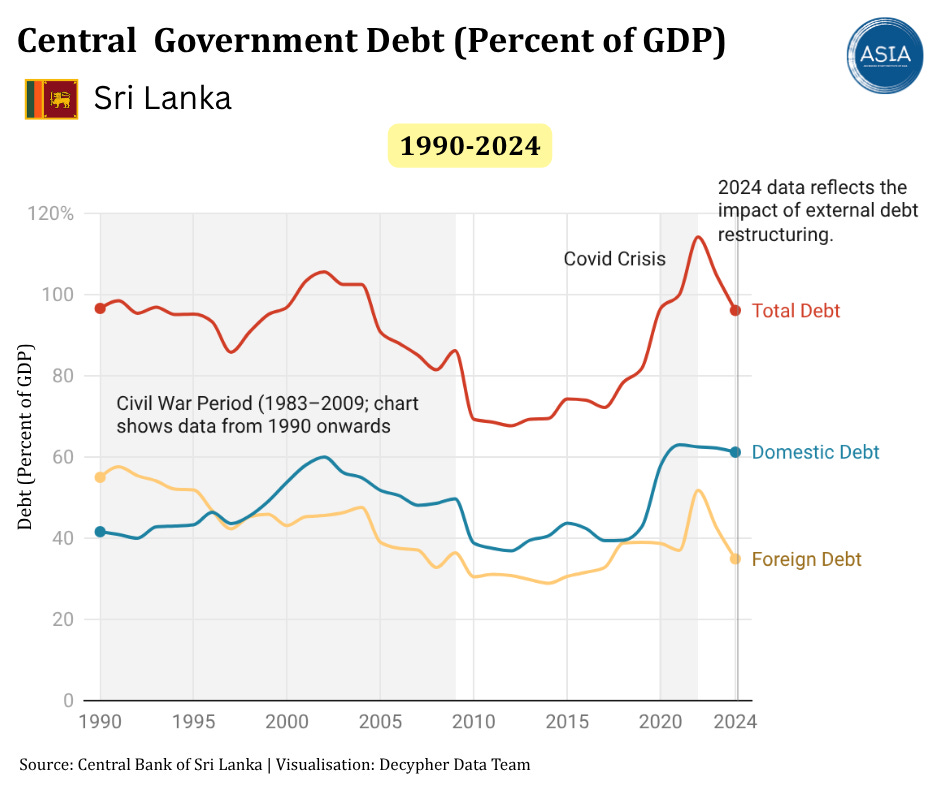
Sri Lanka's central government debt stayed elevated at 95–105% of GDP through the civil war years, briefly easing to ~68% by 2012. The 2022 economic crisis drove it to a record 114.2% of GDP — a figure also reflecting the absorption of several state enterprise loans into central government books. Following the April 2022 external debt default, IMF-backed restructuring has since brought total debt down to 96.1% of GDP in 2024, though overdue debt service payments remain excluded from these figures.
— — —
Long View: Preksha Jalan- Assistant Program Officer in the Digital History Lab at The Advanced Study Institute of Asia (ASIA), affiliated with SGT University, Gurugram.
Data: Bhupesh
Produced by Decypher Team in New Delhi, India
— — —