


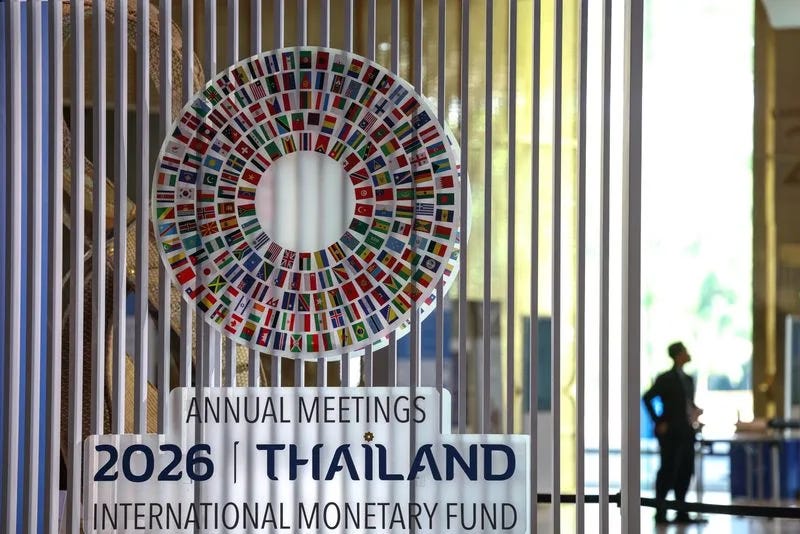
When more than 15,000 delegates arrive in Bangkok for the IMF and World Bank meetings, Thailand wants them to remember more than what was discussed. The food has been planned as carefully as the diplomacy. Tilapia will be aged with makrut lime, lemongrass and spices; local rice, coconuts and salt from Pattani will appear across the menus; Thai music and design will accompany the meetings. For a middle power, hosting finance ministers, central bankers and executives from 191 countries offers something difficult to manufacture through ordinary diplomacy: several days in which people who make consequential economic decisions are paying attention to Thailand.
The logic is persuasive. A delegate remembers the meal, becomes curious about the country, and perhaps returns as a tourist or looks more closely at Thailand as an investment destination, but a considerable distance separates each of those outcomes. If someone leaves Bangkok thinking more favourably about Thailand, the country has succeeded in generating attraction. Whether that attraction has given Thailand greater power is a harder question.
Joseph Nye’s original formulation of soft power made precisely this distinction. Culture, political values, and foreign policy can make a country attractive, but attraction matters politically because it can help produce preferred outcomes without coercion or payment. Over time, the first half of that proposition has become much easier to demonstrate than the second. Governments point to international students, cultural exports, tourism, cuisine and favourable perceptions as evidence of soft power, even when it remains unclear what another actor subsequently did differently because of them.
Soft power has not stopped working; its effectiveness depends on what it is asked to achieve. Attraction converts relatively easily into consumption, can accumulate into trust and access, but becomes much harder to isolate when the desired outcome is a costly economic or strategic choice.
From the restaurant to the negotiating table
Thailand’s own experience makes the distinction unusually visible because its use of food diplomacy is neither new nor unsuccessful. Its “Kitchen of the World” policy has long linked promoting Thai cuisine overseas with food exports, restaurants, tourism, entrepreneurs, and farmers. Thailand’s foreign ministry still describes the programme in explicitly commercial terms: popularising Thai food is intended not only to enhance the country’s image but to expand markets for Thai products and businesses.
Here the route from attraction to outcome is relatively clear. Someone who develops a taste for Thai food may buy Thai ingredients or seek out Thai restaurants. A diner who becomes curious about the country may eventually visit it. Culture changes behaviour because the desired behaviour is closely connected to the source of attraction itself. Thailand’s gastrodiplomacy therefore provides a strong case for soft power, but it also shows why the argument becomes harder as the desired outcome moves further from the original cultural encounter.
The IMF meetings bring Thailand into contact not simply with consumers but with people making decisions about capital and investment. Bangkok is using the gathering to present itself as an investment destination at a moment when the government is trying to raise growth through sectors including semiconductors, data centres, electric vehicles and renewable energy. Yet Thailand also faces the material constraints that shape those decisions: relatively weak investment, high household debt, slow growth, and uncertainty around external trade. The meetings may help get Thailand onto an investor’s radar; whether the investment follows will depend on a much less atmospheric calculation. This is where the value of attraction becomes conditional. If two investment destinations offer broadly comparable opportunities, familiarity and confidence may tip a decision. As the difference in returns, regulation or risk widens, a favourable impression has progressively more work to do. Soft power matters most where the underlying choice remains open enough for attraction to influence it.
What does trust buy?
Southeast Asia offers a harder version of the same problem because its relationships with major powers refuse to arrange themselves into a simple hierarchy of preference. The 2026 State of Southeast Asia Survey found Japan to be the region’s most trusted major power, with 65.6 per cent of respondents expressing confidence in it. Decades of Japanese investment, development assistance, and relatively consistent diplomacy have built a reservoir of trust that Tokyo can draw on. Yet Japan is not the partner Southeast Asians regard as most strategically relevant to ASEAN. China holds that position, followed by the United States and then Japan. China is also regarded as the region’s leading economic and political-strategic power, despite persistent anxiety about its regional behaviour.
The contrast is not evidence that trust is irrelevant. Japan’s reputation gives it strategic value. Japanese investment or security cooperation can enter regional politics carrying less suspicion than initiatives from a country whose intentions are more contested. Trust reduces the reassurance Tokyo must provide and gives Japanese diplomacy credibility before a negotiation even begins. However, it has not overturned the region’s material calculations. Southeast Asian governments can trust Japan while trading intensively with China and retaining security relationships with the United States. They do not have to translate affection for one partner into alignment with it.
There is a further complication. Japan’s reputation did not develop separately from its material presence in Southeast Asia. Decades of infrastructure financing, investment, and development cooperation helped create the trust now described as a Japanese soft-power asset, which may in turn make further cooperation easier. Cause and effect reinforce one another, which is precisely why it becomes difficult to claim that attraction alone produced the influence. The more useful conclusion is that attraction often changes the terms on which power is exercised rather than the underlying distribution of power itself. A trusted country can pursue its interests with less resistance. A distrusted one may remain indispensable but pay more for cooperation.
Attraction without alignment
The United States shows how far these elements can separate. The 2026 Global Soft Power Index still ranks it first globally, reflecting the extraordinary reach of American universities, entertainment, technology and brands. Yet the United States also recorded the sharpest decline of all 193 countries surveyed. Its overall score fell by 4.6 points and its reputation ranking dropped eleven places, while familiarity was the only broad metric on which it did not decline.
The divergence is more revealing than the ranking. Someone can want an American university education, watch American films and use American technology while becoming more critical of American governance or foreign policy. Cultural attraction can survive political disagreement because individuals and governments don’t need to encounter another country as a single package.
South Korea shows the same separation, but in the other direction. The Korean Wave has created enormous audiences for Korean music, television, film and consumer products, with clear economic consequences. Yet the difficulty of turning that popularity into political influence has long been recognised even by advocates of South Korean soft power. A Carnegie study noted that simply attaching celebrities to diplomatic events does not establish what foreign-policy purpose their popularity serves. Cultural appeal can draw an audience to diplomacy; it cannot guarantee that the audience will accept Seoul’s position once the subject becomes politically contentious.
An even sharper example appears in South Korea’s immediate neighbourhood. South Korean popular culture has penetrated North Korea deeply enough for Pyongyang to criminalise its consumption and impose severe punishments on young people caught watching or distributing it. Few cases demonstrate culture’s capacity to cross a hostile political boundary more vividly. Yet that attraction has not resolved the security relationship between the two Koreas or removed the strategic calculations sustaining it. Culture can alter how people imagine another society without immediately altering the state that governs them.
The contemporary international system makes this separation increasingly normal. Governments can seek Chinese markets, Japanese infrastructure, American security cooperation and Korean cultural products simultaneously. Attraction hasn’t disappeared; it’s become easier to compartmentalise.
Where attraction becomes power
It does not leave soft power with nothing to do. The cases above suggest something more precise about where it matters.
International decisions are not made through material calculation alone. Governments operate within relationships shaped by familiarity, legitimacy and accumulated trust. A country that is considered reliable may receive the benefit of the doubt during a crisis. An investment proposal associated with a familiar partner may face less domestic resistance. Universities and exchange programmes can create professional networks that endure long after individual participants return home. None of these effects is dramatic, but diplomacy often depends on precisely these differences at the margin.
Soft power becomes most consequential when it changes the cost of cooperation. Japan does not become Southeast Asia’s dominant strategic actor because it is trusted, but trust makes Japanese engagement easier to accept. Thailand cannot make an uneconomic investment attractive through cuisine, but familiarity may matter when an investor is choosing between otherwise comparable opportunities. Cultural attraction does not have to determine a decision to influence it. The limit appears when attraction is expected to compensate for a large material or political disadvantage. The higher the cost of the choice, the less likely favourable sentiment is to carry it alone. A positive national image can influence where someone holidays or studies. It may help determine between comparable commercial partners. It is much less likely to persuade a government to sacrifice an important market, accept a serious security risk or absorb a substantial domestic political cost.
Asking whether soft power still “works” therefore yields an incomplete answer unless we first specify what it is expected to do. Thailand and South Korea show that cultural attraction can readily translate into consumption, tourism, and commercial opportunity. Japan shows how reputation can build trust that makes subsequent cooperation easier. None proves that attraction can reliably move actors towards costly choices that their existing interests tell them to reject. This distinction brings the argument back to Bangkok. If delegates leave IMF meetings wanting to return to Thailand, seek Thai products, or pay closer attention to opportunities in the country, the exercise has achieved something tangible. If greater familiarity leads an investor to choose Thailand when economic fundamentals are otherwise close, attraction has influenced a consequential decision.
The problem begins when every stage of that process is described as power. Being known, being liked, being trusted, and being able to change another actor’s choices are related advantages, but not interchangeable. Contemporary international politics increasingly demonstrates how easily they can come apart. Nye’s original test remains useful precisely because it was harder. The question was never simply whether others found a country attractive. It was whether that attraction helped the country obtain outcomes it wanted. The Thai chef preparing this week’s menus offered a simpler measure. If just one delegate returns home saying the food was delicious, he will be satisfied. For hospitality, that is a perfectly reasonable standard. For power, it is where the question begins.
Essay: Preksha Jalan- Associate Fellow, Digital History Lab at The Advanced Study Institute of Asia (ASIA).
Produced by Decypher Team in New Delhi, India