


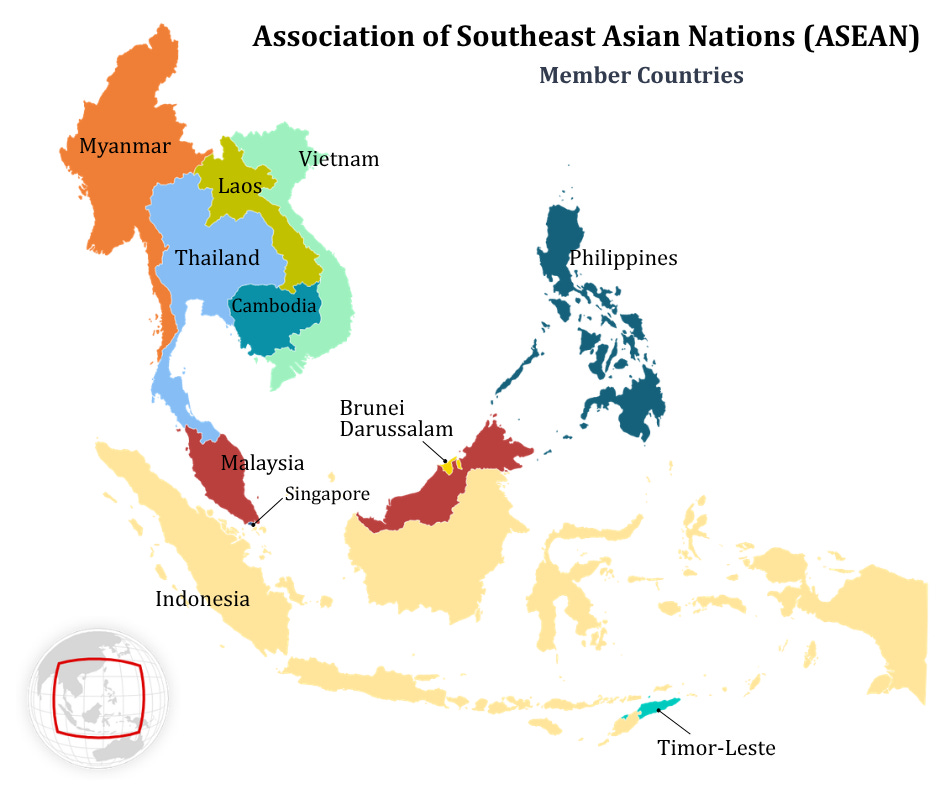
Every major power in Asia knows how to respect ASEAN. They attend its summits, sit through its forums, endorse its centrality, and fold Southeast Asia into their preferred Indo-Pacific lexicon. Washington does it. Beijing does it. Tokyo, Delhi, Canberra, Seoul and Brussels do it too. ASEAN remains the region’s diplomatic common room: a place where rival powers can appear together without conceding too much to one another, and where smaller states are not forced to face giants alone. The difficulty begins after the communiqués. China continues to press maritime claims in the South China Sea. The United States and China are reorganising technology, trade and supply chains around strategic competition. Myanmar’s civil war continues despite years of ASEAN statements and consensus language. Critical minerals, semiconductors, data governance, port infrastructure, energy corridors and maritime security are increasingly shaped by smaller coalitions, bilateral pressure and great-power industrial policy rather than by ASEAN acting as a bloc.
ASEAN is still relevant. Asia cannot do without it, but its leverage is declining. The real question is why this scale does not become leverage. Why does a region with such economic weight, such strategic geography and such diplomatic visibility still struggle to bargain collectively with superpowers? Why is ASEAN everywhere in Asia’s diplomatic architecture, yet less present where hard decisions are made?
Relevance and leverage are not the same thing. ASEAN remains relevant because it gives Southeast Asia a diplomatic floor. It allows politically different states to sit together. It gives smaller countries cover against facing superpowers alone. It provides external powers with a common regional platform. Without ASEAN, Southeast Asia would not have become more unified. It would become more exposed. Leverage means something harder: the ability to impose costs, coordinate pressure, and shape the choices of others. On that measure, ASEAN is failing. Its economic scale is real, but its political command is thin. Its centrality is still invoked, but increasingly as ritual. The danger is not that ASEAN disappears. The danger is that it becomes ceremonial: respected in statements, honoured at summits, and bypassed when decisions matter.
The scale makes this more striking. ASEAN’s total goods trade reached about $3.8 trillion in 2024, with exports of $1.95 trillion and imports of $1.89 trillion. China alone accounted for $772.4 billion in two-way merchandise trade with ASEAN in 2024, around a fifth of the bloc’s total goods trade. Foreign direct investment remains large too: the ASEAN Investment Report 2025 recorded $226 billion in FDI inflows to ASEAN in 2024, even as global flows declined. Southeast Asia is not peripheral. It is embedded in the operating system of global capitalism.
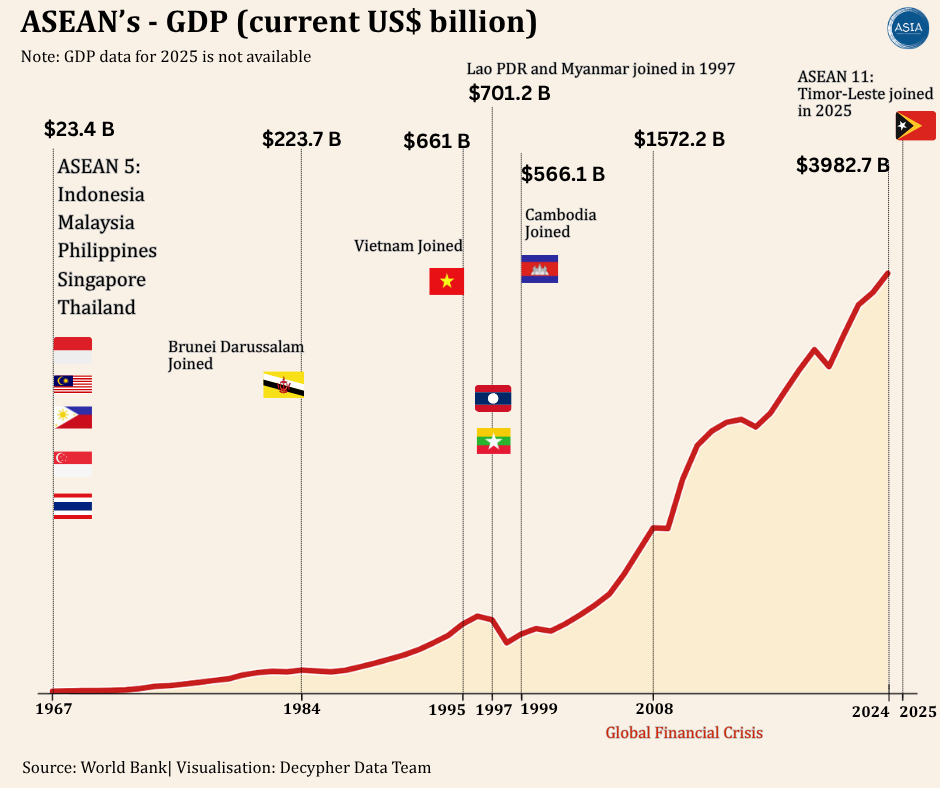
Yet economic size has not become bargaining power. ASEAN attracts investment, hosts summits and issues statements. It does not reliably force superpowers to adjust course. The reason is not simply timidity. It is structured. ASEAN’s scale is aggregated; its sovereignty is not. The bloc has a large collective economy, but it lacks a single external tariff, a unified sanctions mechanism, a supranational regulator, or a central executive capable of imposing a common position. ASEAN has size. It does not have enough organised authority. That weakness is built into the bargain that made ASEAN possible. The organisation was not designed to be a regional superpower. It was designed to prevent Southeast Asia from being broken by superpowers. Its founding logic was restraint: keep fragile, postcolonial and politically diverse states in conversation; reduce the risk of interstate conflict; protect sovereignty; and create a diplomatic habit strong enough to survive external pressure. That bargain worked. Southeast Asia did not collapse into permanent interstate conflict. Rival governments learned to sit together. External powers learned that they had to engage ASEAN-led spaces if they wanted regional legitimacy.
ASEAN’s relevance lies in what Asia would look like without it. If ASEAN is not seen as part of the regional architecture, then Southeast Asia becomes easier to divide. Smaller states would face China and the United States more bilaterally, without the diplomatic cover of a regional platform. Middle powers would compete through narrower coalitions without a common Southeast Asian floor. Great powers would find it easier to split the region through infrastructure, defence access, technology standards and trade incentives. ASEAN matters because it makes fragmentation harder. Its value is defensive rather than coercive. ASEAN does not command Asia, but it slows the speed at which Asia fractures. It gives Southeast Asian states a shared vocabulary- centrality, neutrality, consensus, non-alignment, openness- through which they can resist being forced into someone else’s bloc. That vocabulary is not always enough, but it is not meaningless. In a region where almost every country wants Chinese markets, American technology, Japanese capital, Indian engagement and European access in different proportions, ASEAN creates political space for not choosing too quickly.
ASEAN-led forums still matter for that reason. The East Asia Summit, the ASEAN Regional Forum and the ASEAN Defence Ministers’ Meeting Plus do not settle the region’s hardest disputes. But they keep rivals inside a common diplomatic theatre. The ASEAN Outlook on the Indo-Pacific makes this logic explicit: ASEAN-led mechanisms are meant to preserve dialogue, cooperation and inclusivity in a region increasingly pulled toward competition. That is not empty symbolism. In a period of hardening great-power rivalry, even the existence of a shared room matters.
The cost of this model is now unavoidable. The same principles that hold ASEAN together also prevent it from acting with force. The ASEAN Charter commits the organisation to sovereignty, equality, territorial integrity, non-interference, consultation, consensus and unity in diversity. These principles allow monarchies, one-party states, electoral democracies, military-dominated systems, city-states, archipelagic giants, poorer mainland economies and advanced trading hubs to sit under one roof without fearing domination by one another. They are ASEAN’s operating system. ASEAN’s great virtue is that it is non-threatening to its own members. Its great failure is that it is rarely threatening to anyone else.
The European Union comparison enters here for a reason. The EU shows how economic scale can become external leverage when backed by pooled sovereignty. Brussels can turn market access into regulatory power because it has common rules, legal authority and institutions that can enforce them. ASEAN deliberately avoided that path. Its members wanted cooperation without surrendering autonomy. For postcolonial states shaped by intervention, insurgency, regime insecurity and suspicion of neighbours, sovereignty is not an inconvenience. It is the prize. The comparison, therefore, clarifies the problem without offering a model ASEAN can simply copy. Europe’s postwar project was built around binding former continental rivals into a shared legal-economic order. ASEAN was built to keep newly independent and vulnerable states from being overwhelmed by one another or by external powers. The EU’s answer was legal integration. ASEAN’s answer was diplomatic restraint. One produces regulatory power. The other produces survival. Survival matters. But survival is no longer enough.
The world around ASEAN has changed faster than ASEAN’s operating system. The older regional model worked when Southeast Asian states could take Chinese trade, American security, Japanese investment, Indian engagement and European markets without choosing too sharply among them. That space is narrowing. U.S.-China rivalry now runs through semiconductors, critical minerals, export controls, data governance, green technology, artificial intelligence, ports, undersea cables and industrial policy. Economics itself has become security. Ambiguity is harder to sustain when pressure enters infrastructure. A country may say it does not want to choose, but supply chains choose through regulation. Ports choose through financing. Telecom networks choose through standards. Militaries choose through interoperability. Energy systems are chosen through infrastructure. ASEAN’s language of neutrality still matters, but neutrality without capacity becomes passivity.
The bloc’s weakness is not only institutional. It is distributive. ASEAN members are not exposed to superpowers in the same way. Vietnam and the Philippines face China through maritime pressure in ways Laos and Cambodia do not. Singapore’s role as a financial and logistics hub produces a different calculation from Indonesia’s archipelagic scale. Thailand’s constraints are not Malaysia’s. Myanmar’s isolation creates its own incentives. Some states fear Chinese coercion. Others fear losing Chinese capital. Some want a stronger U.S. security presence. Others fear being dragged into containment. Most want Chinese markets, American technology, Japanese capital, Indian engagement and European access at once.
That is not sophisticated neutrality. It is an asymmetric dependence.
A real bargaining bloc can say: if you move against one of us, we will respond together. ASEAN cannot say that with credibility. A Chinese manoeuvre near Philippine waters is not felt in Vientiane the way it is felt in Manila. A U.S. technology restriction may hurt one ASEAN member and help another attract diverted investment. A tariff shock does not land evenly across the region. Without shared exposure, there is no shared threat. Without shared threat, there is no shared leverage.
The South China Sea makes the external limit visible. ASEAN has spent years keeping alive a diplomatic process with China around a Code of Conduct, while repeatedly calling for restraint and respect for international law. It calls for restraint, international law and peaceful resolution. The language is correct. The pressure is weak. Beijing benefits from dealing bilaterally with claimants, where its power advantage is greater. ASEAN members disagree over how far to push. When leaders again called for an early South China Sea code in accordance with international law, the statement showed the bloc’s strength and weakness at once: it kept the issue on the table, but it did not change the balance at sea. The process survives. The behaviour continues.
Myanmar is the internal version of the same failure. After the 2021 coup, ASEAN produced the Five-Point Consensus, calling for an end to violence, dialogue among all parties, humanitarian assistance and a special envoy. The framework gave ASEAN a language of response. It did not give ASEAN the power to make the junta comply. Years later, ASEAN is still reviewing the implementation of the same consensus. The 2025 leaders’ review kept the Five-Point Consensus at the centre of the bloc’s approach, which only underlined the problem: ASEAN remains engaged, but engagement has not become control.
These are not abstract institutional failures. They have human consequences. In Myanmar, civilians live in a war that ASEAN cannot stop. In the South China Sea, fishers and coastal communities live with contested waters and coercive patrols while diplomacy moves slowly above them. Across the region, workers depend on supply chains increasingly shaped by U.S.-China rivalry, export controls and industrial policy far beyond their control. When regional architecture fails, failure becomes ordinary life: unsafe seas, unstable prices, closed factories, displaced families and the quiet knowledge that the institution meant to manage the region can only urge, reaffirm and review.
ASEAN is strongest when the task is to keep everyone talking. It is weakest when the task is to make someone stop. That sentence settles the relevance debate. ASEAN still matters because talking matters. In a region this diverse, keeping all states inside one diplomatic frame is valuable. Without ASEAN, Southeast Asia would face superpower pressure more nakedly and more bilaterally. Smaller states would lose coverage. Middle powers would build harder coalitions without a common regional floor. China and the United States would find it easier to divide the region into clients, partners and holdouts.
Asia now needs instruments, not just forums. It needs supply-chain coordination, common digital rules, energy resilience, maritime awareness, food security mechanisms, infrastructure standards and a collective position on economic coercion. ASEAN centrality gives Southeast Asia a diplomatic language. It does not yet provide enough strategic capacity. Asia is already responding. It is building around ASEAN. The future regional order is becoming layered. ASEAN remains the broad diplomatic floor: inclusive, legitimate, region-wide. Above that floor, narrower and faster arrangements are multiplying: the Quad, AUKUS, U.S.-Japan-Philippines cooperation, supply-chain initiatives, semiconductor partnerships, critical-mineral arrangements, digital economy agreements, maritime-domain awareness networks and energy-security partnerships. These arrangements do not have ASEAN’s region-wide legitimacy, but they move because they do not require consensus among all Southeast Asian states.
It does not abolish ASEAN. It stops pretending ASEAN can do everything. ASEAN provides legitimacy and inclusivity. Other coalitions provide speed and capability. Bilateral alliances provide deterrence. Issue-based groups provide standards, financing, technology cooperation and supply-chain resilience. Middle powers provide connective tissue. The question is whether this layered order strengthens ASEAN or sidelines it. If this grows around ASEAN while respecting its regional role, Asia can gain both stability and capability. If it grows over ASEAN, bypassing it entirely, ASEAN becomes ceremonial: honoured at summits, invoked in statements, but absent from the places where consequential decisions are made. That is the real danger. ASEAN will not disappear. It will be politely sidelined.
ASEAN’s leaders know the danger. The ASEAN Community Vision 2045 calls for stronger institutional capacity, more decisive and timely mechanisms and a strengthened ASEAN Secretariat. The 2025 economic integration agenda aims to harmonise trade standards, deepen financial integration, improve mobility, strengthen supply chains, support energy security and enhance transport connectivity. These goals matter because they recognise the central truth: scale must be organised before it becomes power.
Neutrality also needs a harder edge. Active hedging is not waiting. A passive hedge waits for superpowers to define choices. An active hedge builds internal capacity, so choices remain open. If ASEAN wants to avoid choosing between Washington and Beijing, it must become harder for either to divide. That means deeper intra-ASEAN trade, compatible digital rules, stronger regional infrastructure, energy coordination and a clearer collective stance against economic coercion. Economic scale can become leverage, but not by declaration. ASEAN will not become a sanctions machine or a military bloc. It will not bargain like a superpower next year. But it can become harder to bypass. Superpowers listen not only to size. They listen to coherence. ASEAN has size. It lacks enough coherence.
Timor-Leste’s accession reinforces ASEAN’s relevance while also sharpening the question of capacity. States do not struggle for years to join institutions that no longer matter. But a larger ASEAN also makes coordination harder. More inclusion does not automatically mean more power.
It is relevant because Asia still needs a diplomatic floor that includes all of Southeast Asia. Smaller states need coverage. Great powers need a place to meet. The region needs a mechanism for ambiguity. Without ASEAN, Southeast Asia would be more exposed, more divided and more vulnerable to bilateral pressure. It is failing because it cannot convert economic scale into strategic leverage. Its limitations are not accidental. They are built into the same sovereignty-preserving design that keeps it alive. ASEAN was made to manage pressure, not impose it. That was enough for an earlier Asia. It is not for the Asia emerging now.
— — —
Essay: Preksha Jalan- Assistant Program Officer in the Digital History Lab at The Advanced Study Institute of Asia (ASIA), affiliated with SGT University, Gurugram.
Data: Bhupesh
Produced by Decypher Team in New Delhi, India
— — —