

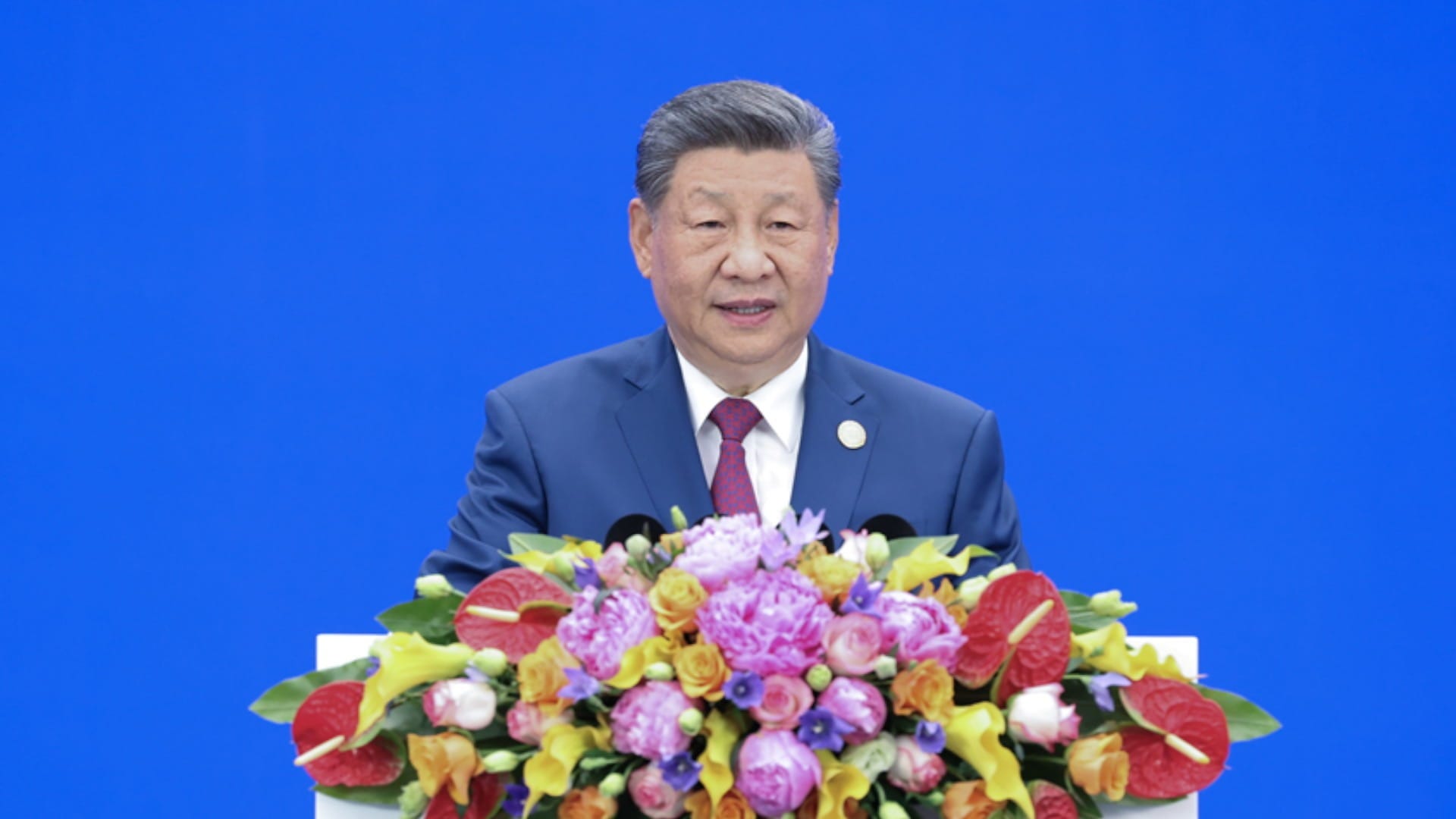

Xi Jinping stood in Shanghai’s World Expo hall on July 17th and made his pitch in one line: “人工智能发展不应该是某个国家的独奏,而应当是全球合作的交响” - AI’s development, he said, should not be one country’s solo, but a global symphony. Kazakhstan’s Tokayev was in the room. So were Cambodia’s Hun Manet, Thailand’s Anutin, and UN Secretary-General Guterres, with delegations from more than a hundred countries there to watch China sign the World AI Cooperation Organisation into existence. Four days earlier, China’s own statisticians had confirmed the number the keynote never mentioned: the economy grew 4.3 per cent year-over-year in the second quarter, missing the consensus forecast of 4.5 percent and marking the weakest quarterly expansion since the country was still grappling with zero-Covid in late 2022. Beijing wrote this score alone, in a room without the other players, and is now asking the rest of the world to play from it before anyone checks it against the state of the band.
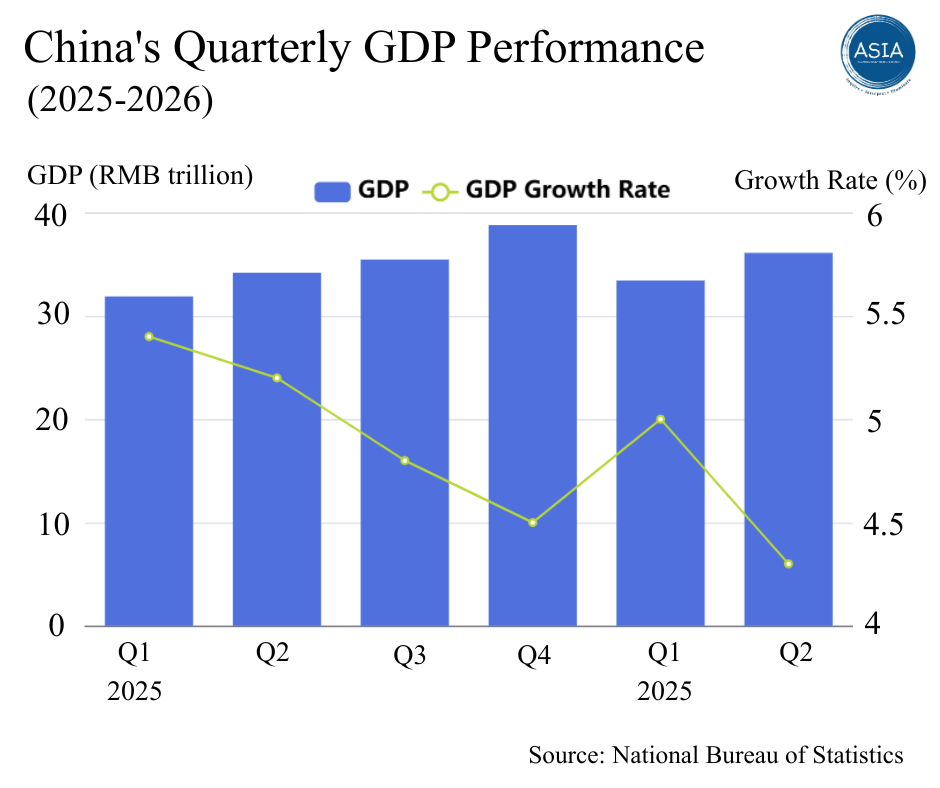
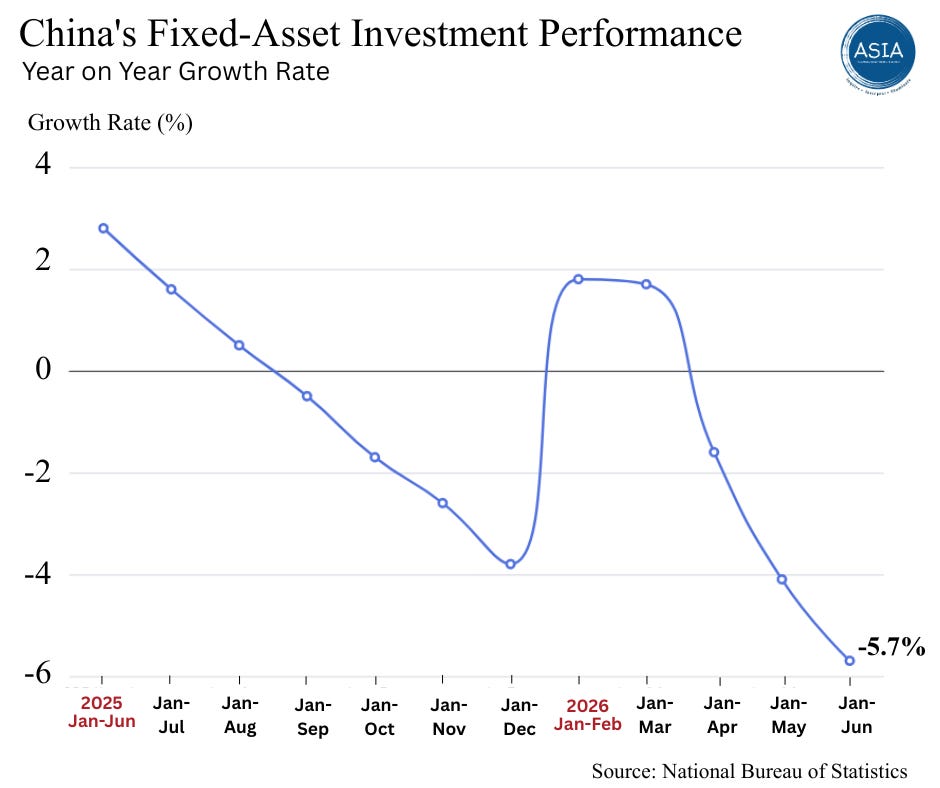
Here is the arithmetic. Fixed-asset investment fell 5.7 per cent in the first half, worse than forecast, dragged down by an 18 percent collapse in property investment. Retail sales grew a bare 1 per cent in June, the third straight soft month, as households pull back rather than spend. Exports rose 27 per cent year-over-year in June, and integrated-circuit shipments and AI-related equipment carried almost all of it. Everything domestic is contracting; the one line still growing is the one built on chips and AI export hardware.
Caixin’s economists caught something sharper than the headline miss: China’s nominal GDP growth beat its real GDP growth for the first time in thirteen quarters. Demand didn’t recover; AI-supply-chain prices and oil prices pushed the GDP deflator positive instead. The only part of the Chinese economy still able to set a price upward this quarter is the part built on chips and AI hardware. Cornell’s Eswar Prasad said it without the diplomacy attached: “China’s economy is becoming increasingly unbalanced,” with investment piling into frontier technology while consumption stays flat. The imbalance is the reason for the Shanghai summit.
This is state control, not market momentum. Beijing directs capital into AI and semiconductors by command, the same way it ordered the food-delivery discount war to stop last year, and a World AI Cooperation Organisation built by a state that runs its own economy this way carries that control with it into the framework it offers everyone else. Five thousand AI training slots for developing-country officials over five years. Joint application centres built with ASEAN, the Arab League, the African Union, CELAC, the SCO and BRICS. A weather-forecasting system already running in thirty countries. Each of these is genuine capacity-building for countries that need it, and each also converts a domestic dependency into an export relationship on Beijing’s terms before anyone else gets to define the exchange. A government this size doesn’t project confidence abroad to hide anxiety at home; it manages the anxiety at home by making the rest of the world need what it sells.
Delhi ran its own summit five months earlier, one China skipped: roughly seventy countries moved toward a Delhi Declaration with Modi, Sam Altman, Sundar Pichai and Macron in the room, the same week a White House official told the room outright, “We totally reject global governance of AI”.
The gap Delhi can’t out-declare is technical, not rhetorical. Chinese open-weight models like DeepSeek and Qwen have logged more than ten billion cumulative downloads and, by the Chinese industry’s own account, already function as the default stack for developers outside the American ecosystem. Domestic chipmakers such as Huawei Ascend, Cambricon, Biren, now cover over 40 per cent of China’s own compute needs. By the time any plurilateral alternative gets its secretariat funded, a meaningful share of the infrastructure decision may already be made quietly, at the level of which repository an engineer chose to clone.
The involution precedent makes the point concrete. China has one word - 内卷, involution - for competition so wasteful it burns capital without building anything real. Regulators used it last year on the food-delivery war, where three platforms torched over 100 billion yuan in subsidies before Beijing ordered it stopped, and state media ran the verdict as a headline: “the delivery war should end”. That is state control exercised over a domestic industry in real time, and it is the same authority now steering capital into AI. Xi’s line about not “putting one’s own security above others’” reads differently once you know that.
A policymaker in Delhi finishing this piece should walk away with one fact: China’s economy needs the world to adopt its AI framework roughly as much as the world needs a functioning framework at all, and that mutual need is what lets Beijing lecture on governance from a position its own Q2 numbers show to be more fragile than the keynote let on. Whether the Global South accepts a Chinese-drafted architecture by default, or builds the plurilateral alternative before the standards lock in, is being decided now, by whichever government moves from declaration to delivery mechanism first. China already made that move. The clock started on July 17th, and nobody in the room asked Delhi’s permission to start it.
Essay: Maseera Shaik- Research Intern (Security, Crisis and Strategy) at The Advanced Study Institute of Asia (ASIA)
Produced by Decypher Team in New Delhi, India