


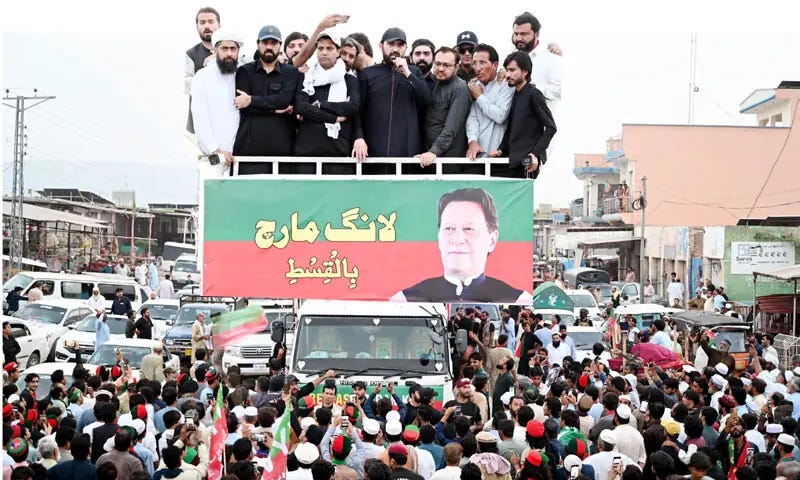
The talks between the federal government and Pakistan Tehreek-e-Insaf (PTI) collapsed in the early hours of Sunday, 4 October 2026, and PTI’s long march left Lakki Marwat that afternoon. Most commentary calls this a failed negotiation. It reads better as the latest turn of a pattern. The government needs a deal it can justify to the military establishment. PTI needs one it can justify to its jailed founder and its street base. Since 2022, those two requirements have seldom overlapped. Three arguments can be made. The civil-military constraint under every PTI negotiation since 2022 limits what a civilian delegation can offer. The counter-militancy dispute that sank the October round rests on a real governance problem in Khyber Pakhtunkhwa (KP), which neither side is addressing. And cycles of delay-then-collapse now work as a stable way of managing confrontation, which is different from a path to resolving it. “Design” in the title means structure. Nothing here claims that any actor planned the outcome.
The pattern starts with Imran Khan’s ouster in April 2022. After Khan was jailed on 5 August 2023, Dawn reported, his party’s relations with the government and the establishment turned deeply hostile. AP says all but one of his convictions have since been suspended or overturned on appeal, and he is still in prison. PTI alleged rigging in the February 2024 election. The 26th Amendment of October 2024 changed how the chief justice is selected and created constitutional benches. PTI’s November 2024 Islamabad protest ended in a crackdown in which the state acknowledged the deaths of Rangers and a policeman; PTI says at least 12 of its supporters were killed, which the authorities deny. ACLED notes that the 27th Amendment of November 2025 entrenched military supremacy over civilian leadership. This year the Supreme Court ruled in August that Khan should be moved to a civilian hospital, but authorities returned him to prison after a short stay, and the September arrests of his three sisters raised tensions again. PTI’s march, first set for 27 September, was pushed to 4 October to leave room for talks. Each step cut into the space for a civilian settlement.
That history explains why neither delegation had much room to move. Each had to bargain across the table and also satisfy a constituency outside it that could refuse to ratify the result, and in both cases that constituency was not in the room. For the government, it is the establishment, which has already taken a side in the counter-militancy dispute: the ISPR director-general has said the provincial government is responsible for rising terrorism, and PTI denies any non-cooperation. On the questions PTI cares about most, the judicial status of its founder, the inquiries into 9 May 2023 and 26 November 2024, and the release of detained workers, no civilian team looks free to decide. That is an inference from the charter, since both inquiries would have examined the conduct of security forces, and neither side has said it in so many words. The government’s coalition adds a second limit. PPP Senator Sherry Rehman, a member of the government team, said her party wanted the march ended, not merely suspended.
For PTI, the limit is Khan, and in practice Chief Minister Sohail Afridi as well. Opposition leader Mahmood Khan Achakzai held that any decision to cancel the march needed approval from both. The party is not united on this. Shaukat Yousafzai urged postponement and wider consultation, warned the march could turn bloody, and said that replacing Afridi was for Khan alone to decide. A team that cannot bind its own principal gives the government little to ratify, and the government has little it is free to give.
The October round shows both limits at work. Two rounds were held, on Friday and on Saturday afternoon into the night. PTI wanted a jail meeting with its founder before calling off the protest; the government wanted the march cancelled first. Each side blamed the other. Interior Minister Mohsin Naqvi said the draft was changed four times once Afridi became involved, and Rehman said PTI repeatedly accepted terms and then backed away. PTI Secretary General Salman Akram Raja gave a different cause: the federal demand that KP own anti-terrorism actions Islamabad had launched unilaterally. Minister of State for Interior Tallal Chaudhry said the talks failed because the KP government could not assure whether they would cooperate in the fight against terrorism.
The gap looked small. Naqvi put agreement at 99 percent, a figure that is his own, and Fawad Chaudhry called agreement on over 90 percent of issues a major achievement. A near-complete draft that still collapses fits the argument here. What remained, access to Khan and ownership of the counter-terrorism commitments, runs into the establishment’s interests on one side and the founder’s veto on the other.
January 2025 set the precedent. PTI’s written charter, presented on 16 January, asked for two commissions of inquiry under the Commission of Inquiry Act 2017, one on May 9 and one on November 26, plus state support for bail and sentence suspensions for political prisoners. It framed these as a “prerequisite to wider negotiations with respect to the restoration of the Constitution”. Both inquiries would have examined the military’s own conduct, including the legality of Khan’s arrest and the break-in at the Islamabad High Court. PTI wanted the commissions within seven days; the government promised a reply within seven working days. Khan called off the talks on 23 January, and the government declared them over on 31 January, saying PTI had left before the reply was due and that a parliamentary committee, not a judicial commission, was the right forum. October 2026 repeats the logic on a smaller scale. Sequencing becomes the weapon, because whoever concedes first gives up the mobilisation that made them a negotiating partner.
Under the sequencing fight sat the stated cause of the collapse: counter-militancy cooperation. It deserves attention, though not in the form the federal government gives it. The emergency is real. ACLED found that militant violence in 2025 surpassed 2024, itself one of the most violent years in over a decade, and counted around 700 attacks by the Tehrik-e-Taliban Pakistan (TTP) on security forces, or clashes with them, in the first eleven months. Most of that activity was in KP, and security forces have run Operation 11 Garaj across the province for months. Information Minister Attaullah Tarar said on 4 October that PTI must decide whether it stands with Pakistan or Afghanistan, and on 28 September he called the party the B-team of the banned TTP.
The provincial record complicates that framing. In July 2026 KP added 4,306 constables, and Afridi told them action against terrorism should be their highest priority. In the first half of 2026, KP police report, the Counter Terrorism Department ran 2,004 intelligence-based operations, arrested 504 suspects including 14 high-value commanders, and killed 182. A province that runs two thousand operations in six months is not refusing to fight militancy. It fights with provincial instruments and resists a federal military operation that Islamabad has hinted at. That resistance has local roots. ACLED reports that locals remain hostile to a sustained military presence, and that air and drone strikes causing civilian casualties in KP have prompted backlash.
The deeper failure is institutional. The funding argument has no shared baseline. Federal ministers have cited security funding for KP of Rs150 billion, Rs700 billion and Rs800 billion, while Afridi says constitutionally due funds are being withheld. The consultation mechanism is contested too. PTI says Islamabad wanted KP to accept a counter-terrorism framework without adequate provincial consultation, and Tarar asks why the provincial government does not convene its Provincial Apex Committee. Both sides point to the same body, and neither has used it to settle the question. A dispute that could be argued as policy is argued as loyalty, and the only province the opposition governs is the one being delegitimised.
Set beside the 2025 precedent, the cycles of December 2024 to February 2025 and September to October 2026 suggest that delay-then-collapse is a stable equilibrium and no longer a failed route to settlement. In a competitive authoritarian regime, where formal democratic competition persists under unequal conditions, incumbents gain from opposition mobilisation that comes in bursts and stays contained. Negotiation windows do that work. They cool things at peak mobilisation, divide the opposition between street and table, and reset the game with nothing conceded. PTI feeds the cycle itself: each march announcement is its main tool for forcing talks, and each cancellation or collapse drains the mobilisation it must then rebuild. Each side’s pressure also justifies the other’s. A march announcement brings containers and warnings of force, and those give PTI its case for the next march. The arrangement holds while PTI’s mobilisation costs less than concession, while state coercion stays containable, and while KP’s security crisis does not force a rupture. The costs fall unevenly. Negotiators on both sides pay little for a collapsed round. Residents of KP, who live with the militancy and with the political fight over how to meet it, pay more.
If the pattern is stable, the question is what would break it. An exit would need four things, and the record shows each is at least partly available. The first is a sequencing formula that removes the first-mover penalty. Government sources said at one point that Barrister Gohar would be allowed to meet Khan, and Rehman said the government had offered assurances on his medical treatment. A meeting and a suspension of the march, announced together, would show whether sequencing is the real obstacle. The second is to move counter-terrorism onto an institutional track. Afridi’s released draft sought regular federal-provincial consultations on security, and Rana Sanaullah has said Islamabad stays open to talks if PTI and the KP administration cooperate on counterterrorism. The Provincial Apex Committee is the obvious venue. The third is a mechanism on 9 May and 26 November that the establishment can tolerate. The government prefers a parliamentary committee and PTI a judicial commission, and a parliamentary committee with judicial participation is one possible bridge, though it still meets the same obstacle. The fourth is a guarantor, which is the hardest. The Speaker, the PPP and others can broker, but none of them can bind the military.
The alternatives are less benign. Tarar called talk of governor’s rule or an emergency in KP premature, which confirms that it is being discussed. The government has warned the march will not be allowed into Islamabad, and Naqvi has said Afridi will be held responsible for any deaths. As of 8 October, Afridi was due to announce the march’s next phase at Khairabad. Four things would show whether the cycle is breaking: access for Khan’s lawyers and doctors, a formally constituted inquiry, a meeting of the Provincial Apex Committee, and whether the march meets lethal force.
The October 2026 collapse is best read as the system working as built. The civil-military settlement of 2022 produced a configuration in which the principal opposition party can be negotiated with but never settled with, and a province can be drafted rhetorically into a security narrative while its governance crisis goes unaddressed. Delay and collapse have become a method of living inside the crisis, and the method is stable only while neither side’s alternative to it costs more. The next cycle will test whether it can hold when the question it manages, the state’s accountability for its own political conduct, is one it was designed never to answer.
Essay: Maseera Shaik- Research Assistant (Security, Crisis and Strategy) at The Advanced Study Institute of Asia (ASIA)
Produced by Decypher Team in New Delhi, India