


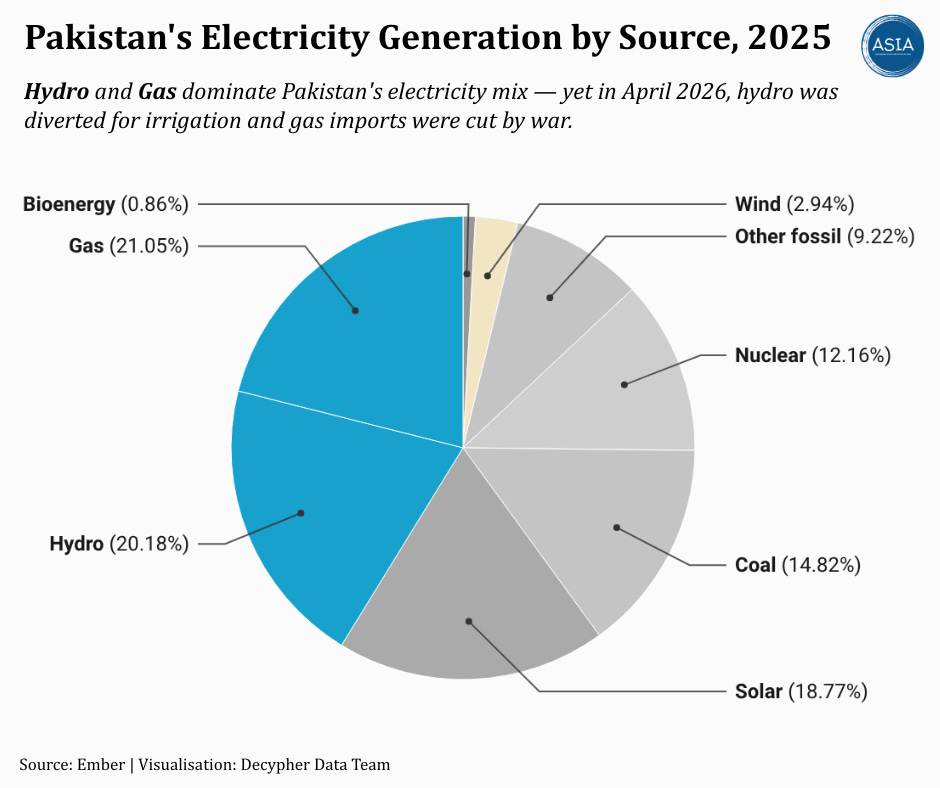
Pakistan’s current diplomatic moment is built on a contradiction. Even as Islamabad tried to make itself the venue for renewed U.S.-Iran engagement, the country was experiencing a power shortfall severe enough to leave cities in the middle of a punishing summer without power. The figures were not abstract: a 4,500-megawatt gap during peak hours, emergency reliance on spot LNG purchases, and a system in which hydropower was underperforming because reservoir releases had been calibrated around irrigation rather than electricity demand. Pakistan was not brokering peace from strategic comfort. It was trying to do so while struggling to keep the lights on.
Pakistan is trying to act as a pivot power while still living like a vulnerable one. Its diplomacy is not proof that it has overcome its old economic and infrastructural weaknesses; it is proof that it is trying to turn those weaknesses into leverage. A state exposed to Gulf energy shocks, dependent on maritime stability, and vulnerable to price spikes has every reason to shorten the war and every incentive to make itself useful in the process. The mediation push is therefore not separate from Pakistan’s fragility. It is produced by it.
For a brief moment, that strategy looked plausible. Pakistan had already emerged as one of the more visible intermediaries in the crisis, alongside Turkey and Egypt, because it had channels to Tehran and improving access to Washington at the same time. The effort was tied closely to Field Marshal Asim Munir, whose diplomatic visibility helped recast Pakistan from a recent outlier into a state others were willing to use. That shift mattered because it fed an old Pakistani aspiration: to be more than a frontline state or a supplicant, to matter. After all, it can connect South Asia, the Gulf, Iran, and the West. In a region suddenly short of trusted go-betweens, Islamabad briefly looked as though it might make that aspiration real.
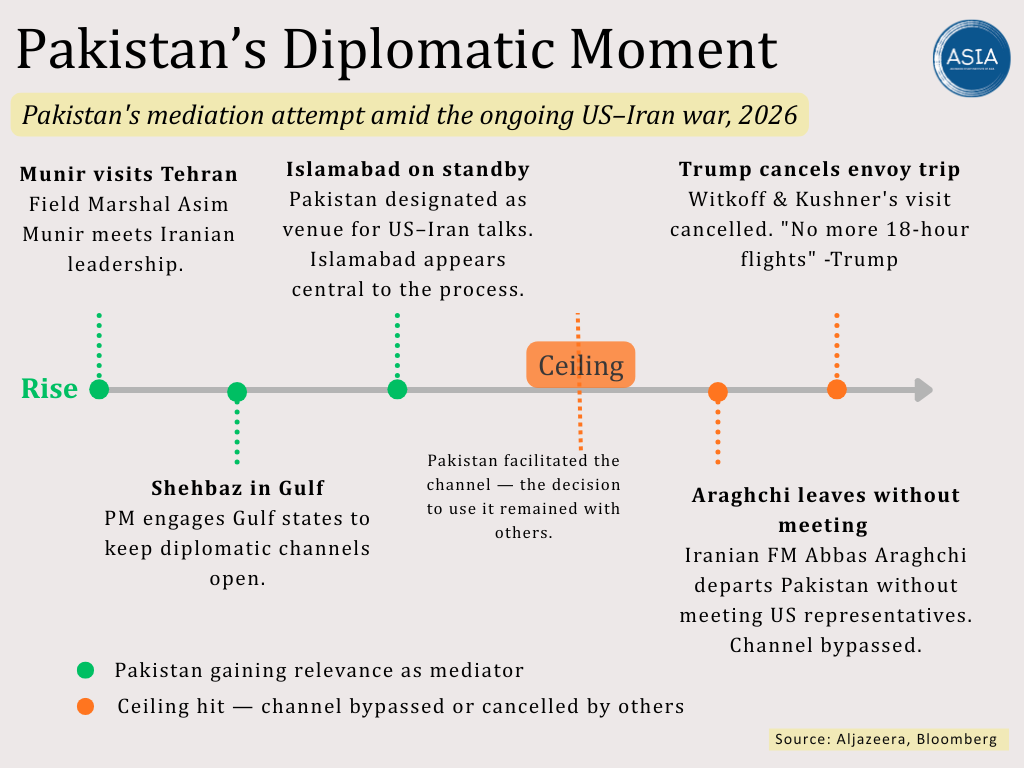
Munir moved through Tehran, where his visit was described in public as reflecting a “deep and great bilateral relationship”. Shehbaz Sharif was in Doha and Riyadh. Pakistani officials spoke of “sincere efforts” to keep diplomacy alive. Islamabad itself was repeatedly put on standby for another round of talks. All of this created the impression of a state suddenly central to the management of a regional war. But leverage built on crisis always has a ceiling, because the very actors who make the mediator useful can also decide, without warning, that they no longer need the mediator in the same way.
This is exactly what makes Pakistan’s leverage fragile rather than transformative. It depends on being useful to others, and usefulness is never sovereign. This vulnerability becomes unmistakable after Iranian Foreign Minister Abbas Araghchi left Pakistan without meeting U.S. representatives, Donald Trump cancelled the expected visit by Steve Witkoff and Jared Kushner. He said his envoys would not make “any more 18-hour flights” and suggested that Tehran could reach Washington directly if it wanted to negotiate. Islamabad may have helped open a channel, but it could not guarantee that the channel would remain central once Washington recalculated the costs and optics of using it. Pakistan can make itself useful. It cannot make itself indispensable.
This is the structural condition of Pakistan’s diplomacy. It can offer access, venue, military credibility, and political flexibility. It cannot own the process. The U.S. and Iran can downgrade, bypass, or reroute the Islamabad track for reasons of their own, and Pakistan is left with the consequences of a crisis it did not create but cannot escape. That is why the country’s relevance rises with the war and becomes most precarious at the same moment. The more valuable Pakistan becomes as a middle power intermediary, the more exposed it is to being reminded that middle powers mediate on sufferance, not on entitlement.
The domestic side of this matters just as much. Mediation offers the state a way to perform competence and significance at a time when ordinary Pakistanis are living through the visible signs of institutional fragility. Blackouts tell one story: an exposed state, improvising around shortages and administrative missteps. High diplomacy tells another: a connected state, trusted enough to carry messages between enemies. The effort to hold those two stories together explains much of Islamabad’s current posture. Pakistan is not simply seeking peace between two adversaries. It is trying to show that geography can still be translated into political value even when the economy underneath that geography remains shaky.
It is better understood as crisis diplomacy in its most compressed form: an attempt to turn vulnerability into leverage before vulnerability becomes unmanageable. That is a rational strategy. It may even be the only strategy available to a state whose geography ensures that it is always near the fire, but rarely in control of it. Yet the setback over the Islamabad talks revealed the ceiling as clearly as the opportunity. Pakistan can open doors, but it cannot decide who walks through them. It can briefly look central, but it cannot stabilise that centrality on its own. The country is not emerging here as a confident pivot power. It is manoeuvring, but precariously, as a fragile one.
— — —
Essay: Preksha Jalan- Assistant Program Officer in the Digital History Lab at The Advanced Study Institute of Asia (ASIA), affiliated with SGT University, Gurugram.
Data: Bhupesh
Produced by Decypher Team in New Delhi, India
— — —