


Behind Walls, Below Potential
Pakistan’s agricultural crisis, the gender question at its centre, and what the Chaos Map reveals about a sector trapped between labour and agency.
Pakistan’s agricultural crisis is usually narrated through weather, water, and weak logistics. Floods destroy crops, input costs rise, cold chains remain thin, exports stay concentrated, and the rural economy struggles to move up the value chain. All of that is true. But it does not get to the centre of the problem. One of the deepest constraints on Pakistan’s agricultural future is that the sector depends heavily on women’s labour while systematically denying women economic agency. Women work, but too often do not own. They produce, but too often do not price, borrow, transport, formalise, or scale. That is not merely a social wrong. It is a structural economic drag. Pakistan cannot seriously talk about agricultural modernisation while keeping much of the sector’s productive base behind social and institutional walls. ADB’s Asian Development Outlook April 2026 chapter on Pakistan lays out the sector’s fragility, while the World Bank’s report on women’s economic empowerment in Pakistan shows how deeply women remain excluded from the institutional side of the economy.
This matters because agriculture is not a residual sector Pakistan can afford to neglect. According to the ADB, agriculture still accounts for about 20 per cent of GDP and 38 per cent of employment. Yet in FY2025 the sector grew by only 1.5 per cent, down sharply from 6.4 per cent in FY2024, as higher input costs, excessive rain, and monsoon flooding cut wheat, sugarcane, and cotton production. Agriculture’s contribution to GDP growth fell from 1.5 percentage points to just 0.4. That is not a small deceleration inside a marginal corner of the economy. It is a weakness in one of Pakistan’s foundational sectors at the very moment the country is trying to stabilise inflation, revive investment, and guard against fresh external shocks.

The broader macroeconomic picture makes that weakness more consequential. The same ADB chapter projects GDP growth of 3.5 per cent in FY2026 and 4.5 per cent in FY2027, but also warns that a prolonged Middle East conflict could slow growth by raising energy and fertiliser costs, disrupting trade, curbing remittances from the Gulf, lifting inflation, and widening the current account deficit. Inflation is projected to rise to 6.4 per cent in FY2026 and 6.5 per cent in FY2027. The point is not that Pakistan is already back in crisis. Its recovery remains narrow and exposed. When a country is trying to consolidate stability under those conditions, agriculture cannot remain weak without wider consequences for prices, exports, household consumption, and rural demand.
The gender question enters here not as an ethical add-on but as a core economic fact. The same ADB chapter says women account for an estimated 65 per cent of the agricultural labour force, while remaining largely excluded from formal agribusiness ownership, access to finance, and market linkages. That single contrast should reorder how the sector is understood. Pakistan does not suffer from a lack of women in agriculture. It suffers from a lack of women’s authorship within agriculture. Women are present as labour but absent as agents. They plant, transplant, harvest, sort, tend livestock, and sustain household food economies, yet too often do so without land title, commercial visibility, bargaining power, or direct control over income. The economy accepts women’s work while rationing women’s power.
The glass wall
That is where the argument about glass walls becomes more useful than the usual language of empowerment. A wall is obvious; you can point to it. A glass wall is harder to name because it often looks like custom, modesty, family authority, or “protection” rather than exclusion. Its force lies precisely in that ambiguity. Women are not always formally barred from economic life; instead, they are allowed to participate in ways that keep them indispensable but subordinate. They may work in fields, manage livestock, process food, and sustain rural households, yet still require male permission to travel, market produce, open accounts, access credit, or convert labour into enterprise. The wall is “glass” because it does not remove women from the economy altogether; it lets them be seen working while stopping them from becoming fully legible as economic actors. It keeps labour visible and agency out of reach.
The effect is not merely social containment. It is a political economy of controlled usefulness: women are permitted to sustain production, but not easily to command value. Once seen that way, the familiar list of agricultural inefficiencies looks different. Pakistan’s value chains are weak not only because of bad storage, low mechanisation, thin certification systems, or poor processing capacity, though all of those matter. They are also weak because those doing a large share of the work are blocked from the institutions that would allow them to upgrade the chain itself. A value chain cannot deepen when much of the labour base remains outside ownership, finance, market access, and formal enterprise. A sector cannot diversify when those doing the work are excluded from the decisions that determine what gets grown, stored, processed, certified, and sold. This is why gender disparity is not one more problem on the list of agricultural inefficiencies. It is one reason the list persists. Pakistan’s post-harvest losses, weak agribusiness scale, and shallow market integration are technical failures, yes. They are also failures of agency.
Field-level accounts make the same point more vividly. An ITC account from rural Pakistan describes women as the driving force behind livestock and farm work while receiving little training, little recognition, and limited access to the formal side of commerce. A 2025 study on the socio-economic problems faced by rural women in agricultural activities in Pakistan similarly portrays women as deeply involved in planting, harvesting, and income support, yet burdened by unpaid work, domestic responsibilities, restricted mobility, and limited authority. These accounts matter not because they are dramatic, but because they show how the rural economy actually functions: women are most indispensable where their labour is least formalised and least rewarded. That is a poor foundation for productivity growth.
The risk is not abstract
This is why the risk of a slowdown is not abstract. Pakistan’s agricultural value chains are already under pressure from climate shocks, rising input costs, weak market integration, and thin private investment. The ADB notes that the 2022 floods destroyed 4.4 million acres of crops, that less than 1 per cent of climate finance in Pakistan is directed to agriculture, and that agribusiness accounts for only 5 per cent of private-sector investment. It also estimates that Pakistan needs an additional $220 million in agriculture-related investment to meet its nationally determined contribution commitments by 2030. A country facing those pressures should be widening the set of people who can adapt, invest, formalise, and sell. Instead, it continues to narrow that set by treating women as labour reserves rather than economic actors. That makes the rural economy less resilient exactly when resilience is most needed.
There is also a macroeconomic irony here. Pakistan’s recent stabilisation story has relied on lower inflation, improved reserves, stronger remittances, and recovering investment. But the lower farm incomes slowed private consumption growth in FY2025 even as the broader economy stabilised. That matters. It suggests agriculture is not simply lagging while the rest of the economy recovers; it is actively constraining how broad-based that recovery can become. If lower farm incomes and weak agricultural performance already weigh on consumption in a year of stabilisation, then continued underperformance under harsher external conditions will matter even more. In that setting, denying women agency is not some cultural cost the economy can absorb. It is a productivity loss that the economy is already paying for.
Pakistan’s agricultural problem, then, is not only that the weather is worsening or infrastructure is inadequate. It is that the country is trying to modernise a sector while preserving a social order that denies economic agency to many of the workers on whom that sector depends. There is no serious path to resilient growth in agriculture that does not pass through women’s mobility, ownership, finance, training, and market access. The walls are not only around women. They are around the economy itself.
Reading the Chaos Map
The essay’s argument becomes spatially visible when plotted on the Chaos Map — the framework for locating actors between order and chaos (vertical axis) and relational and conceptual pattern-making (horizontal axis). The map below plots every major actor in Pakistan’s agricultural system by its gravity point and motion type.
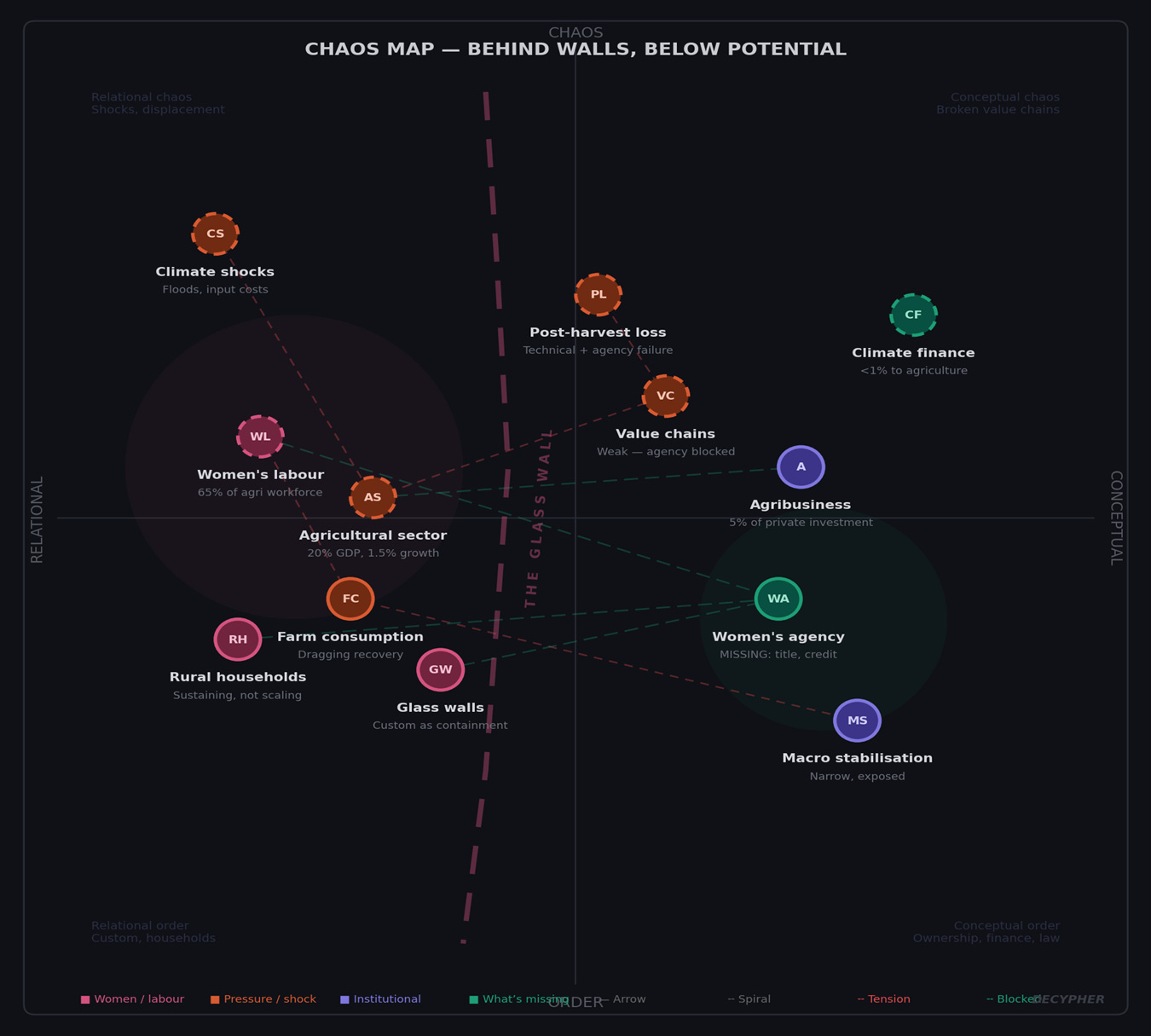
The glass wall runs down the centre of the map. It is the essay’s core structure, and on the Chaos Map it is visible as a barrier that severs the relational left from the conceptual right. Women’s labour (65% of the agricultural workforce) sits deep in relational space: present, productive, indispensable. Women’s agency — ownership, finance, market access, formal enterprise — sits in conceptual order on the other side of the wall. The green blocked-pathway lines trace what should connect them. The wall is what doesn’t let it.
The left side is full. Women’s labour, rural households, farm consumption, the agricultural sector itself — all cluster in relational space. This is a sector sustained by relational energy (people working, households managing, crops planted and harvested) but structurally prevented from converting that energy into conceptual infrastructure (titles, credit, value chain position, enterprise). The labour is visible. The agency is unreachable. That is what a glass wall does on a map: it lets you see across but not move across.
The right side is hollow. Women’s agency sits in conceptual order as the thing that should exist but doesn’t. Agribusiness is there but starved (5% of private investment). Climate finance is there but negligible (less than 1% to agriculture). Macro stabilisation is there but can’t reach the agricultural cluster because the sector’s relational base — households, women, consumption — is trapped on the other side of the wall.
Value chains and post-harvest loss sit in conceptual chaos — the upper right. They should be in conceptual order (functioning systems, certification, processing, cold chains). They are instead chaotic, and the map shows why: the people who do 65% of the work are blocked from the institutions that would let them upgrade the chain. The technical failures are real. But they persist because the agency failures are structural.
The macroeconomic irony is visible in the tension line from farm consumption to macro stabilisation. The ADB projects 3.5% growth in FY2026, but lower farm incomes already dragged private consumption in FY2025. The recovery is narrow precisely because the sector that employs 38% of the population — and where 65% of the workers are women without economic agency — cannot contribute purchasing power to the broader economy. The stabilisation sits in conceptual order. The consumption it needs sits in relational order, behind the wall.


After Orbán, but what does it mean for Russia, and China?
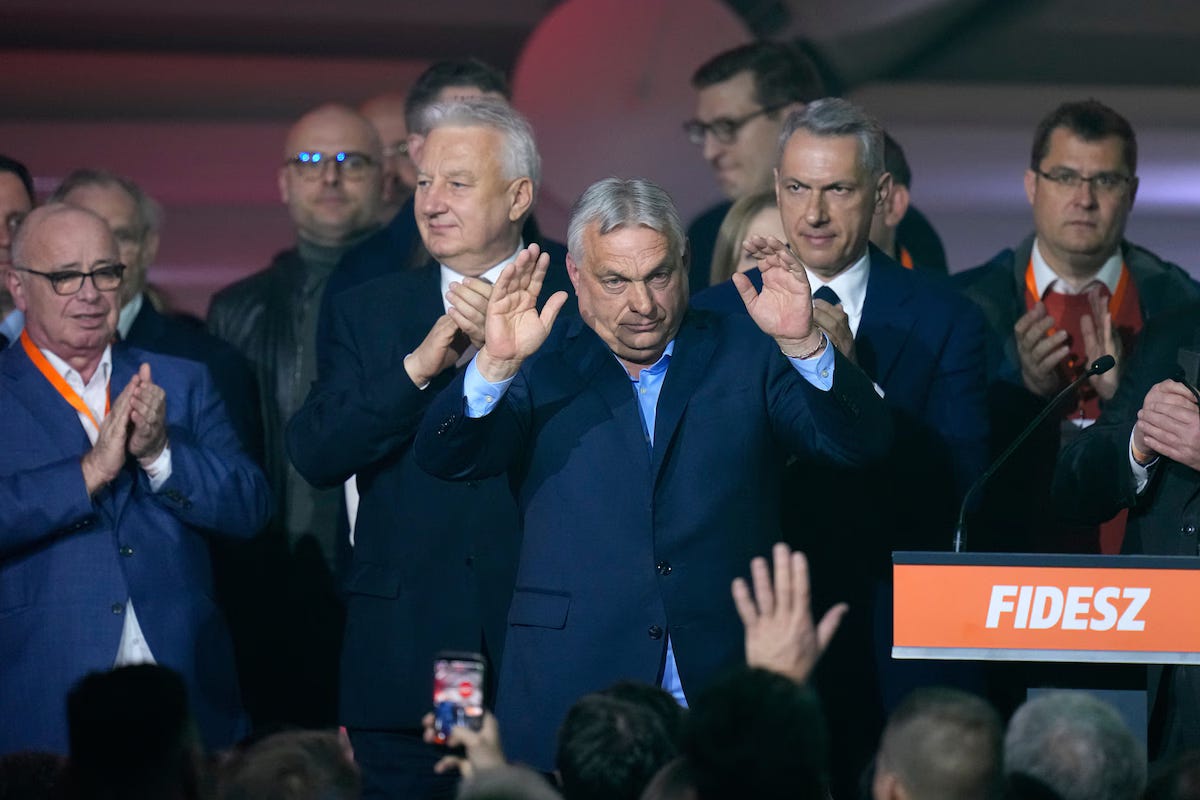
Viktor Orbán did not lose an election on Sunday. He lost a franchise.
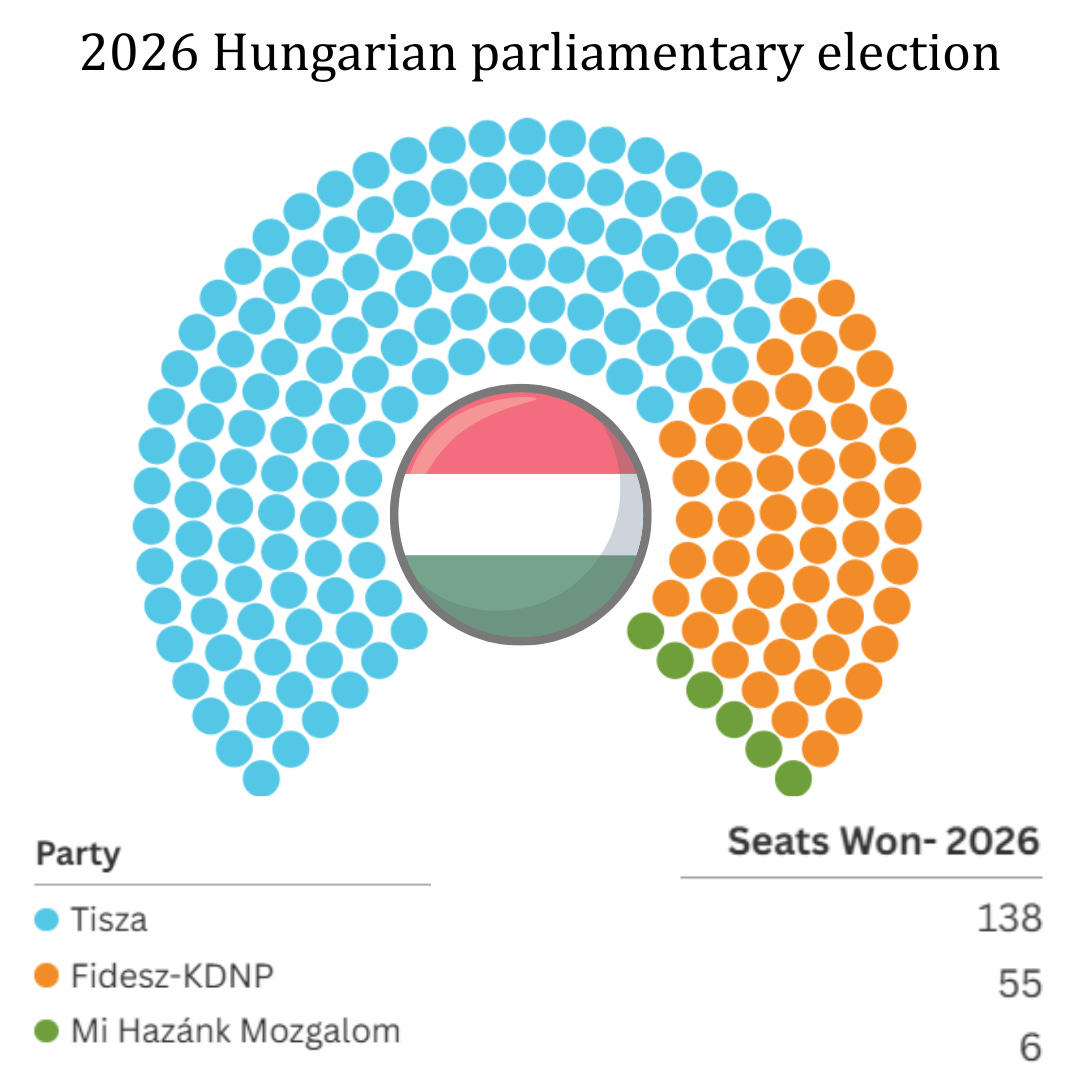
Péter Magyar’s Tisza party took 138 of 199 parliamentary seats — a constitutional supermajority — on 53.6 per cent of the popular vote, at a record turnout of nearly 80 per cent. Orbán conceded on election night. Fidesz, which held a two-thirds majority for three consecutive terms, was reduced to 55 seats. The margin was not close enough to contest, not narrow enough to spin. The system Orbán built over sixteen years — the captured judiciary, the oligarchic economy, the rigged electoral map — could not absorb the popular deficit of trust. The machine broke under the weight of its own corruption.
This is consequential well beyond Central Europe. Orbán was not merely a right-wing prime minister. He was the operating system. Budapest was the capital of a transnational illiberal project — the node through which American MAGA networks, European national-conservative parties, and Russian soft-power operations ran their wiring. That node is now offline.
The illiberal international loses its server room
The standard reading of Orbán’s defeat is ideological: illiberalism has been repudiated. This is only partly right. What has actually been dismantled is infrastructure.
Budapest hosted annual CPAC satellite conferences. Fidesz-aligned foundations ran fellowship programmes that brought American and European conservatives to Hungary for ideological formation. Orbán funded think-tanks across the continent. He provided something no other illiberal leader could: a working government inside the European Union that proved you could hollow out democratic institutions, consolidate media, build a patronage economy, and still win elections. Salvini, Le Pen, Wilders, the AfD — none of them were in power long enough or structurally enough to offer that proof. Orbán was the demonstration model.
Magyar has no interest in inheriting this role. He is a centre-right pragmatist running on corruption, healthcare, and EU re-engagement. The institutional scaffolding of the illiberal international — the conferences, the talking points factory, the prestige of a sitting head of government endorsing the programme — will be wound down. The ideas will persist in Paris, Amsterdam, and Berlin. The infrastructure will not.
The American dimension is worth isolating. JD Vance held a rally in Budapest’s MTK Stadium days before the vote. Rubio visited. Trump was beamed in live. This was real political capital, deployed visibly, and it produced nothing. Magyar’s response was elegant and lethal: this election will be decided by Hungarians. The result suggests that American backing cannot rescue a domestic record that voters have turned against. The global right now has data on the limits of external endorsement — and it is not encouraging data.
The Ukraine corridor opens
Orbán’s foreign policy was, at its core, a blocking operation. Hungary vetoed or delayed EU sanctions packages against Russia, obstructed military aid to Ukraine, and ran a campaign premised on the claim that Brussels and Kyiv would drag Hungarian soldiers into war. He maintained a close energy relationship with Moscow, leveraged Hungary’s border with Ukraine to stoke fear, and positioned himself as Europe’s lone voice for peace — while cashing Russian oil cheques.
That obstruction is now removed. A Magyar government will not immediately reverse every Orbán-era position — Hungarian energy infrastructure still runs partly on Russian supply, and unwinding that dependency is a multi-year project. But the veto is gone. EU sanctions packages, military aid frameworks, and Ukraine’s accession process no longer face a guaranteed Hungarian block. The European Commission has already signalled that approximately €17 billion in frozen funds — withheld over rule-of-law concerns — could be released under a cooperative Hungarian government. Von der Leyen’s response was immediate: “Hungary has chosen Europe.”
For Putin, this is the loss of his last institutional ally inside the EU. The significance is not sentimental. Hungary’s veto power gave Russia a structural lever within European decision-making — a single member state that could slow, dilute, or block collective action. That lever is broken. Reports in the final days of the campaign — GRU political technologists operating from the Russian embassy in Budapest, coordinated Telegram bot farms pushing pro-Fidesz narratives — suggest Moscow understood exactly what was at stake and could not prevent it.
The China problem nobody is discussing
The Orbán defeat has a third dimension that most Western commentary has so far missed. Hungary was not only Russia’s door into European institutions. It was China’s.
Orbán was Beijing’s most reliable European partner. Hungary was the first EU member state to sign onto the Belt and Road Initiative. The Budapest–Belgrade railway, a flagship BRI infrastructure project, was designed to give Chinese goods a fast rail corridor from the Greek port of Piraeus into the heart of Central Europe. Orbán welcomed Fudan University’s plan to build a campus in Budapest — a project that drew mass protests in 2021 but which the government pushed forward regardless. He blocked or diluted EU statements critical of China on Hong Kong, Xinjiang, and Taiwan with reliable consistency. When the EU attempted to develop a common China strategy, Hungary was the wedge that prevented consensus.
This was not ideology. Orbán did not share Beijing’s political model in any meaningful sense. It was transactional alignment. China provided investment and infrastructure financing; Orbán provided diplomatic cover inside the European institutional machinery. The relationship was structurally identical to the Russian one — a single member state leveraged as a blocking mechanism against collective European action.
Magyar’s EU pivot dismantles this arrangement. A government seeking to re-enter the European mainstream cannot simultaneously function as Beijing’s institutional proxy. The Fudan campus project, already deeply unpopular domestically, is likely dead. Hungary’s BRI commitments will be reviewed. The reliable veto on China-critical EU positions disappears.
This matters for Beijing’s European strategy at a moment when it can least afford the loss. The EU has moved decisively toward economic de-risking — tariffs on Chinese EVs, investment screening mechanisms, critical raw materials diversification. China’s ability to slow or fragment that process depended partly on maintaining sympathetic voices within member-state governments. Orbán was the loudest and most structurally useful of those voices. His removal forces Beijing to find a new approach to a Europe that is consolidating, not fragmenting, on China policy.
What Asia should read in Budapest
There is a temptation to draw a straight line from Budapest to every illiberal or authoritarian-adjacent government in Asia. Resist it. The Orbánist model was specific: it was ideological, networked, conference-based, and embedded within a democratic institutional framework that it parasitised but did not replace. Asian authoritarianism operates on entirely different structural foundations.
China’s governance model is not exportable as ideology — Beijing does not host CPACs or fund think-tanks promoting “illiberal democracy with Chinese characteristics.” It exports infrastructure, surveillance technology, and debt relationships. The intellectual scaffolding is minimal by design. What China built in Hungary was not ideological alignment but transactional leverage, and that kind of leverage can be rebuilt elsewhere — in Serbia, in parts of the Western Balkans, in Central Asian states that answer to no EU framework.
The more relevant Asian reading is about regime durability. Orbán did everything the playbook demands: captured the judiciary, consolidated media, built an oligarchic support base, rigged the electoral map in his favour, secured external great-power backing from both Washington and Moscow. He still lost — to a candidate who had been in his side of politics and was independent following his wife dismissal as justice minister barely two years ago. The mechanism of failure was prosaic: inflation, crumbling hospitals, visible corruption. The regime’s own supporters switched when material conditions declined enough.
This has direct relevance for governments in the region that rely on similar combinations of institutional capture and economic performance for legitimacy. Populist incumbents across Southeast Asia like Indonesia — and some in South Asia like Pakistan — should note that electoral authoritarianism has a performance threshold. Below it, no amount of media control or foreign endorsement holds. The Hungarian electorate did not vote for liberalism. They voted against a declining standard of living. That is a universal pressure, and it does not require a democratic tradition to be electorally devastating.
The structural question
The mistake now would be to call this the end of right-wing populism. It is not. The conditions that produced Orbánism — economic anxiety, cultural displacement, resentment of distant technocratic governance — are structural features of globalisation, not contingent features of Hungarian politics. Le Pen does not need Budapest to run her next campaign. The AfD’s strength in eastern Germany has domestic roots. Trump’s movement is self-sustaining.
What has ended is the proof of concept. The one government in the democratic world that demonstrated you could build an illiberal state inside a liberal institutional framework and keep winning has been demolished from within — not by the left, not by Brussels, not by civil society, but by a centre-right challenger running on hospitals and potholes. The ideological case for Orbánism survives. The empirical case does not.
Magyar now holds a supermajority capable of rewriting the constitution, dismantling Fidesz’s institutional architecture, and restoring judicial independence. Whether he uses it is the open question. Orbán’s parting shot — “we are not giving up; never, never, never” — was a promise, not a concession. He is sixty-three. He has staged comebacks before. The illiberal international is watching to see whether its capital can be recaptured, or whether the new government will burn the infrastructure to the foundation.
For the global right, for Moscow, for Beijing — and for every government that looked at Budapest and saw a model worth emulating — that question is now the only one that matters.

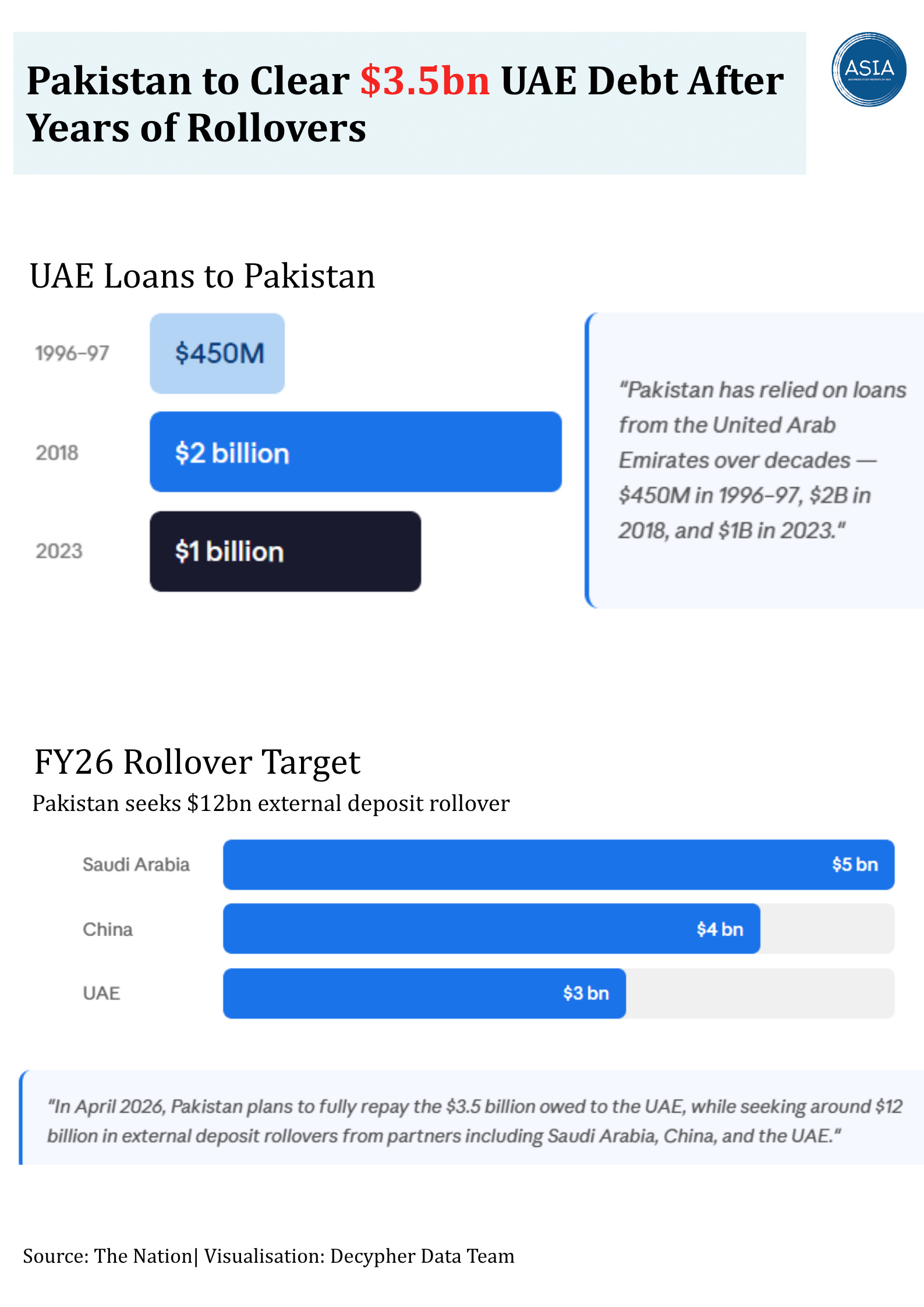
Pakistan is set to repay $3.5 billion to the UAE by month-end, including a $2 billion deposit extended in 2018, a $1 billion loan provided in 2023, and an older $450 million loan dating back to 1996–97. The 2018 facility had been rolled over annually after Pakistan was unable to repay it on schedule.
— — —
Long View: Preksha Jalan- Assistant Program Officer in the Digital History Lab at The Advanced Study Institute of Asia (ASIA), affiliated with SGT University, Gurugram.
Essay: Amogh Dev Rai
Data: Bhupesh
Produced by Decypher Team in New Delhi, India
— — —