

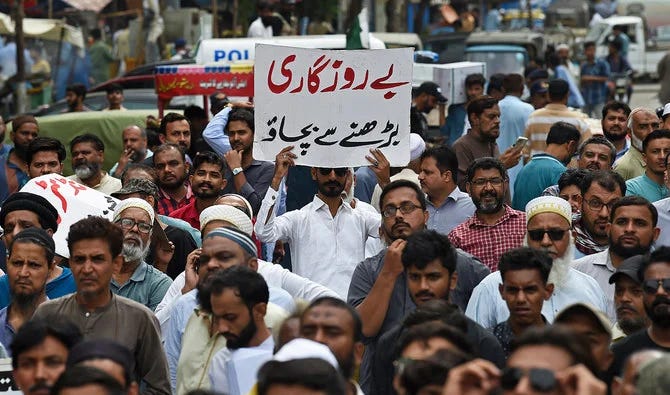

Pakistan is again visible abroad. It has kept channels open with Iran, remained tied to the Gulf, negotiated under IMF discipline and tried to position itself as useful in moments of regional tension. That external relevance matters, but it does not settle the domestic question now sitting beneath the budget: what does a young, nuclear-armed, security-heavy state do when its economy stabilises faster than its labour market?
The worker who best explains that question is not necessarily unemployed. He may be driving a rickshaw in Lahore, working longer hours, paying more for fuel and still finding that the job no longer covers the cost of doing it. The problem is not absence from the labour market. It is that work no longer reliably becomes security.
Pakistan’s latest Economic Survey gives the government a balance-sheet story. It reports a primary surplus, stronger reserves and growth returning after the crisis years. The same survey, according to Dawn’s reporting on the Economic Survey, places poverty at 28.9 per cent, rural poverty at 36.2 per cent and urban poverty at 17.4 per cent. The budget will foreground the first set of numbers because they speak to fiscal consolidation and lender confidence. The household ledger begins with the second. Stabilisation is not recovery, and a primary surplus is not a paycheque. The budget process made that hierarchy visible. Before the government could present recovery to citizens, it had to settle the terms of credibility with the IMF. Reuters reported that the budget was delayed amid IMF negotiations, oil price pressures from the war in Iran, and disagreements over provincial fund reallocations. When the budget was presented, Reuters reported that it raised defence spending while squeezing development spending to meet IMF goals. The state could show discipline, but the discipline itself narrowed the room for household relief.
Beneath those fiscal numbers lies the labour-market intake problem. Pakistan has to create work for new entrants before it can reduce the existing backlog. East Asia Forum estimates that the economy is unable to absorb more than 3.5 million new labour-market entrants each year. Growth in FY2024–25 was around 3 per cent, close to the population growth rate, while Pakistan needs sustained growth of 6 to 7 per cent to absorb entrants and reduce unemployment. The country is producing workers faster than it is producing work, so each year’s new entrants add to a backlog the economy has not cleared. The unemployment rate has to be read through the lens of this intake pressure. Gallup Pakistan’s analysis of the Labour Force Survey 2024–25 places unemployment at 6.9 per cent under the 13th ICLS framework, up from 6.3 per cent in 2020–21. East Asia Forum uses an 8 per cent estimate. The difference reflects method, informality and framework. The structural risk lies less in choosing between the two than in recognising that macro-stability has arrived before labour absorption.
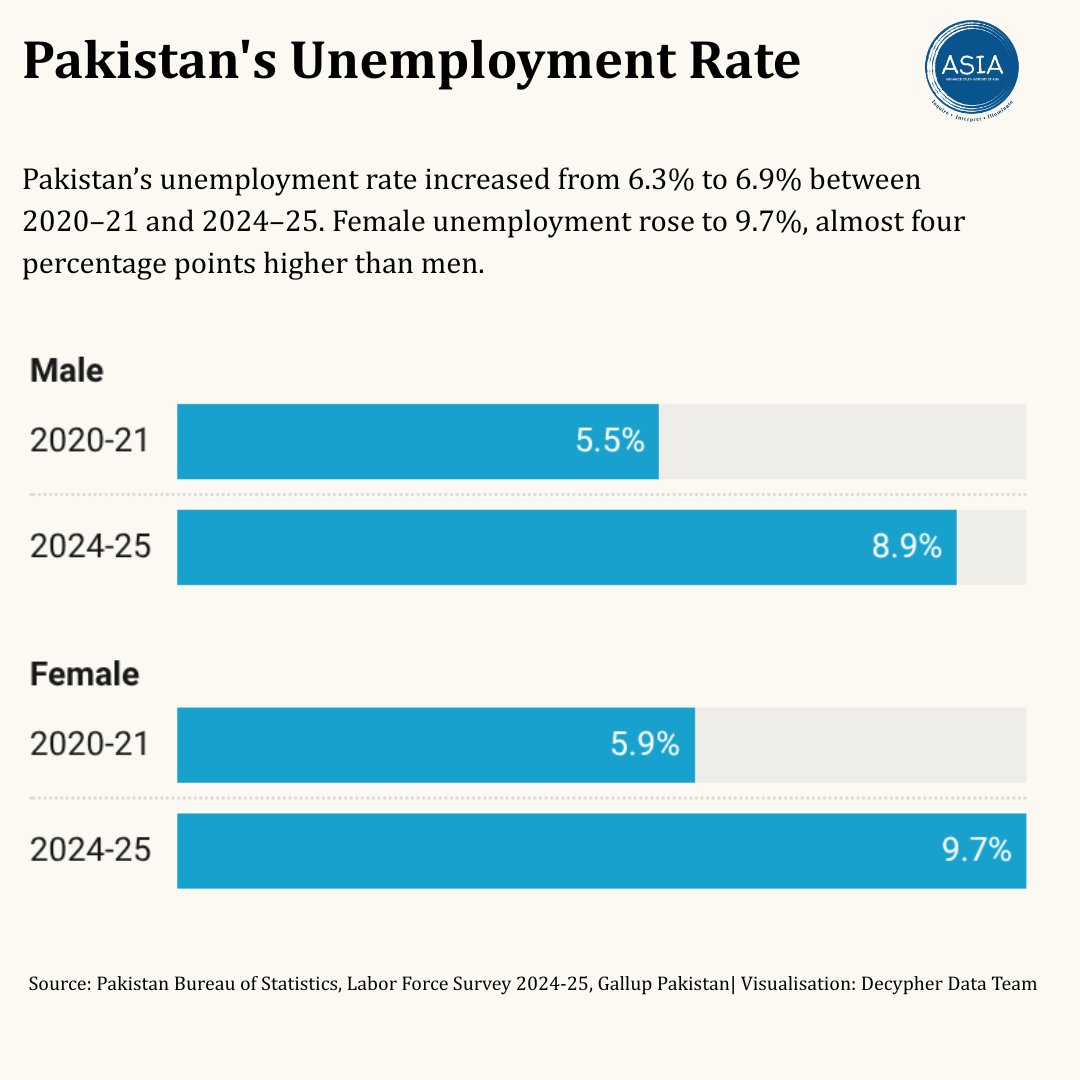
Pakistan’s young population sharpens the risk. Nearly two-thirds of the country is under 30, a demographic fact noted by the Centre for Research and Security Studies. In policy language, this is a dividend. In the labour market, it is also a queue. Gallup’s disaggregation shows where the queue is most difficult to enter. Youth unemployment among those aged 15 to 24 stands at 12.5 per cent. Female unemployment is 9.7 per cent against 5.9 per cent for men, while urban women face unemployment of 17 to 18 per cent. Pakistan is not merely failing to create enough jobs for young people; it is failing most sharply where young women try to convert education into paid work.
These numbers carry a Pakistan-specific weight. This is not a generic labour-market case. Pakistan is a nuclear state with a powerful security establishment, uneven provincial development, recurring IMF dependence and a history of militancy. The TTP has not disappeared; the UN Security Council’s sanctions listing describes it as a Pakistan Taliban alliance rooted along the Afghanistan-Pakistan border. Unemployment does not mechanically produce extremism. Prolonged youth exclusion does, however, enlarge the field of grievance from which many actors can draw: parties, clerics, patrons, migration agents, protest movements and, at the margins, coercive networks. A weak labour market is therefore not only an economic inefficiency. In Pakistan, it is a question of stability.
The same shock also travels differently across class and province. A higher bill or water shortage in parts of Lahore may be managed through storage, tankers or private arrangements. In rural Sindh, south Punjab or Balochistan, similar stress can mean lower yields, fewer workdays, more debt or another push toward migration. Pakistan does not have one household ledger. Class, province, gender and access to informal buffers decide how far a household can absorb the same macro shock. The education-to-work pipeline deepens this mismatch. Pakistan’s young people are not excluded only because there is no work. Many are being prepared for a labour market that does not exist in the form promised to them. Paradigm Shift points to rote-learning education, weak vocational systems and poor alignment between training and industry demand. Certification has moved faster than capability. Entrepreneurship is offered as an escape route, but the same analysis notes that fewer than 5 per cent of young Pakistanis have access to formal credit. Without credit, networks and market access, self-employment becomes less a ladder than a holding pattern. Much of what is called entrepreneurship is closer to survival work.
Migration has thus become a more reliable release valve. More than 860,000 Pakistanis registered for overseas employment in 2023, and outward flows have continued since, according to the Bureau of Emigration and Overseas Employment. Remittances remain crucial for households, paying for food, rent, education, healthcare and debt. But in this labour-market context, they increasingly function as distress insurance rather than development capital. A country that exports young workers because it cannot employ them at home is managing pressure by letting them leave.
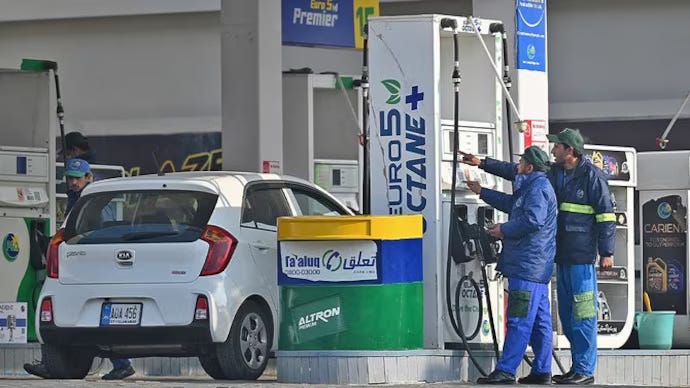
Fuel prices make the pressure visible on the street. Pakistan’s dependence on imported energy leaves workers exposed to global prices, while IMF limits narrow the fiscal room to cushion them. Al Jazeera’s April 2026 reporting captured this through Lahore’s rickshaw drivers protesting rising fuel prices. Kaiser Bengali’s phrase, “absolute dependency”, names the bind: pass costs to consumers and absorb anger, or subsidise and breach fiscal limits. The contradiction echoes Pakistan’s power-sector problem more broadly: the state can speak of surplus electricity, data centres and digital ambition, but for workers and small firms, electricity still arrives as tariff pressure, load uncertainty and another cost of staying productive. The rickshaw driver is not decorative. He shows why employment alone cannot measure recovery. Fuel raises the cost of work itself.
The digital economy is expected to soften this labour market pressure. Freelancing, remote work and IT-enabled services are presented as ways for young Pakistanis to bypass a weak domestic jobs market. Yet the state’s internet policy often runs counter to that ambition. Reuters reported that Pakistan’s software industry warned of losses of up to $300 million from firewall-related disruptions, while The Guardian reported slowdowns affecting IT firms, online classes, freelancers and client deadlines. The contradiction is direct: the state encourages young people to work online while weakening the connectivity on which that work depends. Social media gives these pressures political form before they reach formal politics. Pakistani X does not create inflation, fuel costs, electricity bills or joblessness. It gives them a public grammar. A young graduate unable to find work, a freelancer losing clients because of slow internet, and a rickshaw driver paying more for fuel are not experiencing the same problem in the same way. Online, they become part of a single narrative: recovery is announced before it is felt.
Pakistan may gain international room by being useful to Iran, the Gulf, and the United States. It may satisfy lenders through a primary surplus and stronger reserves. But one can only go so far on geopolitics if the domestic picture keeps narrowing. The government has stabilised the economy by many of the metrics the IMF measures, and a few that a twenty-three-year-old looking for a first job can feel. The primary surplus is real. So is the 12.5 per cent youth unemployment rate. Both are true. Only one of them votes, protests, emigrates, or enters the informal networks through which grievance is organised.
Essay: Preksha Jalan- Assistant Program Officer in the Digital History Lab at The Advanced Study Institute of Asia (ASIA), affiliated with SGT University, Gurugram.
Produced by Decypher Team in New Delhi, India