


The Population Challenge Facing Pakistan
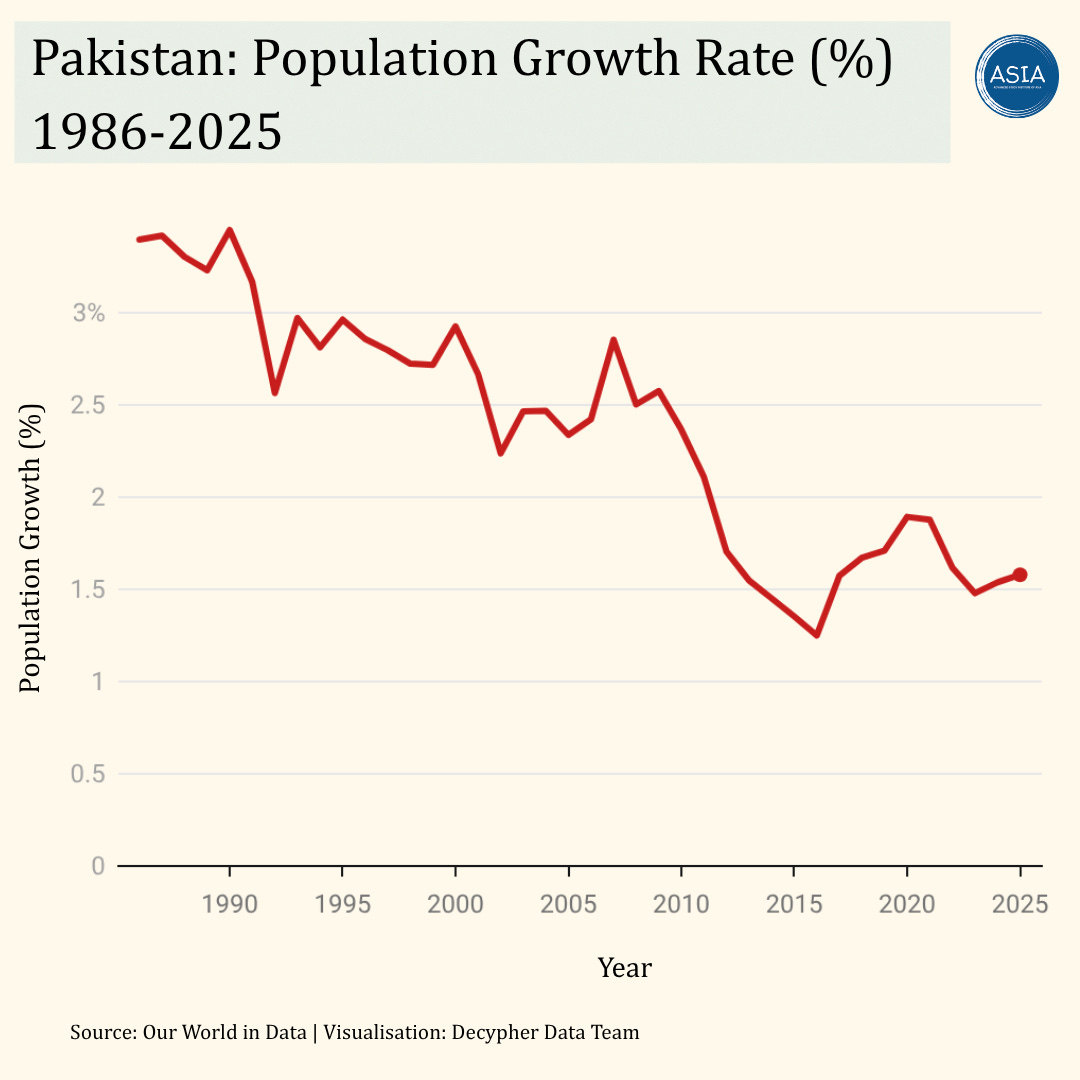
Pakistan's population is growing at 6.2 million per year. The country will be the world's fourth most populous within five years. Those are the health minister's numbers, not an opposition talking point. The question the Dawn editorial raises but does not answer is: what happens if the trajectory holds?
The structural arithmetic is not complicated. Pakistan's public debt stands at 70.7 per cent of GDP, breaching its own statutory ceiling of 56 per cent by fifteen percentage points. Exports have collapsed from 16 per cent of GDP in the 1990s to 10.4 per cent. The economy grows at roughly 3 per cent per year. The population grows faster than the state's capacity to absorb it. Every hospital, school, road, and water system is being asked to do more with less, and the gap is widening.
Run this forward. A Monte Carlo simulation calibrated against Pakistan's Fragile States Index history — which has averaged 98.2 since 2007, peaking at 104.1 in 2009 and briefly touching 89.7 in 2022 — produces a median trajectory that crosses back into the Alert tier (FSI ≥ 100, alongside Nigeria and Zimbabwe) by 2033 under baseline assumptions. That is not a catastrophe scenario. That is structural pressures continuing as they are, with no major shock and no major reform. By 2040, the median baseline FSI reaches 105. By 2050, 109 — the edge of state failure as measured by the Fund for Peace.
The crisis scenario, which layers in climate tail risk, debt default, and security deterioration at historically observed probabilities, reaches Alert by 2031 and Somalia tier by 2039. The reform scenario — sustained demographic intervention, export rebuilding, institutional coordination — holds Pakistan around 98–101, oscillating at the boundary indefinitely. That is the Bangladesh path. It requires exactly what Dawn describes: family planning infrastructure in underserved areas, girls staying in school, fiscal incentives that stop rewarding population size, and governance that stops operating in silos.
Pakistan has entered 25 IMF programmes since 1950. It has recognised the population problem for decades. The editorial is right that this is not about fate but about governance. But the model's uncomfortable output is that baseline governance — the governance Pakistan actually delivers, not the governance it announces — produces reversion to a mean that already sits inside the Alert zone. The 2018–2022 improvement was the anomaly. The question is not whether Pakistan can reform. It is whether it can reform faster than it reproduces. The numbers say the window is roughly seven years.
https://www.dawn.com/news/amp/1988934

The War on the Unfinished Border
Wars do not vanish because they are small. They vanish because they unfold on the wrong edge of the map and inside the wrong hierarchy of attention. The current Afghanistan-Pakistan conflict is one such war. Since late February, Pakistani strikes inside Afghanistan, Taliban retaliation, collapsed truces, and Chinese mediation have produced the most severe fighting between the two neighbours since the Taliban returned to Kabul in 2021. Yet the conflict still tends to appear in fragments: a strike here, a ceasefire there, a casualty count, a diplomatic meeting. Seen that way, it looks like another difficult month on a difficult frontier. Seen whole, it looks more troubling: a war on an unfinished border, driven by a militant problem neither side can honestly resolve and made easier to ignore because it is legible only in pieces.
The first mistake in reading the crisis is conceptual. It is tempting to say that Pakistan is fighting “the Taliban,” and leave the matter there. But the Afghan Taliban and the Tehrik-e-Taliban Pakistan are not the same organisation. The Afghan Taliban are the rulers in Kabul, a movement that returned to power in 2021 after two decades of insurgency. The TTP is a Pakistani militant network that seeks to overthrow the Pakistani state and build its own emirate inside Pakistan. The two are allied, ideologically close, and historically intertwined, but they are not organizationally identical, and they do not occupy the same political position. Al Jazeera’s April 2 report put the point plainly: the TTP is “separate from but allied with” the Afghan Taliban. Reuters, in its backgrounder on the conflict, notes that the TTP fought alongside the Afghan Taliban against U.S.-led forces and hosted Afghan fighters in Pakistan. That distinction is not a technicality. Without it, the present war collapses into a blur of militant sameness and loses its real political shape.
Once that distinction is made, the crisis becomes harder, not easier, to explain. Pakistan’s case is not invented. Islamabad has argued for years that anti-Pakistan militants operate from Afghan territory and that Kabul has either tolerated or failed to restrain them. During the latest China-mediated talks, Pakistan again insisted that any serious process depends on “visible and verifiable” action against militants using Afghan soil to attack Pakistan. Kabul, for its part, denies harbouring such groups and says militancy inside Pakistan is Pakistan’s own internal problem. Both claims contain enough truth to sustain escalation and too little shared ground to produce trust. Pakistan is not wrong to see a threat. But Kabul is not a switchboard that can simply turn the TTP off without political consequences to itself. A government that came to power claiming it had expelled foreign domination cannot easily accept a framework in which a neighbour reserves the right to bomb Afghan territory until it is satisfied with Afghan behaviour. The result is a conflict in which counterterrorism language and sovereignty language now feed each other rather than contain each other.
The border deepens this impasse. The Durand Line is not merely where the conflict is happening. It is one reason the conflict cannot be stabilised by force alone. Established in 1893 between British India and the Emirate of Afghanistan, and inherited by Pakistan after 1947, it never became politically natural in Afghan eyes. The 1,600-mile frontier separating Afghanistan and Pakistan is a colonial inheritance that lives on in the present, not only as a line of control but as an unresolved argument about authority, mobility, and who gets to define security in the borderlands. The line was always more than a cartographic boundary. It cut through older social and tribal geographies while demanding the obedience owed to a modern frontier. To say that this is a war on an unfinished frontier is not a rhetorical flourish. It is the most precise way of naming a space where state sovereignty has always rested uneasily on top of older social geographies and older political refusals. Moreover, Pakistan once saw the Afghan Taliban as strategically useful, but Taliban-ruled Afghanistan has not yielded the compliance Islamabad expected after 2021. What was once treated as “strategic depth” now appears, from Pakistan’s perspective, as strategic blowback.
This is also why the present escalation should not be mistaken for routine frontier turbulence. Tensions have been building since at least October 2025, when serious clashes killed dozens before outside mediation produced a ceasefire that did not hold. The latest phase sharpened in late February 2026, when Pakistan escalated with deeper strikes inside Afghanistan and the Taliban retaliated. Reports describe air and ground operations, repeated exchanges along the border, the collapse of an Eid pause, and the reopening of talks in Urumqi under Chinese sponsorship. Diplomacy and violence now proceed in parallel, as though each has accepted that the other will continue. That is usually a sign that a conflict has crossed a threshold: it is no longer an interruption to politics but one of politics’ working forms. But the most important thing about the war is not what officials say it is. It is what the conflict becomes when lived from the borderlands. The humanitarian dimension is too often described as collateral damage, but that language is far too weak. In eastern Afghanistan, the war is not experienced only in the moment of impact. It is experienced in what follows: the road that no longer feels safe to travel, the crossing that closes, the clinic that cannot restock, the market that thins out, the village that empties because staying has become indistinguishable from waiting to be hit. Reuters reported that more than 100,000 people were displaced by the fighting by early March, and that shelling was hitting border communities during Ramadan evenings as families gathered to break their fast. According to UNAMA, at least 42 Afghan civilians were killed and 104 wounded between February 26 and March 2 alone.
This matters because coercion on a frontier is rarely exhausted by the strike alone. It travels outward into the texture of everyday life. A blocked crossing, a damaged road, a district cut off from supplies, a family displaced before harvest, a clinic overwhelmed not just by the wounded but by the fragility of everything around it. These are not secondary details to the conflict. They are part of the way the conflict works. Pressure exerted by one state on another is not absorbed only by military installations or ministries. It is absorbed by civilians, by circulation, by the routines that make ordinary life possible. AP’s reporting from Asadabad, where shelling killed one person and wounded more than a dozen, mostly women and children, captures the violence at the level of a single episode. Other local reporting from the Afghan side describes emptied villages, broken roads, medical shortages, and districts pushed toward blockade conditions. Whether or not civilians are the declared object of coercion, civilian vulnerability becomes one of the mediums through which the contest is made felt.
Pakistan’s stated demand is action against militants. But because it cannot compel trust, and because Kabul cannot concede without weakening its own claim to sovereign legitimacy, pressure is increasingly communicated through force whose effects radiate outward into civilian life. When roads close, markets empty, crossings harden, and displacement spreads, the state on the other side is being pressured not only through battlefield losses but through the visible disorder of the society it claims to govern. That is the deeper tragedy of the conflict: civilian suffering does not remain outside the strategic logic. It becomes structurally useful to it. The border war is not only killing civilians; it is turning civilian life into a pressure point.
Pakistan’s own internal pressures help explain why this politics of force has hardened. It would be simplistic to call the war a diversion; the TTP threat is real. But it would be equally naive to pretend domestic strain does not shape Islamabad’s response. The Associated Press reported in January that 2025 was Pakistan’s deadliest year in over a decade, with combat-related deaths up 74 per cent according to an independent think tank. At the same time, Pakistan is under acute economic stress. The government sharply raised fuel prices for the second time in less than a month because of the wider Middle East conflict, only to reduce them amid public outrage. In that context, force on the Afghan frontier is not merely military action. It is also a performance of state resolve at a time when both insecurity and economic pain are politically dangerous.
There is a final irony here. Pakistan has, at the same time, sought to present itself as a useful interlocutor in the broader West Asia crisis. Reuters and other outlets have reported on Islamabad’s diplomatic activism around Iran even as fighting with Afghanistan continued, and fresh talks were being held under Chinese auspices. That coexistence matters. A state can be read as a mediator in one theatre and a belligerent in another, without either role cancelling the other. The consequence is not simply hypocrisy. It is selective scrutiny. Strategic usefulness elsewhere can soften attention to coercion on a frontier that the world still treats as familiar, difficult, and therefore somehow less urgent. Afghanistan, by contrast, has little capacity to shape how this war is narrated beyond protesting civilian harm and denying Pakistani accusations. That asymmetry of narrative power is part of why the humanitarian dimension keeps appearing as fallout rather than as the core of the conflict’s lived reality. China’s role throws this into even sharper relief. Beijing is no longer a distant observer issuing generic calls for restraint. In April, China held high-level calls with both foreign ministers, sent a special envoy in March, and said talks were “advancing steadily.” It was reported that the agenda in Urumqi was not only a ceasefire but also the reopening of border crossings for trade and travel. That is crucial. It means the conflict is now being managed not just as a military dispute but as a threat to circulation itself: goods, people, border commerce, regional connectivity. China’s intervention is therefore not a sign that peace is near. It is a sign that the war has become too consequential to be left entirely to the two parties most invested in narrating it past each other.
That is where much of the existing coverage, though valuable, remains incomplete. The global media at large has either ignored the conflict or has limited it to event form: strikes, claims, talks, resumptions, casualties. Regional coverage often places the same events inside a wider diplomatic and geopolitical frame. The difference is not that one set of outlets sees the war, and another does not. It is that the war enters different narrative hierarchies. In one register, it appears as a security flare-up. In another, it appears as part of a larger contest over order, mediation, trade routes, and regional influence. That difference in framing matters because wars are not only fought on territory. They also fought over the terms in which they became intelligible.
The concepts that best illuminate this crisis are therefore not grand abstractions but modest, precise ones. This is an unfinished border. It is a case of securitisation, in which cross-border militancy is cast as intolerable and externally located, making coercive force seem more available than political ambiguity. It is also a case of strategic neglect, in which a war can be visible enough to be reported and remain under-framed. But above all, it is a conflict in which each side’s most defensible claim sustains the other side’s most dangerous fear. Pakistan sees a real militant threat and concludes that pressure is necessary. Kabul sees pressure and concludes that sovereignty is the real target. Civilians experience the result as shelling, displacement, road closures, and the knowledge that their suffering enters the world mainly as an intermittent update.
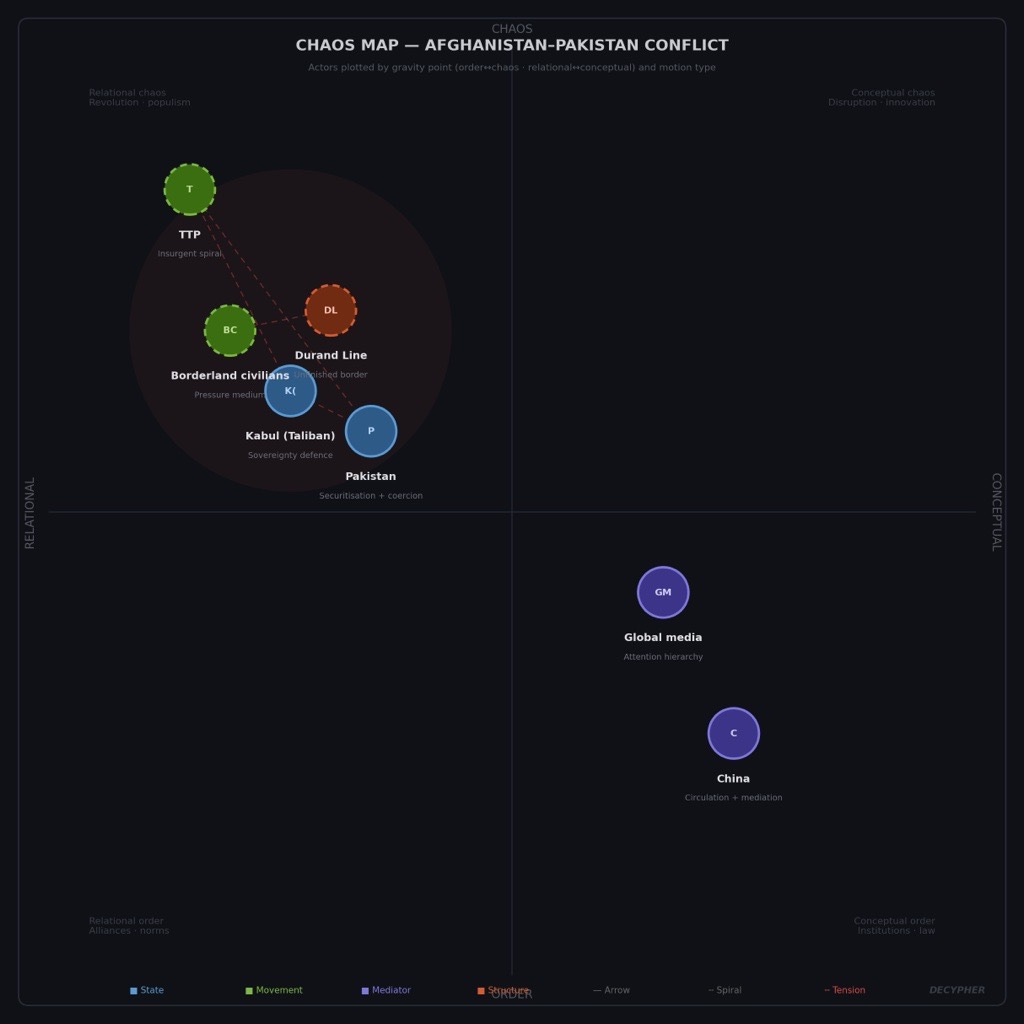
The conflict cluster sits deep in relational chaos: Pakistan, Kabul, the TTP, borderland civilians, and even the Durand Line occupy the same unstable zone. There is no shared legal framework, accepted border regime, or institutional arbiter. The dispute is therefore fought through relational leverage — coercion, sovereignty claims, tribal loyalties, and narrative control.
Pakistan operates in arrow motion: goal-directed and outwardly integrative, trying to frame the conflict as counterterrorism. But its centre of gravity is pulled back into chaos by the TTP threat and domestic fragility. It aims at order, but acts from instability, which is why coercion spills into civilian life rather than resolving the conflict.
Kabul sits nearby, but deeper in chaos. Its sovereignty claim is defensive, not institution-building, and it cannot concede without undermining its own legitimacy. The TTP is the system’s deepest chaos actor: adaptive, non-linear, and resistant to integration.
Forecast: Without a conceptual anchor entering the conflict cluster: a border agreement, an institutional framework, a shared legal grammar, the system will continue cycling between coercion and truce. China’s arrow motion toward mediation is the only structural force capable of pulling actors toward order, but its distance from the cluster means progress will be slow and fragile. The most likely near-term trajectory: oscillation, not resolution.

When the State Logs In: The Quiet Merger of Power and Platforms
The relationship between governments and social media platforms has historically been characterised by tension, negotiation and, at times, outright resistance. However, recent developments suggest a fundamental shift in this dynamic. The diplomatic cable issued by US Secretary of State Marco Rubio, which explicitly endorses Elon Musk’s platform X as a tool for American diplomacy and psychological operations, marks a critical turning point. As analysed in Kate Klonick’s article, “The State Department’s X Directive and the End of Platform Independence”, this directive signals not merely a policy change, but a structural transformation in the role of digital platforms within state power.
Historically, such a directive would have been considered extraordinary, if not unthinkable. Major US technology companies such as Google, Facebook and Twitter, prior to its acquisition by Elon Musk, often positioned themselves as independent actors resisting government intrusion. For instance, Google famously withdrew its search engine operations from mainland China rather than comply with censorship demands, while Twitter challenged government requests for user data and content removal. These actions reflected a broader institutional norm: that platforms should act as intermediaries, not instruments of state power.
This norm was underpinned by both legal and cultural factors. In the United States, the First Amendment establishes a strong presumption against government interference in speech. While private companies are not directly bound by the First Amendment, they have traditionally operated within a legal environment that discourages state coercion or influence in content moderation decisions.
Platforms like Twitter and Facebook frequently positioned themselves as neutral arbiters of global discourse, occasionally resisting government data requests and asserting their operational independence through transparency reports and legal challenges.
The Symbolic Power of the “X Directive”
The X directive represents a departure from these established principles. Rather than resisting state influence, the platform is now explicitly integrated into government strategy. This shift reflects broader structural changes in the technology ecosystem. Over time, the legal accountability, operational independence, and institutional resilience of platforms have been eroded, making closer alignment with state power not only possible but, in some cases, normalized.
One way to understand this transformation is through Jack Balkin’s speech triangle, which conceptualizes the relationship between the state, private platforms, and users. Traditionally, this triangular model distributed power in a way that enabled platforms to act as a buffer between governments and citizens, thereby enhancing freedom of expression. However, as the relationship between the state and platforms grows increasingly collaborative, this triangle risks collapsing into a more centralized structure of control. The convergence of state and platform power can marginalize users, reducing their autonomy and exposing them to coordinated information campaigns. By naming X, the administration has effectively signalled that the platform is no longer merely a private forum, but a strategic asset of the American state.
The Erosion of Accountability and Independence
Klonick argues that this shift did not happen in a vacuum; it is the result of systematic dismantling of the legal and operational safeguards that once ensured platform independence. To understand this collapse, one must look at the structural changes within the platforms themselves.
Before its acquisition by Elon Musk, Twitter was a publicly traded company. This status imposed specific requirements: pressure from a diverse board of directors, and the need to appease a broad base of advertisers who demanded predictable content moderation. These corporate accountability architectures provided a buffer against government overreach. When Musk took the company private, these buffers vanished.
This privatization turned the platform’s amplification and suppression mechanics into tools that could be deployed based on personal preference rather than standardized policy. As Musk became a central figure in U.S. politics, the line between his private interests and state objectives began to blur. The X Directive is simply the formalization of a reality where a platform’s owner is closely aligned with the administration’s ideological and strategic goals.
The “Collapse of the Triangle”
Traditionally, the digital ecosystem was envisioned as a triangle with three distinct nodes: state power, private platforms, and the users. The independence of the platforms was supposed to protect users from the state, and the state was supposed to regulate platforms to protect users.
The X Directive represents a collapse of this triangle. When the state and the platform form a symbiotic relationship the two most powerful nodes merge, leaving the third node i.e. the user more vulnerable. Klonick notes that this alignment allows the government to route around privacy laws and surveillance protections. If a platform is an enthusiastic partner in state messaging, it may be less inclined to resist data requests or challenge the constitutionality of government-directed censorship or amplification.
Strategic Consequences: Diplomacy and Psyop
The directive identifies five operational goals: countering hostile messaging, expanding information access, exposing adversarial behaviour, elevating sympathetic local voices, and telling America’s story. By instructing embassies to recruit local influencers and community leaders to carry U.S.-funded messaging via X, the State Department is effectively privatizing diplomacy.
However, the alignment with military psychological operations introduces a more complex dimension. Diplomacy is traditionally overt, whereas psychological operations may involve subtle or indirect forms of influence. When both operate through the same platform, the credibility of official messaging may be undermined. If users perceive X as a preferred tool for state-aligned communication, they may begin to question the authenticity of all content on the platform, including that produced independently.
Conclusion
The State Department’s X Directive is more than a change in diplomatic strategy; it is a moment that requires deep contemplation as the historical role of the state as the regulator of the internet undergoes a monumental change. The integration of private tech oligarchs into the machinery of state propaganda suggests a future where our information environments are shaped not by transparent policies or democratic consensus, but by the shared interests of state actors and the owners of the platforms we inhabit. This development raises serious concerns about freedom of expression, democratic accountability, and the integrity of online discourse. As governments and platforms continue to navigate this evolving landscape, it is essential to reaffirm the principles of transparency, independence, and user autonomy that have historically underpinned the internet’s role as a space for open and democratic communication.

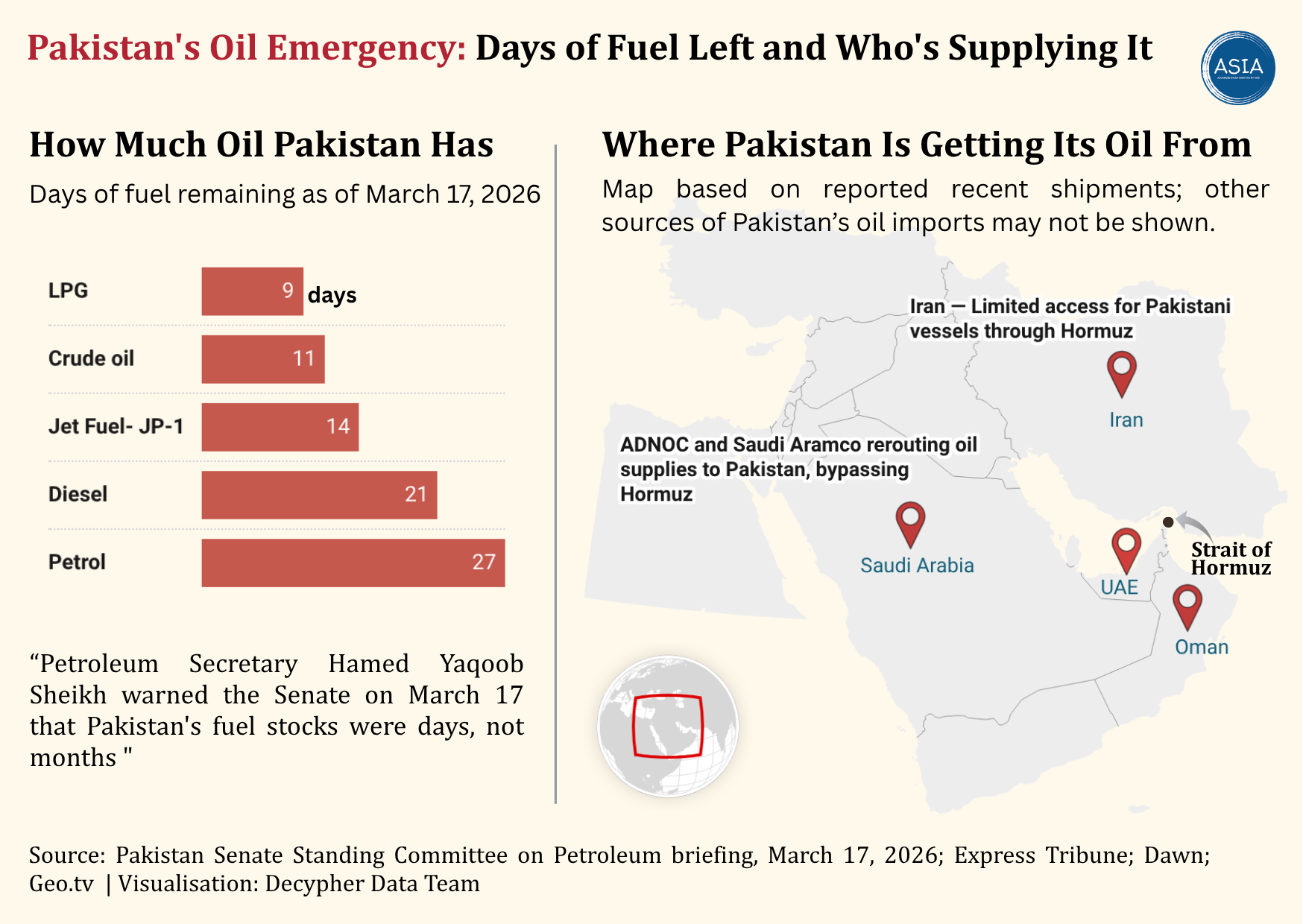
As of March 17, 2026, Pakistan had 27 days of petrol reserves and 21 days of diesel stocks remaining, according to the Senate Standing Committee on Petroleum briefing. Emergency fuel supplies are coming primarily from Saudi Arabia and the UAE, with some shipments being rerouted to bypass the Strait of Hormuz and limited passage allowed for select Pakistani vessels.
— — —
Long View: Amogh Dev Rai- Research Director at the Advanced Study Institute of Asia (ASIA), affiliated with SGT University, Gurugram.
Essay: Preksha
Microessay: Shivani
Data: Bhupesh
Produced by Decypher Team in New Delhi, India
— — —