


“Strategic depth” entered Pakistan’s military vocabulary on a hot August day in 1988, weeks after General Zia-ul-Haq’s plane fell out of the Punjab sky, when General Mirza Aslam Beg first used the phrase before his officers at General Headquarters. Beg would later insist he never meant the crude version — the army falling back into Afghanistan if India came over the eastern plains — but the phrase escaped him and took on a life. The man who built the machinery to make it real was his spymaster, Lieutenant-General Hamid Gul, the ISI chief who had armed and blessed the Afghan mujahideen and dreamed of a Kabul that would be Pakistan’s protected hinterland: a backyard with the gate bolted from Rawalpindi’s side.
The idea outlived both men. It survived the first Taliban emirate, the long American interregnum, the insurgent years. When Kabul fell a second time in August 2021 and Imran Khan declared that Afghans had broken the shackles of slavery, the old dream seemed finally to have come good. Pakistan had its friendly regime. The depth was banked.
Four and a half years on, the gate is open. The trouble is the direction of the traffic.
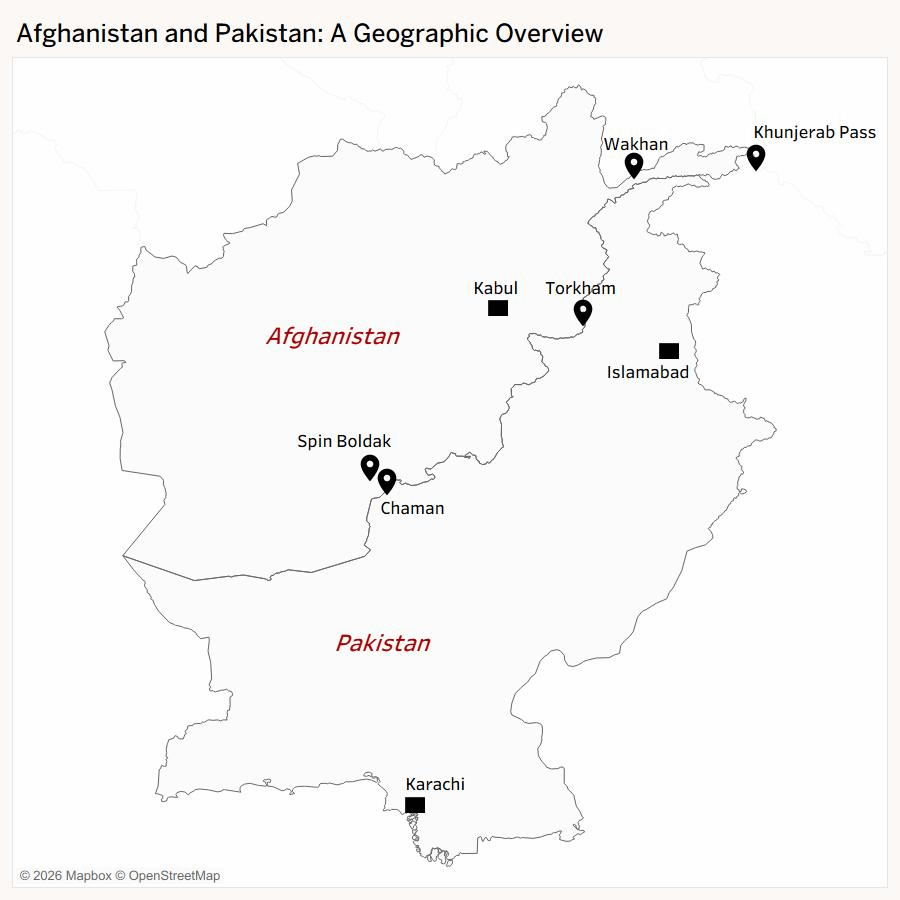
Since the border closures that began in October 2025, Pakistan has lost something on the order of $1.4 billion in disrupted trade, the bulk of it from the shuttering of the great frontier crossings at Torkham, Spin Boldak and Chaman. Transport firms that once lived off Afghan transit cargo have watched the business wither. These are not the numbers that matter most, though they are the ones Islamabad can bear to print. The number that should keep the planners awake is quieter: Afghan exports to the Central Asian states nearly doubled in a single year, from $122 million in 2024 to $216 million in 2025. Kabul now claims its trade with Iran has overtaken its trade with Pakistan. A landlocked country that depended on Karachi and the Khyber for thirty years is learning to live without them.
That dependence was Pakistan’s quiet leverage, worth more than any treaty. It is dissolving, and from both ends at once. Afghanistan is pushing its commerce west to Iran and north into Central Asia. But Pakistan, too, is routing around Afghanistan — opening a corridor to the Central Asian republics through China’s Khunjerab Pass and the Sost dry port, taking its first Kyrgyz shipment in April, and activating a crossing into Iran the same month to reach Turkmenistan and Uzbekistan. Each neighbour is amputating the other. The Durand Line that Sir Mortimer Durand drew through Pashtun country in 1893, the line Pakistan inherited as an asset, is being bypassed by the two states it was meant to bind.
This is the inversion that ought to frame everything else. Strategic depth was always a theory about geography as captivity: Afghanistan could not leave, so Afghanistan could be managed. Remove the captivity and the theory collapses. Pakistan spent four decades trying to prevent exactly the thing it has now produced — a Kabul that looks anywhere but east, and a frontier that has turned from leverage into liability. A border you cannot close, it turns out, is not an asset at all.
How did the captive walk out? Through the one thing the doctrine never priced in: that the Taliban in Kabul and the Taliban fighting Pakistan are cousins, not contradictions. The Tehreek-e-Taliban Pakistan shares the Afghan movement’s creed, its Pashtun base, its memory of the common war against the Americans. Islamabad’s demand that Kabul throttle the TTP asks the Afghan Taliban to turn on the men who fought beside them. They have declined. Pakistan answered with airpower — strikes on Kabul, Kandahar and Nangarhar, and the declaration in February of what its own defence minister called open war. Each strike has done what punitive bombing of an irregular enemy usually does. It has pushed Kabul and the TTP closer, and handed the Taliban a fresh grievance to wave while they walk toward the other doors.
Into all this the third player has stepped, with the soft tread it prefers. Since the start of April, Chinese diplomats have hosted Pakistani and Afghan envoys in Urumqi, quietly, without the photo-ops Western mediation cannot resist. Beijing dresses the effort in the gauze of Xi Jinping’s Global Security Initiative — commonality over difference, dialogue over force, the Asian way. The substance is harder and more local. China wants no instability near the corridor it has sunk tens of billions into, no sanctuary in Afghanistan for the Uyghur fighters it fears, and no collapse of a Pakistani client it has spent a generation cultivating. So it referees.
But look at what China is also doing while it referees. It is carving a road through the Wakhan Corridor to give Afghanistan direct access to Chinese markets, explicitly to cut Kabul’s reliance on Pakistan. It is the one outside power building the door that reliably opens. And so the ironies stack to the ceiling: Pakistan loses the transit it counted on; India loses the port it paid for; Iran inherits a terminal; and the only actor whose plan survives contact with reality is the one sitting at the head of the table in Urumqi. Beijing is mediating a quarrel whose resolution-by-rerouting funnels Afghanistan deeper into Chinese dependence. The mediator is also the beneficiary.
You would not learn much of this from the papers Pakistanis actually read. In the English press, written half for an outside audience, the war is at least visible — the open-war rhetoric, the body counts, the occasional admission that hard kinetic policy on this frontier leads into a cul-de-sac. Turn to the Urdu front pages and the story changes shape. There the enemy is never merely the TTP. It is the gathjor, the nexus — a single conspiracy fusing the secular Baloch separatists of the BLA, the jihadists of the TTP, the remnants of al-Qaeda and the hidden hand of India into one body operating off Afghan soil. The largest Urdu daily runs this on its front page, sourced to “security sources” and a nameless report, in the unmistakable diction of the establishment. That the BLA and the TTP despise each other, that one fights for an ethnic homeland and the other for a caliphate, does not survive the translation. The point of the nexus is not accuracy. It is to gather every wound into a single foreign knife.
And note the one thing the vernacular cannot print. In the Urdu story CPEC appears only as a victim — a thing the conspiracy wishes to wreck — never as a stake that Pakistan’s own choices have put at hazard. The trade walking out the back door does not appear at all. To print it would be to admit the depth is gone. So two registers run at once from the same headquarters: an outward face that can name the war, and an inward face that recasts it as a siege by a borderless enemy and quietly edits the strategic loss out of the national story.
Hamid Gul died in the summer of 2015, before the dream he built turned inside out. He would have recognised the machinery — the planted story, the invisible Indian hand, the faith that depth could be conjured by will and proxies. He would not have recognised the result. The doctrine promised a backyard that could not leave. What Pakistan has instead is a neighbour with a new set of roads, a patron who is also that neighbour’s customer, and a public being told, in its own language, that none of it is happening. The depth was always a fiction about geography. The geography, it turns out, had a door in it the whole time — and it opens toward Beijing.
Produced by Decypher Team in New Delhi, India