


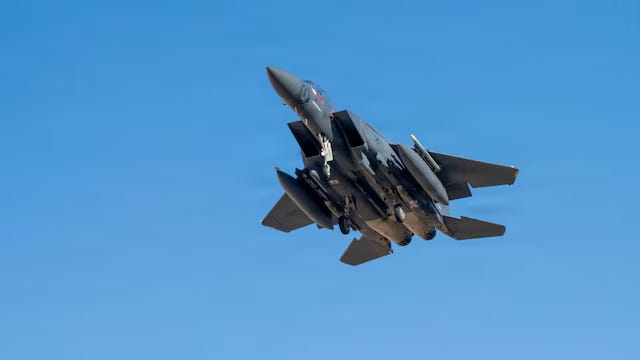
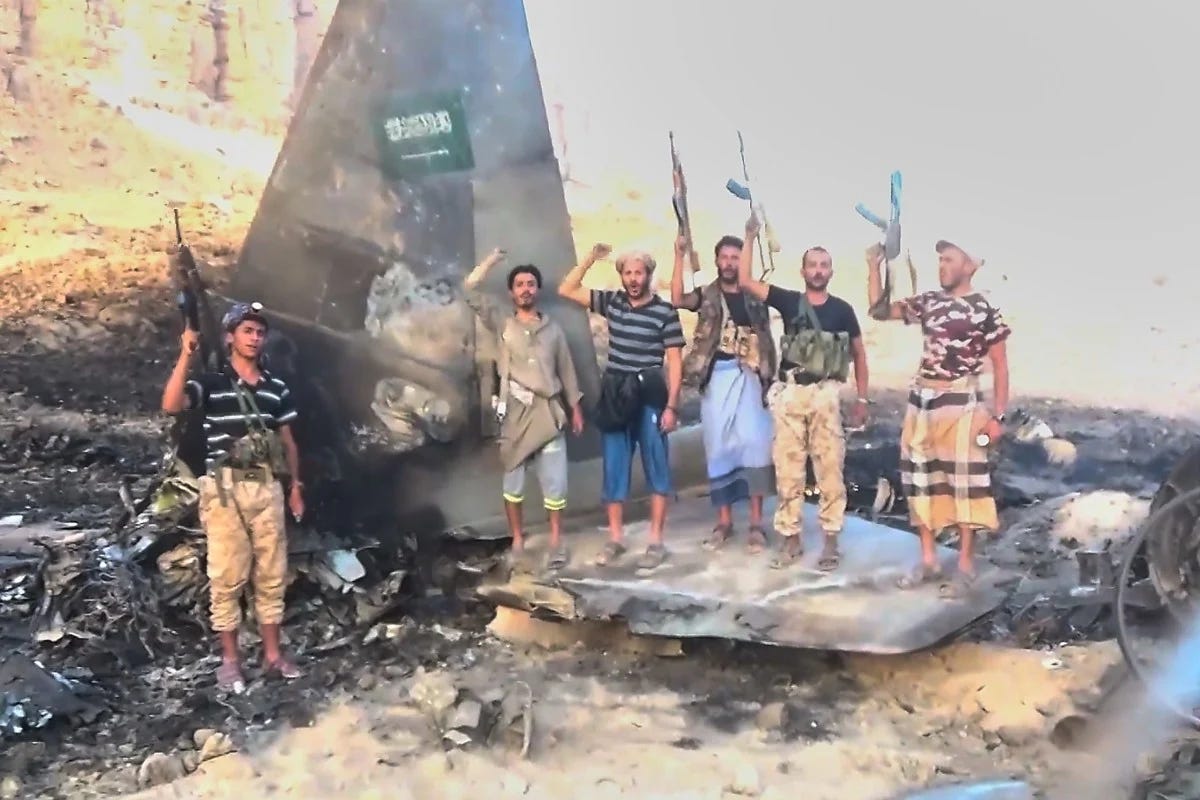
On the evening of 15 September 2026, the Saudi-led coalition reports that its air defences destroyed a Houthi drone south of Mecca before it reached the holy city’s prohibited airspace. The next day, the Houthi military spokesman, Yahya Saree, announced that his forces had shot down a Saudi F-15 over Marib with a locally made surface-to-air missile. Neither claim has been settled. The Houthis reject the Mecca account, and as of 24 September Riyadh has confirmed nothing about the jet or its two-person crew. The prevailing interpretation treats the pair as bait, an effort to draw Saudi Arabia into a wider war. This article argues that the evidence supports a different reading: a calibrated demonstration, in which one probe was designed to be intercepted, and one trophy was designed to be seen, addressed simultaneously to Riyadh, Tehran and Washington.
The evidentiary base is thinner than the volume of coverage suggests. The Mecca claim rests on a single official source, the statement of the coalition spokesman, Major General Turki al-Maliki, which describes the drone as the second attempt on the city after a ballistic missile on 27 July 2017. Sareereplied that Houthi targets were oil facilities and military bases, well away from the holy sites. No independent party has published material on the drone’s launch point or route. The accounts of the two sides therefore cannot presently be adjudicated.

The jet is better documented but no less incomplete. CNN geolocated the wreckage to Marib and noted that the Houthi footage said nothing of the two aircrew. TWZ read the tailfin as number 5539 of the 55th Squadron and identified the airframe as an F-15SR, one of 68 older F-15S jets rebuilt in Saudi Arabia, and not one of the 84 new-build F-15SAs. Early descriptions of the loss as that of the kingdom’s most advanced fighter were therefore overstated. The imagery establishes that a Saudi F-15 was destroyed and that Ansar Allah claims credit, and it does not establish the cause. Precedent sharpens the significance of Saudi silence. When the Houthis said in February 2020 that they had downed a Saudi Tornado, the coalition confirmed the loss through the Saudi Press Agency the following day. A prolonged absence of comment departs from that pattern, although the explanation could be operational security, the unresolved fate of the crew, or both.
Against that record, the Mecca episode reads as the manipulation of a threshold and not as an attempt to cross it. By the coalition’s own count, two attempts in nine years is a low tempo for a war of this length. The Houthis are Zaydis who also revere Mecca, so a genuine strike on the city would forfeit the religious legitimacy on which they draw at home, and Tehran has little reason to be associated with an assault on Islam’s holiest site. A drone stopped short of the city and followed by a denial is consistent with a pattern in which proximity is itself the message. The coalition’s “red line” rhetoric performs a parallel function. It fixes a public threshold, attracts diplomatic sympathy, and leaves the actual military response free to operate beneath it. This is an inference from pattern and cannot be demonstrated from the available record.
The F-15 claim carries a different payload. Saree named neither the missile nor the time of the engagement, yet asserted that Houthi batteries turned back two formations sent to search for the wreckage and that Saudi aircraft flew more than 450 strikes in a single week. None of this is verified, and each detail serves the narrative under construction. The underlying hardware is nonetheless credible. TWZ describes a Houthi air-defence architecture built from mobile launchers, repurposed R-73 and R-27 air-to-air missiles, and passive infrared sensors that give a pilot no radar warning of being tracked. It also counts around a dozen Saudi helicopters, five jets and as many as 30 drones lost between 2015 and 2022. Aircraft losses are thus a familiar feature of this war. What distinguishes the present claim is the type of airframe, its timing within a broad offensive, and the deliberate publicity attached to it.
The description “locally manufactured” addresses a further audience. G7 leaders on 22 September called on Iran to end its arming of the Houthis, and the United Kingdom told the Security Council that Iranian support continues to enable the attacks. Both statements treat supply as the lever through which the Houthi arsenal can be constrained. A domestic missile, whether real or merely asserted, contests that premise at negligible cost to Tehran, which benefits from a partner able to test Saudi defences at a distance.
If the bait thesis were correct, the Houthis would be expected to welcome a large Saudi response, and their circumstances make that improbable. They have just taken Mokha and, according to the G7 statement, the whole of Yemen’s Red Sea coast, gains that a major Saudi escalation would place at risk. Washington’s conduct also counts against the thesis. Reuters reported that US embassy staff met Houthi representatives in Muscat on 13 September, where the Houthis said they did not intend to attack American ships and remained bound by the 2025 ceasefire, and the State Department declined to comment on that specific meeting. President Trump said the Houthis had asked Washington to stay out, Vice President Vance confirmed direct contact, and the administration has rebuffed Saudi requests for direct intervention. Yet Washington has not left the field. The US embassy for Yemen affirmed solidarity with the Yemeni government, and CENTCOM cited a longstanding military relationship with Saudi partners. “Conditional distance” describes this posture more accurately than indifference, and the Houthi wager appears to rest on precisely that ambiguity.
The demonstration reading also explains the asymmetry between the two claims. The Mecca drone arrived with deniability built in. The F-15 arrived with video, a tailfin, and a crew status left deliberately unstated. In terms of Schelling’s account of coercion (Arms and Influence, 1966), both operate on the adversary’s perception of risk and impose no direct cost. They show what could be done and leave the other side to price it. For Riyadh, the signal is that air superiority over Yemen can no longer be assumed. For Tehran, it is that its partner retains escalation options at low cost. For Washington, it is that disengagement does not make Yemen cheap.
The strongest counter-evidence is the attack on Riyadh on 19 September. The coalition stated that it had destroyed a ballistic missile aimed at the capital, yet an AFP journalist observed an Aramco-marked fuel tank burning near King Khalid airport, and the State Department warned that the conflict had the potential to escalate rapidly. The Security Council’s statement of 18 September demanded that the Houthis halt their escalation and affirmed Saudi Arabia’s right to self-defence, which furnishes Riyadh with diplomatic cover for retaliation. Both episodes complicate a purely symbolic reading, since a strike that reaches the capital’s infrastructure imposes real costs, whatever its intended audience.
The two interpretations nonetheless generate different predictions. If strikes near Mecca recur with evident intent, or if Riyadh confirms the crew’s fate and commits to a sustained campaign, the provocation reading gains ground. If the Houthis continue to strike energy and airbase targets while avoiding the holy cities, and the Muscat channel remains open, the demonstration reading holds. The jet may never be verified beyond its wreckage. Saudi planners must nonetheless proceed as though the next one could fall the same way.
Essay: Maseera Shaik- Research Intern (Security, Crisis and Strategy) at The Advanced Study Institute of Asia (ASIA)
Produced by Decypher Team in New Delhi, India