


Lee Seung-ho did not borrow five times his savings because he wanted to become a trader. The 24-year-old student wanted an apartment before marriage. He turned 20 million won saved during compulsory military service into nearly 300 million won, then watched it disappear in four weeks as his brokerage sold his falling shares. Lee told Reuters that he would borrow again. His target remained a Seoul home, marriage and two children.
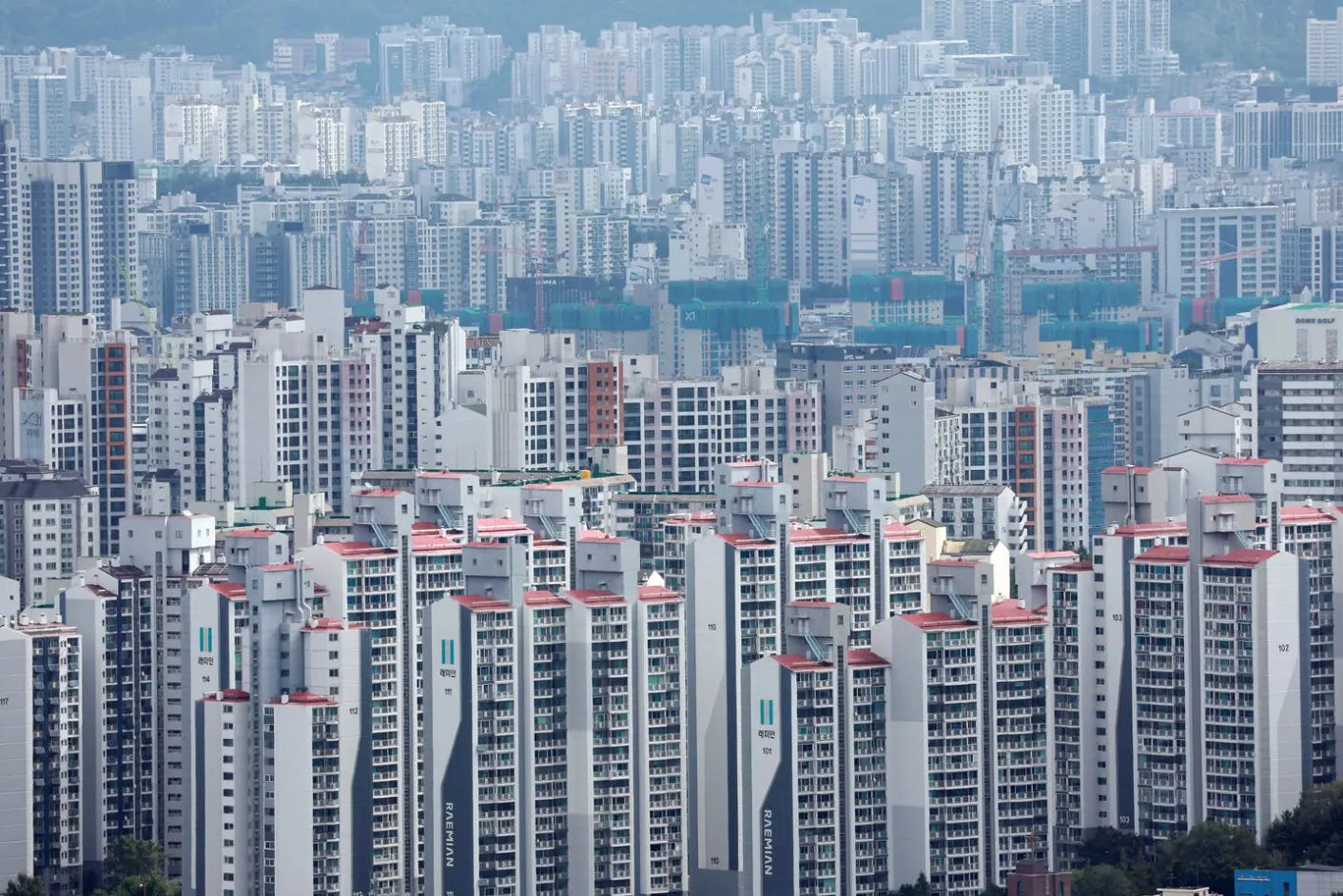
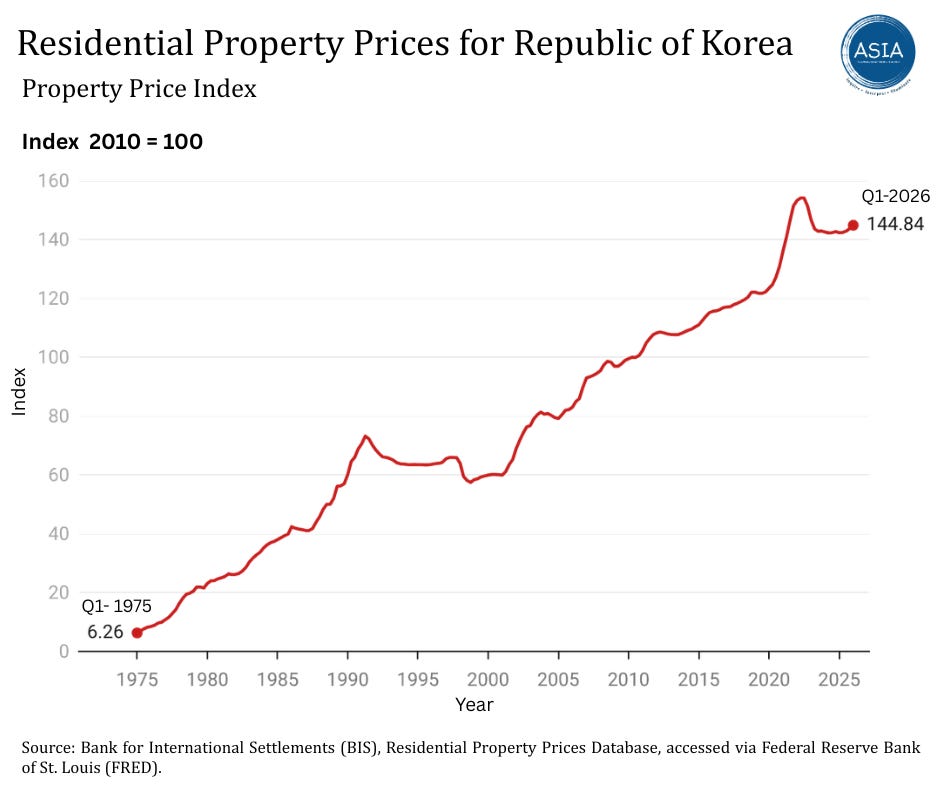
The distance between Lee’s savings and the life he imagines is written into Seoul’s housing market. The city’s median apartment price exceeded one billion won in 2024, having doubled in five years. In 2025, the mean age at first marriage reached 33.9 for men and 31.6 for women. The OECD estimates that the doubling of house prices between 2013 and 2019 reduced the likelihood of marriage by between 4 and 5.7 per cent. Where childbirth remains closely tied to marriage, the missing apartment delays more than the wedding. For an older generation, that distance was supposed to narrow through work. Korea’s government-led industrialisation created globally competitive exporters and attached a social promise to their success: education would lead to a secure company job, the job to property, and property to family life. Korea still builds advanced ships, cars, weapons and semiconductors. What has thinned is the route by which national prowess becomes ordinary security.
This ladder narrows at the entrance to stable employment. South Korea has the lowest share of large-company jobs in the OECD. The Korea Development Institute links this scarcity of “good jobs” to weaker social mobility, lower birth rates and the concentration of opportunity in Seoul. A few conglomerates offer wages and protections that much of the labour market cannot match. The economy remains world-class at the top while becoming less compelling below. Unable to close the gap through salaries, many young Koreans have turned to the companies that dominate both the economy and the share market. Samsung Electronics and SK Hynix now account for more than half of the KOSPI. Their gains rest on real demand for the high-bandwidth memory used in AI data centres. Yet the rally draws household savings into the family-controlled chaebol system, where founding families retain influence beyond their direct ownership. Recent corporate-law reforms aimed at strengthening smaller shareholders show that the old concentration of power remains unresolved. Borrowing has transformed participation into a wager. Margin-loan balances reached a record 38.63 trillion won in June, while total investor debt passed 60 trillion won in May. Regulators permitted funds that doubled the daily movement of individual shares, then blocked new listings two months later. The apartment market keeps the ants outside the property boom; the KOSPI brings them inside the corporate economy as leveraged minority shareholders. Work accumulates too slowly, housing recedes too quickly, and the trading app appears to compress the years between the two.
The same scarcity of believable growth shapes global markets. A collapse in Korean retail trading would hurt households, but it would not repeat 2008, when losses on mortgage-related assets spread strains through global financial markets. The greater danger lies in the story the ants have borrowed to join. Korea supplies the memory chips, American technology companies supply the data-centre spending, and investors everywhere price in the same hoped-for leap in productivity.
AI has become one of the few places where a slow-growing world can still imagine abundance. The IMF’s July 2026 outlook projects global growth of 3 per cent and finds that economies within the technology value chain are outperforming those outside it. Investors can retreat to economies offering modest earnings growth, or continue to push money towards the same narrow group of AI-linked firms. If data-centre spending slows, Korean chip orders and factory investment will weaken, followed by suppliers elsewhere in Asia and technology valuations in the United States. The collapse would not create stagnation. It would reveal how much momentum had been concentrated in one technological cycle.
The costs of Korea’s exhausted aspirational order already extend beyond markets. Delayed marriage is fuelling demographic contraction in a country where defence still depends on compulsory service. Between 2019 and 2025, the armed forces shrank by 20 per cent to about 450,000 personnel as the number of men reaching enlistment age fell. The defence ministry reported a shortfall of 50,000 personnel. President Lee Jae Myung is now pursuing selective conscription, a more technologically advanced military, and greater self-reliance within the American alliance.
Technology can reduce the number of soldiers required for specific tasks. It cannot detach military capacity from the society that supplies soldiers, workers and taxpayers. Korea’s corporations remain capable of extraordinary production, but the ordinary life that industrial growth was meant to secure has moved further away. The ants bet on AI because salaries no longer seem able to carry them towards it. When an apartment requires a jackpot, a booming market does not prove that aspiration survives. It shows that advancement has shifted from the wage packet to the wager.
Essay: Preksha Jalan- Associate Fellow, Digital History Lab at The Advanced Study Institute of Asia (ASIA), affiliated with SGT University, Gurugram.
Produced by Decypher Team in New Delhi, India