


Japan Is No Longer a Pacifist State
For eighty years Japan made the same bargain. It would host American bases, buy American weapons, and keep its own defence industry on a short lead. In return, the United States would guarantee the security of the western Pacific. The arrangement suited everyone. Japan got to spend its money on semiconductors and cars rather than aircraft carriers. America got an unsinkable platform off the Asian mainland. The constitution, which renounced war, was less a constraint than a convenience: it gave Tokyo a permanent excuse not to do what it did not wish to do anyway.
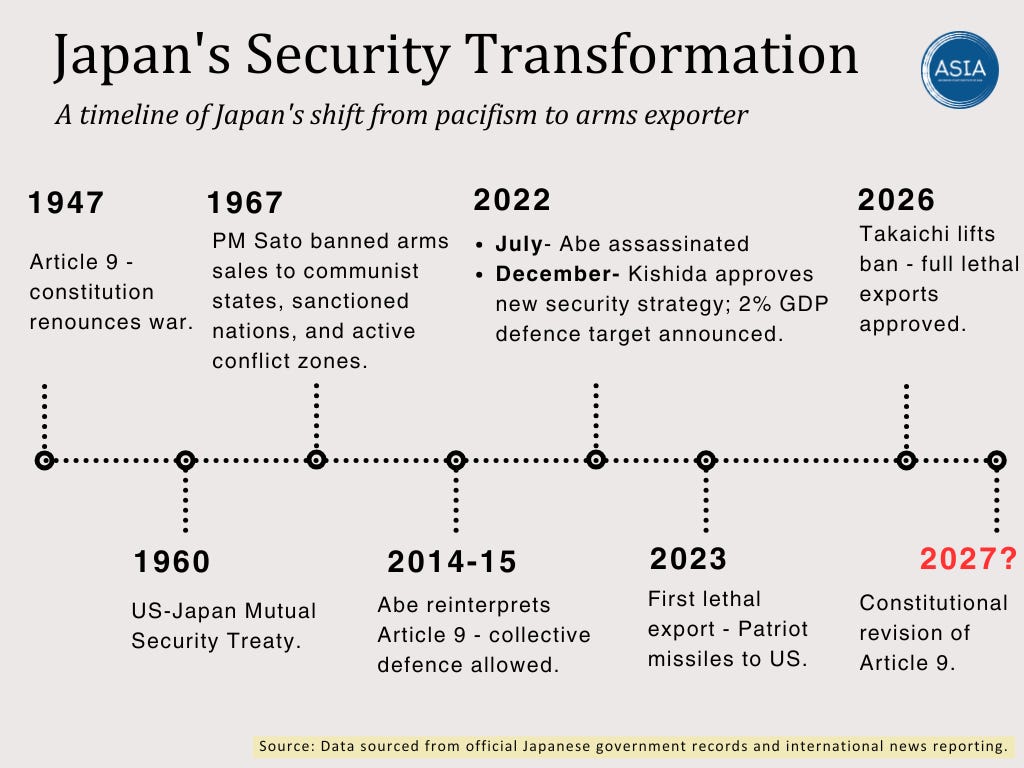
Sanae Takaichi’s cabinet will this week announce that the convenience has expired. Japan is lifting its postwar ban on the export of lethal weapons. Destroyers, missiles, and advanced frigates will be offered to seventeen countries with which Tokyo already has defence-cooperation agreements. The first deal is already done: eleven Mogami-class stealth frigates to Australia for $6 billion, the largest Japanese defence contract since 1945. The Philippines, which faces Chinese coastguard vessels in the South China Sea with a navy built for a smaller era, is next in line. Indonesia and Vietnam are said to be interested. Mitsubishi Electric, whose defence division has until now relied on the domestic budget, reports that “offers are coming from everywhere” and is hiring staff in London and Singapore to handle the traffic.
The proximate cause is China. Beijing’s island-building in the South China Sea, its military pressure on Taiwan, and its grey-zone operations against the Philippines have concentrated minds in Tokyo as no amount of American encouragement could. But the deeper cause is the growing suspicion that American security guarantees are subject to a prior claim. The Iran war consumed two carrier strike groups, 50,000 troops, the largest air deployment since Iraq, and the full political bandwidth of the administration. While the Strait of Hormuz was closed and American marines were sailing toward Kharg Island, no American carrier was present in the western Pacific. It was the fifth such gap in two years. China built an island during it. Japan noticed.
The phrase that best describes what Japan is doing comes not from a diplomat but from a defence-industry adviser in Tokyo. Andrew Koch observed that Japan “has stopped being a consumer of security and is poised to become a producer of it.” The distinction matters. A consumer depends on the supplier’s capacity and attention. A producer shapes the market. Japan is positioning itself as the second production node in the allied defence-industrial network — the one that does not depend on the Pentagon’s backlog or the American Congress’s mood. For European states whose own arsenals are drawn down by Ukraine, and for Southeast Asian navies that cannot wait three years for an American frigate, Japan offers something Washington currently cannot: availability.
Ms Takaichi is known in the Japanese press as the country’s Iron Lady, a comparison she does not discourage. Her mentor was Shinzo Abe, who began the slow work of loosening the export restrictions before his assassination in 2022. Abe understood that the constitution’s pacifist clause, Article 9, was a political artefact of 1947 that had hardened into national identity. He chipped at it carefully. The first postwar lethal export — Patriot missiles sent back to the United States — took place in December 2023, a transaction so circular it barely registered. Each step looked incremental. Taken together, they amount to a reversal.
Ms Takaichi intends to go further. At her party’s annual conference she suggested that proposals for constitutional amendment could be put forward in 2027. She has the parliamentary votes: a three-quarters majority in the lower house, secured through her landslide in February. What she does not yet have is the social consensus. The Japanese public’s attachment to pacifism is not a policy preference. It is a post-traumatic settlement. Hiroshima, Nagasaki, the fire-bombings, the imperial catastrophe — these are not abstractions in Japanese public memory. They are the reason the constitution says what it says. Ms Takaichi is shrewd enough to know that the export ban can be sold as industrial policy (Mitsubishi expects defence revenues to triple by 2031) whereas constitutional revision can only be sold as what it is.
The harder question is whether Japan’s defence sector can scale to meet the demand it is about to invite. Eighty years of domestic-only procurement have produced an industrial base that is technically advanced but operationally narrow. Mitsubishi, Kawasaki, and IHI build excellent systems in small quantities for a single customer. Building them in volume for a dozen customers across Southeast Asia and the Pacific requires factory expansion, supply-chain diversification, and a workforce pipeline that does not yet exist. The political will has arrived. The production capacity has not. Whether the second follows the first in time to matter is the variable on which the whole enterprise depends.
There is a final irony worth noting. The system Japan is building — a network of defence partnerships radiating outward from Tokyo to Manila, Canberra, Jakarta, Hanoi, and London — resembles nothing so much as the alliance architecture the United States built after 1945, when it was the sole power capable of producing and exporting security at scale. Japan is not replacing America. It is doing what America did, for the same reason America did it: because a single guarantor cannot be everywhere, and the states that depend on the guarantee have begun to understand that fact. The sun has not set on Japanese pacifism because of ideology. It has set because the conditions that made pacifism sufficient no longer obtain. When the umbrella develops holes, the sensible response is not to stand in the rain. It is to start making umbrellas.

China Criticises Local Governments for Imprudent Public Spending
The central government of China has publicly criticised several local authorities for spending public money in what it called an “imprudent” and unnecessary manner. This is the first time Beijing has openly criticised local governments as part of a larger drive to ensure authorities prioritise real results over spectacular initiatives.
One of the examples highlighted was Zhaojue county in Sichuan, which was once one of China’s poorest areas. Authorities claim that the county spent 1.49 million yuan (about US$210,000) on three songs to promote tourism using funds from higher levels of government. In another instance, a local arts college and representatives of Hubei’s culture and tourist department allegedly approved 3 million yuan for a promotional song.
The criticism is part of a nationwide campaign that runs from February to July, urging authorities at the county and higher levels to follow normal performance evaluation rules. According to state media, the authorities continued these programs after the campaign began, without fully assessing their usefulness.
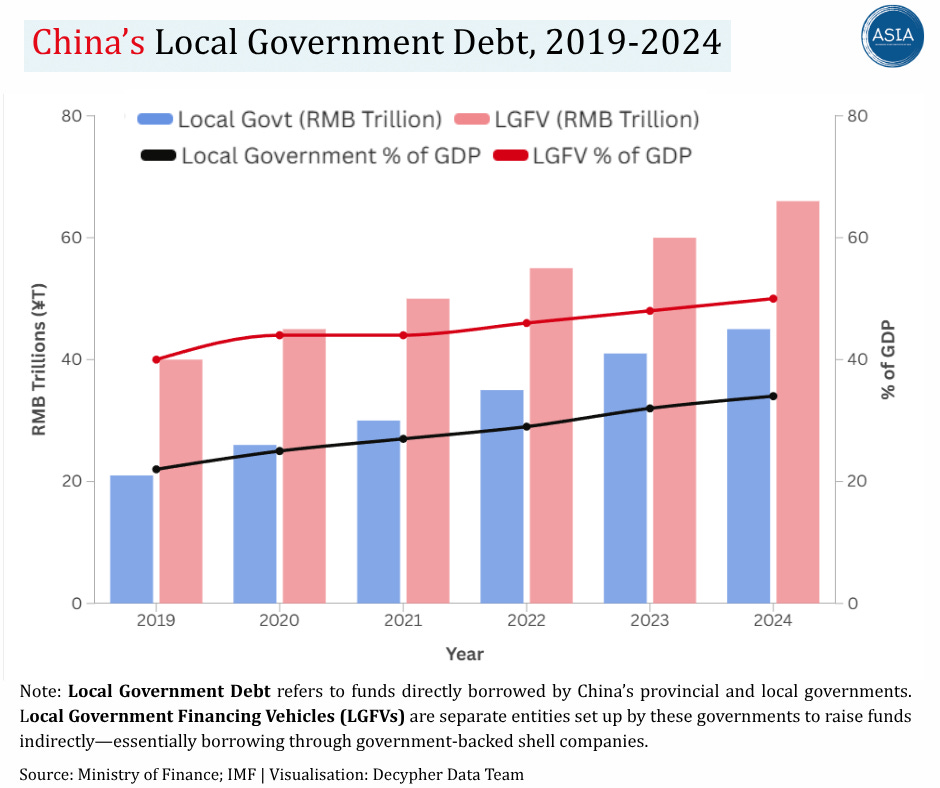
Beijing claimed that such spending was unrelated to realistic public requirements and represented a tendency among some authorities to emphasise high-profile projects that provide little genuine value to citizens. The action is also linked to China’s broader push to control local government debt and eliminate wasteful expenditure, particularly when land-sale income are declining and government finances are under strain. With state revenue expected to fall 1.7% in 2025, officials have been urged to spend public monies more wisely and prioritize critical requirements.

How India and China Are Quietly Rewriting the Rules of Engagement
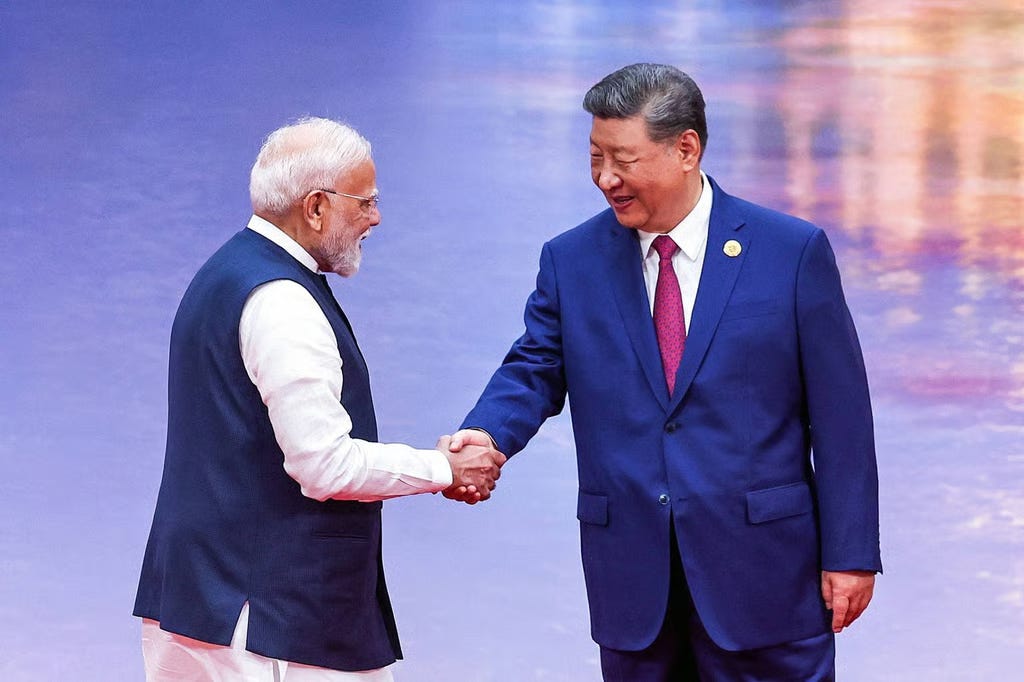
Relations between India and China are being recalibrated slowly from some cautious perspective with both sides trying harder than ever to separate issues of border tension from economic and multilateral relations. Recent consultations in New Delhi at the first ever Shanghai Cooperation Organisation (SCO) on 16-17 April indicate both sides’ common preference to stabilize relations via what some analysts have called the structured compartmentalisation. Through deepening trade, security and regional diplomacy cooperation, the two countries seem like hedging against global uncertainty while protecting their strategic interests and reducing inter-state friction. But this interaction is structurally bound, and very cautious in its facilitation.
The shadow of the 2020 clash in the Galwan Valley continues to haunt mutual distrust, while substantial troop deployments along the Line of Actual Control have showed how tenuous any thaw can be. Though withdrawal at the right friction points has allowed for some diplomatic rapprochement, the fundamental boundary dispute remains unresolved, constraining the depth of rapprochement. That trajectory gets further complicated by economic realities. India’s expanding trade deficit with China — now exceeding $100 billion — reveals both interdependence and asymmetry. Although China regards India as a critical market, New Delhi is concerned about growing economic dependency if it does not make similar progress on security.
The SCO provides in return a pragmatic foundation rather than a transformative one in this sense. It enables both governments to participate without giving in to controversial bilateral disputes. An example is India’s strict stance on the BRI. However, whether the organization can maintain momentum will depend on whether building trust slowly can exceed cycles of geopolitical conflict. Finally, despite the fact that SCO-based engagement reflects efforts to re-establish cooperation, the balance between border tension, economic asymmetry and regional and global strategic orientation will determine whether this phase matures into sustainable cooperation or simply adjustment.

Analysis based on Dong, Wang & Yang (2025)
Under baseline assumptions (SSP2-4.5 equivalent), China’s national high-temperature risk index crosses 0.30 — the level currently seen only in provinces like Sichuan and Guangxi — by 2030 with 50% probability. It crosses 0.40 — systemic agricultural disruption territory, currently seen only in Henan (0.746), Zhejiang (0.453), and Guangdong (0.417) — by 2040. The median path reaches 0.486 by 2050. What is now the experience of three or four southeastern provinces becomes the national norm within a generation.
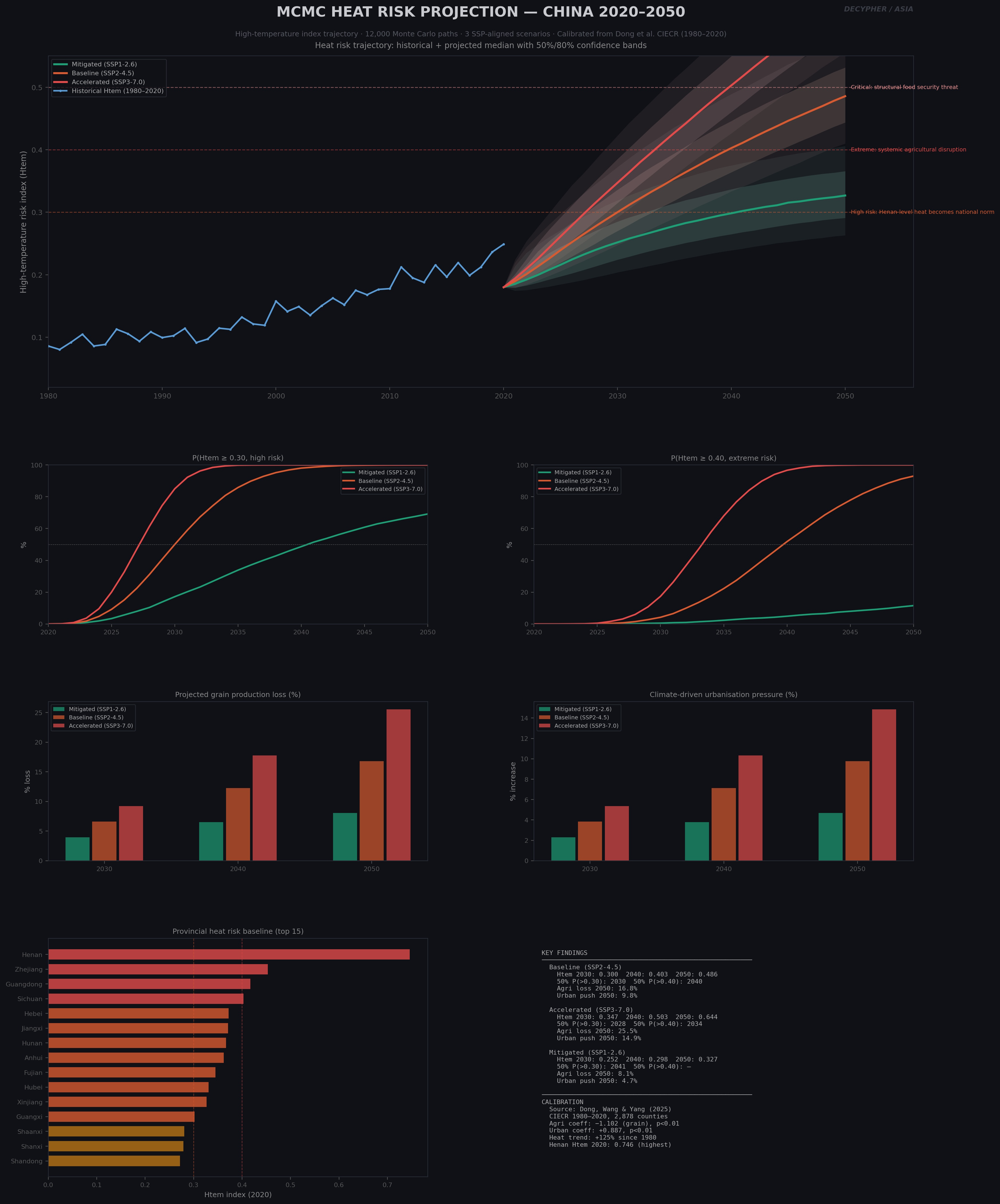
The agricultural transmission. The paper’s regression coefficient (-1.102 on grain production, significant at 99%) converts the heat trajectory into a food security forecast. Baseline: 6.6% grain production loss by 2030, 12.2% by 2040, 16.8% by 2050. Accelerated scenario: 25.5% by 2050. These are not hypothetical. They are mechanical outputs of the relationship the paper already measured in historical data. Cotton and oil crops, which the paper shows are twice as heat-sensitive as grain, would face losses roughly double these figures.
The urbanisation engine. This is the paper’s most structurally interesting finding and the one the MCMC makes visible at scale. The regression shows that rising climate risk increases urban employment (coefficient +0.887, p<0.01) while decreasing rural employment (-1.494, p<0.01). Heat does not just destroy crops. It moves people. The simulation projects 7–10% additional urbanisation pressure by 2050 under baseline — climate-driven migration from rural counties where heat is no longer survivable to cities that can absorb it. Under the accelerated scenario, that figure reaches 15%.
The Chaos Map reading. The paper’s findings map cleanly onto the framework:
The heat risk sits in relational chaos — it is a physical shock that disrupts the lived texture of rural life (crops, employment, habitability). But the paper shows that the response to heat risk sits in conceptual order: it drives industrial production (demand for climate-adaptive equipment), promotes modern agriculture (efficient irrigation, intelligent systems), and accelerates urbanisation. The chaos does not produce only destruction. It produces a forced migration from the relational-chaos quadrant (subsistence agriculture, rural exposure) to the conceptual-order quadrant (urban employment, industrial production, adaptive infrastructure).
The structural danger is that the migration is coerced, not chosen. Rural populations are not moving to cities because cities offer better opportunities. They are moving because the countryside is becoming uninhabitable during peak heat months. The paper’s data on Henan — which already has the highest heat index in China at 0.746 — is the leading indicator. Henan is also one of China’s largest grain-producing provinces. A province that is simultaneously the most heat-stressed and the most agriculturally productive is a system with an internal contradiction the heat trajectory will resolve. The MCMC shows when: by 2040 under baseline, Henan-level heat becomes the norm for most of central and southern China.
What to watch. Three falsification signals. First: if China’s afforestation programme (which the paper credits with reducing wind risk by 80% since 1980) is extended to heat mitigation through urban green infrastructure, the mitigated scenario becomes more probable. Second: if grain imports rise faster than population growth between now and 2030, the agricultural loss channel is already activating. Third: if internal migration statistics show accelerating rural-to-urban flows in Henan, Hunan, and Jiangxi specifically, the climate-urbanisation mechanism is operating at the provincial level the MCMC projects at the national level.
___
Essay and Data: Amogh Dev Rai- Research Director at the Advanced Study Institute of Asia (ASIA), affiliated with SGT University, Gurugram.
Postscript: Neeti and Bhupesh
Produced by Decypher Team in New Delhi, India
___