

View From the Drum Tower: The Takaichi Mandate for Democratic Support for Strategic Clarity in Japan and Its Implications for East Asian Security Dynamics
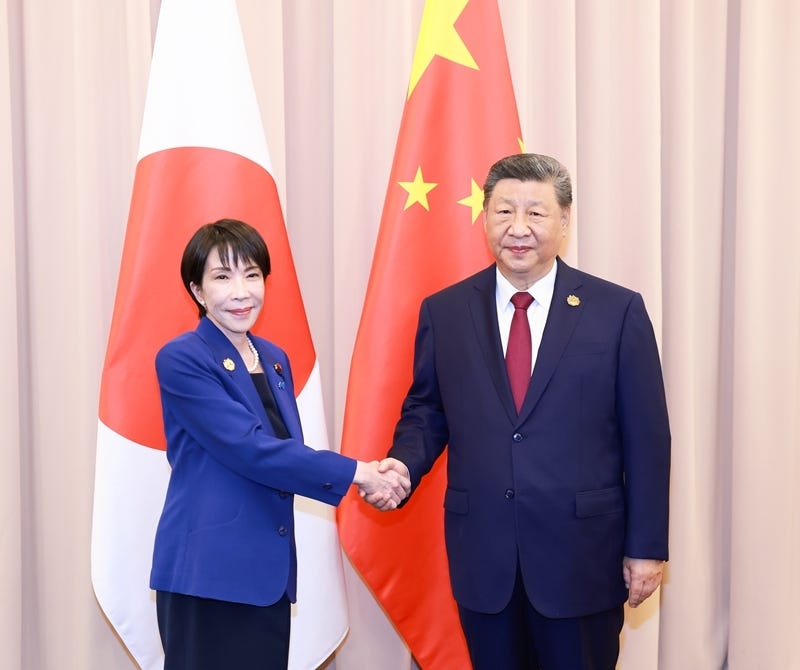
The landslide victory of the Liberal Democratic Party (LDP) under Prime Minister Sanae Takaichi resulted in a comfortable two-thirds majority in the Lower House of Parliament, which constitutes arguably the most significant post-war electoral mandate in Japanese history at par with what Shinzo Abe secured, and fundamental in more ways than even that win. This result can indicates a fundamental shift in East Asian security dynamics that reflect a public desire for strategic resilience against coercive strategy seeking to contain democratic governance, even at significant economic sacrifice and beyond. It signals an eagerness to retool the Japanese governance away from consensus to stand alone dominance.
Introduction: Electoral Outcomes and Strategic Implications
The LDP in Japan won a landslide victory on February 9, 2026, to continue a mandate that goes beyond domestic politics to signal a shift in regional security priorities. The electoral victory expresses a definitive public opinion on the need to resist coercive action by authoritarian states, especially in terms of strategy that subordinates national security to economic considerations. In this respect, the electoral victory signals a shift in the Japanese security stance in the larger East Asian context.
The Failure of Coercive Diplomacy
The Chinese reaction to Takaichi’s comments in November 2025 about Japanese military action in a Taiwan crisis scenario was the usual coercive pattern: economic coercion through warnings about tourism, seafood imports, and rare earth exports; diplomatic isolation tactics; and strident threats about punishment by the international community to force policy change. Historically, this coercive diplomacy has had selective success, including South Korea’s 2017 THAAD deployment, some Philippine maritime claims, and Australian reactions to Chinese policies. The strategic logic assumes that the economic costs imposed by Beijing can change public opinion against governments opposing Chinese preferences, thus forcing a reversal of policy or a change at the polls.
However, Takaichi’s electoral success shows a significant misjudgment of this strategy as it applies to modern Japan. Rather than undermining support for Takaichi, Chinese pressure seems to have reinforced it. As Christopher Hughes of the University of Warwick explains, “China’s strategy has thus far failed, or, in fact, backfired, as Japanese voters have approved of Takaichi’s willingness to stand up to Chinese pressure.” This trend shows that coercive diplomacy, successful against smaller economies, may actually be ineffective against a highly developed democracy with strong national sovereignty and historical pride.
Implications for Strategic Reliability and Regional Deterrence
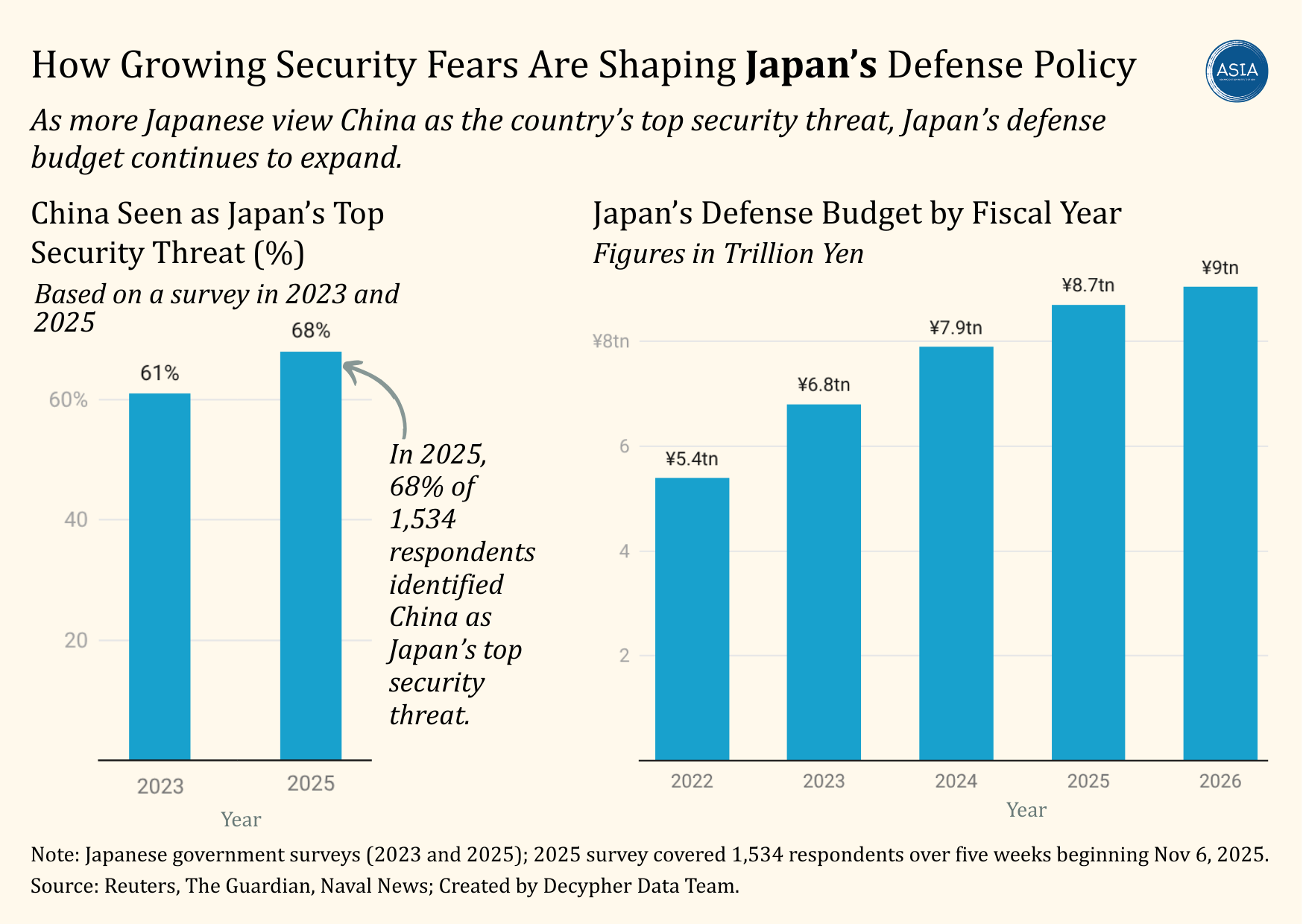
This electoral success is more than a temporary setback for Beijing; it is a strategic failure with far-reaching implications. The coercive strategy, successful in the past in imposing economic costs on politicians resisting Beijing’s preferences, is ineffective when turned against Japan’s strong, globally integrated economy and its deepened democratic legitimacy. The Japanese public’s assignment of economic costs to strategic security decisions, rather than leadership weakness, represents a shift in risk calculus, prioritizing security over economic expediency in the short term.
The End of Strategic Ambiguity in Japan’s Taiwan Policy
Historically, Tokyo has practiced a strategic ambiguity on Taiwan policy, expressing concern for cross-strait stability while refusing to commit to military action in support of Taiwan. This stance has enabled a continued policy of economic engagement with China while incrementally developing defense capabilities, thus maintaining strategic flexibility. The November expression of Takaichi’s view that “a Chinese naval blockade of Taiwan would represent a ‘survival-threatening situation’ for Japan and potentially meet the criteria for collective self-defense” has upset this balance. More significantly, the electoral support for this position raises it from a ministerial view to a policy position with democratic credentials and majority political support. This is a turning point in Japanese security policy, similar in importance to the Abe administration’s reinterpretation of collective self-defense, but more specific in its application. While Abe’s reforms were more of a vision, Takaichi’s approach outlines conditions and publicly correlates Japan’s security with Taiwan’s status. The implications are far-reaching.
International and Global Implications
The People’s Republic of China is now faced with a situation where a stable, popular Japanese government with a strong majority in parliament has publicly correlated its security position with preventing Chinese influence in Taiwan. This particular arrangement is not easily reversed by economic pressure or diplomatic isolation. Takaichi’s term of office, which extends until at least 2028, provides significant operational flexibility.
For the United States, the implications are ones of changed burden-sharing and clear commitments from regional partners on Taiwan-related contingencies. Takaichi’s position effectively provides a ready-made alignment that may expedite trilateral cooperation between Washington, Tokyo, and Taipei, consistent with what the People’s Republic of China fears most.
For Taiwan, the electoral result provides strategic comfort. As noted by Sean King of Park Strategies, Takaichi’s views demonstrate an explicit commitment, within a narrowly defined diplomatic framework, to cooperate with the United States in defending Taiwan, which communicates a strong message of solidarity without compromising diplomatic subtlety.
Constitutional Issues and Prospects for Revision
The issue of constitutional revision remains a strategic consideration. The LDP’s two-thirds majority in the Lower House increases the likelihood of revising Article 9, which prohibits war and the maintenance of armed forces with the potential for war, although much remains to be overcome, including two-thirds majorities in the Upper House and a national referendum. Beijing considers constitutional revision a potentially revolutionary force in regional balance, threatening interpretations of regional peace and stability. Ironically, Beijing’s forceful policies have strengthened the argument for Japanese security capabilities by proving that economic interdependence is no guarantee of stability. The escalation of Chinese reactions to Japanese security policy initiatives may, in turn, confirm the need for a stronger security posture.
Comparative Analysis: Abe’s Precedent and Future Scenarios
Comparison with the second Abe administration offers both lessons and differences. Like Abe following his 2013 Yasukuni Shrine visit, Takaichi seems to follow a policy of resolute nationalist credentials and pragmatic engagement. Both leaders have attempted to articulate a position in which sovereignty disputes are not used as diplomatic leverage while maintaining dialogue channels.
Nonetheless, the current situation offers a more difficult context for China’s economic coercion, as it has become more selective and transparent in its use of coercion. Taiwan’s international status and democratic achievements have progressed, and the US-China relationship has deteriorated to the point of open rivalry. Most importantly, the Japanese people have shown a preference for security policy over economic cooperation, indicating a strategic shift in policy priorities from previous eras.
Future Diplomatic Engagements and Summit Politics
Upcoming high-level interactions—the March 2026 visit of Takaichi to Washington and the April 2026 meeting between President Trump and President Xi in Beijing—will prove the challenge of continued diplomatic engagement. Beijing may seek to leverage pressure on Takaichi to soften her position in the wider US-China talks. In contrast, Takaichi’s electoral mandate strengthens her credibility against concessions, while Trump’s political calculations may make it difficult for him to publicly challenge her position.
Regional Order and Security Architectures
The Takaichi mandate pushes forward several existing trends in the region:
The development of democratic security blocs, including Japan, South Korea, Taiwan, the Philippines, and Australia, based on shared values and threat perceptions.
The militarization of Taiwan contingency planning, with the clear threat of Japanese intervention informing both Beijing’s and Washington’s strategic intentions.
The constraints of economic statecraft against advanced democracies, forcing Beijing to potentially turn to military coercion, thus reinforcing the security imperatives driving Japan’s policy shift.
The politics of foreign policy in democracies with genuine popular sovereignty, exemplifying how external pressure can mobilize political support in opposition; a shift in the public’s generational attitudes towards Beijing is apparent in the “Sana-mania” phenomenon.
Pathways Forward and Strategic Dores
Beijing faces a strategic choice between continued pressure, risking a hardening of the regional alignment against China; escalated pressure, potentially with greater backlash; or accommodation, requiring acceptance of the Taiwan security framework now clearly linked with Japanese security calculations. Expert analysis, such as Ryo Sahashi’s description of a temporary “wait-and-see” strategy until spring 2026, indicates that if Trump adopts a constructive approach to Japanese policies and resists Chinese concessions on Taiwan, Beijing may eventually find it in their interest to engage with a stable, popular Japanese government, as under Abe, but on terms that are much different from those of the past decades.
Conclusion
The electoral success of Sanae Takaichi marks a turning point in East Asian international relations, not only as a result for a specific political party or politician but also as a public expression of support for security policies that prioritize strategic autonomy over economic accommodation with China. This democratic mandate translates what may have otherwise been considered partisan political rhetoric into a long-term mandate for a Japanese foreign policy shift. The shift in Japan’s policy towards China is not only a question of leadership but also of public legitimacy and political stability. The public’s backing of a more assertive security policy challenges Beijing’s most effective strategy—economic coercion as a political club—and gives Tokyo the political stability it needs to maintain a long-term deterrence strategy. While conflict is not inevitable, the path to détente has become much narrower, and any possible détente will be on Japan’s terms and not according to Beijing’s preferences.
After Election Win, Japan Faces Rising Pressure from China
Japan’s Prime Minister Takaichi Sanae won a decisive election, focusing attention on the future of Japan-China relations. Tensions have risen since Takaichi suggested that a Taiwan emergency could threaten Japan’s survival, prompting sharp reactions from Beijing.
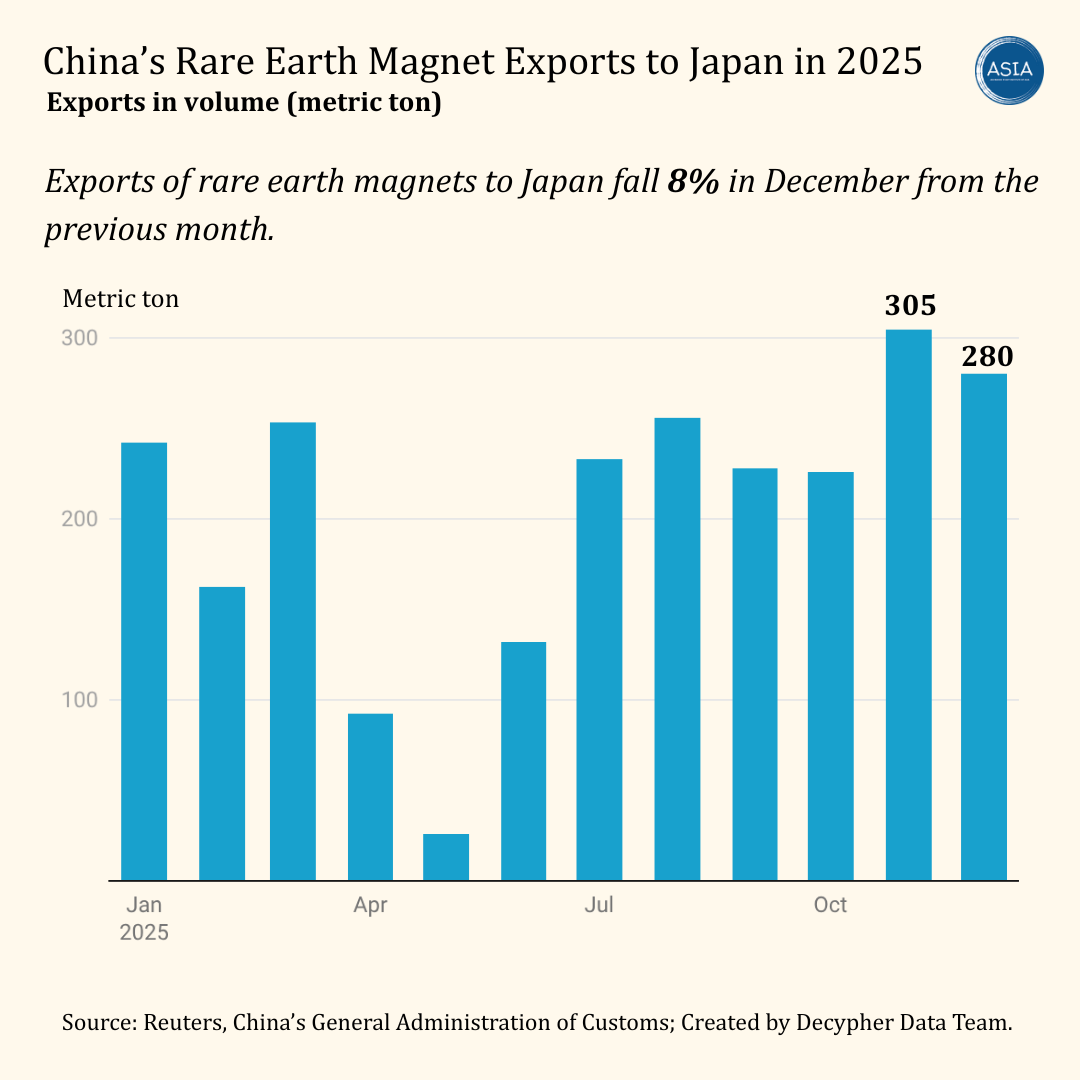
China has put pressure on Japan by tightening export regulations on dual-use items, such as rare earths, which are critical to high-tech sectors. Japan’s Chamber of Commerce and Industry in China has sought confirmation that the measure will not affect exports of civilian-use items.
Beijing has also discouraged its citizens from traveling to Japan, resulting in a sharp 45% year-on-year drop in Chinese tourist arrivals in December 2025. At the same time, China has escalated assertions that Japan is pursuing “new militarism” and possibly nuclear ambitions, which Tokyo denies.
Despite tense relations, Japan’s ambassador to China, Kanasugi Kenji has called for continued dialogue to counter misinformation while keeping communication channels open.
Meanwhile, China appears to be concentrating on bigger strategic concerns, such as a prospective summit with US President Donald Trump and hosting the APEC summit in November. With Beijing prioritising relations with Washington, questions remain about how high Japan ranks on China’s agenda. Kanasugi advocates patience and pragmatism, emphasising the need to rebuild dialogue and stabilize relations.
Postscript: How China Is Seen by Its Neighbours 🌏
How Indonesia and Malaysia View China in 2026
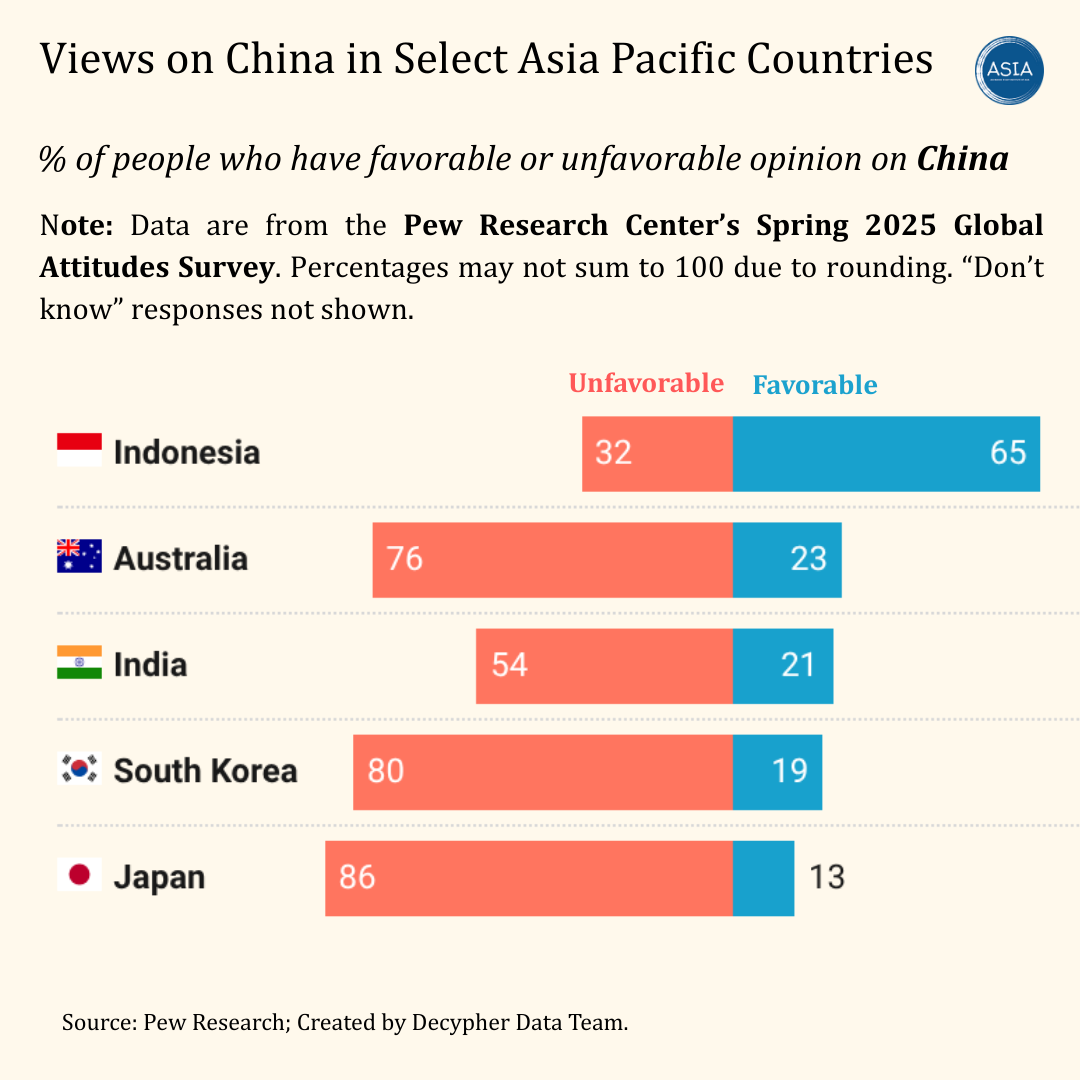
In January 2026, Indonesia’s Coordinating Minister for Economic Affairs, Airlangga Hartarto, called for expanded cooperation with China across sectors such as infrastructure, logistics, AI, digital economy, food security, and human capital development. He highlighted the mutual benefits of deeper collaboration in trade and investment — indicating Indonesia’s forward-looking strategic engagement with China. This reflects Jakarta’s preference to broaden economic ties into technology and human capital domains, not just traditional trade and investment — signaling a pragmatic, economic-first orientation in 2026.
Indonesia’s telecom leadership is raising alarm about “digital colonisation” amid the rise of proprietary AI systems, arguing this could undermine national digital sovereignty. At the South China Morning Post China Conference: Southeast Asia 2026 in Jakarta, Indosat Ooredoo Hutchison CEO Vikram Sinha highlighted the threat posed by closed-source AI monopolies, and pointed to China’s open-source AI offerings as more respectful of local control and regulatory guardrails. Sinha argued that open models could help Indonesia preserve digital autonomy, stressing localisation and sovereignty as key priorities while Chinese AI cloud providers seek to compete with US firms in Southeast Asia’s fast-growing market.
Under President Prabowo Subianto, Indonesia is facing a growing “multi-alignment” challenge as it tries to work with several major powers at the same time. Indonesian scholar Evan A. Laksmana notes that Jakarta wants to stay true to its long-standing “free and active” foreign policy, but global rivalry between China and the US is making this balance harder. Indonesia is engaging China for trade and investment, while also strengthening ties with Western partners and new groupings like BRICS.
China has expanded cultural outreach to Indonesia’s Muslim community—offering Mandarin classes at major mosques, hosting Ramadan events, and engaging Islamic organizations—to improve its image and counter criticism over Xinjiang. While some religious leaders now view China more positively, public opinion remains mixed, especially amid concerns about Uyghur rights.
Malaysia sees China mainly as an important economic partner and a key diplomatic actor in the region. Over the years, ties between the two countries have grown through trade, investment, tourism, and cultural exchanges. China has been Malaysia’s largest trading partner for 17 consecutive years, with bilateral trade reaching around US$191.66 billion. Major infrastructure projects such as the East Coast Rail Link (ECRL) and the Two Countries, Twin Parks initiative show the depth of economic cooperation.
The relationship reached a new stage after President Xi Jinping’s visit, where both sides agreed to build a “high-level strategic China-Malaysia community with a shared future.” Easier visa rules and more flights have also increased people-to-people contact, with millions of Chinese tourists visiting Malaysia.
China’s expanding presence in Malaysia is reshaping competition at the sectoral level, particularly in AI, digital services, and advanced manufacturing. Chinese tech firms operating in Malaysia often deploy ready-to-scale AI systems, cloud platforms, and smart logistics solutions, allowing faster rollout than many local competitors. In infrastructure and energy projects, Chinese contractors bring integrated financing, engineering, and execution models, giving them a clear cost and speed advantage.
Malaysian scholar Cheng-Chwee Kuik argues that Kuala Lumpur’s China policy is best understood as hedging — a balanced, risk-aware strategy, not simple alignment or opposition. In his SCMP op-ed, “Why Malaysia seeks enduring ASEAN-GCC-China cooperation,” Kuik highlights Malaysia’s role as a bridge linking ASEAN, China, and other regions in practical, expansive cooperation. His article on “Malaysian equidistance” explains how Malaysia maintains macro-level neutrality with China while building selective, multilayered ties. In “Deference and Defiance in Malaysia’s China Policy”, he and co-author Yew Meng Lai show Malaysia mixes cooperation with China and cautious autonomy as part of its dualistic diplomacy.
Perceptions of China in Singapore and Thailand — A Short Commentary Synthesis
In Singapore, commentary in The Straits Times and writings by senior strategic thinkers such as Bilahari Kausikan and Kishore Mahbubani reflect a persistent leitmotif: “China is indispensable but never to be depended upon”.
Singapore’s elite discourse views Beijing as a permanent structural fact that is both culturally close, economically significant, and geopolitically influential, but also potentially a source of political fragility. Given that Singapore is a firmly multicultural state with a majority ethnic Chinese population, analysts frequently stress the need of avoiding even the appearance of alignment.
Balance, not loyalty, is the prevailing rationale for maintaining autonomy in small states. Kausikan’s actions highlight the necessity of shielding national sovereignty from outside interference, whereas Mahbubani presents China’s ascent as normal but consistently cautions that US-China cooperation is necessary for regional stability.
As a result, editorials in The Straits Times support a steady balance via strong commerce with China, security relations with the US, and a refusal to join containment coalitions. In this perspective, China is not viewed as an adversary, but it is also not considered a reliable strategic ally. In a nutshell, the perception may be described as respectful caution.
The Bangkok Post’s editorial pieces and the analysis of experts like Kavi Chongkittavorn in Thailand present China as an opportunity rather than a threat. In Thai discourse, “bamboo diplomacy” is emphasized as maximizing national gain while adapting to geopolitical winds. China is typically seen as a significant investor, economic partner, and regional stabilizer, despite worries about low-cost imports hurting homegrown sectors. Thai opinion, in contrast to Singaporean discourse, rarely portrays Chinese influence as a danger to sovereignty.
Thai pundits discuss how to profit from China without being overexposed, whereas Singaporean commentators discuss how to avoid being dependent on China. This is a stark contrast. Thailand’s press emphasizes strategic flexibility, whereas Singapore’s press places more emphasis on strategic balance.
How India Views China
In 2026, India’s stance to China is cautious but practical. New Delhi is continuing to have talks with Beijing, with the goal of reducing border tensions and gradually restoring regular diplomatic and commercial exchanges. However, trust remains shaky following previous military standoffs. Analysts such as Rishi Gupta believe that India’s policy is to remain vigilant while maintaining dialogue — cooperating where possible but not relaxing its strategic guard.
According to China experts such as Srikanth Kondapalli, India now chooses to “trust, but verify” — which means cooperation is feasible, but only with caution. Even if some diplomatic efforts have resumed, fundamental strategic competition and unsolved border issues continue to affect India’s worldview. Other commentators believe that rivalry between the two Asian nations will remain a long-term reality.
Trade with China expanded significantly in 2025, suggesting that business continues despite political challenges. Nonetheless, the government is aiming to reduce reliance on Chinese supply chains by signing new agreements on critical minerals with France, Brazil, Canada, and the Netherlands.
Overall, India’s attitude toward China today is balanced: cooperate where essential, compete where necessary, and be prepared for uncertainty.
— — —
Essay: Amogh Dev Rai
Postscript: Abhilasha Semwal and Neeti Goutam
Data and Visualisation: Bhupesh
Produced by Decypher Team in New Delhi, India
— — —