


Two Asian states, one chokepoint, and the diverging arithmetic of energy security
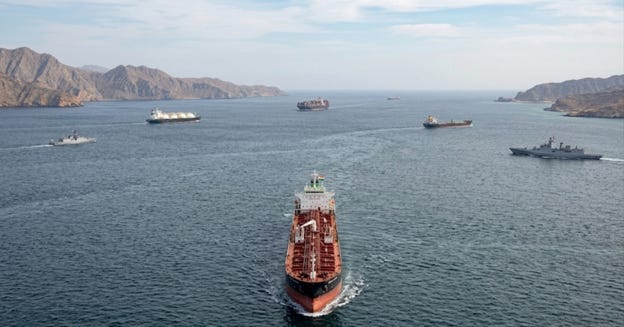
Before hostilities escalated in the vital Middle Eastern chokepoint, 110 vessels a day transited the strait carrying crude, refined products and LNG. By late February, that figure had collapsed to near zero. A mid-June deal briefly restored traffic to about 35 crossings a day, still a third of normal, before a second, harder escalation cycle beginning around 7 July pushed it back down: by 23 July commercial transit had fallen to roughly 11 per cent of pre-crisis volume, ten vessels against a typical eighty-eight. The strait did not reopen so much as flicker. In an ordinary year the passage carries close to a fifth of the world’s oil and gas shipments, and most of it moves east.
Two Asian economies received this shock at the same time and did entirely different things about it.
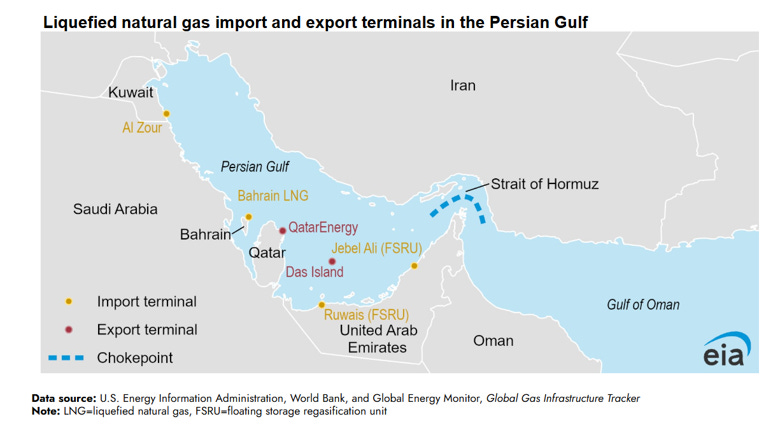
That exposure was never symmetric to begin with. Western economies absorb the same kind of shock through Atlantic Basin supply and domestic production that Asia does not have. India’s own exposure had actually been rising before the war: by March 2026 around 52 per cent of its crude imports were passing through Hormuz, up from 41 per cent the year before, as refiners had trimmed Russian purchases in favour of Gulf term contracts. China’s dependence sits higher still: close to 89 per cent of Iran’s own crude exports go to China alone. The LNG exposure matters more quietly, but it is the one that carries through to the Japan section later. In 2024, about 20 per cent of global LNG trade moved through Hormuz, and 83 percent of that was Asia-bound, with China, India and South Korea together taking 52 percent of it; Europe’s equivalent exposure is a fraction of that. Bypass routes exist: Saudi Red Sea terminals, Fujairah, the Iraq-Türkiye pipeline to Ceyhan, Iran’s own Jask terminal, but the April assessment from the IEA and Kpler showed those routes absorbing only a fraction of what the strait normally carries, with weeks added to transit time in the bargain.
India’s answer was arbitrage, and the shape of it is collapse, then capture. Indian fuel exports fell to about 866,000 barrels a day in May, the lowest in nearly four years. Hindustan Petroleum’s managing director said the company received almost nothing against its Middle East term contracts in the first quarter, because the cargoes sat stranded on the far side of the strait. Indian Oil abandoned a plan to send the supertanker Lila Jamnagar, a two-million-barrel vessel, through Hormuz, judged the crossing not worth the risk, and suspended Iraqi liftings along with Mangalore Refinery. Then came the recovery. July is tracking near 1.55 million barrels a day of light and middle distillates, close to double May and the second-highest month in Kpler’s series going back to 2017, on the back of the ceasefire’s collapse and the refining-margin rally that followed. Refiners tested new grades from Angola and Venezuela while Russian volumes stayed near record levels through July.
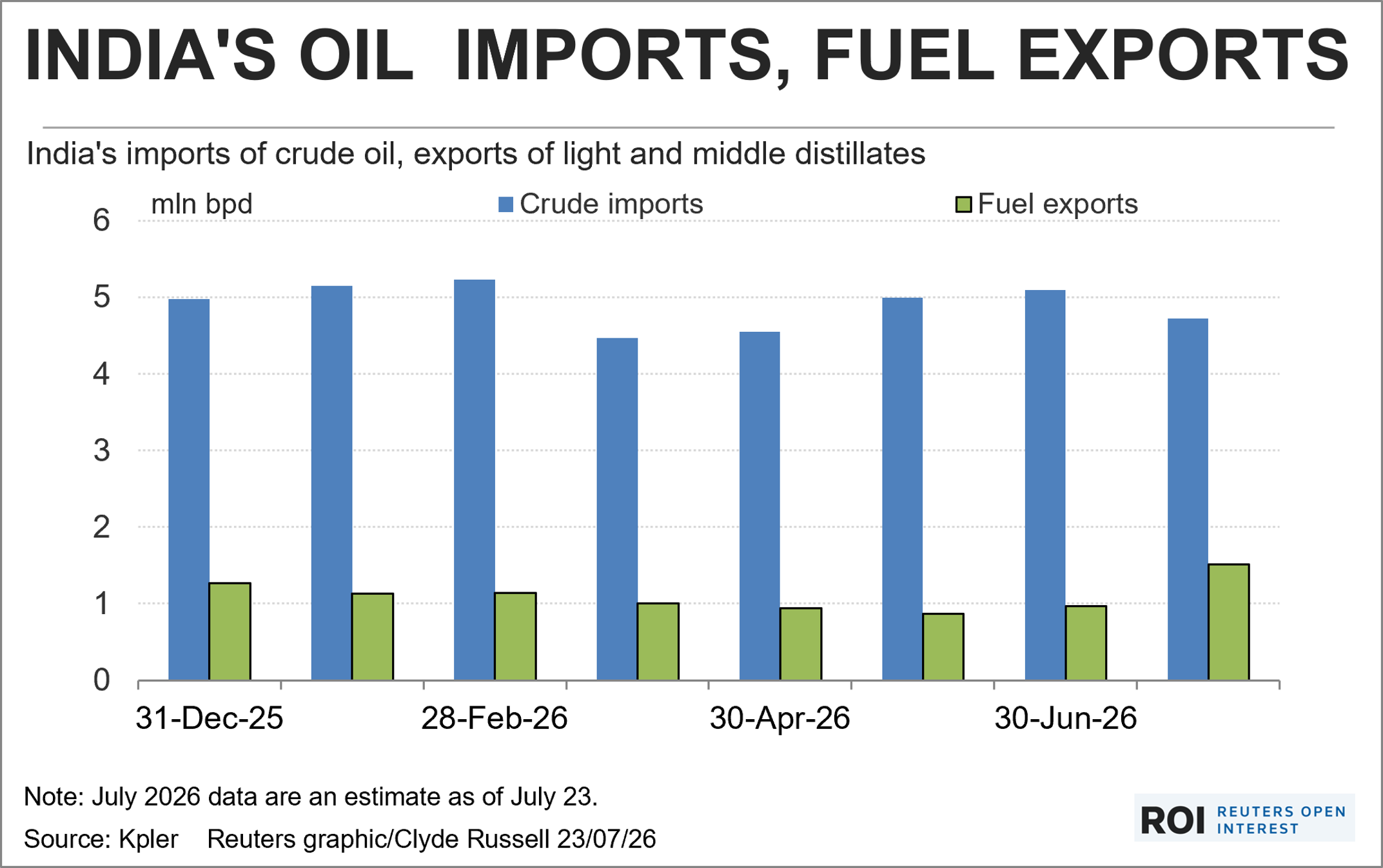
This could be viewed as a triumph, but it isn’t one. The capacity is being monetised: Jamnagar, Vadinar, the coastal export complexes were built over two decades for entirely commercial reasons, long before anyone in Delhi was thinking about a Hormuz contingency. The state did not plan this. It was positioned for it, which is a different claim. The comparators keep the claim honest: Oman, shipping from ports outside the strait entirely, hit an all-time high of 783,200 barrels a day in July; Taiwan reached 306,000 barrels a day, its strongest month since December; and Asia’s total distillate imports, even with all of this, sat at roughly 5.80 million barrels a day in July, up from June’s five-year low but still 18 percent below the 7.05 million barrel average of the three months before the war. India is the largest single filler of a gap that is still open.
India’s state refiners went into July holding roughly two months of crude cover, and were in no hurry to resume Gulf term liftings even once the strait showed signs of reopening. None of this is autarky or stockpiling. It is a state controlling the pace of its own re-entry into a market it does not control the entry point to. In an import-dependent economy, its capacity shows up less as reserves or pipelines than as the ability to choose when to normalise.
Japan’s answer was the opposite instrument entirely. Defence minister Shinjiro Koizumi said in a webcast in July that the country could no longer treat the subject as unspeakable: “While this is a difficult issue for Japan to discuss, one topic we cannot avoid is nuclear weapons,” he said. Koizumi pointed to precedent outside Japan, Macron’s March announcement of an expanded French arsenal, and Finland’s parliamentary repeal of its own nuclear prohibition in June. Sergei Lavrov, speaking in Manila after the ASEAN foreign ministers’ meetings on 22 July, called Takaichi’s statement “a serious signal,” and said it echoed drills already underway between the United States and South Korea.
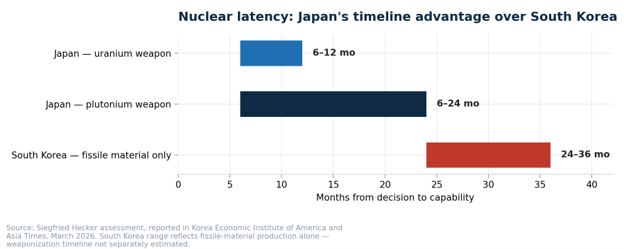
The Northeast Asian latency debate is not driven only by doubt about American extended deterrence but also driven by energy. Japan and South Korea import nearly all of their oil and LNG. Hormuz hit both directly, and the pressure to secure stable supply feeds straight into the argument for domestic nuclear capability, civil first and latent after. The taboo is eroding precisely where energy insecurity and deterrence insecurity meet. Japan’s timeline advantage over South Korea is worth a line and no more: nuclear expert Siegfried Hecker has assessed that Japan could assemble a uranium weapon in six months to a year, a plutonium weapon in up to two, against a longer timeline for South Korea’s fissile material production alone. That is a fact about capability, not a forecast about intent.
Comparison here holds up best as a mechanism, not a moral. Two variables do the explaining. First, the substitutability of inputs. India can swap one crude grade for another because it has refining flexibility and roughly forty suppliers to draw on. Japan cannot swap a nuclear umbrella for a different umbrella. Second, the autonomy of the security guarantee itself. India’s deterrent is its own, and its Hormuz exposure is painful and commercial. Japan’s energy exposure is close to existential, and the deterrent meant to cover its worst cases belongs to someone else. India hedged downstream, in the part of the chain it actually controls. Japan is hedging upstream, at the level of the guarantee itself, because that is where its exposure sits. Neither state chose its instrument freely. Each reached for the only one within reach. A shock does not reveal a state’s intentions. It reveals its inventory.
On 28 July the US Senate voted 86 to 12 to advance the Lindsey O. Graham Sanctioning Russia and Iran Act of 2026, which would let the president impose tariffs of up to 100 per cent on the world’s five largest buyers of Russian crude, currently China, India, Slovakia, Hungary and Azerbaijan, with a separate and more forgiving threshold shielding most European gas buyers. The bill requires the top-five list to be reassessed every 180 days, and still needs a House vote and a presidential signature before it becomes law.
So here’s the asymmetry. India’s arbitrage runs, in part, on Russian crude that a foreign legislature revisits twice a year. Japan’s hedge, if it proceeds, will not need anyone’s recertification. Both are bets on autonomy. Only one of them answers to somebody else’s calendar.
Essay: Maseera Shaik- Research Intern (Security, Crisis and Strategy) at The Advanced Study Institute of Asia (ASIA)
Produced by Decypher Team in New Delhi, India