

The Little Giants Outgrew Their Purpose
Industrial policy can, in itself, cause the very problem it seeks to solve. China’s Little Giants program, a tiered certification system for small and medium-sized manufacturers, is a case in point. It started by trying to reduce the chokepoint that competing economies were trying to place on Chinese economy and its ability to acquire new technology for emerging industries.
German Chancellor Friedrich Merz who visited Beijing as part of a string of Western leaders trying to repair a relationship in disrepair. He was not ambiguous about his intentions. In a meeting with Premier Li Qiang, as per The New York Times he called on China to cut subsidies to local manufacturers, allow the renminbi to strengthen, and stop limiting the export of strategic minerals. From the German government’s point of view, this was a simple request. From the Chinese government’s point of view, it would mean removing a supporting wall. Don't think it will happen—not through obstruction, but because the internal logic of the Little Giants has grown in such a way that it has become politically and economically impossible to reverse even for a powerful leader like Xi. Even Xi can't fight multiple fires, he has his hands full with cadre management.
Origins of the Program
The program was born out of a particular moment of weakness. After Washington’s sanctions on ZTE in April 2018, Beijing reacted with official concern. The Ministry of Science and Technology issued a list of 35 technology areas in which China was precariously dependent on foreign sources. The problem was not that China lacked large companies; rather, its small and medium-sized enterprise (SME) base was not sufficiently strong to support a supply chain network under stress.
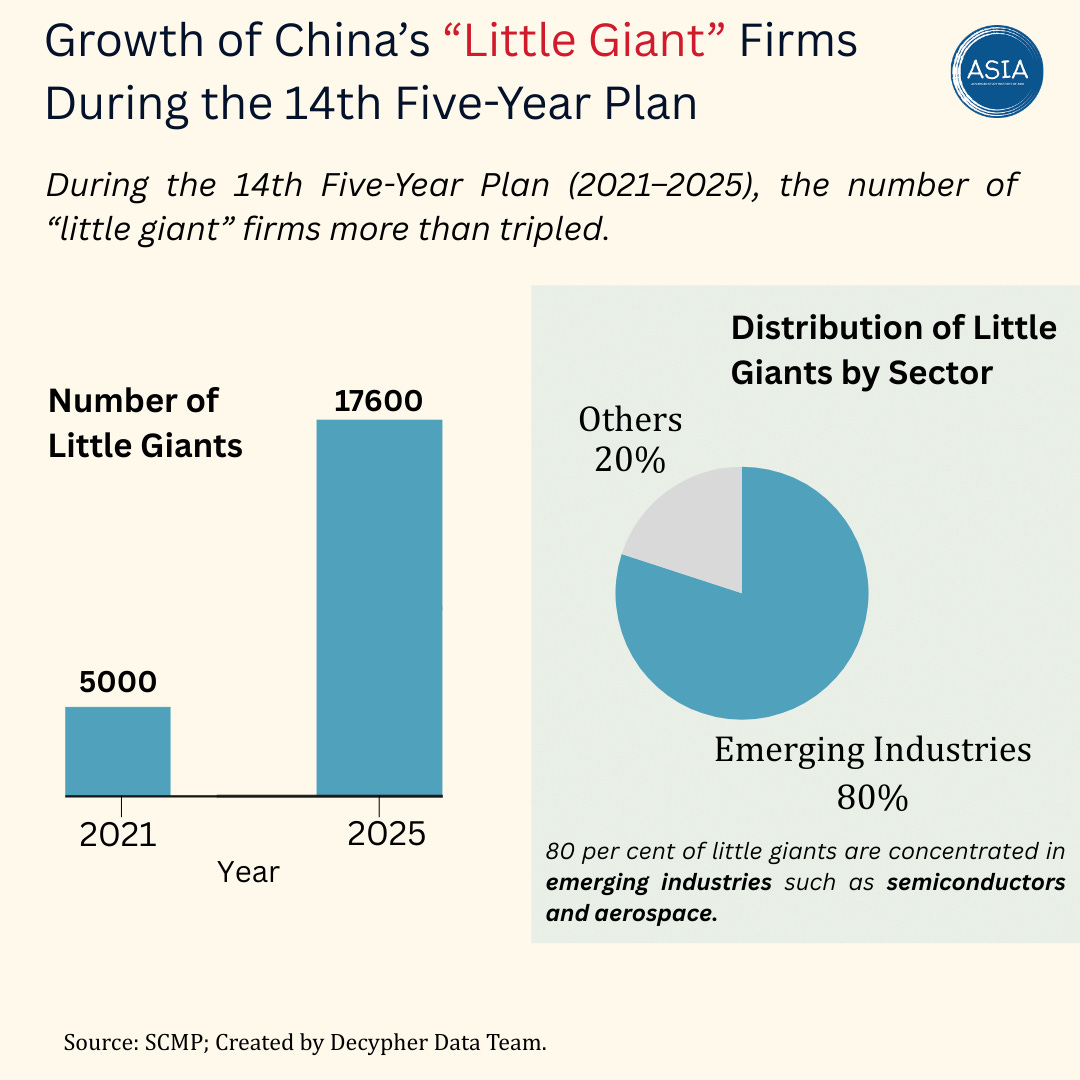
The approach was systematic. A certification ladder ranked companies based on their degree of specialization, innovation, and technological sophistication. The best companies were labeled Little Giants, together with state support tailored to them. Between 2021 and 2025, the number of specialized certified companies increased from fewer than 40,000 to over 140,000, with the number of Little Giants growing from about 5,000 to 17,600. The average expenditure on research and development by certified companies was about 7 percent of their sales, about twice as high as that of similar Western manufacturing SMEs.
Take, for example, photoresists, a critical material for semiconductor production that made the list of vulnerabilities in 2018, which, thanks to the initiative, improved from having almost zero domestic capacity to 35 Little Giants, each with average annual sales of 1.9 billion yuan. Unitree Robotics, a quadruped robotics firm that Merz showcased during a visit to Hangzhou, was reportedly dominating the global quadruped robot market with a 60 percent market share by 2024. A decade before, it began as a university project. For Berlin, these trends point to a problem.
Comprehensive Integration Rather Than Fragmented Sectors
The traditional theory of comparative advantage assumes that the advantage is a relatively stable concept, resulting in predictable trade flows and benefits for all. The Little Giants initiative upended this theory. China did not just improve its isolated sectors. Instead, it enhanced its capabilities throughout the entire industrial value chain in areas such as semiconductors, robotics, advanced manufacturing equipment, aerospace components, quantum technologies, and AI infrastructure, which define the future of global industrial competition.
The $1.19 trillion trade surplus that China has in 2024 did not happen incidentally. It is a result of the two-decade-long functioning of this architectural method. When German car manufacturers state that their Chinese competitors perform better in terms of price and quality at the same time, it is not an isolated event. In the same manner, the loss of market share of German machinery manufacturers, who are replaced by less expensive but more advanced competitors, is also not an incident. The Little Giants are the driving force behind these events.
Constraints on Internal Reversal
The key challenge is that the program was designed to respond to a national security issue—weak dependencies in technology supply chains—and it has fulfilled this purpose. However, in terms of size, it also became a significant source of employment, taxes, and exports in an economy that has been experiencing a prolonged real estate recession. What began as industrial policy with strategic intent has, in terms of size, become macroeconomic policy support.
The withdrawal of subsidies would not only affect competitive conditions but, in many local economies, the affected companies are the primary employers and taxpayers. A strengthening renminbi would damage the export performance of the entire sector at a time when exports are one of the few positive factors in the economy. Therefore, rebalancing is not being pursued by Beijing at this time. The current draft recommendations for the 15th Five-Year Plan, which are being finalized, further emphasize support for SMEs. The Ministry of Industry and Information Technology is also actively working on new national policies for tech-smart SMEs. From an internal point of view, the program does not need to be changed; it needs to be scaled up.
Diplomatic Calculus
The key question is not whether China will make voluntary changes—the answer is likely to be no—but how long the external pressure will force China to make changes. The visit by Merz came at a time when the European Union had just suspended the implementation of a trade agreement with the United States due to a Supreme Court decision that invalidated some tariffs. This gave China an opportunity to demonstrate that it is a stable and trustworthy trading partner, and this is what China did through its Airbus purchases, diplomatic language, and joint statements.
However, this does not solve the underlying pressure. Every percentage point of Chinese electric vehicle market share in Europe raises political pressures in Germany, France, and Italy. Every Chinese robotics company that displaces business from a German engineering SME expands the support base for tougher trade barriers. The EU’s upcoming Industrial Accelerator Act, which requires “buy European” in public procurement contracts, is a direct institutional reaction to Chinese market penetration in Europe.
The German stance is clear: trade can continue, but it is close to a political tipping point beyond which it is no longer feasible to maintain it; without voluntary changes, forced changes will follow. The current Chinese government view is that European political will to enforce tough barriers is weak and divided. This may be true in 2026; by 2028, it may prove less accurate.
Potential Solutions
A credible view is that Western governments should focus on reviving their own industrial base rather than trying to force a change in the Chinese economy. The West has allowed similar policy tools to fall into disuse, which has contributed to the current situation. However, the underlying problem goes beyond the relative effectiveness of industrial policy. The presence of large subsidies, a managed exchange rate, and protected home markets amounts to a form of competition that traditional market economies find difficult to match through policy measures alone. This is not simply an unfair playing field; it is a different system.
True adjustment would mean a transition of China’s economy towards consumption-driven growth, rather than just indicating this, which has been the case for the last fifteen years, with Beijing expressing its commitment to this goal without reducing the gap between its ambitions and actions. It would also mean that certain manufacturing sectors must be allowed to shrink as a result of rising wages, rather than continuing to subsidize them through market share. It would also require that the renminbi be market-driven.
Implications and Outlook
The Airbus order, the diplomatic talk, and the re-establishment of official communication are the positive implications of Merz’s visit. However, these do not have any bearing on the structural reality. The Little Giants program completed its first task, and this has paradoxically created a diplomatic problem, as Beijing has developed resilience against chokepoints and created a trade balance. The future is not straightforward or easy. It involves a long-term, sector-by-sector negotiation of the degree to which European markets can absorb Chinese industrial capacity, and it would also involve a massive European reinvestment in manufacturing, which has been neglected for a long time. This would take many years, and it may not even resolve the conflict. Merz understands this, and Xi understands this.
Leading Neuroscientist Arthur Konnerth Moves to China for Full-Time Research Role
Arthur Konnerth, who received the Brain Prize, has taken up a full-time position at Shenzhen Bay Laboratory (SZBL), according to an announcement by the institute on January 29. Konnerth’s long career has spanned many decades and has shaped modern understanding of brain function. His work is at the intersection of electrophysiology, imaging, and cellular biology, with a special focus on learning and memory mechanisms.
Among his key and most enduring contributions is the establishment of the in vitro brain slice patch-clamp recording method. The technique involves approaching the surface of a brain cell with a glass microelectrode to seal it tightly, thereby preventing any current from leaking out and allowing the measurement of the very small currents flowing through a single ionic channel in the cell membrane. In 1989, together with Bert Sakmann, Frances Edwards, and Tomoyuki Takahashi, Konnerth enabled the transition of this method from a largely experimental idea to a generally available tool by adapting it from isolated cells to cells in neurons maintained in brain tissue slices. This led to the development of modern slice electrophysiology.
In 2003, he and his colleagues developed an imaging method that allowed the visualization of activity in entire neuronal networks with all individual cells resolved. In 2010, they refined this method by combining two-photon microscopy with electrical recording to record activity in a living mouse at the level of individual synapses, thereby resolving activity in dendritic structures.
Konnerth has held high-ranking academic positions at the Technical University of Munich and Ludwig Maximilian University and has been the holder of a number of prizes, including the Max Planck Research Award and the Gottfried Wilhelm Leibniz Prize, in addition to the Brain Prize in 2015.
SZBL, located in Shenzhen, Guangdong Province, has adopted a policy of rapid expansion. Biologist Yan Ning, appointed as director in 2023, said at the time that “Shenzhen will establish a leading position in the world of biomedicine in the next decade or two.”
Iran Close to Acquiring Supersonic Anti-Ship Missiles From China as U.S. Naval Presence Grows
According to a Fox News report, citing Reuters, Iran is close to sealing a deal with China to acquire CM-302 supersonic anti-ship cruise missiles. The Chinese-made missiles, which can travel approximately 180 miles at supersonic speeds and fly at low altitudes to avoid radar, would dramatically improve Iran’s ability to attack naval vessels, including US carrier strike groups operating in the region. While the agreement is said to be near completion, key details such as delivery deadlines, missile count, cost, and whether China will eventually continue remain unknown.
Negotiations reportedly accelerated following last year’s 12-day conflict between Israel and Iran, which strained Tehran’s military infrastructure and intensified regional tensions. The development comes amid heightened friction between Washington and Tehran over Iran’s nuclear program. President Donald Trump has warned that Iran must reach a nuclear agreement within days or face potential military consequences. In response to rising tensions, the Pentagon has deployed multiple carrier strike groups, including the USS Abraham Lincoln and USS Gerald R. Ford, marking one of the largest U.S. naval buildups in the region in recent years.
Ayatollah Ali Khamenei, the Supreme Leader of Iran, has issued a warning on the susceptibility of American warships. Analysts say the introduction of supersonic anti-ship missiles could complicate U.S. naval operations, though American forces maintain layered missile defenses and advanced air capabilities to counter potential threats.
North Korea Re-Elects Kim Jong-un as Party Chief, Overhauls Leadership

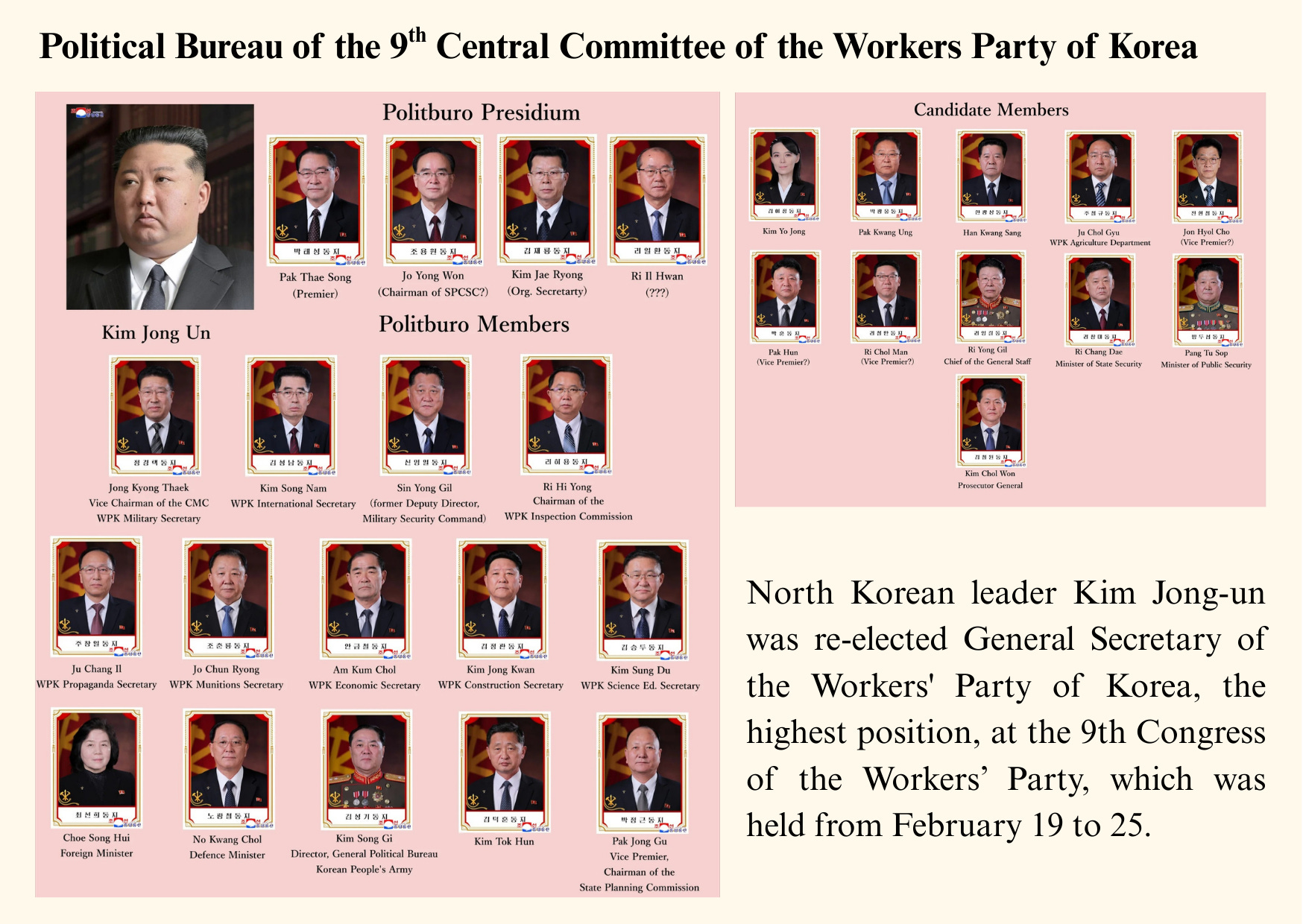
North Korean leader Kim Jong-un was unanimously re-elected as General Secretary of the Workers’ Party of Korea on the fourth day of the party’s 9th Congress, according to official media. At a time of increased military and political propaganda, the position, which is the highest in the ruling party, solidifies Kim’s power.
Party propaganda highlighted Kim’s “great victory” and the beginning of a “new era,” portraying him as surpassing his predecessors. Observers say this marks a shift toward intensified personal glorification, with rhetoric elevating him above both Kim Il-sung and Kim Jong-il. The congress emphasised achievements such as strengthening a “revolutionary armed force” and enhancing nuclear-based war deterrence.
His re-election was accompanied by a significant leadership reshuffle. More than half of the Central Committee and alternate members were replaced, signaling a generational shift. Key inter-Korean relations officials Kim Yong-chol and Ri Son-gwon, along with senior figure Choe Ryong-hae, were excluded from the new lineup. While only 47.5% of Central Committee members retained their posts, a large majority of alternate members were newly appointed, indicating consolidation around younger loyalists.
Analysts view the overhaul as part of Kim’s broader effort to consolidate power following recent foreign policy moves, including military cooperation with Russia. The party also announced partial revisions to its charter, though specific details remain unclear.
— — —
Essay: Amogh Dev Rai
Data and Postscript: Bhupesh
Produced by Decypher Team in New Delhi, India
— — —