


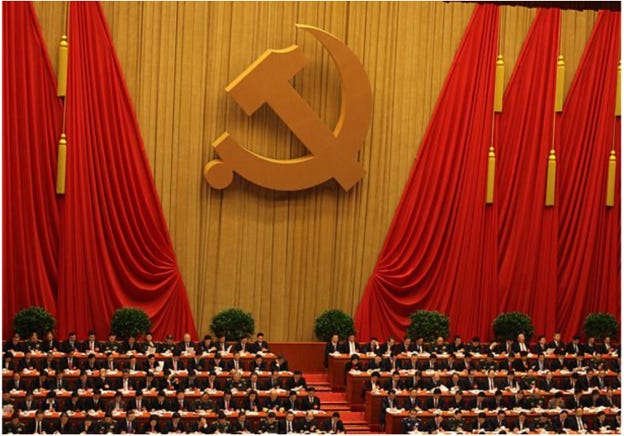
The Fifth Plenary Session of the 20th Central Committee opened in Beijing on 26 October and closed on 29 October. Xi Jinping delivered the Politburo’s work report and explained a draft decision on persevering with full and rigorous Party self-governance. Xinhua reports that the session adopted the decision, elected General Zhang Shengmin to the Politburo and set the 21st Party Congress for the second half of 2027. The communiqué confirmed the expulsion of 33 officials and the loss of Party posts for a 34th. NBC describes this as a post-Mao record and reports the highest rate of absences in that period. SCMP adds that 34 is a new high for recent plenums. Eighteen of the cases were senior civilians and sixteen were military figures, all of them full or alternate Central Committee members.
A fifth plenum in a Congress cycle normally turns to economic planning. Bloomberg had noted that this one was expected to focus on ideology and governance. The economic groundwork was finished a year earlier, when the fourth plenum adopted the recommendations for the 15th Five-Year Plan, and the communiqué gives the economy a closing paragraph of routine year-end guidance. That left the session free to take up a question the leadership treats as a precondition for everything else: can the Party’s own officials be made to carry out what the centre decides?
The preparation was long and unusually visible. On 30 July the Politburo set the agenda and conceded that Party self-governance, for all its progress since 2012, faced new circumstances and challenges. At its 21 September meeting it reported that an earlier draft had gone to Party members and non-Party figures for comment. A text drafted, consulted on and revised over months is meant to be programmatic and to outlast the session that adopts it.
There is a precedent. The last plenum devoted to this theme met in 2016, when, as Jamestown’s China Brief recalls, Xi accused a very small number of senior cadres of “political conspiratorial activities.” That session conferred the “core” title on Xi and institutionalised his discipline campaign. Yet the plenum documents also reiterated collective leadership and intra-Party democracy, which Lance Gore reads as a sign of resistance and compromise. The 2021 plenum later adopted a history resolution that elevated his doctrines. Plenums on Party discipline have a habit of doing more than disciplining.
Reading one: the hall as evidence
Plenums offer one of the few chances to audit the Central Committee from outside. The communiqué reports how many members and alternates attended, and the pattern of absences and promotions shows who remains in good standing.
The baseline was already stark. At the fourth plenum, 168 of 205 full members and 147 of 171 alternates attended. That is 315 of 376, or 83.8 per cent, the lowest relative turnout since 1976 according to the Egmont Institute. Brookings found that the same session purged ten full members and four alternates and promoted eleven alternates, skipping eight who had polled more votes at the 2022 Congress. The fifth plenum went lower. SCMP reports that 162 of the 205 full members attended, a turnout of 79 per cent against 82 per cent the year before. Alternate attendance fell from 147 to 117. SCMP calls it the lowest attendance in decades.
The purge was larger than the preceding months suggested. The plenum formally confirmed 34 cases, about nine per cent of the 376 members elected in 2022. Thirty-three people were expelled, and Li Yunze, head of the National Financial Regulatory Administration, lost his Party posts. Eighteen were civilians and sixteen were military. NBC lists among those removed the former Politburo members Ma Xingrui and Zhang Youxia and the former industry minister Jin Zhuanglong. Sixteen of 34 is roughly 47 per cent, a heavy share for the military. The earlier figures were already sharp: of the 44 uniformed officers elected as full members in 2022, only two appeared to have escaped purge or disappearance.
The communiqué also ended a long silence on Liu Jianchao. SCMP reports that Xinhua confirmed for the first time that he is under investigation and will be removed from the Central Committee. He has not been seen in public since August 2025, and Liu Haixing replaced him as head of the Party’s International Department the following month. Liu Jianchao had run that department since June 2022 and travelled widely to repair China’s image after the pandemic. On my reading, the purge now reaches the Party’s outward-facing channels as well as the military.
Promotions point the same way. Ten alternates moved up to full membership to fill the vacated seats. SCMP describes them as relatively young regional and economic officials, among them Shanxi governor Lu Dongliang (52), Zhejiang governor Liu Jie (56), Inner Mongolia chairman Bao Gang (57) and Jinan party chief Liu Qiang (55). Five alternates were passed over although promotion is supposed to follow ranking. Two of them are People’s Armed Police lieutenant generals: Fu Wenhua, a former Beijing garrison commander, and Zhu Wenxiang, a former commander of the PAP’s First Mobile Corps. The skipping of ranked alternates that Brookings recorded at the fourth plenum has happened again.
Two details go beyond atmospherics. The first is the wording of the 21 September expulsion notice for Zhang Youxia and Liu Zhenli. It charged them with forming cliques and being disloyal and dishonest to the Party, and it tied those charges to the sale of promotions. It left out “political ambition” and “conspiracy,” words that appeared in earlier charge sheets and in the 2016 speech, and it never said what their disloyalty consisted of. Jamestown reads that restraint as a signal that the leadership wants the case understood as clique-building inside the system, which carries no implication of a plot against Xi.
The second is a pair of tests that Takshashila’s Anushka Saxena proposed for judging whether the purge was nearing its end. One asked whether the alternates bypassed in 2025 would be passed over again. The other asked whether the language about Zhang would harden into “pernicious influence,” phrasing that preceded years of follow-on purges after Guo Boxiong and Xu Caihou. The first test has an answer: five ranked alternates were passed over again. The sources used here do not show whether the language on Zhang hardened.
Reading two: a system built to outlast the campaign
A second reading treats the meeting as construction more than purge. Ruby Osman of the Tony Blair Institute describes the aim as a disciplined system able to carry Xi’s priorities across leadership cycles. She cautions that record disciplinary numbers need not mean corruption is rebounding, since they can equally show the standard rising. The full text of the resolution had not been released when the communiqué appeared, so what follows rests on the communiqué alone. It supports the construction reading in three ways.
First, it supplies a diagnosis and a doctrine. It describes a Party whose leadership had at one time become weakened, hollowed out and diluted, with lax management and some shocking problems. It credits the Central Committee under Xi with fundamentally reversing this and eliminating serious risks “within the Party, the country and the military.” It names “Xi Jinping Thought on Party building” as a component of Xi Jinping Thought, and it claims that self-revolution and public supervision together answer the historical cycle of dynastic rise and fall. Manoj Kewalramani observes that the achievements paragraph credits the Central Committee collectively while the theoretical paragraph exalts Xi’s own contribution. What results is a codified doctrine of Party building that can outlive a campaign.
Second, it assigns responsibility downward. Th Party organisations at all levels are the principal entities of self-governance. This extends the line in Xi’s 31 August article, which places primary responsibility on Party organisations and their chief officials. The communiqué calls for a responsibility system in which each unit answers for its own area under unified coordination. It asks for better mechanisms to assess how responsibilities are discharged, and for accountability against those who govern the Party ineffectively. Xi had told the discipline inspectors in January to confine power in an institutional cage, and the institutional agenda follows that logic. It promises to make Party-committee supervision “substantive,” to refine the dual-leadership system for discipline inspection, to strengthen inspections, to improve intra-Party regulations and to break down unspoken rules. SCMP adds that it calls for constraints and oversight on the exercise of power and for ideological foundations to uphold integrity. The Asia Society paper had predicted assessments tailored to places and jobs. The communiqué points that way by tying the “correct view of political achievements” campaign to leadership transitions, with training for newly appointed leaders, especially “top leaders.” It gives no metrics.
Third, the machinery is already running at scale. A seventh round of central inspections this year sent fifteen teams into 36 central institutions. The Central Commission for Discipline Inspection’s 2025 work report records more than a million cases, 983,000 people punished and 47,000 placed in detention. In 2024 the figures were 877,000 cases, 889,000 punished and 38,000 detained, so detentions rose by roughly a quarter and punishments by about eleven per cent. Kewalramani notes that the CCDI and National Supervisory Commission opened some 800,000 cases between January and September 2026. SCMP reports that the communiqué calls for corruption to be fought to the end, so there will be no slackening. A campaign in its fourteenth year that is still accelerating has become a standing institution. Nobody is treating it as a clean-up.
What gets policed has also shifted. The 2025 report counts 150,000 cases of hedonism and extravagance and 141,000 of formalism and bureaucratism. Formalism means going through the motions: shirking, inaction, hollow performance of duty. Punishing it takes the campaign from taking money to not doing the job, and the second offence is much harder to define. Lianhe Zaobao anticipated this when the agenda was announced, observing that the scope could be broader than anti-corruption. The communiqué bears that out by pairing the work-style campaign with the anti-corruption campaign and calling for the eight-point regulation to be made routine and long-lasting.
Reading three: a loyalty system
The system being built is openly a loyalty system. State media published an article just before the plenum based on a January speech in which Xi attacked officials who seem to follow central orders while resisting inwardly. According to AP, he added that leadership transitions are the moment to elevate cadres who are reliable and consistent in word and deed, and never to let a two-faced person through. Mingda Qiu of Eurasia Group reads the signal plainly: officials are now tested for compliance and action as well as loyalty.
The communiqué gives this agenda a pedagogy. It names the cultivation of Party spirit the fundamental task of self-governance. It calls for education in loyalty to the Party and for stronger “discernment of Party spirit,” a phrase that implies officials can be sorted by it. It describes the ideal cadre as loyal, clean and responsible. SCMP’s rendering asks for a team that is “politically steadfast, highly competent, exemplary in conduct and strict in discipline,” and it ties strict management to education, selection, appointment and supervision. The same passage asks officials to take the initiative and deliver results.
Loyalty of this kind is hard to specify. Jamestown notes that the September notice did not say how Zhang and Liu were disloyal and cited none of the forms listed in the Party’s disciplinary regulations. Whether an act counts as disloyalty therefore rests largely on Xi’s own judgement. The communiqué added a vocabulary but no operational definition, and the full resolution may yet supply one. An official facing a test whose edges he cannot see has one rational response, which is to over-signal. This is the principal-agent problem that Daria Impiombato of MERICS identifies: a centre that sets ever more priorities must get distant officials, who control the information, to carry them out as intended. Heavier penalties for non-implementation may raise the price of honest reporting as much as the price of shirking. The Asia Society authors put the limit bluntly: commanding Zhongnanhai is easier than controlling 101 million Party members.
The communiqué also contains a tension that the loyalty reading tends to miss. It reaffirms centralised, unified leadership, but it also calls for stricter decision-making and deliberation rules for leadership teams and for regulating how “top leaders” exercise power. The centre wants more obedience from local chiefs and less discretion for them, and it treats the chief as both the guarantor of compliance and a risk to it. The 2016 plenum paired the “core” title with reaffirmations of collective leadership, and this text follows the same pattern of coupling personal elevation with procedural reassurance. That parallel is my reading, not a stated intention.
The 2027 Congress sharpens the problem. Neil Thomas of the Asia Society Policy Institute expects tougher scrutiny of officials competing to join Xi’s next leadership team, now that so many of those he promoted in 2022 have been removed.
What the empty chairs measure
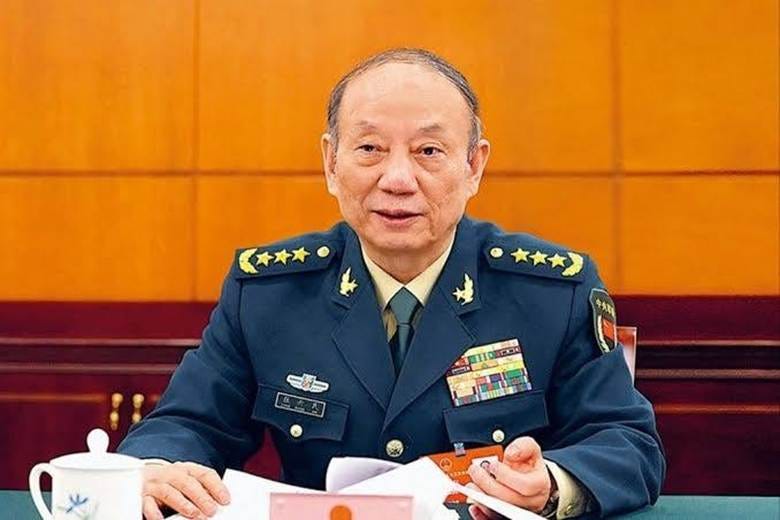
The empty chairs record something the calm reading underweights: the circle of the exempt keeps shrinking. In October 2025 Brookings could still observe that Xi’s closest lieutenants, Zhang Youxia among them, had been spared, at least “so far.” In January the defence ministry announced an investigation into Zhang and Liu. In September the Party expelled both, and in October the plenum confirmed it. Ma Xingrui, expelled in July, left a Politburo that had 21 members. AFP counts three Politburo members purged, the most in any single term since 1980.
Who is being removed matters analytically. Many of them are people Xi himself promoted, so each purge counts as evidence against the vetting that came before it. The response is more vetting, more inspection and more tests of loyalty. A system that cannot trust its promotion decisions has to re-verify continuously, and continuous re-verification generates cases.
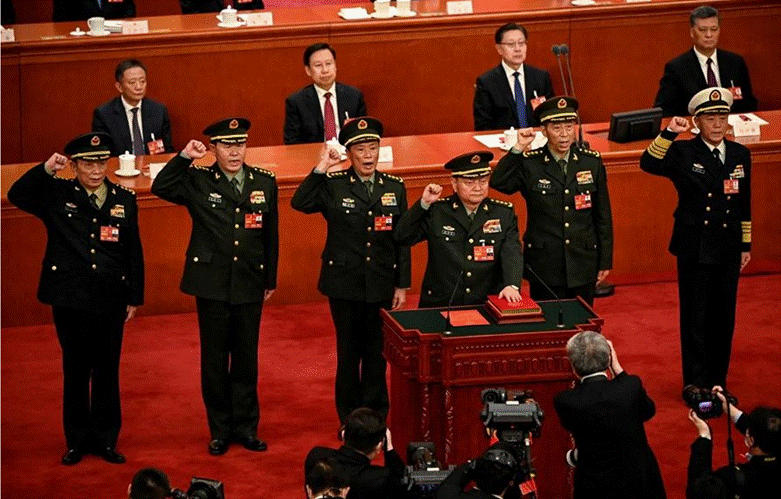
The promotion of Zhang Shengmin shows the loop in the military. SCMP reports that Zhang, made a Central Military Commission vice-chair a year ago, was the military’s anti-corruption chief from 2018 until July this year and is the top enforcer of the drive that cut into the PLA’s leadership. That drive left both of the Politburo’s military representatives disgraced, so the body had no military member after January, against a norm of two since 1997. Kewalramani counts 22 active Politburo members after the promotion, from 24 elected in 2022. The system restored to the top table the officer who had run its military discipline inspection, and no field commander. That suggests the Party values the enforcement function enough to give it a Politburo seat. It also leaves the PLA’s representation resting on one person, with the CMC reduced to Xi and Zhang. Whether a second general joins him at the 21st Congress remains open.
Why 2027 raises the stakes
Timing helps explain why the Party chose this theme now. The plenum was the last of its kind before the 21st Congress. The communiqué fixes the Congress for Beijing in the second half of 2027 and calls it a highly important meeting at a critical stage on the way to the second centenary goal. Kewalramani infers that no further plenum is likely before it. Neil Thomas and his colleagues expected the meeting to prepare the ground for a fourth term and to reinforce expectations of continuity in politics and policy. The Asia Society paper was more cautious about succession. It treated a move to signal an heir as possible but unlikely, and noted that Xi’s own elevation to Central Military Commission vice chairman came at the fifth plenum of 2010. The communiqué named no heir.
The usual way to read a fifth plenum is as a succession signal, and this one is better read as something close to the reverse. A leader who intends to stay has no need to designate a successor. He needs a cadre corps that will carry out his preferences for another five years without close supervision, and a Decision on self-governance is the instrument for producing one. The discipline agenda then works as succession policy by other means. It shapes the pool from which the 2027 Congress will draw and fixes the standard that pool will be judged against. That is my reading of the evidence, and the leadership has not stated it as an aim.
The plenum also qualified an earlier expectation. After the fourth plenum, Thomas had suggested that Xi would wait for the 21st Congress to vet new CMC and Politburo members. Zhang’s elevation breaks that pattern. SCMP notes that Politburo promotions normally happen at the five-yearly Congress and that the last mid-term one came in 1994. The waiting strategy holds for the Central Military Commission, which still has two members, but not for the Politburo.
The Asia Society authors also warn that tighter control offers no guarantee of better government. Officials who fear punishment for inaction may act without authority, and those who fear punishment for error may do nothing. The communiqué asks for both strict discipline and initiative and leaves the line between them undrawn. The Decision’s weight will fall on where that line is placed.
Where the readings leave us
The hall shows power on display, through attendance, expulsions, promotions and the wording of notices. The institutional record shows a discipline apparatus that the communiqué now writes down as doctrine and a responsibility system, built to last beyond one term. The loyalty agenda explains why that apparatus cannot rest: obedience that cannot be verified has to be tested again and again. The full resolution, once published, will show how much of this is written into the text.
Essay: Maseera Shaik- Research Assistant (Security, Crisis and Strategy) at The Advanced Study Institute of Asia (ASIA)
Produced by Decypher Team in New Delhi, India