

China’s “Small and Beautiful” Strategy: Recalibrating the Belt and Road
China’s Belt and Road Initiative (BRI), once defined by massive infrastructure projects across continents, is undergoing a strategic revision. After a decade of megaprojects—from railways and highways to ports and power plants—Beijing is increasingly emphasizing what Chinese policymakers call “small and beautiful” (小而美, xiao er mei) projects.
The shift reflects China’s attempt to sustain its global development strategy while responding to financial risks, geopolitical criticism, and changing economic priorities. China appears to be transforming it into a new phase—one that focuses on smaller, targeted, and more sustainable investments.
Origins of the “Small and Beautiful” Concept
The concept gained prominence in 2021, when Chinese President Xi Jinping began advocating smaller projects as part of the next phase of the Belt and Road Initiative. In speeches and policy discussions that year, Xi urged Chinese institutions and companies to prioritize “small yet smart” or “small and beautiful” projects, signaling a shift away from the large infrastructure developments that characterised the BRI’s first decade.
Analysts interpret this as a strategic adjustment. According to policy research, the phrase was introduced as part of a broader attempt to transition the BRI from massive capital-intensive infrastructure projects toward smaller, greener, digital, financially viable initiatives resembling traditional development aid programs.
Xi reiterated this emphasis during the Third Belt and Road Forum in 2023, stating that China would promote both major “signature projects” and smaller livelihood programs aimed at improving people’s daily lives.
From Megaprojects to Targeted Development
During its first decade, the BRI focused heavily on large infrastructure investments such as ports, railways, pipelines, and highways. Between 2013 and 2020, Chinese state banks and companies financed projects worth hundreds of billions of dollars across Asia, Africa, and Europe.
However, these large projects often faced criticism. Some recipient countries experienced rising debt burdens, delays, and governance concerns. At the same time, China’s own economic slowdown and financial pressures made massive overseas lending less sustainable.
The “small and beautiful” model reflects a response to these challenges. These projects characterise China’s foreign aid and international development cooperation. Instead of billion-dollar infrastructure schemes, the new approach emphasizes projects that are:
Catering local needs
People centered philosophy
Diversified participation
Green development
Low carbon footprint
Directly beneficial to local communities
The shift also allows China to focus on sectors where it has growing technological advantages, including renewable energy, digital infrastructure, and telecommunications.
Types of Projects and Development Impact
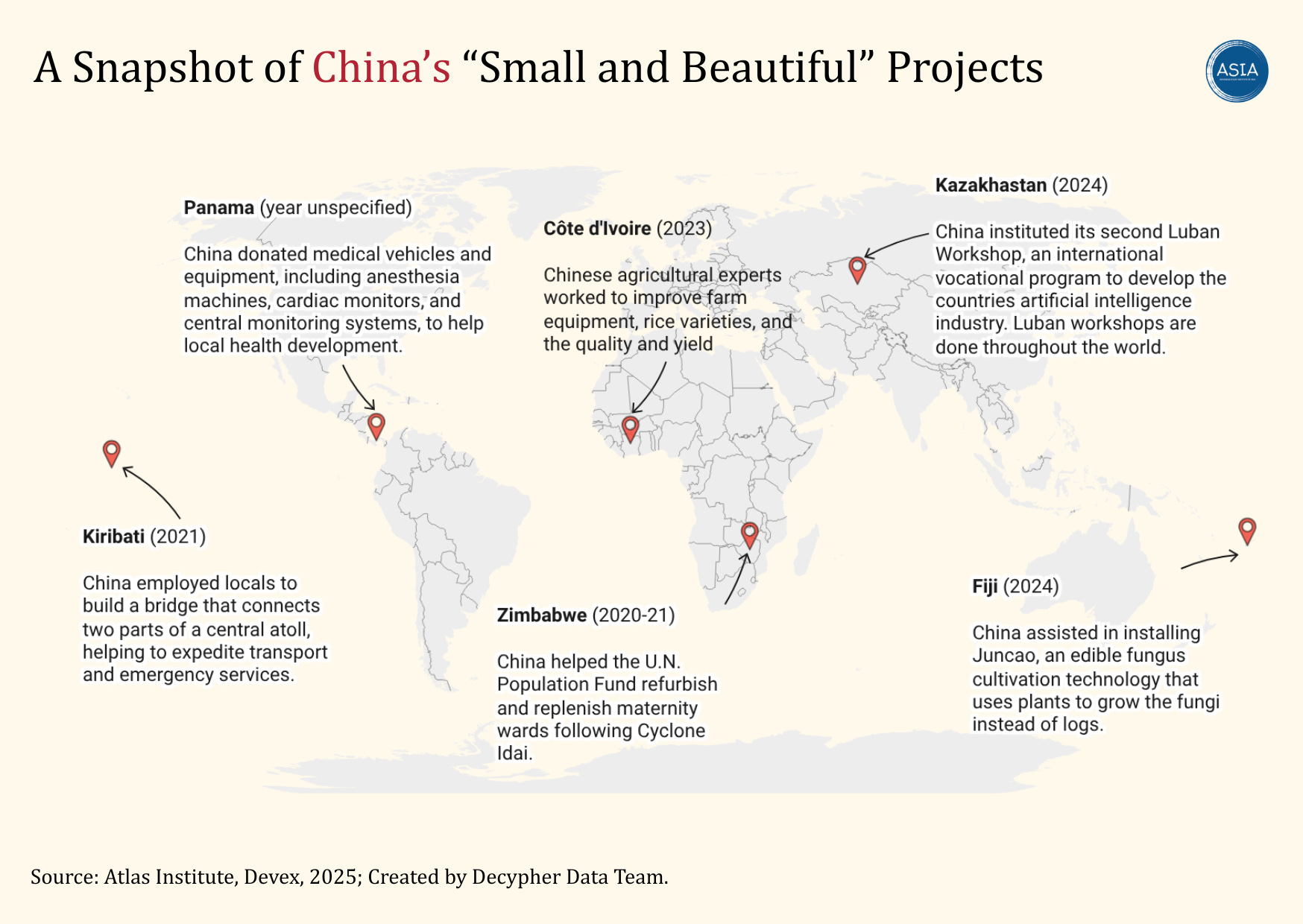
Examples of “small and beautiful” projects illustrate the shift in China’s development strategy. Instead of large ports or railways, many initiatives now focus on community-level improvements such as:
Solar and wind energy facilities
Digital connectivity infrastructure
Agricultural modernization programs
Educational workshops & rural livelihood programs
Health projects
Luban workshop (Chinese Vocational Training Program) in fields of automation, AI, engineering

For example, Luban workshops (establishing strong link between Chinese Universities and African Businesses) in many of the African countries namely Djibouti, Kenya, South Africa, Mali, Egypt, Nigeria, Uganda, Ethiopia, Madagascar) seek to train young and African professionals through funding from China. There are also Technical and Vocational Education and Training programs (TVET) seeking to promote cooperation between the two. Chinese technology firms have launched affordable broadband projects in parts of Africa, bringing internet connectivity to communities previously lacking access. These initiatives have reportedly created thousands of local jobs while expanding China’s digital presence abroad. Moreover, China has supported Laos through the China-aided Lao Railway Vocational Technical College, which trains local railway instructors and technicians to address skill shortages.
Broad Collaborative framework
At the Third BRI forum China has announced carrying out 1000 small scale livelihood programs and projects and also enhancing vocational educational workshops and other initiatives. China has promoted “small and beautiful” Belt and Road projects through a broad collaborative framework involving government institutions, local authorities, enterprises, think tanks, universities, and international organizations. The central government plays a leading role by funding grant-based assistance projects, while also encouraging companies to participate through market-oriented mechanisms and supportive policy platforms. According to available statistics, 92 “small and beautiful” projects were implemented in 2022–2023 across 17 countries, covering 48 communities and 153 educational institutions, and benefiting over 2.6 million people directly or indirectly. In Myanmar, 24 projects since 2022 have focused on infrastructure, industrial development, agricultural technology, and education.
Geographic Focus and Key Partners
According to the data estimates of Green Finance and Development Centre, 2025 saw the highest number of BRI engagements. Over 140 countries have joined the BRI initiative. Africa remains especially important. More than 50 African countries have joined the Belt and Road Initiative (as of 2025), making the continent one of the largest partners in China’s overseas development strategy followed by Europe, Latin America and Caribbean, Pacific, Southeast Asia and so on.
Global Responses
China’s evolving strategy has drawn mixed reactions from other major powers.
The United States and its allies have launched alternative infrastructure initiatives, such as the Partnership for Global Infrastructure and Investment (PGII) and the European Union’s Global Gateway program. These initiatives aim to provide competing development financing in the Global South.
China’s new development strategy raises broader geopolitical questions. On one hand, smaller projects may encourage greater cooperation with local governments and international institutions, making Chinese investment more politically acceptable. On the other hand, critics argue that the shift may deepen China’s economic presence across developing regions, potentially increasing geopolitical competition. A decade after launching the Belt and Road Initiative, China appears to be entering a new phase of global engagement. The emphasis on “small and beautiful” projects signals a move toward more targeted, sustainable, and financially manageable investments.
Whether this transformation leads to deeper international cooperation or intensifies geopolitical rivalry remains uncertain. What is clear, however, is that China’s global development strategy is evolving reducing risk apetite – and the next decade of the BRI will likely look very different from its first – a fine brush approach.
Power Shift in Tehran: Global Reactions to Mojtaba Khamenei
According to a report by Al Jazeera, the appointment of Mojtaba Khamenei as Iran’s new supreme leader has triggered sharply divided reactions across the world, reflecting deep geopolitical fault lines surrounding the ongoing US–Israel conflict with Iran. Mojtaba Khamenei, a cleric who has never held an official government position but has close ties to the Islamic Revolutionary Guard Corps (IRGC), was nominated by Iran’s Assembly of Experts just days after his father, former supreme leader Ali Khamenei, was killed in US–Israeli airstrikes.
Within Iran, key political and security authorities, including President Masoud Pezeshkian and senior IRGC officials, quickly endorsed the decision, signalling an attempt to maintain leadership continuity during one of the most severe crises in the Islamic Republic’s history.
Regional reactions have largely been supportive. Sultan Haitham bin Tariq of Oman sent a message of congratulations, while Iraqi Prime Minister Mohammed Shia al-Sudani expressed confidence that Iran’s new leadership could navigate the current turmoil and maintain regional stability. Yemen’s Houthi movement also praised the decision, calling it a victory for the Islamic Revolution.
However, Western nations and Israel have expressed open hostility. US President Donald Trump dismissed Mojtaba Khamenei’s leadership and warned that his appointment could further destabilise the region. Israel’s Foreign Ministry went further, calling him a “tyrant” and warning that he would continue the policies of his father.
Meanwhile, Russia and China have adopted a cautious, although broadly supportive, stance. Russian President Vladimir Putin reiterated Moscow’s support for Tehran, while China emphasised Iran’s sovereignty and opposed foreign involvement in its internal affairs.
How the US–Iran War Is Triggering a Gas Crisis in India
Two weeks ago, Donald Trump launched a war aimed at toppling the regime in Iran, expecting a swift victory. Instead, the conflict has escalated, with continued missile and drone strikes across the Gulf and toward Israel. Despite the killing of Supreme Leader Ali Khamenei and significant military casualties, Tehran has demonstrated resilience by immediately appointing a new hardline leader and shifting the war to strategic pressure points Most notably, a significant shock to the world’s oil and gas supply has been caused by disruptions in the Strait of Hormuz, one of the most important energy corridors in the world (analysis based on a remark in GZERO Media).
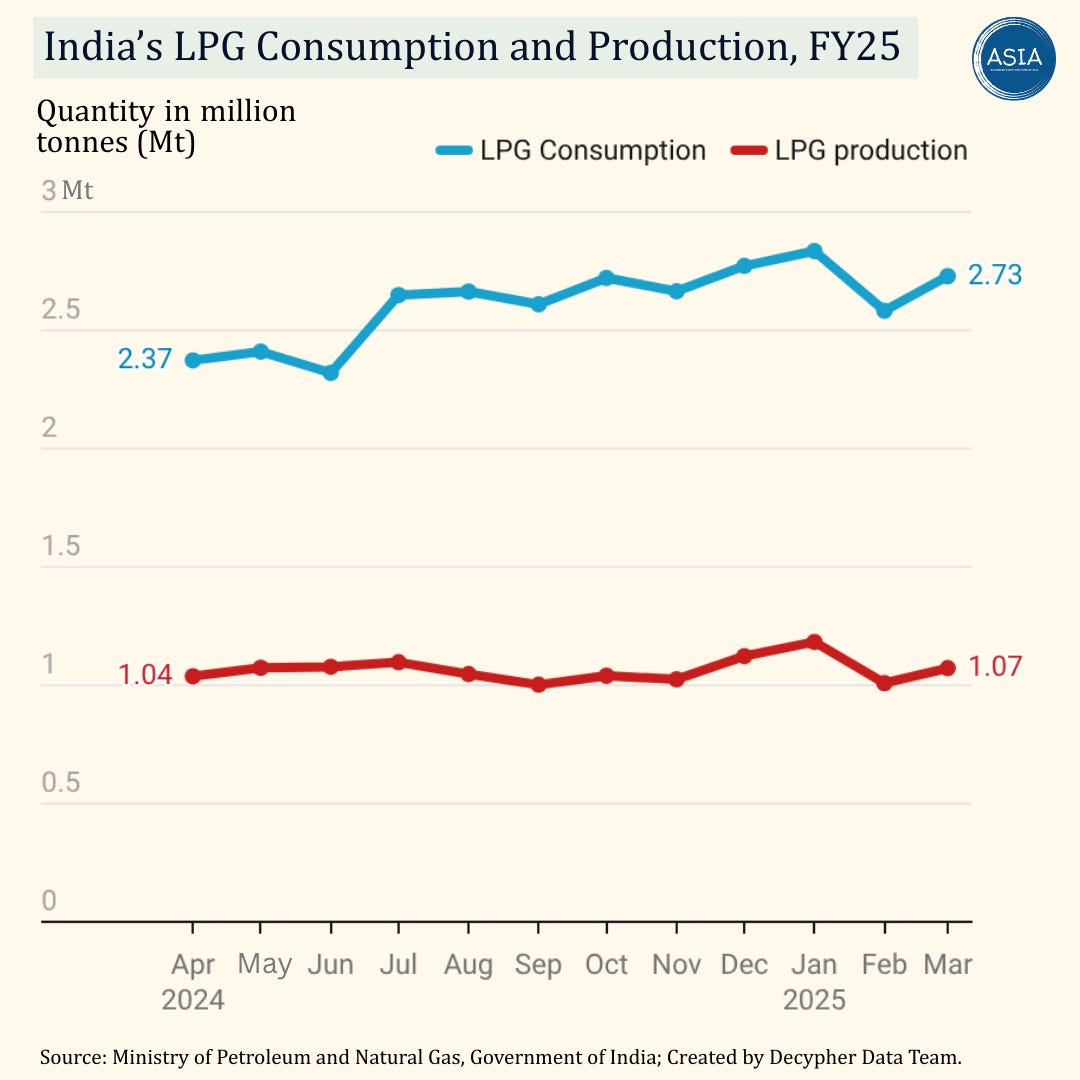
The ripple effects are now reaching India. According to Mint, India imports more than 60% of its LPG needs, with 85-90% of those shipments passing through the Strait of Hormuz, making the country especially vulnerable to interruptions along the route. India imported approximately 31.3 million tonnes of LPG in FY25, compared to domestic output of only 12.8 million tonnes. As tanker traffic slows, LNG and LPG supplies are tightening and prices are rising, putting pressure on gas-dependent sectors such as fertilisers, city gas distribution, and food services. LPG shortages are already creating operational risks for restaurant chains and food delivery platforms, with establishments in cities such as Mumbai and Bengaluru warning of possible closures due to limited fuel availability. Meanwhile, the government has prioritised gas allocation for essential uses such as household LPG and transport-related CNG.
— — —
Essay: Neeti Goutam
Data and Postscript: Bhupesh
Produced by Decypher Team in New Delhi, India
— — —