

The View from the Great Hall: China’s Two Storms
What the Two Sessions and the War on Iran reveal about the world Beijing is preparing for
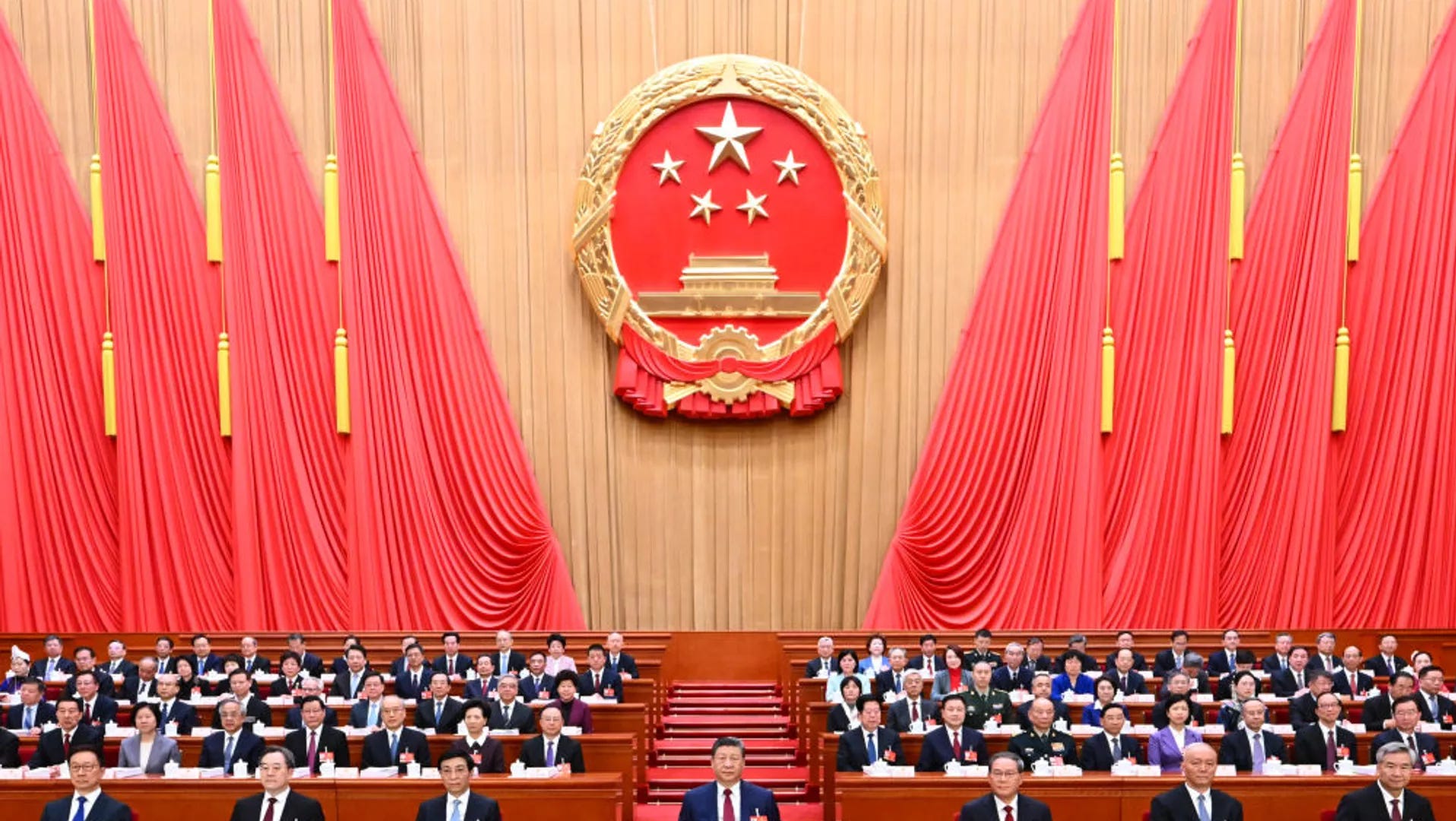
As Premier Li Qiang stepped up to the podium on the morning of March 5th to deliver the government work report to the National People’s Congress, the Strait of Hormuz felt like a war zone. Three oil tankers had been hit, QatarEnergy had suspended production of LNG, and oil prices had risen by 13 percent on the day. The world that Chinese planners had modeled for their five-year projections was, quite literally, on fire.
Let’s take a step back for a moment. On one side of the Great Hall, the government spoke with the authority of their long-term plans, their targets, their ratios, their spending priorities. On the other, the conditions that their plans presupposed were unraveling – in the Strait of Hormuz, in the oil markets, in the rubble of Iran’s air defense sites. The 2026 policy statements that Beijing is about to unveil should be understood against this backdrop: not simply as housekeeping, but as a statement of how Beijing plans to hold its ground in the world.
I. The Growth Target as Strategic Signal
The most prominent figure in the work report—China’s target of 4.5 to 5 percent in GDP growth—is the lowest target since 1991 and a reduction from the “around 5 percent” target that China has been aiming for since 2023. The reduction is not inaccurate but also not complete. What is perhaps more significant is the form of the target, as a range of 4.5 to 5 percent, as opposed to a hard figure, as Shen Danyang, director of the State Council Research Office, said in explaining the decision to set the target as a range: “to retain flexibility in responding to uncertainties.” Chinese targets for growth have traditionally been set as floors—numbers that the government has hoped to exceed, as it has in the past. The decision to set the target as a range, however, suggests that the government is unsure of the external environment.
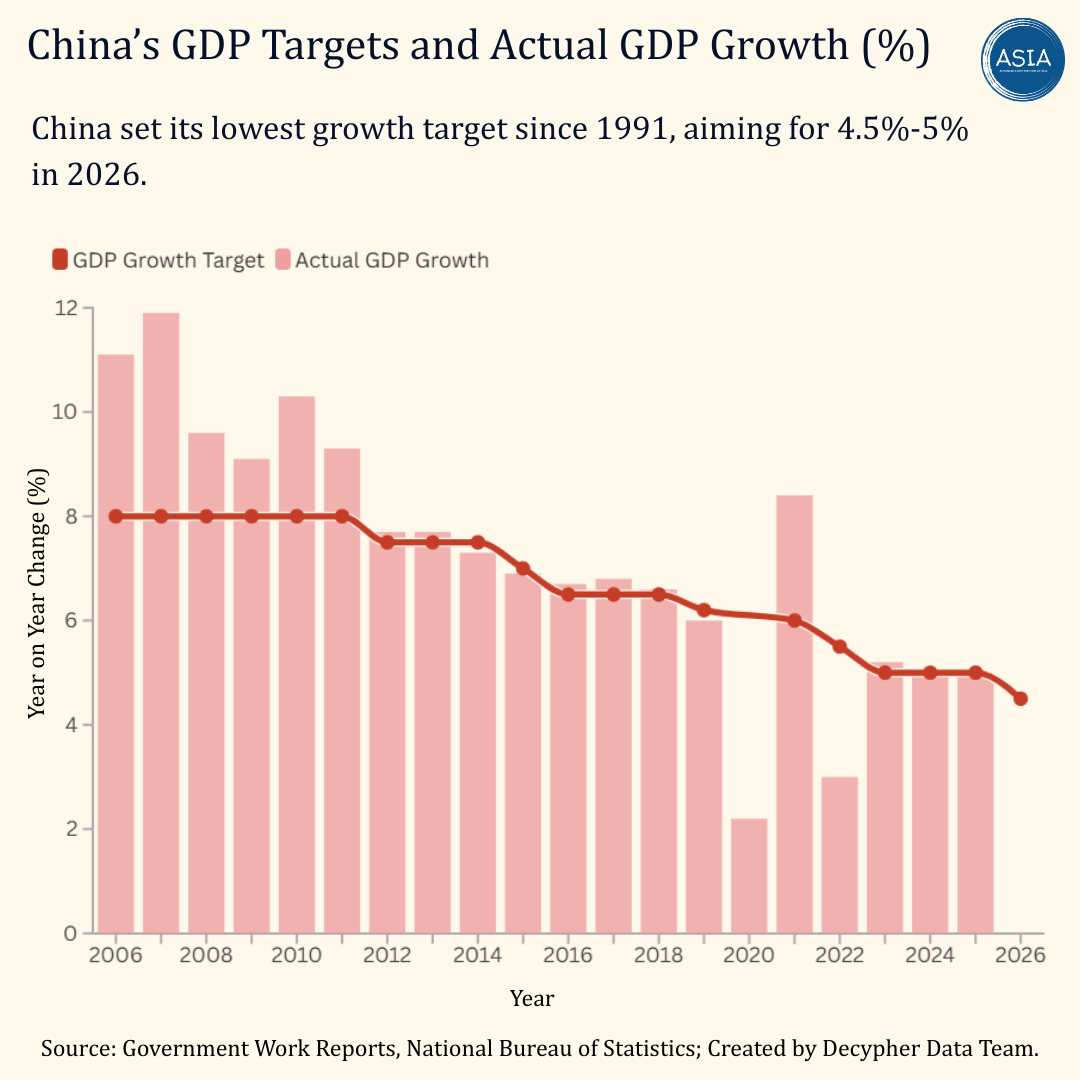
The most significant part of the work report, however, is not the target it sets but the budget it releases in its wake. Every time China has faced some external shock, it has turned to stimulus packages in infrastructure as the sure-fire solution to boost growth. Not so in the budget that accompanies the work report, where the fiscal deficit is set at 4 percent of GDP, a large figure by Chinese standards, but where allocations to science, technology, diplomacy, defense, all rose by 7 to 10 percent, suggesting that the government has decided that the next phase of China’s development will not be determined by the construction industry but by what happens in the fabs of semiconductor manufacturers and the research centers of AI scientists. The question is whether the gamble will pay off quickly enough to offset the damage that the external environment is already causing to the Chinese economy.
II. The Five-Year Plan and the Long Game
The simultaneous release of the outline of the draft of the 15th five-year plan with Li’s work report was no coincidence. The five-year plan supplies the ideological underpinning; the work report operationalizes it for the year. The combination of the two represents the most detailed articulation of what the concept of “new quality productive forces” that Jinping has long championed really means.
The essence of the plan is that technology-driven growth, not consumption stimulus, urbanization, nor export manufacturing, is to drive the next phase of development. Prioritized sectors include a list of technology fields that could have been drawn up in direct answer to American technology restrictions: integrated circuits, aerospace, biomedicine, quantum technology, embodied artificial intelligence, brain-computer interfaces, 6G technology. These are fields in which China is already competitive, vulnerable to American leverage, or both.
Xi’s meeting with Jiangsu deputies on the margins of the NPC is consistent with this plan. Jiangsu is home to thousands of small manufacturers specializing in a few products—a “little giant” industrial model that Beijing has been cultivating for a decade. Xi’s instruction to make “breakthroughs in tackling core technologies” was a direct appeal to this sector. It is a test case for whether deep industrial complexity can be improved without losing the specialization that makes it valuable.
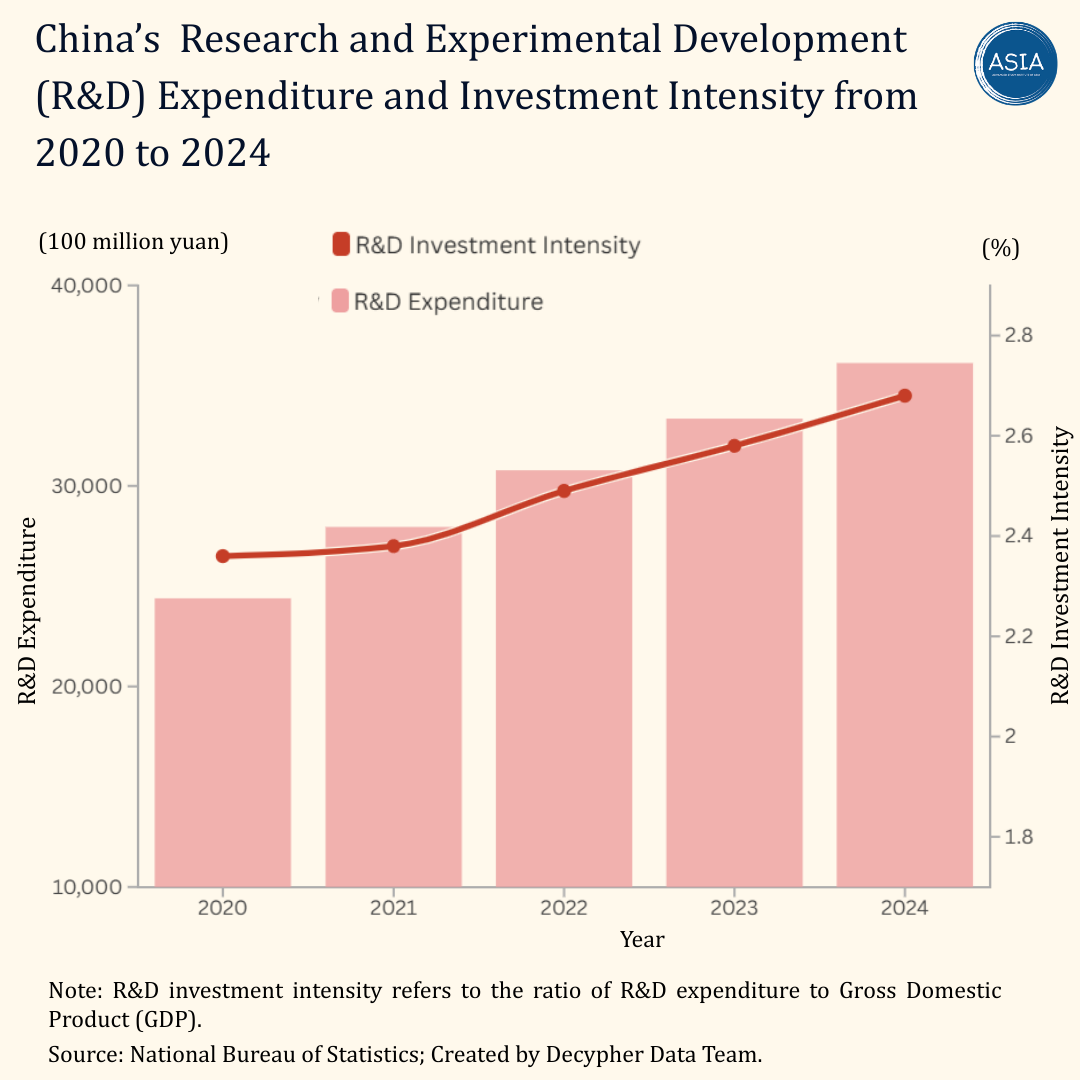
The plan commits to a minimum increase in R&D spending of 7 percent a year until 2030. Science and technology budgets are to increase by 10 percent this year alone. Whether or not China can leverage these investments into genuine innovation instead of merely well-funded mediocrity is a question that cannot be answered in a planning document. No plan can guarantee success.
III. Iran: What Does the Silence Cost?
The US/Israel strikes against Iran that began over the weekend before the NPC began in earnest is a stress test that no one in Beijing could have anticipated. China imports half its oil from the Middle East. Eighty-seven percent of Iranian oil passing through the Strait of Hormuz was headed for Chinese refineries. The killing of Khamenei and suspension of transit through the Strait is not an abstraction for a new world order for Beijing. It is a direct economic blow.
China has responded with strong rhetoric but taken no meaningful action. The rhetoric—denouncing the strikes as “unacceptable” and calling for restraint and dialogue—follows a pattern now well established. As with the US operation in Venezuela in January, China has expressed strong opposition to US military action and then done nothing more. The principle of the “non-alliance” that Chinese foreign policy analysts must sometimes explain to Westerners is no mere rhetoric. It was policy in operation here and was correct.
The logic here was hardly complex. The issue was that Xi was about to meet with Trump and that meeting would be important for the trajectory of the tariff war. The IEEPA framework, technology export controls, and Huawei sanctions were what would really determine China’s economic trajectory in the next five years. As Zhu Feng of Nanjing University pointed out, “If China were to send military aid to Iran, it would mean a total breakdown in Sino-US relations... However much symbolic value that would have, it would be to China’s detriment.”
The problem was that it came at a cost. Of all the countries that have entered into Chinese “comprehensive strategic partnerships” that Chinese analysts take seriously as security partnerships, China has been in solidarity with none in times of need. China and Russia responded to US strikes against Iran with rhetoric but nothing else. The question of whether China’s “comprehensive strategic partnerships” mean anything beyond trade and investment relations in times of need was one that would not go away.
IV. The Deeper Coherence
Collectively, the Two Sessions communiques and China’s response to the Iran strikes suggest that Beijing is not trying to contest U.S. primacy. Rather, it is seeking to avoid the impact of U.S. pressure while developing the technological, financial, and military strength that will make it more resilient in the next round.
One element of Li’s work report that warrants more attention than the increase in the economic growth target: the equal weighting of “investment in people” with physical infrastructure spending. This is not simply an afterthought of the government’s social policies. Rather, it suggests that Beijing’s policymakers have taken the unusual step of reading the Chinese economy with candor—weak demand, tepid market sentiment, income pressures on households. Growth targets no longer provide the same level of cover for Beijing policymakers that they once did. Li’s work report suggests that Beijing understands this.
And then there is Taiwan. The change in Li’s work report from “oppose” last year’s separatist activities to “resolutely crack down” this year suggests that Beijing is taking note of the U.S. strikes in Iran. Xi Jinping has watched the U.S. launch not one but two significant military operations in six weeks. The mistake that Beijing policymakers have not made is that the U.S. is too weak. Rather, it is that the U.S. remains more disposed to use force than recent events have indicated. And the opportunity for Beijing to use force on Taiwan is not obviously expanding.
The defense budget provides the strongest indicator of all. While it still grew by 7 percent, it is a slower rate than last year's 7.2 percent and the lowest since 2021. This is not a country that is engaging in a military buildup when it faces its greatest external threat in years. The fact that Beijing is currently engaged in an anti-corruption drive that has already ensnared such high-ranking military officials as Zhang Youxia and Liu Zhenli indicates that Beijing's priority is political control over its military, not a military buildup.
V. What to Watch
There are three things to watch to determine if Beijing's current posture holds.
First, the upcoming meeting between President Xi and President Trump. If a framework for resolving the tariff dispute that was negotiated in Busan holds, then Beijing's apparent willingness to take on the reputational risk of standing by Iran will look like a rational decision. If President Trump goes to Beijing and comes home empty-handed on issues such as Taiwan or technology, or if Beijing caves on these issues, it will look like a mistake.
Second, Hormuz. Beijing has 1.2 billion barrels of oil in strategic reserve, or 104 days' worth of oil at current rates of consumption, according to researchers at Columbia University. Beijing has been working on a pipeline import deal with Russia that is not subject to Hormuz disruptions. While a Hormuz-specific conflict can be contained, a larger-scale conflict that spreads into Saudi Arabia, where an oil refinery has already been attacked by Iranian drones, is a different story.
Third, the technology plan. The 15th five-year plan is a bet that Beijing can reduce its critical technology dependencies over the next five years, even as they are being aggressively suppressed by the United States. The fact that DeepSeek demonstrated that constraints can drive breakthroughs, not just workarounds, is a powerful argument for Beijing's strategy. But it is also a bet, and one that could turn out to be wrong.
“We are a large ship,” said Justin Lin Yifu on the NPC’s sidelines. “We can sail forward against the wind and waves.” The metaphor is characteristically Chinese in its confidence. What the Two Sessions and the Tehran fires together suggest is that the wind is picking up, the waves are higher than last year’s, and the captain is quietly telling his crew to check the lifeboats.
What does the US-Israel attack on Iran mean for China?
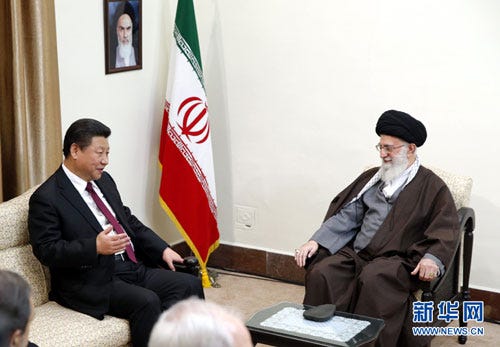
The US–Israel airstrikes that killed Iran’s Supreme Leader Ayatollah Ali Khamenei and Tehran’s subsequent retaliation against US and Israeli targets have major implications for China, primarily in energy and strategic terms. While Beijing has called for de-escalation, its deeper concern lies in the stability of global energy flows and regional balance of power.
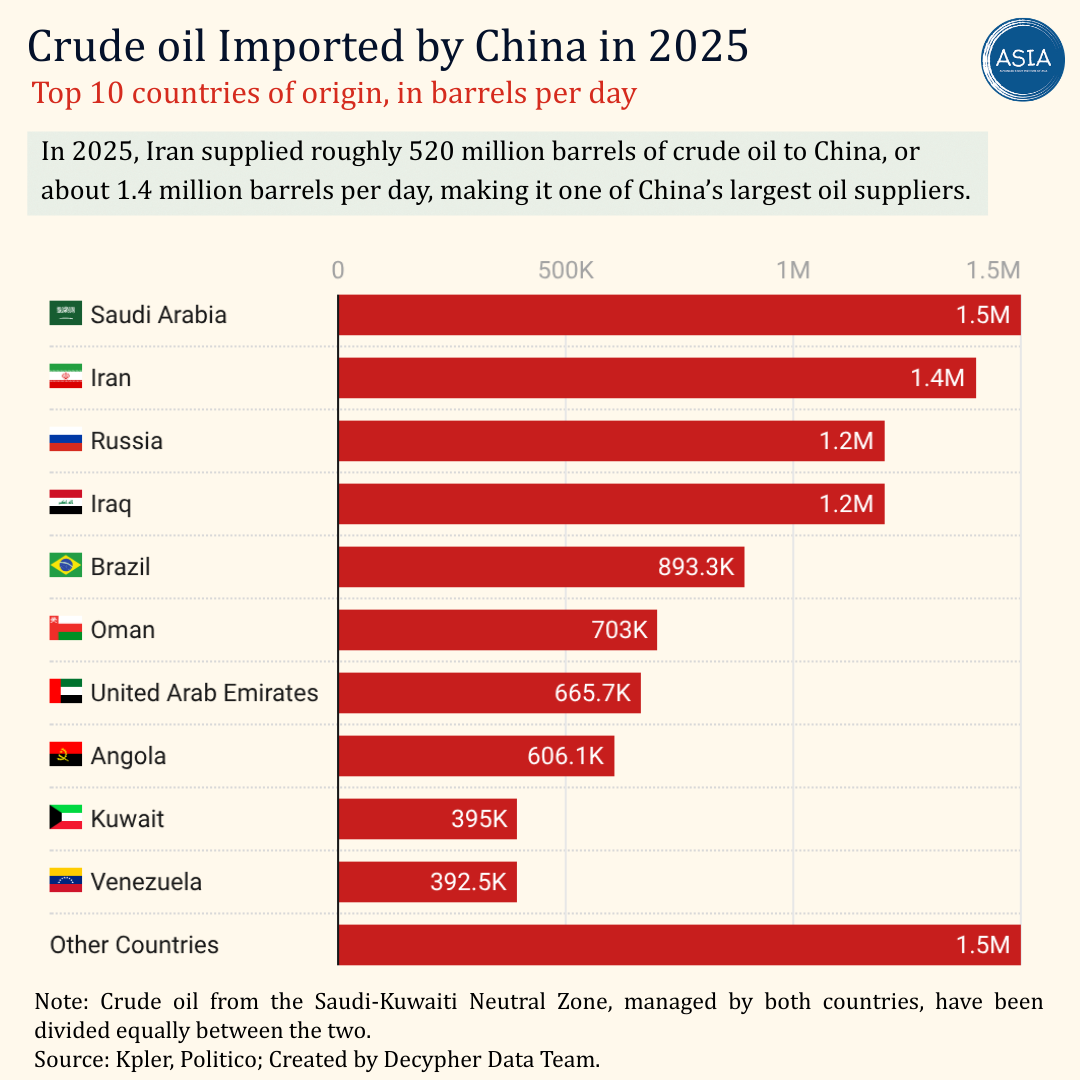
At the centre of China’s anxiety is the Strait of Hormuz, a critical chokepoint through which roughly 20% of global oil and LNG supplies pass. More than 80% of shipments through this route head to Asian markets. Any prolonged disruption would raise energy prices and directly affect China, the world’s largest crude importer. In 2025, China imported around 1.4 million barrels per day of Iranian oil—about 13% of its seaborne crude imports—much of it at discounted rates due to US sanctions.
Beyond energy, Iran plays a strategic role in China’s broader effort to counterbalance US influence in the Middle East. A weakened or destabilized Iran could diminish Beijing’s leverage in the region. However, China is unlikely to intervene directly; its priority is preventing a wider war that destabilizes trade routes, spikes oil prices, and complicates its geopolitical positioning.
Ultimately, for Beijing, this crisis is less about defending Tehran and more about safeguarding energy security and regional stability.
After Khamenei: Will Iran’s System Hold?
The death of Ali Khamenei has bought back a long-standing question: is Iran’s political system strong enough to survive without the man who led it for more than three decades? A recent analysis in the South China Morning Post argues that while the moment is historic, the collapse of the Islamic Republic is far from inevitable.
The article highlights that Iran’s system was intentionally designed to outlive any single leader. Power does not rest solely with the Supreme Leader but is distributed among institutions such as the Islamic Revolutionary Guard Corps, clerical networks, and constitutional bodies like the Assembly of Experts, which is responsible for appointing the next Supreme Leader.
Analysts argue that even in the absence of Ali Khamenei, these entrenched institutions are likely to manage a controlled transition of power. However, the real challenge may lie ahead: internal factional rivalries, economic pressures, and public dissatisfaction could test the system’s cohesion over time.
In the short term, Iran’s political structure appears capable of maintaining continuity. Yet the succession process may quietly reshape the balance of power within the Islamic Republic, particularly between clerical authorities and security institutions.
For observers across West Asia, the coming months will reveal whether Iran’s system remains stable—or gradually evolves in the post-Khamenei era.
Oil, Remittances and Risk: The Economic Stakes for India in the Iran Conflict
India’s economy has recently been enjoying a “sweet spot” of strong growth with $3.8 trillion economy. However, the escalating conflict involving Iran and the military strikes by United States and Israel threaten to disrupt this favourable balance, according to an analysis published by Reuters.
The article argues that the biggest risk to India lies in its deep economic linkages with the Gulf and broader West Asian region. A prolonged conflict could drive higher commodity prices to lower worker remittances and may increase global energy prices , especially as disruptions around the Strait of Hormuz—through which a large share of global oil flows—have already rattled energy markets. Rising oil prices could widen India’s current account deficit and place pressure on domestic inflation as 50% of India’s crude oil imports come from the Middle East. As of early 2026, around 55% of India’s crude imports—about 2.74 million barrels per day—come from the region, making it highly exposed to any prolonged supply disruptions. Analysts suggest that higher oil costs (10-13% increase in global oil prices), weaker remittances from Indian workers in the Gulf, and disruptions to business activity in the region could slow economic momentum even if inflation remains manageable.
The Middle East remains a crucial economic corridor for India—not only for energy imports but also for trade, investment, and remittance flows.
— — —
Essay: Amogh Dev Rai- Research Director at the Advanced Study Institute of Asia (ASIA), affiliated with SGT University, Gurugram.
Data and Postscript: Bhupesh and Neeti.
Produced by Decypher Team in New Delhi, India
— — —