

China Moves Quickly After Bangladesh’s Vote, Betting on Continuity
China’s reaction to Bangladesh’s February 2026 election was fast and unusually uniform. That speed looks less like political closeness and more like a move to limit uncertainty. By recognising the outcome early, Beijing likely aimed to reassure Chinese firms, keep project pipelines moving, and make the bilateral channel look predictable while Dhaka’s politics reset. It also, arguably, pre-empts rivals by framing the transition as normal rather than precarious.
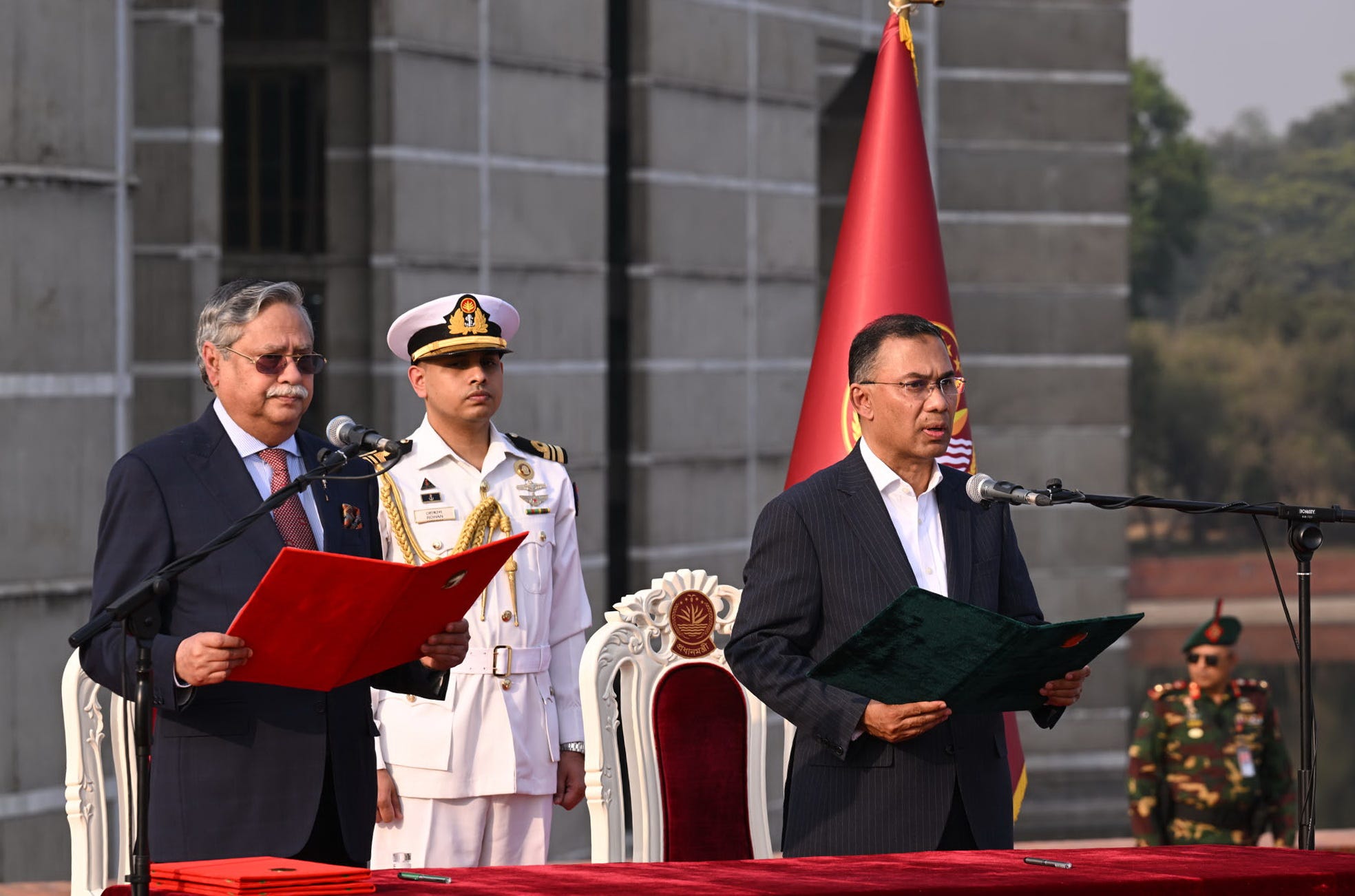
Bangladesh held its 13th parliamentary election on 12 February 2026, the first nationwide vote since the 2024 uprising and the interim administration led by Muhammad Yunus. Reports quickly emerged of a landslide victory for the Bangladesh Nationalist Party, positioning Tarique Rahman to become prime minister, with turnout around 59 to 60 per cent. The incoming government has promised to restore order, revive investor confidence in the frequently shaky Bangladeshi market, and tackle inflation and jobs. That agenda becomes crucial for China because Beijing is already embedded as a major trade and infrastructure partner; a handover raises questions about, let’s say, contract continuity or disbursements.
Economically, the relationship of the two countries is defined by import dependence and project finance. The latest World Bank WITS country snapshot shows Bangladesh importing about US$10.349 billion in goods from China, roughly 21.53% of Bangladesh’s total goods imports, making China its single largest import partner by a clear margin. Chinese official and quasi-official reporting often frames the broader commercial tie as being in the US$20–25 billion range in recent years (the exact total varies by dataset and whether you count only merchandise), which still points to the same structural fact: Bangladesh’s manufacturing and infrastructure build-out relies heavily on Chinese machinery, intermediate inputs, and turnkey contracting capacity.
Beyond economics, the tie has been politically upgraded and selectively securitised. In July 2024, China and Bangladesh announced a “comprehensive strategic cooperative partnership” in a joint statement, signalling an intent to institutionalise cooperation across finance, connectivity, and governance coordination, not only transactions. On the defence side, Bangladesh’s acquisition of two refurbished Chinese Type 035G submarines under a contract widely reported at about US$203 million remains the clearest hard-security marker of Chinese penetration, even if Dhaka continues to insist on balance. More recently, external competition has become explicit: a February 2026 Reuters report described Washington preparing to pitch defence alternatives to reduce reliance on Chinese systems, suggesting that Bangladesh’s procurement and basing choices are now read through a wider Indo-Pacific contest rather than as a matter of bilateral convenience.
Yet the decisive election result does not guarantee a stable governing bargain. The post-2024 landscape still carries unresolved issues about party inclusion, institutional repair, and social polarisation in Bangladesh. There were also reports on the vote’s youth afterlife is instructive, suggesting that protest energy has been hard to translate into a durable electoral organisation, and that coalition choices can quickly splinter constituencies. In parallel, Bangladesh’s position on the Bay of Bengal connectivity map means that decisions over ports, energy, and industrial capacity are read as strategic signals by India, the United States, and China, even when Dhaka insists it is being pragmatic.
Beijing’s public messaging tried to compress that uncertainty. In the foreign-ministry line repeated by Xinhua News Agency, China “noted” a “steady and smooth” election and “congratulates” the BNP on its win. People’s Daily Online carried essentially the same formulation, which signals coordination rather than debate. CGTN added the relationship cue, calling China a “traditional friend and neighbour” that “supports the country in advancing its domestic political agenda”. It also stressed readiness to deepen “high-quality” Belt and Road Initiative cooperation and strengthen the comprehensive strategic cooperative partnership.
Three signals follow. First, “steady and smooth” sets a procedural bar. It lets China recognise quickly while avoiding arguments about electoral legitimacy that other capitals might foreground. Second, support for a “domestic political agenda” reads like conditional reassurance. It frames cooperation as compatible with reform, but it also ties partnership to governability, which is where lenders, contractors, and insurers focus. Third, repetition is itself a tool of statecraft. When multiple Chinese outlets circulate the same sentences, narrative space shrinks for rivals who prefer to frame the transition as fragile or reversible.
For Dhaka, early Chinese validation may widen bargaining space at the margins, keeping financing and implementation options open as priorities are set. Yet it can also raise the reputational cost of renegotiation if projects become symbolic tests of credibility. A Nikkei Asia opinion column warned that the election may deliver power more readily than stability. China’s response, then, is less a verdict on democracy than an attempt to price stability into the relationship, and to ensure that continuity is treated as the baseline.
Spain Deepens China Engagement as US Relations Strain
Bloomberg reported that Spain is preparing to strengthen political and financial links with China under a new Asia-Pacific strategy, as shifting US policies reshape global trade dynamics. The three-year blueprint calls for expanded high-level exchanges with Beijing and closer coordination among European Union members in managing relations with major Asian powers.
The strategy document presents the approach as an effort to balance relations with Washington while reinforcing what it describes as a “comprehensive strategic partnership” with China. In April, Prime Minister Pedro Sánchez is scheduled to make his fourth visit to Beijing in less than three years, where he is expected to meet President Xi Jinping alongside Spanish business leaders. The move reflects Spain’s intention to sustain engagement with China despite growing transatlantic strains.
The strategy emphasises China’s importance as Spain’s top supplier since 2024 and a key economic partner, despite Spain’s significant trade imbalance. Madrid hopes to increase market access for Spanish businesses while also encouraging Chinese investment in automobile production, renewable energy, and possible rare earths cooperation.
At the same time, Spain recognises the importance of concerted EU action in tackling structural trade imbalances and managing economic competition with China. Cooperation with Beijing on global challenges such as climate change is also viewed as essential.
Overall, Madrid sees its outreach as a realistic effort to protect economic interests in a more fragmented geopolitical situation, rather than a retreat from European alignment.
Judicial Enforcement of Constitutional Order in South Korea: The Yoon Suk Yeol Insurrection Verdict
In February 2026, a Seoul court convicted former South Korean President Yoon Suk Yeol of leading an insurrection following his failed attempt to impose martial law in December 2024. The Seoul Central District Court ruled that his actions constituted a grave violation of the constitutional order.
The court found that Yoon, in coordination with senior aides including the defence minister, ordered the deployment of military troops and police forces to surround the National Assembly. This move aimed to obstruct legislative activity and suspend democratic governance. Lawmakers overturned the martial law declaration within hours, preventing its implementation and reaffirming parliamentary authority.
Yoon had been impeached by the legislature in late 2024 and was formally removed from office by the Constitutional Court in April 2025. Prior to the insurrection ruling, he had already received separate convictions, including a five-year prison sentence for abuse of power and obstruction of justice.
In the insurrection case, prosecutors sought the death penalty. However, the court imposed life imprisonment, citing the absence of mass violence and the presence of mitigating circumstances. The verdict intensified political polarization, with large demonstrations by both supporters and opponents outside the courthouse.
The case marks a landmark moment in South Korea’s legal history. It underscores the judiciary’s central role in safeguarding democratic institutions and enforcing constitutional limits on executive power.
China–Iran Relations Amid Rising U.S. Pressure
China’s engagement with Iran has intensified across military, diplomatic, and technological domains, even as U.S. pressure on Tehran continues to mount.
Gulf News reported that Russia, China and Iran have deployed naval vessels for joint exercises in the strategic Strait of Hormuz region under the “Maritime Security Belt 2026” framework.
Iran’s architecture of internet control is built on technologies from China, according to an analysis published by a British human rights organisation.
The report by Article 19 says the technologies include facial recognition tools used on Uyghurs in western China and a Chinese alternative to the US-based GPS system, BeiDou.
Eurasian Times reported that on February 8, the Chinese military attaché presented a mock-up of the J-20 to Brigadier General Bahman Behmard on the occasion of Iranian Air Force Day. While no contract has been announced, the timing and symbolism of the Chinese gesture were hard to miss, as it represented more than a ceremonial gesture and was intended to send a message not only to Tehran but also to the US and Israel.
Global Times reported that on the eve of U.S.–Iran nuclear talks in Oman, Chinese Assistant Foreign Minister Liu Bin met Iranian Deputy Foreign Minister Kazem Gharibabadi in Beijing. China reaffirmed its support for a peaceful resolution of the nuclear issue and Iran’s right to the peaceful use of nuclear energy.
— — —
Essay: Manashjyoti Karjee - an independent researcher specialising in international relations, security studies, and geopolitical risk analysis, with a particular interest in Arctic governance. He previously worked at Advanced Study Institute of Asia and has a master’s in International Relations and Area Studies from Jamia Millia Islamia.
Postscript: Neeti and Bhupesh
Produced by Decypher Team in New Delhi, India
— — —