


Amogh Dev Rai is a Research Director and researcher on China, and Chinese Geopolitics.
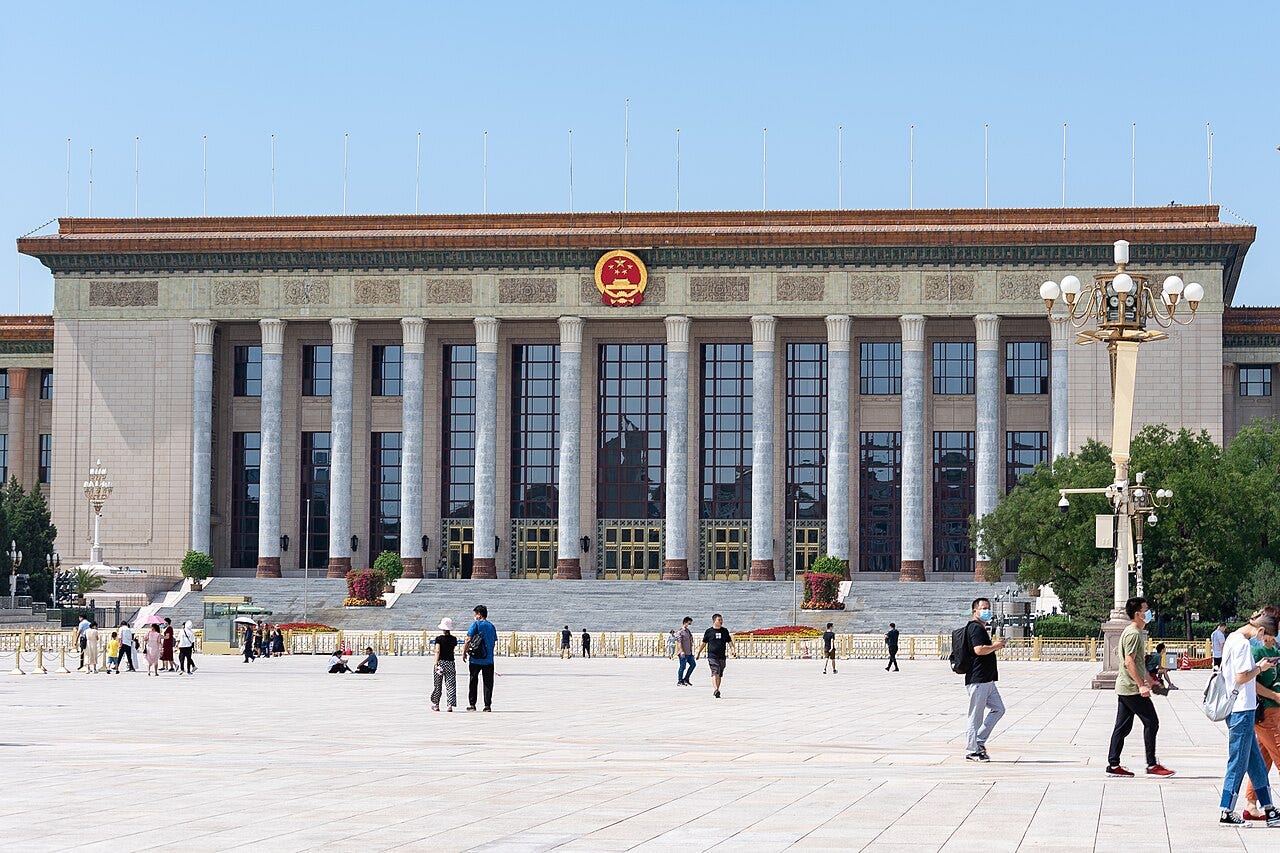
There is a body in Beijing that most people outside China have never counted, and it is worth counting, because the arithmetic is the whole story. The Politburo of the Chinese Communist Party has twenty-four seats. Not twenty-four hundred, not two hundred, twenty-four. These are the people who run the second-largest economy on earth and the largest army, and they meet in rooms the rest of us never see, and their names are known to specialists and almost no one else. It is a small number. When one of them falls, the number is smaller, and you can feel the change the way you feel a missing tooth with your tongue.
On the fourteenth of July, the party expelled Ma Xingrui. He had been the party secretary of Xinjiang, the vast western region, and before that the governor of Guangdong, and before that a space engineer who helped run the country’s programme to put men in orbit. He was, by the standards of the system, a serious man with a serious record. The anti-corruption watchdog said he had traded favours in the appointment of officials, taken bribes, arranged jobs for people he should not have, and, according to one report, exchanged political favours for sex. The language the watchdog used was, in the words of a scholar at Zurich who reads these notices for a living, extremely serious, with some highly unusual charges. When the party wants to bury a man it has a vocabulary for it, and the vocabulary used on Ma was from the harsher end of the shelf.
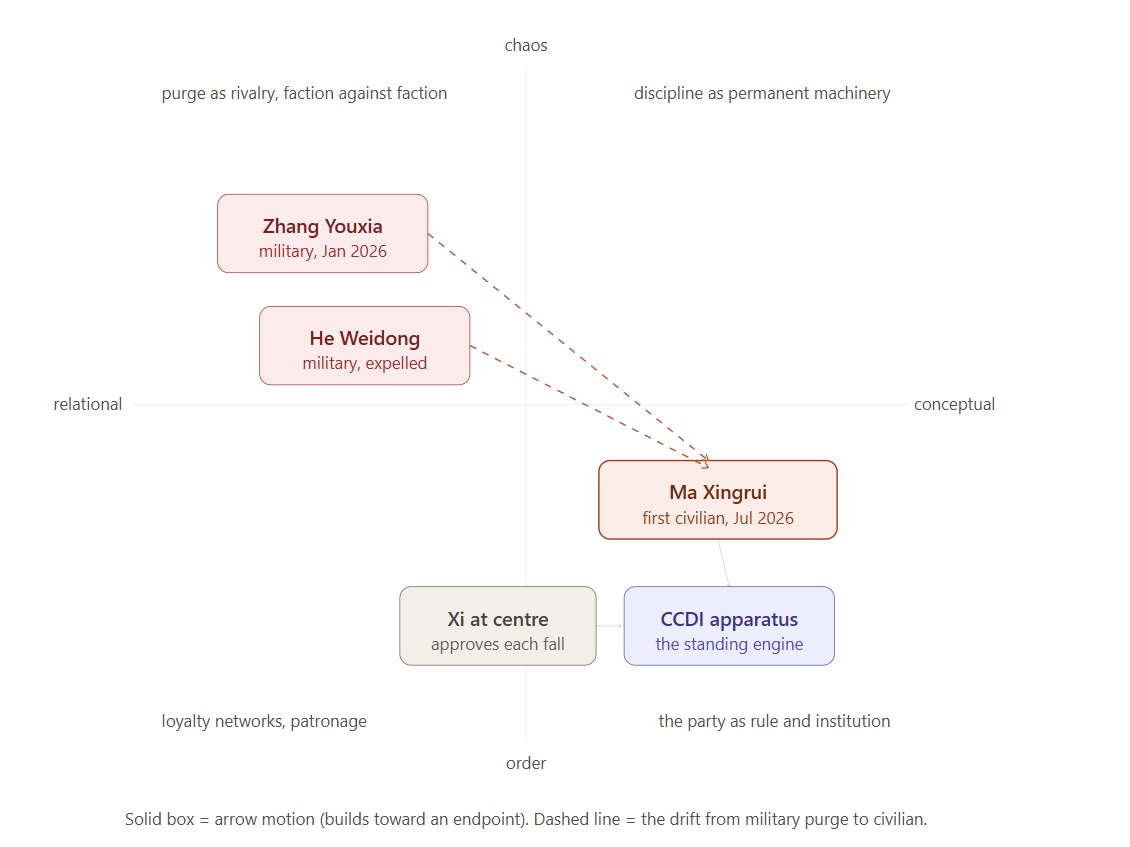
He was the third member of the Politburo to be brought down in this cycle. That is the fact worth sitting with. The first two were soldiers. Zhang Youxia, the most senior general in the country, was placed under investigation in January. He Weidong, a vice chairman of the military commission, was expelled last year, which took the body from twenty-four down to twenty-three. Both were military men, and there is a way of reading military purges that lets you sleep at night, if you are the kind of person who worries about the stability of China. Armies are dangerous to those who rule them. A leader who purges his generals is doing something old and comprehensible, which is making sure the men with the guns do not get ideas. You can file it under self-preservation and move on.
Ma is harder to file. Ma was a civilian. He ran provinces, not divisions. He was an administrator, a technocrat, a man of the bureaucracy rather than the barracks. And when the purge reaches past the soldiers and into the civilian administration at the very top, the reading changes. It is no longer only about the guns. It is about the whole apparatus, the entire class of people who run the country, and the message it sends to every official below them, which is that no rank is high enough to be safe and no record is clean enough to be a shield.
I want to be careful here, because there are two stories you can tell about a thing like this and they point in opposite directions, and honesty requires holding both before choosing.
The first story is that this is exactly what it says it is. China has a real corruption problem, the kind that rots public trust and misallocates enormous sums, and Xi Jinping is doing the hard and unglamorous work of cleaning it out, floor by floor, without regard for rank. In this telling the purge is a sign of health. A system that can discipline its own leaders is stronger than one that cannot. Most states, faced with corruption at the top, look away, because the people who would have to prosecute are the people who would have to be prosecuted. China, in this account, is doing the thing that is supposed to be impossible, which is holding its own princes to account.
The second story is quieter and colder. It is that anti-corruption, in a system with no independent courts and no free press and no opposition, is not a legal process but a political instrument. There is no way, from outside, to know whether Ma Xingrui was guilty of what he was accused of, or guilty of something else, or guilty of nothing beyond ending up on the wrong side of a calculation being made above him. The charges are announced by the same power that decides who is charged. When there is no daylight between the accuser and the judge, the accusation tells you about the accuser’s intentions and very little about the accused’s conduct. In this telling the purge is not about corruption at all. It is about control, and the word corruption is the coat it wears in public.
Both stories are probably true at once, in proportions no outsider can measure, and that is the uncomfortable heart of it. Ma may well have done what they say. Powerful men in unaccountable systems very often do. But the fact that he was caught, and when, and how the charges were framed, and that the decision to end a man of his rank was taken at the very top with Xi’s own backing, all of that belongs to the story of control, not the story of law. A guilty man can still be a convenient one. The two are not in tension. They fit together like a hand in a glove.
What the third chair tells us, the civilian chair, is that the machinery has become permanent. This is the part that matters more than any single name. In the early years you could describe the anti-corruption campaign as a campaign, a thing with a beginning and a middle and an eventual end, a housecleaning after which normal life resumes. Fourteen years on, it has not ended, and it shows no sign of ending, and it has its own standing bureaucracy, the Central Commission for Discipline Inspection, with its own investigators and its own procedures and its own grim momentum. It is no longer an event. It is a feature. It is how the system now works, a permanent engine of discipline humming under the floor of Chinese political life, and every official at every level lives with the knowledge that the engine could turn toward them next.
There is a cost to running a state this way, and it is not the cost you would expect. The obvious worry is instability, the fear that a leader who purges this widely will eventually purge someone who fights back. But that is the less interesting danger. The deeper cost is quieter. When the price of prominence is the permanent possibility of ruin, the capable and the cautious begin to behave in a particular way. They stop taking initiative. They stop making decisions that could later be read against them. They wait for instructions and they cover their traces and they push every choice upward, because a choice made is a choice that can be punished, and a choice deferred is safe. A government of frightened administrators is not an efficient one. It is a government where nothing moves until the centre commands it, and the centre, however clever, cannot command everything.
So the purge that looks like strength contains a weakness, and the weakness is not that the system will crack. It probably will not crack. The weakness is that it will stiffen, that the very machinery built to keep the officials honest will also keep them still, and that a country which needs its administrators to be bold and inventive at exactly this moment, with the economy slowing and the old growth model spent, will find them instead crouched and waiting, watching the engine under the floor, listening for the sound of it turning their way. Ma Xingrui was the third to fall. The men who are still seated learned something on the fourteenth of July, and what they learned was to be careful, and careful men do not build the future. They survive the present. It is not the same thing.
Produced by Decypher Team in New Delhi, India