

China Quote 🗩
"He (Xi) considers Taiwan to be a part of China, and that’s up to him what he’s going to be doing. But I’ve expressed to him that I would be very unhappy if he did that, and I don’t think he’ll do that. I hope he doesn’t do that."
-President Donald Trump on the Venezuela precedence for China and Taiwan.
SITREP | Venezuela — Post-Maduro Shock, Interim Rule, Security & Economic Outlook
As of 9 Jan 2026, 09:30 IST
Executive Summary
A week after a U.S. operation removed Nicolás Maduro, interim leader Delcy Rodríguez is asserting control in Caracas while managing acute security, diplomatic, and economic fallout. Authorities have begun releasing an “important number” of detainees even as security forces and allied colectivos tighten control in the capital. International advisories remain Do Not Travel, and several airlines have curtailed service. Oil markets are watching for shifts in U.S. sanctions policy and near-term export arrangements amid a volatile macro picture.
Current Situation
Security/urban control: Since the January 3 strikes, Caracas has seen intensified patrols, arrests, and sporadic power disruptions in southern districts; colectivos and security services are visible at key intersections and media hubs.
Political moves: National Assembly chief Jorge Rodríguez announced immediate prisoner releases, including some foreign nationals, as a unilateral peace gesture. The government declared mourning for raid casualties, and senior figures project unity around the interim presidency.
Mobility & aviation: Advisories urge citizens not to travel to Venezuela and for those inside to depart when safe; carriers have suspended or reduced frequencies on key Caracas routes, narrowing exit options.
Public messaging: Delcy Rodríguez states no foreign power governs Venezuela, institutions remain in charge, and she will manage the transition while engaging foreign counterparts.
Actors & Intent
Interim Presidency (Delcy Rodríguez): Consolidate authority, ease international pressure via limited concessions (detainee releases), stabilise services, and probe for sanctions relief or energy carve-outs.
Security Apparatus (Interior Ministry/armed services): Deter unrest, secure the palace, bases, communications, and oil logistics, and signal capacity after the U.S. action.
United States: Shape transition terms, test legal/operational channels for energy flows, and maintain pressure on residual hardliners.
Opposition & civil society: Seek verifiable releases, guarantees for political activity, and a credible pathway to elections.
Humanitarian & Economic Effects (near term)
Operational impacts: Curfews, checkpoints, and intermittent power constrain hospital operations and cold-chain in Caracas; NGO mobility and media access are uneven. Flight reductions and tighter land borders complicate humanitarian rotations and supply.
Macro/markets: The bolívar faces renewed pressure; private forecasters warn of triple-digit inflation in 2026. Any incremental oil openings confront degraded upstream capacity, insurance/financing hurdles, and sanctions-compliance risk. Near-term relief for fuel, power stability, and food logistics is uncertain.
International & Diplomatic Posture
Travel/security: Washington, Ottawa, London, and Canberra maintain the highest-risk posture; U.S. alerts amplify on social channels. Spain-linked long-haul service remains curtailed.
Regional signal: Neighbours watch for spillovers (migration, border incidents) and for clarity on Essequibo; investors reassess regional risk premia.
Legal/political debate: Scrutiny continues over the U.S. operation’s legality and recognition dynamics for the interim government.
Outlook (7–14 days)
Security: Elevated risk of night-time detentions and ad-hoc checkpoints; expect visible security presence, potential electricity rationing, internet throttling, and targeted raids on media/activists.
Politics: Additional detainee releases are plausible yet contested; cabinet and command reshuffles may serve as loyalty tests.
Energy: Headlines about “humanitarian” or tightly licensed barrels may multiply; real flows hinge on OFAC guidance, buyer risk tolerance, and logistics/insurance.
Indicators & Tripwires
Verifiable detainee lists with embassy confirmations.
Further Do Not Travel escalations, airline cancellations, or border/airspace closures.
New OFAC guidance or ad-hoc licenses shaping oil marketing, shipping, and payments.
Multi-hour power cuts and network outages in central Caracas.
High-visibility protests or pro-government marches met by force, or elite defections.
Recommended Actions (missions, NGOs, firms)
Duty of care: Align hibernation/relocation triggers with Level-4 advisories; maintain comms redundancy and low-profile movement rules.
Lifelines: Map generator runtime to fuel on hand; stage critical supplies for 7–10 days; pre-book exit seats where possible.
Compliance: Re-screen Venezuelan counterparties; monitor OFAC updates and carriers/P&I notices daily; avoid speculative contracts without written licenses and insurability.
Information hygiene: Log official release names/times; corroborate with multiple outlets before public statements or staff moves.
Economic Activity🏦
China’s Forex Reserves Rise Again as Dollar Sinks, Gold Holdings Climb
Caixin reports that China’s foreign exchange reserves climbed for a second straight month in December to $3.358 trillion, as a weakening U.S. dollar lifted valuations. At the same time, the central bank extended its gold-buying streak to 14 months despite record-high bullion prices. The State Administration of Foreign Exchange (SAFE) said Wednesday that reserves rose by $11.5 billion, or 0.34%, from November, closing the year at $3.358 trillion. The agency attributed the increase to a combination of currency translation effects and changes in global asset prices.
China’s December inflation shows weak demand despite CPI rise
CNBC News reports that China’s consumer price index (CPI) rose 0.8 per cent year-on-year in December 2025, the fastest increase in nearly three years, mainly driven by food prices. However, producer prices (PPI) remained in deflation, signalling persistent weak demand and economic imbalances, and prompting expectations of further policy support.
Shanghai unveils US$10 billion investment spree as US-China tech race heats up
South China Morning Post reports that Shanghai’s Pudong district has unveiled 50 major projects worth over US$10 billion targeting microchips, artificial intelligence, biopharmaceuticals, smart vehicles and aviation, aligning with national efforts to strengthen innovation. The package aims to boost self-sufficiency in core technologies and support local AI start-ups, reflecting intensifying competition with the US in high tech.
Inside China🐉
China’s Oil Giants Turn to Beijing as Venezuela Shock Raises Stakes
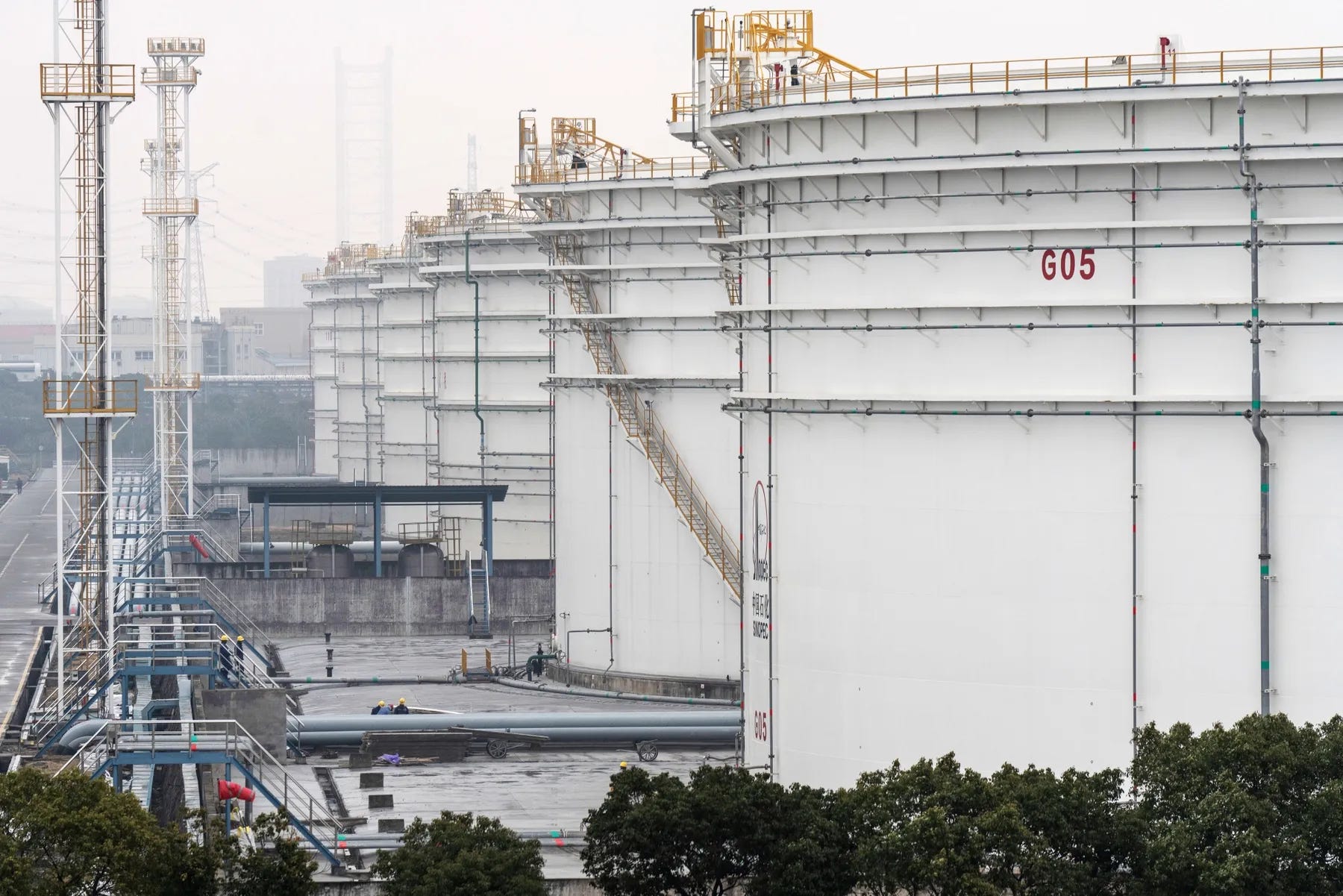
Bloomberg reports that China’s top oil companies are reassessing their strategy as the US intensifies pressure on Venezuela. Firms led by CNPC have sought guidance from Beijing to protect their stakes in major oil reserves after Washington’s arrest of President Nicolas Maduro. Executives are evaluating risks while Chinese officials review potential losses. The move highlights how unexpectedly swift US actions have unsettled Beijing and its state firms.
China’s crackdown on underground churches intensifies with new arrests
BBC News reports that China is reportedly stepping up its suppression of unauthorised Christian groups, with at least two underground church leaders saying authorities are now arresting pastors more quickly than before. Previously, non-compliance led to warnings and fines; now detentions are occurring sooner. The tighter enforcement reflects broader pressure on religious practice outside state-approved structures.
Xi Jinping calls emergency audit of Chinese assimilation policy
Intelligence Online reports China’s President Xi Jinping has ordered an urgent review of the country’s assimilation policies amid growing signs that forced ethnic integration is straining state claims of unity. The move comes as mistrust towards the political establishment in Hong Kong and unrest in regions such as Tibet reveal limitations in Beijing’s efforts to enforce cultural conformity.
Tech in China🖥️
3 Chinese tech stocks gain in Hong Kong debuts as investors jump on AI, robotics
South China Morning Post reports that Three Chinese tech stocks gained strongly on their Hong Kong debuts as investors piled into AI and robotics plays. Zhipu AI rose 3.3% after raising HK$4.35 billion, while GPU maker Iluvatar CoreX and surgery-robot firm Edge Medical jumped over 30%. The strong listings highlight growing confidence in China’s push for technological self-reliance and its expanding AI sector.
China’s CATL turns to powering electric ships, tapping EV battery know-how
Nikkei Asia reports that China’s leading supplier of electric-vehicle batteries, CATL, is quickly branching out into battery-powered ships to achieve further growth. CATL has made deliveries for nearly 900 electric-ship projects, said Su Yiyi, general manager at wholly owned subsidiary Contemporary Amperex Electric Ship Technology (CAES), this past December at a shipping-industry event in Shanghai.
International Relations🌏
Indonesia
China remains Indonesia's top export destination in Jan-Nov 2025
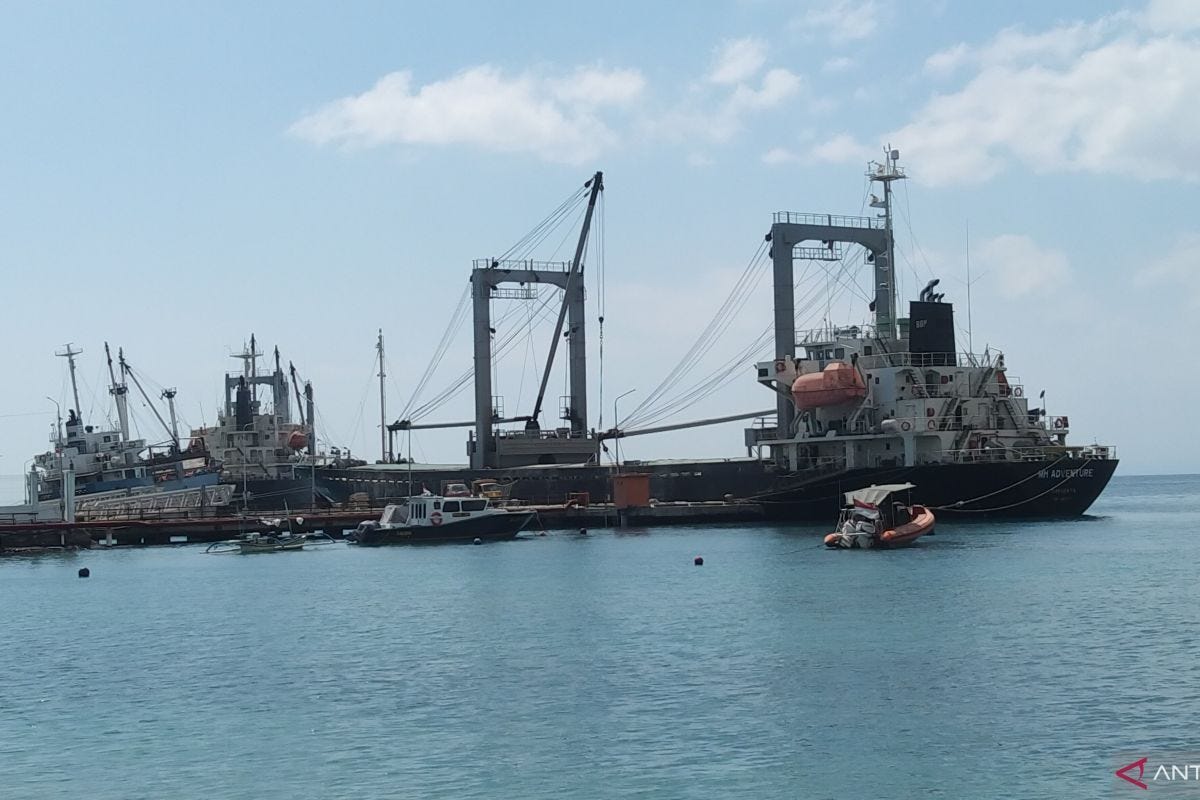
Antara News reports that Statistics Indonesia says China stayed Indonesia’s biggest export market for January–November 2025. The data underlines how closely Jakarta’s external earnings track Chinese demand, complicating any “de-risking” rhetoric. It is a reminder that trade exposure can quietly shape Indonesia’s room for manoeuvre on regional security and ASEAN diplomacy.
How should ASEAN address the 2025 mess?
The Jakarta Post reports that ASEAN’s credibility problem after 2025 is less about slogans than strategic drift, with the Indo-Pacific narrative fraying and major-power competition hardening. The piece frames ASEAN centrality as a bargaining asset only if members close ranks. The subtext is clear: disunity makes Southeast Asia easier to pressure, bilaterally.
Malaysia
Could China move in on Taiwan now after US strike on Venezuela? Analysts weigh in
Malay Mail reports that analysts see a risk Beijing could read Washington’s Venezuela operation as both distraction and precedent, even if Taiwan remains a higher-stakes theatre. The story links recent Chinese live-fire activity around Taiwan to broader signalling dynamics. For Malaysia, it matters because any Taiwan shock would ripple straight into South China Sea risk and trade flows.
Nearly 12,000 checks made in Sarawak waters last year, says MMEA
The Star that Malaysia’s maritime agency carried out nearly 12,000 checks in Sarawak waters in 2025, framing it as enforcement and safety work. In strategic context, the figures also signal steady “presence” politics in contested maritime space. It is a low-drama indicator of how Kuala Lumpur manages sovereignty without overt escalation with China.
A region on a knife edge
Free Malaysia Today reports that the arc from the Taiwan Strait to the South China Sea is increasingly brittle, with deterrence and miscalculation risks rising together. The argument is that regional states cannot treat these flashpoints as separate boxes, because escalation in one theatre can spill into the other. The China takeaway is indirect but sharp: pressure campaigns compound across domains.
Philippines
PCG challenges China ship off Cagayan
The Philippine Star reports that the Philippine Coast Guard radio-challenged a Chinese vessel off Cagayan, seeking clarity on whether it was conducting marine research without Manila’s consent. The PCG said it received no response. Strategically, the incident reflects Manila’s preference for “document and broadcast” tactics: asserting rights through routine enforcement, while keeping escalation below military thresholds.
Accept overlapping claims in West Philippine Sea – China
The Philippine Star reports that China is urging a framing shift: treat West Philippine Sea disputes as “overlapping claims” to be managed, rather than as violations to be adjudicated.It is a familiar move from rules to bargaining. The practical implication is pressure for bilateral “arrangements” that dilute arbitration-based narratives and widen China’s negotiating leverage.
Bangladesh
Ambassador Yao: China stands ready to deepen cooperation with BNP
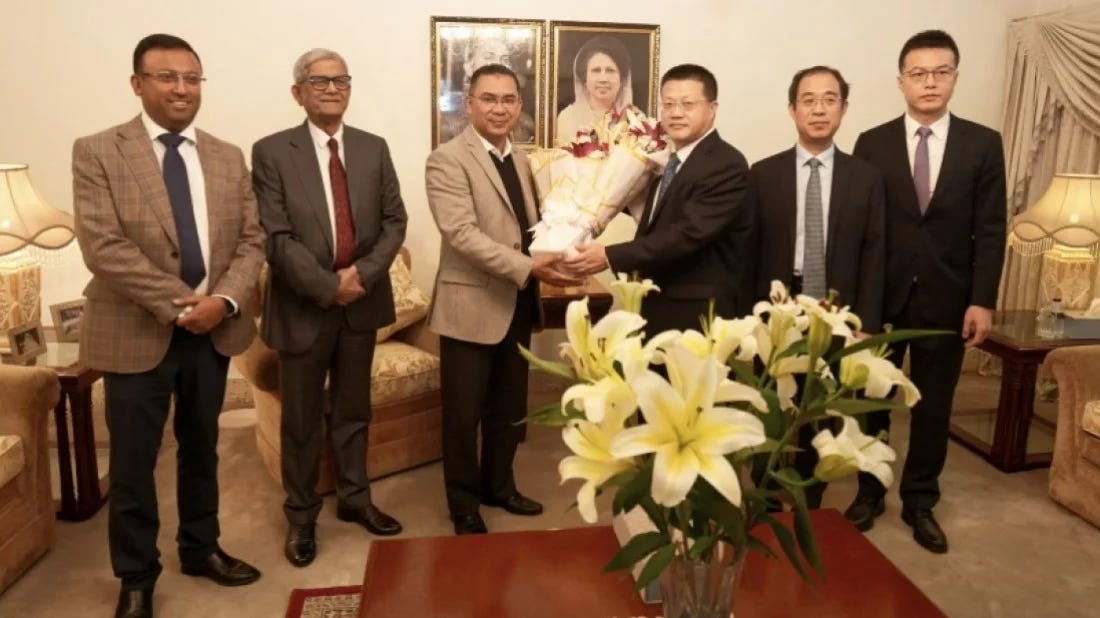
Dhaka Tribune reports that Chinese Ambassador Yao Wen met BNP Acting Chairman Tarique Rahman, stressing non-interference and expressing confidence Bangladesh could hold elections smoothly, while signalling readiness to deepen exchanges. The optics matter: Beijing is cultivating ties across Bangladesh’s political spectrum to protect equities regardless of who governs. For China, it is hedging; for Dhaka, it is leverage and risk management.
Pakistan confirms talks with Bangladesh on potential defence pact, JF-17 jet sale
The Daily Star reports that Pakistan says it is discussing a defence pact with Bangladesh, including possible JF-17 fighter sales. The JF-17’s China co-development makes this more than a bilateral story: it hints at a triangular defence-industrial footprint. It suggests Dhaka’s security diversification amid shifting regional alignments and post-2024 political aftershocks.
Hindu man lynched, set on fire in Bangladesh amid anti-India protests
NDTV reports that a young Hindu man, Dipu Chandra Das, was mob-lynched and his body set alight in Mymensingh during violent protests sparked by the death of student leader Sharif Osman Hadi. The interim government condemned the killing and vowed legal action. The unrest has spread across cities, with attacks on media outlets and heightened security deployments.
Pakistan
Pak-China working group on security to meet quarterly
Dawn reports that Pakistan and China agreed their joint working group on security will meet every three months, following interior-minister-level talks in Beijing. The signal is institutionalisation: Beijing wants predictable mechanisms tied to protecting projects and nationals. For Pakistan, it is reassurance and scrutiny at once. It shows how counter-terror cooperation is being formalised as a condition of deeper economic partnership.
Special protection unit being set up in Islamabad for security of Chinese nationals, says Naqvi
Dawn reports that Interior Minister Mohsin Naqvi announced a dedicated unit in Islamabad to protect Chinese nationals, alongside continued coordination with Beijing. The move reflects the core vulnerability in Pakistan–China ties: security risk to CPEC-linked personnel. Strategically, it tightens the linkage between domestic counter-militancy performance and Islamabad’s ability to keep Chinese investment, goodwill, and high-level engagement steady.
Pakistan, China call for more ‘visible, verifiable’ actions to eliminate terrorist groups based in Afghanistan
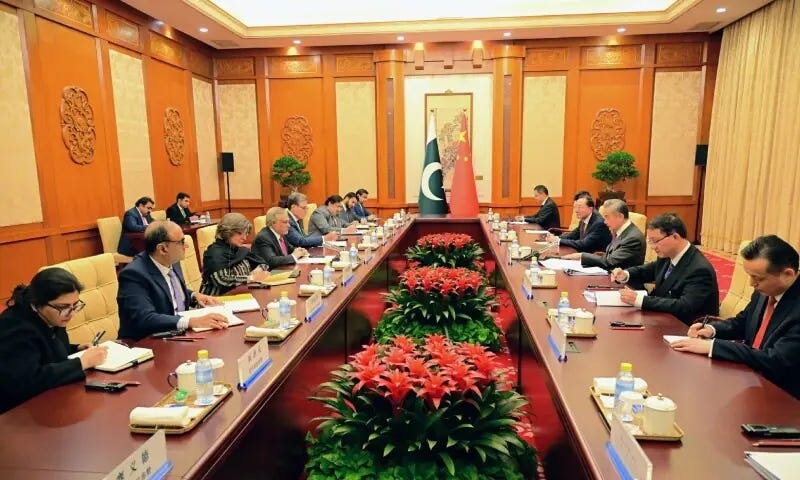
Dawn reports that Pakistan and China pressed Kabul for “visible, verifiable” action against Afghanistan-based terrorist groups, after talks co-chaired by Ishaq Dar and Wang Yi. For IR watchers, the framing matters: it pushes security compliance metrics into diplomacy. It also hints at converging Pakistan–China expectations of the Taliban, with regional connectivity narratives (including CPEC spillover) constrained by hard security realities.
Japan
Japan to check if China’s latest dual-use export ban covers rare earths
The Mainichi reports that Japan will assess whether China’s new dual-use export restrictions extend to rare earths, underscoring Tokyo’s supply-chain anxiety about strategic materials. The story is not just trade policy: it is coercion risk management. It signals how export controls are becoming instruments of statecraft, pushing Japan to deepen diversification and align more tightly with partners.
Japan lodges protest over possible gas field exploration by China
The Mainichi reports that Japan protested China’s operation of mobile drilling rigs near the Japan–China median line, a reminder that maritime friction is not confined to Southeast Asia. The strategic resonance for the region is indirect but real: Beijing’s willingness to normalise contested-zone activity shows a template others fear in the South China Sea, where legal lines and “facts on water” compete.
Sri Lanka
Chinese Foreign Minister Wang Yi to visit Sri Lanka, assistance package likely
The Daily Mirror reports that Wang Yi is expected in Sri Lanka on 12–13 January after an Africa tour, with an assistance package anticipated. For Colombo, high-level Chinese attention is both opportunity and balancing act. For IR observers, the timing suggests Beijing is reinforcing political ties and economic reassurance in a strategically located Indian Ocean state, amid wider competition over ports, debt, and influence.
Thailand
Trump tariffs to bite in 2026, Thai exports may shrink
The Nation reports that Thai officials warn US tariffs could slow or even contract exports in 2026, while demand from China is also expected to cool. The piece highlights a familiar strategic bind: Thailand benefits from “China Plus One” investment shifts, yet remains exposed to both great-power trade policy swings. It is geoeconomics as vulnerability, not just opportunity.
Durian Wars: Vietnam Set to Overtake Thailand in Chinese Market Within Three Years
The Nation reports that Vietnam’s durian exports to China have surged, taking market share rapidly and challenging Thailand’s long-held dominance, with Malaysia also entering the fresh durian market. Beyond fruit, the story tracks shifting leverage inside the ASEAN–China trade corridor: access to Chinese consumers is a strategic prize. It shows how Beijing-facing trade dependence creates both competition and policy pressure within ASEAN.
Singapore
US willingness to act unilaterally, including military actions in Venezuela, has major geopolitical implications: SM Lee
CNA reports that Senior Minister Lee Hsien Loong warned the US strike in Venezuela, seen as contrary to international law, sets troubling precedents for small states. He linked growing unilateralism to a shifting global order, and argued Southeast Asia must build resilience through defence spending, diversified economic links, and regional rule-making.
Longer-term consequences of US strike on Venezuela concerning for small states: SM Lee
The Straits Times reports that Senior Minister Lee Hsien Loong said the US intervention in Venezuela was a contravention of international law and could normalise great-power behaviour that endangers small states. He argued Singapore’s safeguards include economic strength, sustained defence spending near 3% of GDP, and building networks so it is not forced to choose sides.
Myanmar
China Steps Into Great-Power Trap With Myanmar Intervention
The Irrawaddy reports that Beijing’s increasingly overt interventions in Myanmar, from pressuring ethnic armed groups to backing junta elections and shielding scam-linked actors, are meant to stabilise the border and protect Belt and Road projects but may deepen conflict. China’s security role and political cover risk trapping it into propping up an unpopular regime.
Key Facts About Second Phase of Myanmar Junta’s Election
The Irrawaddy reports that Myanmar’s junta is pressing ahead with a second phase of its election on Jan 11 across 12 states and regions, with senior officials and USDP figures among the candidates. The vote extends a contested process criticised by watchdogs and occurs amid active conflict, raising questions about legitimacy and control beyond regime-held areas.
Myanmar Pro-Military Party Wins First Phase of Junta-Run Election: Official Results
The Irrawaddy reports that the military-backed USDP won the vast majority of Lower House seats counted in the first phase of Myanmar’s junta-run election, according to released official results and an AFP tally. The outcome strengthens the regime’s attempt to rebrand via polls that many opponents dismiss as a sham, while fighting continues in several theatres.
Vietnam
Government standing committee urges removal of institutional bottlenecks to fast-track key railway projects
Viet Nam News reports that Hanoi is accelerating flagship rail schemes, including the Lào Cai–Hà Nội–Hải Phòng line, while highlighting the first meeting of the Việt Nam–China Joint Committee on Railway Cooperation. The push couples domestic legal reform with cross-border connectivity planning, signalling that infrastructure strategy is increasingly intertwined with managing China-linked financing and standards.
PM calls for concentrated leadership, resources for railway projects
QDND reports that Prime Minister Phạm Minh Chính ordered faster work on major rail projects, including negotiating a loan agreement and building a Vietnam–China cross-border railway bridge in early 2026. Hanoi wants clearer standards, transparent investment models, and rapid feasibility studies to meet ambitious construction timelines, signalling that connectivity with China is moving from plans to execution.
Cambodia
Cambodia Arrests and Deports Sanctioned Chinese Tycoon Chen Zhi
Cambodianess reports that Cambodia arrested and extradited Chen Zhi, the sanctioned Prince Group chairman, along with two other Chinese nationals, at China’s request, framing it as a transnational-crime operation. The case tests Phnom Penh’s balancing between Beijing and Western cyber-scam sanctions, and underscores China’s leverage over security cooperation in Cambodia.
China Says It Will Aid Dialogue Between Cambodia and Thailand After Ceasefire Agreement
Cambodianess reports that China said it would help dialogue between Cambodia and Thailand after the neighbours agreed to a ceasefire, positioning Beijing as a regional fixer. The move highlights how mainland Southeast Asia disputes can draw in China’s diplomacy, especially where it has significant economic stakes and wants stability along key trade routes.
China donates mine-clearing equipment to support Cambodia’s demining operations
Kampuchea Thmey Daily reports that China donated demining equipment to Cambodia’s mine-action authorities, deepening a long-running assistance relationship. Beyond humanitarian benefits, the support reinforces Beijing’s soft-power presence in a country where Chinese investment and security ties are already prominent, offering Phnom Penh another channel of external backing amid tighter scrutiny of illicit networks.
Laos
Lao Party Congress elects new central committee
The Laotian Times reports that Laos’ ruling party congress elected a new Central Committee and set priorities for the next five years, signalling continuity in a one-party system closely linked to regional partners. Leadership decisions will shape how Vientiane manages debt, connectivity projects and external dependence, including its deep economic exposure to China through infrastructure and trade.
Nepal
Why Chinese arrivals falling despite Nepal’s ‘Visit Nepal 2025’ push
The Kathmandu Post reports that Chinese tourist arrivals to Nepal fell sharply in 2025 despite government marketing, highlighting how infrastructure bottlenecks, flight capacity, and perceptions of safety shape tourism diplomacy. The decline matters beyond revenue: China is a key target market and a strategic neighbour, so slippage complicates Kathmandu’s efforts to diversify its economic ties and balance external partners.
Maldives
Chinese ambassador urges Maldivian business leaders to seek partnerships with Chinese businesses
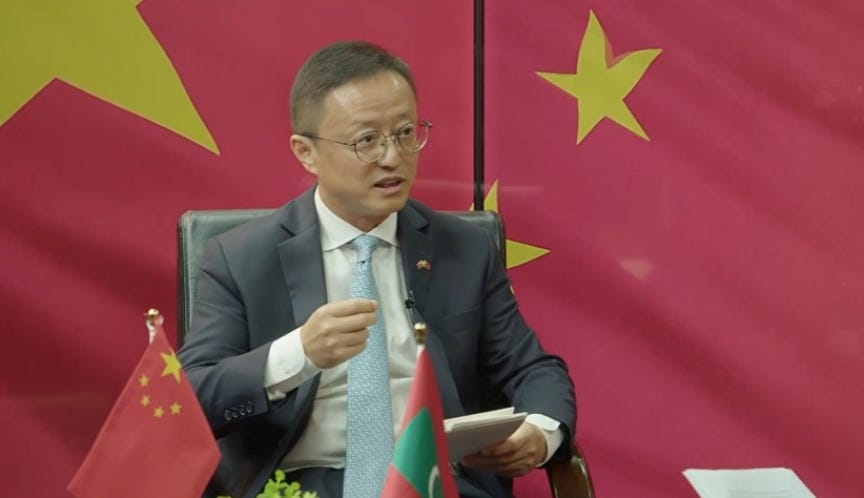
Sun.mv reports that China’s ambassador urged Maldivian business leaders to pursue partnerships with Chinese companies, pitching deeper investment ties. The outreach fits Malé’s effort to widen economic options and attracts attention because Chinese capital can carry strategic signalling in the Indian Ocean. For Maldives, the challenge is capturing growth while avoiding overdependence and domestic political backlash.
Afghanistan
China, Pakistan urge action against terror groups in Afghanistan
Ariana News reports that China and Pakistan urged stronger action against terror groups in Afghanistan, signalling continued regional pressure on Kabul over cross-border militancy. The messaging reflects Beijing’s security concerns for its western frontier and projects, while Islamabad’s stakes remain tied to insurgent spillover. It also highlights how Afghanistan’s isolation leaves neighbours setting the agenda.
Brunei
Hengyi’s Brunei refinery expansion reinforces energy export hub role
The Edge Malaysia reports that Hengyi’s Chinese-backed refinery and petrochemicals complex in Brunei is expanding, reinforcing the sultanate’s role as an energy export hub. The project underlines how Chinese industrial investment is reshaping smaller ASEAN economies and diversifying supply chains. It also raises questions about Brunei’s economic dependence and strategic positioning as US–China rivalry sharpens.
Global Risk🗺️
U.S. tanker seizures put pressure on Russian ‘shadow fleet’ and Putin’s economy
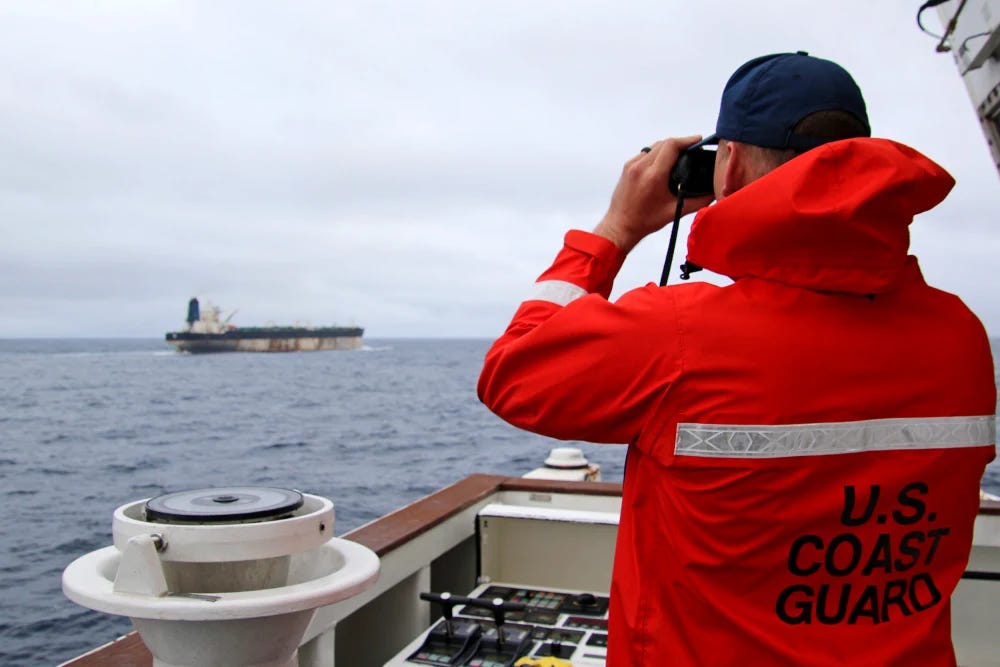
NBC News reports that the U.S. seizure of the Russian-flagged Bella 1 (renamed Marinera) signals tougher enforcement against sanctions-evasion shipping. It raises operating risks for Russia’s shadow fleet and oil revenues, while Moscow calibrates its response amid Ukraine peace talks and Trump’s Venezuela policy.
Venezuela’s New Leader Deploys Old Repression Tactics
Bloomberg reports that Venezuela’s government is reasserting itself after the capture of Nicolás Maduro, flashing warning signs that a new wave of repression has begun. Heavily armed security forces and pro-government motorcycle gangs known as colectivos were seen roaming the capital. For now, there’s little sense of a new dawn. Back in Washington, Donald Trump still has different ideas as to who’s in control—he asked Marco Rubio to lead the process to implement reforms in Venezuela.
China Condemns U.S. Military Action in Venezuela, Calls for Respect for Sovereignty
Sinocism reports that In response to the recent U.S. military operation in Venezuela that resulted in the capture and rendition of President Nicolás Maduro and his wife, the Ministry of Foreign Affairs of the People’s Republic of China issued a strong public statement condemning Washington’s actions.
US Assailed in UN Over Venezuela Attack
Bloomberg reports that a top United Nations official has condemned Donald Trump’s surprise attack on Venezuela as a potential violation of international law that could fuel instability across the region.
Beijing and Moscow conspicuously absent from Caracas intel support before US attack
Intelligence Online reports that Russian and Chinese intelligence support in Caracas appears to have been minimal both before and during Washington’s military operation on Saturday. Analysis of US imagery shows that the operation had been in the works since October.
Russia Appears to Use Nuclear-Capable Missile in Ukraine
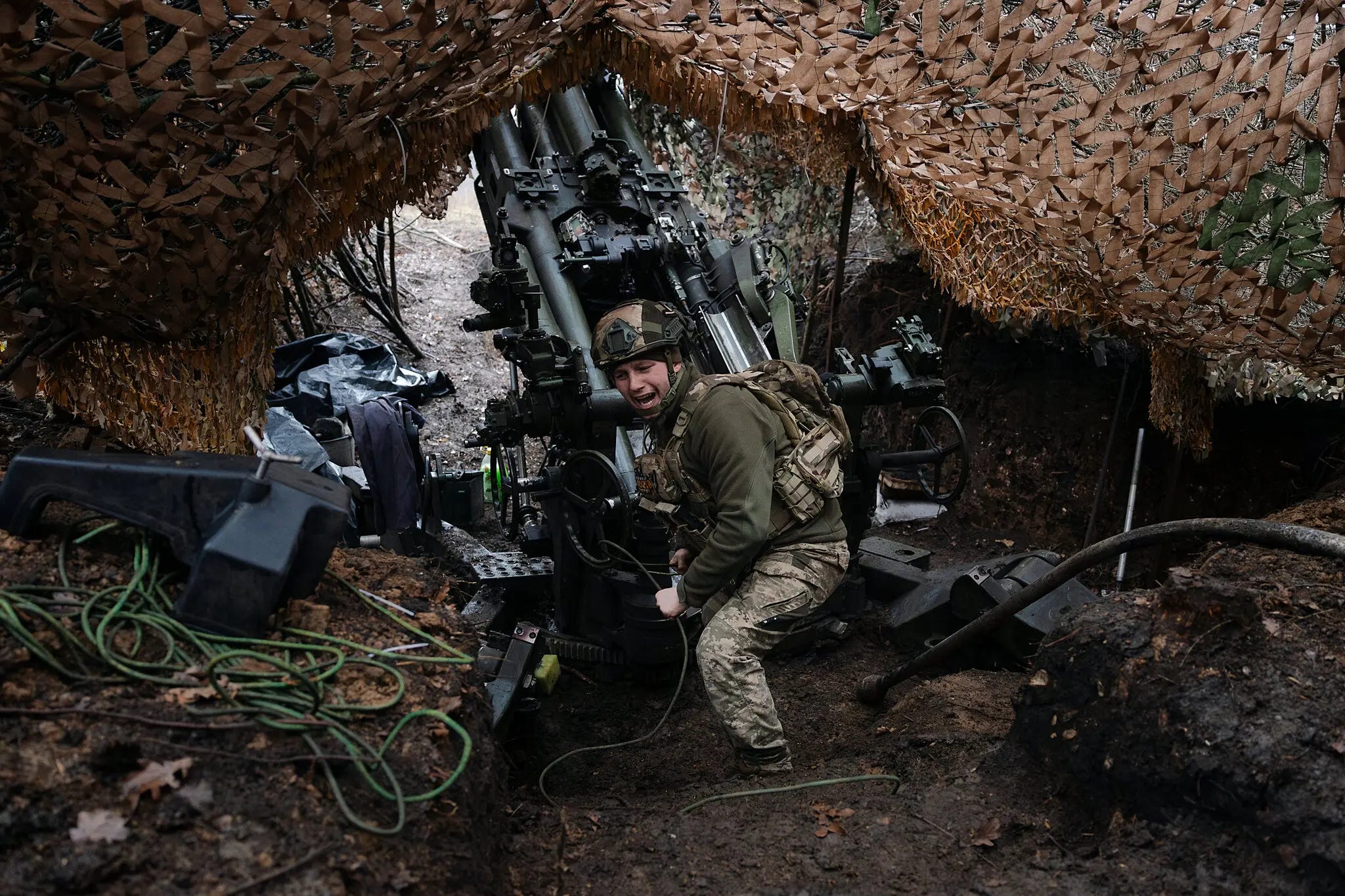
The New York Times reports that Ukraine’s Air Force warned late Thursday of a possible launch of an intermediate-range ballistic missile from Russia’s Kapustin Yar strategic testing site, near the Caspian Sea. Shortly after the alert, explosions were reported near the western city of Lviv, though Ukrainian authorities said it was not yet clear whether a nuclear-capable missile from the site was responsible.
Denmark, Greenland envoys met with White House officials over 'takeover'
Associated Press reports that Denmark and Greenland’s envoys lobbied the White House and lawmakers to dial back Trump’s takeover talk, including hints of force. The episode risks a transatlantic rift and raises uncertainty over US commitments to allies.
Republicans push back on White House military threat toward Greenland
The Washington Post reports that Republicans are split over White House suggestions that military force is an option for Greenland, with some warning of NATO rupture and “strategic self-harm”. Domestic pushback may slow escalation, but the rhetoric still fuels crisis risk.
Trump Airs Doubts on NATO’s Value as Greenland Tensions Rise
Bloomberg reports that Trump publicly questioned NATO’s value as Greenland tensions rose, arguing Russia and China fear the alliance only because of the US. Such messaging risks weakening deterrence, encouraging adversary opportunism, and unsettling European security planning.
How a US takeover of Greenland would undermine Nato from within
The Guardian reports that a US move to seize Greenland would create a NATO scenario the treaty barely contemplates: one member turning on another. Article 5 ambiguity could paralyse decision-making, fracture trust, and hand Moscow an opening to probe the alliance elsewhere.
Greenland-linked stocks jump amid Trump takeover threats
Financial Times reports that Greenland-linked stocks have surged as Trump’s takeover rhetoric energised retail traders, echoing meme-stock dynamics rather than fundamentals. Speculative spikes in banks and mining plays highlight how geopolitical threats can distort markets, misprice risk, and incentivise reckless political brinkmanship.
A marriage of three: Will Mali, Niger, Burkina Faso bloc reshape the Sahel?
Al Jazeera reports that Mali, Niger and Burkina Faso are deepening the Alliance of Sahel States with a joint force, new institutions and a shared narrative after quitting ECOWAS. The bloc could harden authoritarian rule, complicate counterterrorism, and widen great-power rivalry in West Africa.
Suspected jihadists attack Mali’s Morila mine
Reuters that suspected jihadists attacked Mali’s Morila gold mine, burning equipment and briefly taking seven employees hostage. The incident underlines worsening Sahel insecurity, raises operational and insurance costs for extractives, and risks further regional spillover as militants diversify targets.
Russian attacks leave 1 million people in Ukraine without electricity and water
Euronews reports that Russian strikes triggered major outages in Dnipropetrovsk and Zaporizhzhia, disrupting heating, water and services amid winter conditions. The attacks amplify civilian risk, strain emergency response capacity, and signal continued coercion through infrastructure targeting as diplomacy struggles to stabilise the front.
Russia slams Western peacekeeping plan for Ukraine
France 24 reports that Moscow denounced proposed Western peacekeepers and warned foreign forces would be treated as legitimate targets. The stance raises escalation risks around any ceasefire implementation, complicates monitoring and deterrence design, and may deter European capitals from committing troops without firmer US-backed guarantees.
UK and France ‘ready to deploy troops’ to Ukraine after ceasefire
The Guardian reports that London and Paris say they are prepared to deploy troops post-ceasefire, alongside plans for military hubs across Ukraine. The proposal aims to deter renewed Russian attacks, but increases risks of direct confrontation, domestic political backlash, and contested legitimacy under international law.
Foreign troops in Ukraine ‘legitimate targets’ – Russia
RTÉ News reports that Russia reiterated any Western troops deployed to Ukraine would be considered legitimate combat targets after UK–France post-ceasefire discussions. The warning tightens escalation ladders, complicates force-protection planning, and raises commercial risks (insurance, logistics, basing) for states considering participation.
Yemen’s Aden airport shuts as Saudi-UAE rift deepens
Reuters reports that Aden airport shut amid flight restrictions and competing claims of responsibility as the Saudi–UAE rift over Yemen’s southern separatists deepened. The disruption signals widening fractures inside the anti-Houthi camp, raising escalation and humanitarian risks, and threatening Red Sea and Gulf security calculations.
What Does the Maduro Raid Mean for China?
Bloomberg reports that Donald Trump’s move in Venezuela has put China in a difficult position, given Beijing’s deep energy, trade and diplomatic ties with Caracas. The action signals what Trump calls a “Donroe Doctrine,” reviving U.S. dominance in the Americas and squeezing China’s influence. Washington is reportedly pressing Venezuela to curb ties with China and other U.S. rivals, a move Beijing has condemned as bullying. In China, the episode has also sparked debate over its implications for Taiwan.
Why will Saudi-UAE trade ties remain resilient despite Yemen tensions?
Reuters reports that despite Yemen tensions, Saudi–UAE economic interdependence makes a trade rupture unlikely. Bilateral trade was about $30bn in 2023, with sizeable cross-investment. Even so, prolonged political strain could chill investor confidence and ripple across Middle East logistics and capital flows.
Iran judiciary chief warns no leniency for protesters ‘helping enemy’
Reuters reports that Iran’s judiciary chief warned there would be “no leniency” for protesters “helping the enemy”, blaming Israel and the US as unrest spreads from currency-driven anger. Rights groups put deaths at 27+ and arrests above 1,500, though totals are disputed, raising risks of mass violence and wider confrontation.
Internet cut off amid fresh escalation in Tehran; death toll mounts to 45
The Hindu reports that Iran reported a nationwide internet blackout as protests flared in Tehran after exiled Crown Prince Reza Pahlavi urged mass demonstrations. Rights groups say 45 are dead and 2,260 detained. Trump warned “severe action” if authorities “start killing people”.
Decypher Data Dive📊
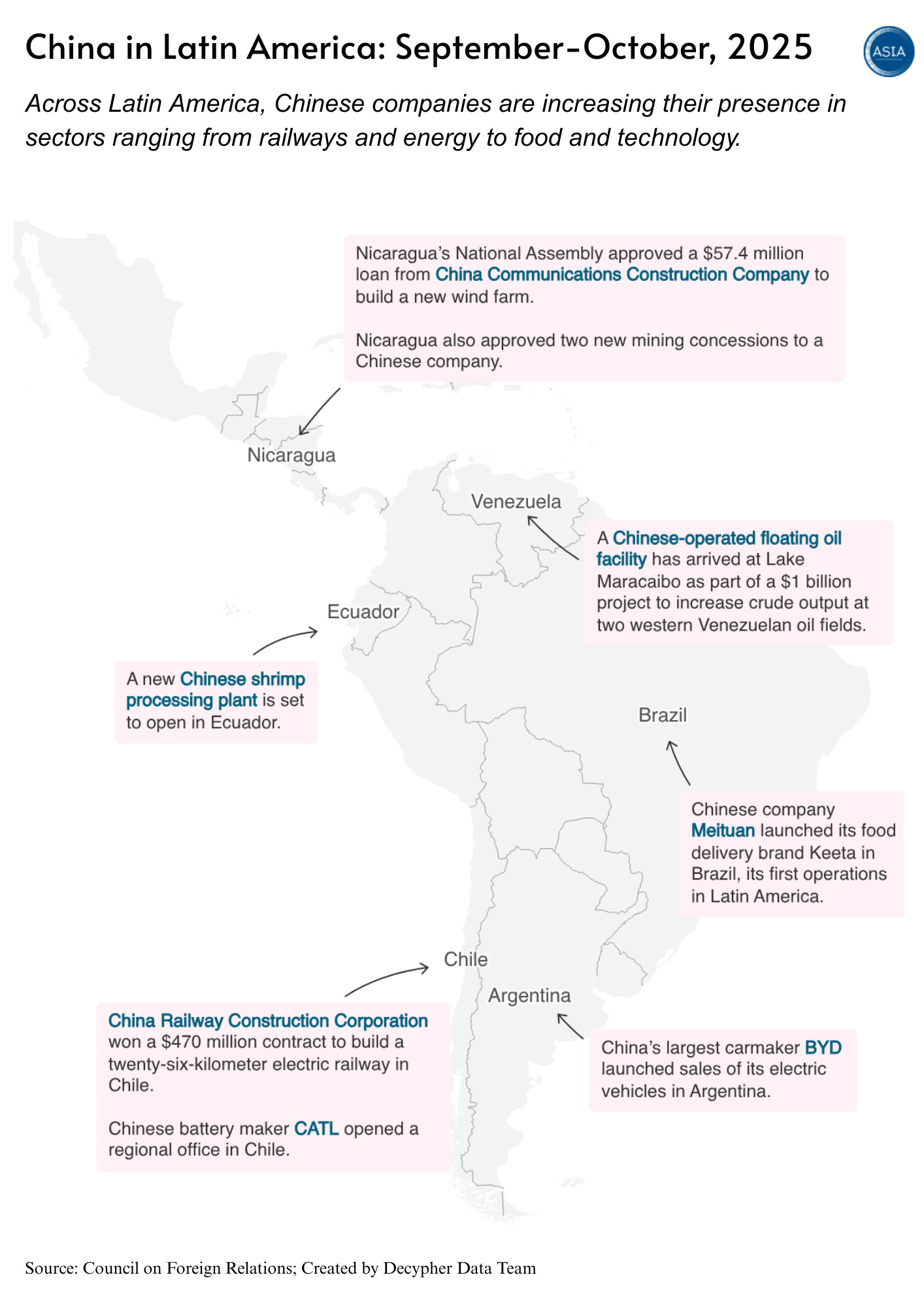
China’s Growing Economic Footprint in Latin America
Latin America’s product imports from China have increased steadily between 2000 and 2023, rising from just $8.4 billion to over $270 billion. Machinery and electrical equipment dominate import categories, reflecting the region’s growing dependence on Chinese industrial goods.
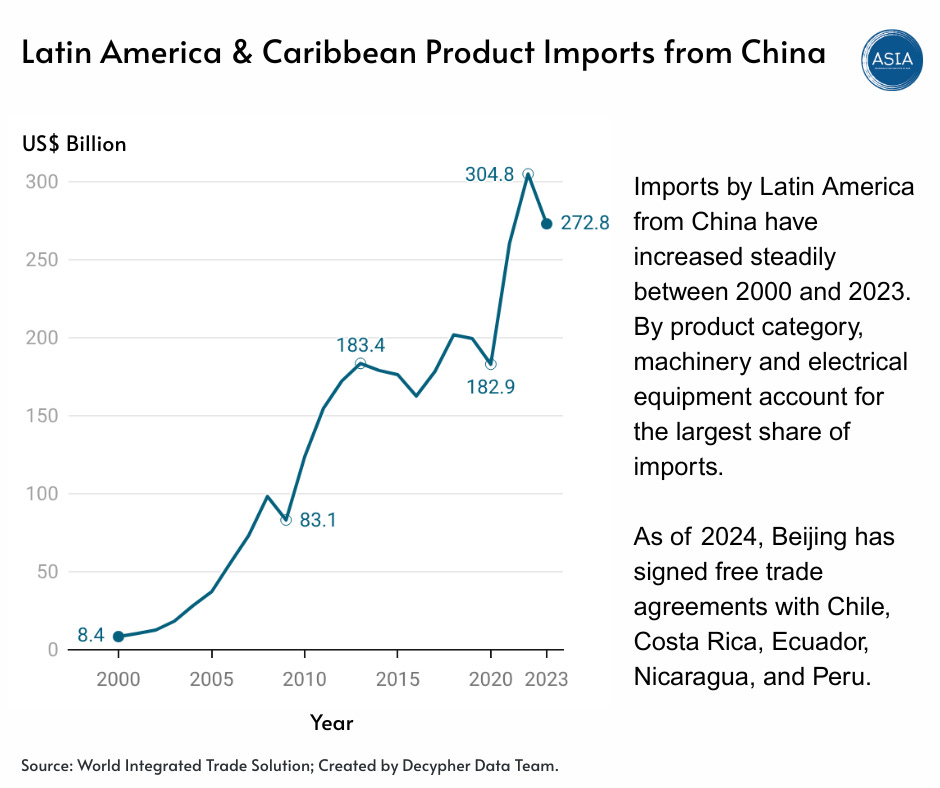
Beyond trade, Chinese companies have expanded their physical presence across Latin America. Recent projects include infrastructure development in Chile, renewable energy investments in Nicaragua, oil facilities in Venezuela, and manufacturing expansion in Ecuador. Chinese firms have also entered consumer markets in Brazil and Argentina.
— — —
SITREP By Manashjyoti
Data By Bhupesh
Edited By Aurko
Produced by Decypher Team in New Delhi, India
— — —