

The Pervasive Pakistani Military
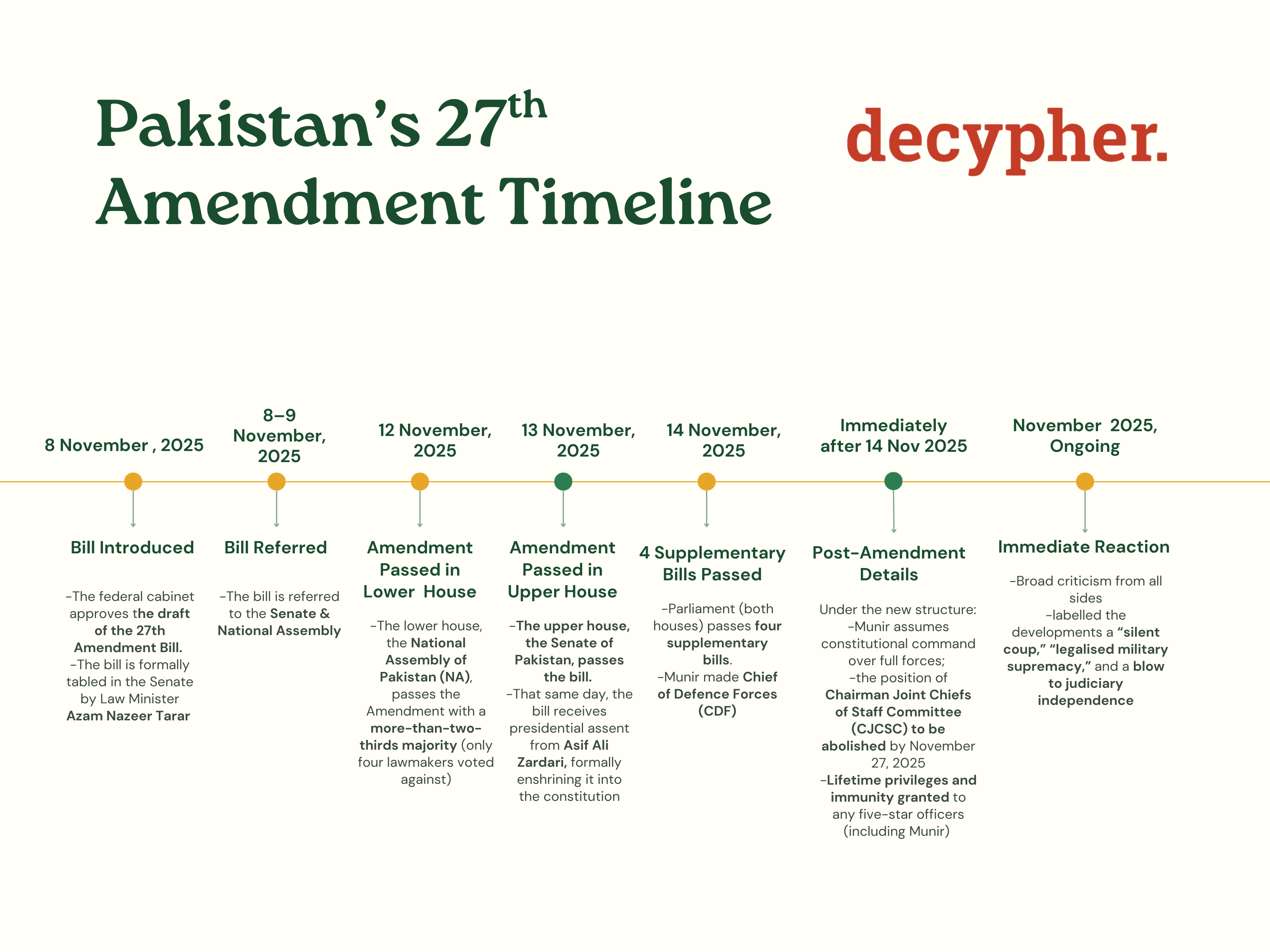
With a history of military takeovers, Pakistan’s most recent power grab has been carried out without a single tank on the streets. The recent amendment passed in the country is a clear indication of a structural break in the political evolution of Pakistan. General Asim Munir now occupies the apex of power in the state – a move done through legal measures and not force. The weaponisation of the constitution by the Pakistan Army will weaken the democratic foundations of the country.
The 27th Amendment passed this week in Pakistan has made General Asim Munir – the Chief of Defence Forces (CDF) giving him centralised control over the army, navy and air force. This had historically been prevented due to the fear of the consolidation of excessive power in the hands of the military. The office of the Chairman of the Joint Chiefs of Staff Committee (CJCSC) remains abolished, and this new post is set to better manage nuclear and strategic assets – making Munir the most powerful man in Pakistan.
What is most alarming however in the amendment is the complete immunity extended not only to Munir but all officers with 5-star rank. This right has previously only been reserved for the head of the state. The immunity granted to the Army Chief accords him with impunity – legally allowing him to be “above all reproach”. This means that he shall remain untouchable by courts even if he partakes in gross violations and misconduct of constitution. The Pakistan Army Chief is quite literally above and beyond the law.
The amendment also establishes a new Federal Constitutional Court (FCC) which is designed to handle all matters of the constitution while making the Supreme Court a mere appellate court for civil and criminal cases. The FCC judges can only be appointed by the executive – effectively cutting the judiciary of at its knees.
These changes are not simple alterations of the institutional design of the country but represent a larger paradigm shift – the Pakistani Military is tipping the fragile civilian-military equilibrium in favour of military supremacy. It has effectively implemented one of the smoothest coups in modern times through the thorough removal of any institutional barriers – courts, parliament or elections.
Pakistan’s cyclical history with martial law and miliary coups have always been upended either through internal revolts or civilian pressures. However, what this amendment does is constitutionally allow the military to maintain power – making it harder to reverse.
The weak civilian government in place under Prime Minister Shehbaz Sharif see the amendment as a cost worth paying as it allows a stable security apparatus, a unified command structure and a shield against future prosecution – but what they do not seem to see is the complete annihilation of democratic governance processes – the separation of power, civilian control over the military and most importantly accountability.
Imran Khan’s political prospects have been decisively narrowed by the 27th Amendment. The change curtails judicial avenues that might have offered Khan legal relief and review. Analysts warn the amendment institutionalises the military control, meaning electoral popularity alone is unlikely to restore him to power or grant him freedom anytime soon. Coupled with mass trials, convictions and crackdowns that have depleted PTI’s organisational capacity, Khan remains popular but politically immobilised - his fate now hinges more on military strategy than less on civilians.
The road ahead of Pakistan is grim. What is happening there can only be described as a “silent coup” under Asim Munir. The institutionalisation of military supremacy comes as no surprise as those aware of Pakistan’s history know it is largely run by the armed forces. What is surprising is that for a country with a vivacious civil society and a power media apparatus, the sheer lack of protest indicates at the citizenry is tired. Pakistan has clearly traded in its democracy for an emerging autocratic regime ripe for military takeover – the transaction however was wrapped in legality and not bullets.
Economic Activity🏦
Trump, after call with China’s Xi, told Tokyo to lower the volume on Taiwan
Wall Street Journal reports that Donald Trump urged Japan to tone down its rhetoric on Taiwan following an intense call with Xi Jinping, who spent half the conversation pressing China’s claims over the island and stressing shared US-China responsibilities. The message unsettled Tokyo, whose prime minister Sanae Takaichi had angered Beijing by suggesting Japan might respond militarily to a Chinese attack on Taiwan. The episode highlights how Beijing is leveraging its direct access to Trump to pressure US allies and shape regional signalling.
Can Chinese authoritarianism stay smart?
Foreign Policy reports that China’s long-term economic trajectory hinges on whether Xi Jinping can maintain a delicate balance between centralised political control and the openness required for innovation. Xi’s third term entrenched a more personalist and restrictive governance model, reversing post-Mao norms that helped fuel decades of growth. While China’s previous blend of limited freedom and state direction enabled major advances in technology and industry, tightening ideological controls, weakened institutions and fear-driven bureaucratic behaviour now risk undermining creativity, foreign investment and problem-solving capacity.
China backs second batch of $131 million bond issuance by private equity firms
Caixin reports that four Chinese private equity firms plan to issue 930 million yuan in sci-tech innovation bonds under a state-supported risk-sharing scheme designed to ease financing constraints for tech-focused investors. The issuance, backed by China Bond Insurance and counter-guaranteed with equity or share pledges, marks the second use of a People’s Bank of China initiative to lower funding costs and lengthen maturities for venture capital backing early-stage hard-tech projects. Roadshows were held in Beijing as authorities push to channel long-term capital into strategic sectors.
Yuan rallies to one-year high on trade optimism and Fed cut bets
Caixin reports that the yuan has strengthened to its highest level in nearly a year, supported by easing trade frictions with the United States and rising expectations of US Federal Reserve rate cuts. The onshore yuan closed at 7.0938 per dollar on Tuesday, gaining 118 basis points from the previous session and briefly breaking below 7.085 overnight. The offshore yuan similarly appreciated to around 7.081. China’s central bank set a stronger daily reference rate at 7.0826, reflecting improved sentiment driven by both policy expectations and calmer US-China trade dynamics.
Electronics Incs’ joint venture wait at China gate gets longer
The Economic Times reports that Indian electronics manufacturers are facing prolonged delays in securing Chinese approvals for technical collaborations and joint ventures. Several firms waiting for clearances to import specialised machinery or formalise partnerships have seen deadlines pushed back, slowing production expansion plans. Industry executives say Chinese regulators are taking significantly longer to process applications, disrupting supply chains and complicating India’s efforts to boost domestic electronics manufacturing.
Chinese pharma is on the cusp of going global
The Economist reports that China has become the world’s second-largest developer of new medicines, now accounting for roughly a third of global clinical trials compared with just 5% a decade ago. Chinese biotech firms are advancing rapidly in fields such as oncology and are attracting strong investor confidence, with valuations rising sharply this year. The sector’s fast, low-cost drugmakers are increasingly positioned to earn more overseas than in China, signalling a shift as the country’s pharmaceutical industry prepares to compete directly in global markets.
How Chinese underground banks became the world’s biggest money-launderers
The Economist reports that Chinese underground banking networks have overtaken rivals to dominate global money laundering, connecting wealthy Chinese citizens, Mexican drug cartels and North Korean hackers. These networks, enabled by China’s strict capital controls and vast trade flows, have driven out older laundering systems through lower fees, technical innovation and global reach. Techniques such as mirror transactions, fake invoicing, online gambling and cryptocurrency operations allow billions in illicit proceeds to be moved without crossing borders on paper.
CITES conference rejects proposal on restricting eel trade
NHK reports that a proposal by the European Union to impose trade restrictions on all eel species, including Japanese eel, was voted down at the CITES Conference of the Parties in Samarkand. While European eel is already regulated, the EU sought to extend similar controls across all species. Japan, backed by China and South Korea, opposed the measure over concerns that domestic prices would rise, noting that around 70 percent of its eel consumption relies on imports. The decision will be formally finalised at a general meeting on December 4.
Inside China🐉
Fire in Hong Kong high-rise complex kills at least 94 people, hundreds reported missing; 3 arrested
CBS News reports that at least 94 people have died and hundreds remain unaccounted for after a massive fire swept through seven towers of the Wang Fuk Court residential complex in Hong Kong’s Tai Po district. Three construction company figures were arrested on suspicion of manslaughter after police found highly flammable foam materials installed near elevator lobbies, contributing to the rapid spread of the blaze. Firefighters battled the level-5 alarm fire for two days, evacuating around 900 residents and rescuing survivors from scorched apartments, though search operations continue amid uncertainty over the number of missing.
Millions in China cram for civil service exam and the hope of a job for life
The Guardian reports that a record 3.7 million people will sit China’s national civil service exam this weekend, reflecting a sharp shift toward secure public-sector jobs amid economic uncertainty. This year’s exam is the first since Beijing raised age limits, allowing general candidates up to 38 and postgraduates up to 43, widening eligibility as youth unemployment remains high and private-sector opportunities shrink. Applicants compete for 38,100 posts, with some roles attracting thousands of candidates for a single vacancy. Despite lower pay and delayed salaries in some regions, civil service jobs are increasingly sought for their stability, the so-called “iron rice bowl”.
International Relations🌏
China issues fresh travel advisory, urging citizens not to visit Japan amid escalating tensions
Anadolu Agency reports that Beijing has issued a new alert warning Chinese citizens to avoid travel to Japan, citing a sharp rise in discrimination complaints and concerns over public security. It is the second advisory in two weeks and follows Prime Minister Sanae Takaichi’s remarks that a Chinese attack on Taiwan could trigger Japan’s collective self-defence. China has intensified pressure on Tokyo, with mass trip cancellations, a seafood import ban and postponed trilateral meetings, while urging Japan to guarantee the safety of Chinese nationals.
Beijing’s invisible hand stifles Inter-Parliamentary Alliance on China
Intelligence Online reports that the recent IPAC meeting in Brussels, which featured an unannounced appearance by Taiwan’s vice president Hsiao Bi-khim, nevertheless highlighted China’s success in constraining pro-Taipei and pro-Hong Kong advocacy. Beijing’s influence has limited IPAC’s effectiveness not only across Africa but also in France, where political pressure has muted parliamentary engagement. Despite symbolic support from Taipei, the alliance continues to struggle against coordinated Chinese efforts to marginalise its activities.
French court upholds expulsion order for Chinese national accused of spying on diaspora
Intelligence Online reports that a French court has rejected an appeal by a Chinese national facing expulsion over allegations he played a central role in monitoring the Chinese diaspora in France. The expulsion order, signed in September by then interior minister Bruno Retailleau, followed assessments by domestic intelligence agency DGSI that the man, resident in France since 1986, was involved in influence work linked to Fujian business networks and United Front–aligned organisations. His case comes amid broader French scrutiny of alleged Chinese covert activity, including previous investigations into clandestine “police stations” and other diaspora surveillance structures.
Taipei bolsters undersea cable security after Chinese sabotage
Intelligence Online reports that Taiwan is tightening laws and increasing penalties to counter suspected Chinese sabotage of its submarine cable network, a critical infrastructure linking the main island with outlying territories such as Matsu. Recent incidents highlighted gaps in monitoring and response systems, prompting the government to draft tougher regulations and expand oversight by agencies including the National Security Bureau and Chunghwa Telecom. However, officials warn the measures may fall short without stronger international cooperation, given that much of the cable infrastructure lies in contested or internationally shared waters.
President Lai Ching-te frets over China’s use of triads to spy on Taiwan
Intelligence Online reports that recent espionage trials targeting President Lai Ching-te and senior adviser Joseph Wu have exposed major security vulnerabilities within Taiwan’s government. Investigations revealed that Chinese intelligence services have been exploiting organised crime networks, including triads, to infiltrate political circles and gather information. The cases highlighted lax background checks, mafia-linked intermediaries and weaknesses inside the National Security Council, prompting concerns in Taipei about systemic exposure to Beijing’s interference.
Beijing freezes Japan youth exchange programmes over PM Takaichi’s Taiwan remarks
South China Morning Post reports that China has suspended all youth exchange programmes with Japan after Prime Minister Sanae Takaichi said Tokyo could deploy forces if conflict broke out in the Taiwan Strait. Diplomatic sources say Beijing informed Tokyo of cancellations in recent weeks, part of wider retaliation that includes travel warnings, concert cancellations and the postponement of planned China–Japan–South Korea summits.
Tech in China🖥️
China warns of bubble risk in humanoid robot boom
France 24 reports that Beijing has cautioned that rapid expansion in China’s humanoid robotics sector could create a market bubble. More than 150 firms are now developing AI-enabled humanoids, but officials said production is racing ahead of real demand. Li Chao of the National Development and Reform Commission warned that the industry faces immaturity in technology, commercialisation and use cases, and urged vigilance against repetitive, low-value products crowding the market.
Global Risk🗺️
Putin says U.S.–Ukraine draft could form basis for ‘serious’ peace talks
CNBC reports that Vladimir Putin has publicly acknowledged the U.S.-backed draft peace plan for the first time, saying its revised framework could serve as a foundation for negotiations when U.S. envoy Steve Witkoff visits Moscow next week. While Russia welcomed signs Washington was considering its positions, officials insisted there would be no concessions on core issues and warned that fighting would end only if Ukrainian forces withdrew from key areas.
Sheikh Khalifa’s houses: Inside the decade-long fight over the Al Nahyan family’s overseas wealth
Intelligence Online reports that a long-running legal battle over the foreign assets of the late UAE president Sheikh Khalifa bin Zayed has drawn to a close, revealing deep fractures within the Al Nahyan family. Newly surfaced details outline a three-way struggle involving Khalifa’s sons and a senior royal relative over control of a vast European property portfolio accumulated before and during his presidency. The dispute, complicated by opaque transfers, offshore structures and earlier attempts to consolidate assets under state-linked entities, tested internal family authority at a time when President Mohammed bin Zayed is reshaping the balance of power among his brothers.
Mansour bin Zayed’s secret negotiations to salvage mega mining deal
Intelligence Online reports that Abu Dhabi has opened discreet talks to regain control of a major bauxite project in Guinea after the venture stalled. The negotiations have become personalised, involving UAE Vice President Mansour bin Zayed and Guinean junta leader Mamadi Doumbouya, with tensions over governance and ownership slowing progress. The mining assets, tied to Emirates Global Aluminium and Guinea Alumina Corp, remain strategically important to the UAE, prompting efforts to revive the deal through back-channel mediation.
Ex-leader of Reform UK in Wales jailed for over 10 years
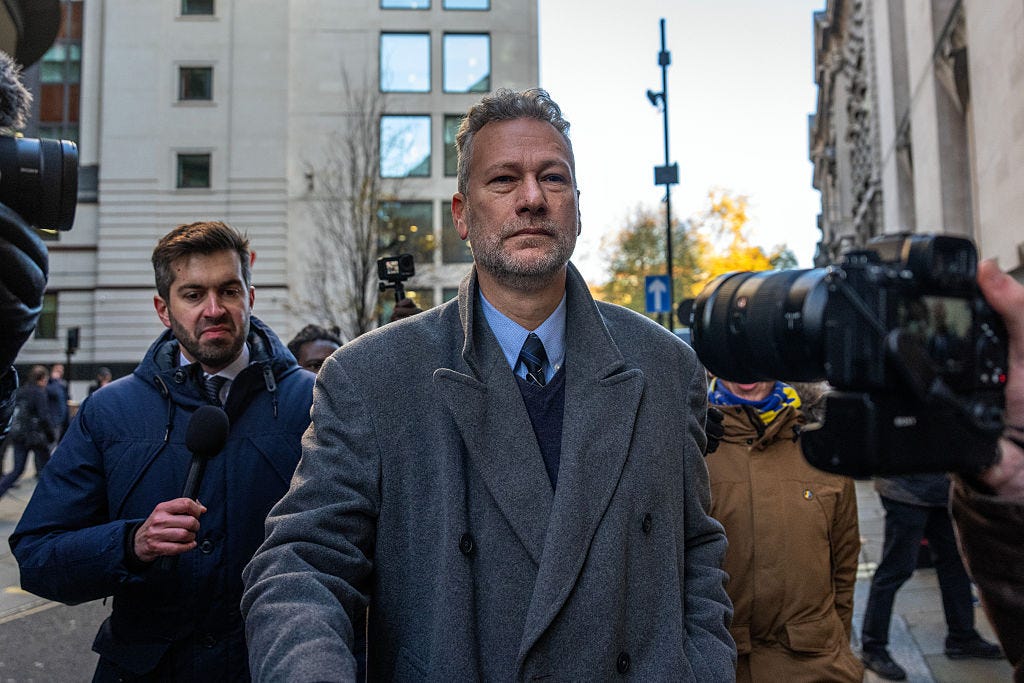
New Statesman reports that former Reform UK politician Nathan Gill has been sentenced to ten and a half years in prison for accepting bribes to deliver pro-Russian statements during his tenure as a Brexit Party MEP. Gill pleaded guilty to eight counts of bribery, with police estimating he received at least £40,000 between late 2018 and mid-2019.
Nato scrambles jets as Russian drones make deepest incursion into Romania
The Guardian reports that Nato fighters were launched on Tuesday after two Russian drones crossed into Romanian airspace in the most extensive and first daytime breach since the start of the Ukraine war. German Typhoons and Romanian F-16s tracked the drones, one of which returned to Ukraine while the other crashed in Puieşti, likely due to fuel loss. Romania’s defence minister said pilots had been authorised to shoot it down if conditions allowed.
Decypher Data Dive📊
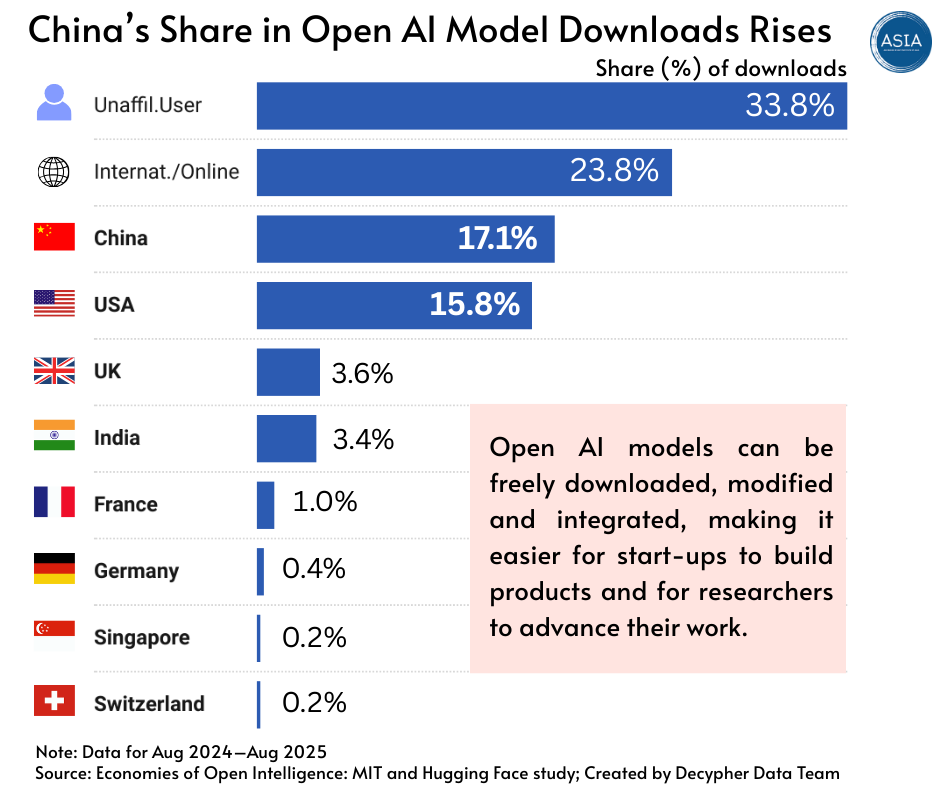
A study by the Massachusetts Institute of Technology and open-source AI start-up Hugging Face found that Chinese open-source AI models captured 17.1% of global downloads between August 2024 and August 2025, surpassing the US share of 15.8% for the first time. The surge is driven largely by DeepSeek and Alibaba’s Qwen models.
— — —
Microessay By Priyanka
Data By Bhupesh
Edited By Aurko
Produced by Decypher Team in New Delhi, India
— — —