

The format of the newsletter will be undergoing both technical and content changes over the next two weeks as we strive to update our product to ensure our readers receive the best available information on China and the world. Please bear with us, and we hope you enjoy the updated newsletter.
There will also be two new newsletters brought to you by the team for a more holistic experience. They are likely to start in February/March:
PostScript (Narrative essays)
Saamrik (Strategy-focused audio)
China Quote 🗩
“We invite enterprises from all over the world to embrace the opportunities of the green and low-carbon transition, and to work closely with China in areas such as green infrastructure, green energy, green minerals, and green finance.”
— He Lifeng, Vice Premier of China, speaking in Davos
Economic Activity🏦
China Plans GDP Growth Range to Retain Policy Flexibility in 2026
South China Morning Post reports that Chinese policymakers are expected to set a GDP growth target as a range rather than a fixed figure for 2026, according to sources familiar with the matter. The move is intended to give Beijing greater flexibility to adjust fiscal and monetary policy amid persistent economic uncertainty, weak domestic demand, property sector stress, and external risks, while signalling continued commitment to stabilising growth.
China Sets Yuan Fixing Stronger Than 7 for First Time Since 2023
Bloomberg reports that China’s central bank set the daily yuan fixing stronger than 7 per US dollar for the first time since 2023, signalling increased efforts to support the currency amid renewed depreciation pressure. The move comes as authorities seek to stabilise financial markets while balancing concerns over capital outflows, weak domestic growth, and diverging monetary policy with the United States.
China Meets 2025 Growth Target as Fourth Quarter GDP Beats Expectations
CNBC reports that China met its 2025 GDP growth target after fourth quarter growth exceeded expectations, supported by stronger industrial output and steady investment, while retail sales growth remained modest. Official data showed mixed momentum across income and employment indicators, highlighting uneven recovery as policymakers balance growth support with longer term economic adjustments.
Chinese Exports to Africa Drive Record Trade Gap Amid US Pressure
South China Morning Post reports that China’s trade surplus with Africa widened to a record US$102 billion in 2025 as exports of manufactured goods surged while imports of African commodities grew more slowly. The figures come amid increased US pressure on African governments to curb reliance on Chinese trade and financing, even as Beijing remains the continent’s largest trading partner.
Inside China🐉
HIT Professor Elected President Elect of IEEE Industrial Electronics Society
Harbin Institute of Technology reports that Professor Gao Huijun from its School of Astronautics has been elected president elect of the IEEE Industrial Electronics Society, becoming the first scholar from the Chinese mainland to hold the position since the society was founded in 1951. The election took place during the society’s Executive Committee meeting in Lisbon, where Gao presented a work report in his new role.
Death Toll Rises to Nine After Blast at Baotou Steel Plant
Yicai Global reports that the death toll from an explosion at a steel plant in Baotou, Inner Mongolia, has risen to nine, citing local authorities. The blast injured several others and triggered an investigation into its cause, with safety inspections under way at the facility.
China’s Birth Rate Continues to Fall Despite Policy Support
Associated Press reports that China’s population decline is deepening as births continue to fall despite years of policy measures aimed at encouraging larger families. Official data show the number of newborns dropped again in 2024, extending a trend driven by high living costs, job insecurity, changing social attitudes, and delayed marriage. Authorities have expanded subsidies, tax incentives, childcare support, and parental leave, but uptake has remained limited, particularly in major cities where housing and education costs are highest. Demographers cited by the report say the decline reflects structural factors rather than short term economic conditions, warning that fewer women of childbearing age will make recovery increasingly difficult. The shrinking population is accelerating ageing pressures, reducing the future workforce, and complicating long term economic planning, including pension and healthcare systems. Local governments are experimenting with cash incentives and family friendly policies, but analysts say reversing the trend would require broader reforms covering employment stability, gender equality in the workplace, housing affordability, and childcare access, with no immediate turnaround in sight.
Tech in China🖥️
China Reaches 35% Self Sufficiency in Semiconductor Equipment
FinancialContent reports that China has achieved about 35 percent self sufficiency in semiconductor manufacturing equipment, driven by domestic advances including progress in advanced lithography technologies. The report says the gains reflect sustained state backing for local suppliers as China seeks to reduce reliance on foreign equipment amid ongoing technology restrictions.
International Relations🌏
China and Russia Hold Talks After Power Supply Halt
Energy News reports that China has halted imports of Russian electricity, with talks under way on a possible resumption after Russia cited higher domestic power prices and rising demand in its Far East. Russia said supplies could restart if mutually acceptable terms are agreed, while InterRAO confirmed that neither side intends to cancel existing long term contracts despite a sharp decline in exports to China in recent years.
China Reaffirms Commitment to Venezuela After Leadership Change
South China Morning Post reports that China has said it remains deeply committed to its relationship with Venezuela, with the Chinese ambassador meeting the country’s new leader following a recent political transition. Beijing reiterated support for bilateral cooperation across energy, trade, and development projects, signalling continuity in ties despite leadership changes in Caracas.
Chinese Special Forces Face Challenges in Taiwan Leadership Targeting Scenario
Intelligence Online reports that the recent capture of Venezuelan leader Nicolás Maduro by US forces has highlighted operational gaps facing China’s special forces in any potential attempt to target Taiwan’s political leadership. The article says the operation underscored US superiority in intelligence coordination, logistics, and rapid execution, increasing pressure on Beijing as it signals preparedness for similar missions against Taiwan. It notes that challenges for China include Taiwan’s internal security measures, reliance on US intelligence support, and the complexity of operating in a densely monitored political environment centred on President Lai Ching-te.
Assessing the Risk of War Between China and Taiwan
The New York Times argues that the likelihood of a military conflict between China and Taiwan remains contested, with analysts weighing deterrence, military capabilities, political signalling, and the role of the United States. The article presents differing views on whether rising tensions increase the risk of war or whether existing constraints continue to prevent escalation.
Taiwan Signals Higher Defence Spending Amid China Tensions
NPR reports that Taiwan is signalling plans to increase defence spending as pressure from China continues to intensify, with the government focusing on readiness, resilience, and procurement of asymmetric capabilities. Officials said budget decisions are shaped by security assessments and coordination with partners, while domestic debate continues over the scale and pace of defence investment.
Musk Warns AI Data Centres Face Power and Chip Constraints
Fortune reports that Elon Musk said the rapid expansion of artificial intelligence data centres is being constrained by shortages of advanced chips and electricity supply, speaking on the sidelines of the World Economic Forum. He highlighted competition with China for computing resources and power infrastructure as a growing challenge for scaling AI systems globally.
Bangladesh
Bangladesh rebalances its foreign policy
The Daily Star reports that Dhaka is warming ties with China and Pakistan while tilting away from India. The shift has regional security implications, especially for Bay of Bengal dynamics and cross-border cooperation. It also raises leverage risks, as major-power competition can translate into sharper conditionality on trade, loans, and defence ties.
China’s influence, election in focus as new US ambassador sets out Bangladesh agenda
The Daily Star reports that the new US ambassador highlighted concerns about Chinese influence and said Washington will not take sides in Bangladesh’s election. The messaging points to a sharper focus on strategic risk in projects and security cooperation. Heightened scrutiny could reshape investment choices and diplomatic manoeuvre as Dhaka balances multiple partners.
Brunei
Exercise Semangat Waja Series 08/2026
BruDirect reports that Brunei has launched Exercise Semangat Waja Series 08/2026 to strengthen military readiness and coordination. The drill underscores how even smaller states are stress-testing crisis response amid a more uncertain regional security climate, where maritime incidents, infrastructure risks, and grey-zone pressure can escalate quickly and draw in external partners.
Discussion Session with Members of the Legislative Council
BruDirect reports that Brunei’s Ministry of Primary Resources and Tourism briefed Legislative Council members on priorities around food security, tourism development, and forest conservation, alongside a review of 2025 achievements. The focus signals how economic resilience and supply security are being treated as strategic issues, with knock-on effects for regional competitiveness and climate-linked stability.
Cambodia
China vows full backing for Kingdom’s crackdown on technology-driven scam hubs
Khmer Times reports that China’s ambassador pledged support for Cambodia’s push against technology-enabled scam networks. The issue matters beyond law enforcement: scam hubs can distort local governance, fuel corruption risks, and trigger cross-border tensions, especially when victims and funds span multiple jurisdictions and prompt external pressure for tougher action.
Cambodia reviews progress in fight against online scams
Khmer Times reports that Cambodia reviewed results from its crackdown on online scams, including large-scale arrests. The campaign is framed as reputational and economic risk management as much as policing, with implications for investment confidence and regional cooperation, since scam networks operate across borders and can become diplomatic flashpoints.
Indonesia
Prabowo Arrives in Switzerland for WEF Davos 2026
Tempo reports that President Prabowo travelled to Switzerland for the World Economic Forum, with a scheduled special address on 22 January. The trip spotlights Jakarta’s push to shape investor perceptions and partnerships during a volatile global cycle, where trade fragmentation and security shocks can quickly tighten financing and constrain policy space.
Prabowo to Pay State Visits to the UK and Switzerland in Early 2026
Tempo reports that President Prabowo is undertaking high-profile diplomacy with visits to the UK and Switzerland. The signalling is strategic: Indonesia is positioning itself for capital, technology, and security cooperation while trying to avoid entanglement in great-power competition that can impose costs on trade, investment, and regional cohesion.
Japan
China Tightens Screening on Japan-bound Rare Earth Exports
Mainichi reports that China has tightened screening on rare earth exports bound for Japan. The move sharpens supply-chain vulnerability for sectors crucial to advanced manufacturing and defence. Even modest delays can ripple through production planning, reinforce “economic security” policy debates, and deepen regional distrust in an already strained trade-and-tech environment.
Japan PM won’t budge over China despite ‘coercion’ ahead of poll
Mainichi reports that Japan’s prime minister is refusing to soften positions towards China despite alleged coercion ahead of an election. The stance suggests a hardening rivalry with limited room for de-escalation. In a tightly coupled region, sharper political rhetoric and reciprocal pressure can raise crisis risks and complicate coordination on trade and security.
Laos
Laos Advises Citizens to Avoid US Visa Applications Amid Temporary Suspension
Laotian Times reports that Laos has advised citizens to avoid applying for US visas amid a suspension affecting visa processing. Beyond travel disruption, the move highlights how mobility controls can spill into diplomacy and economic ties, affecting study, labour movement, and business links—areas that smaller economies often rely on for resilience.
Malaysia
Bank Negara keeps OPR at 2.75pct in first MPC meeting
New Straits Times reports that Bank Negara Malaysia held its policy rate at 2.75% in its first meeting of the year. The decision reflects a cautious stance as external shocks—geopolitics, trade uncertainty, and supply-chain volatility—can transmit quickly into inflation expectations, capital flows, and ringgit stability.
Bursa Malaysia bullish on OPR status quo, easing geopolitical
New Straits Times reports that Malaysian market sentiment firmed on expectations of steady rates and calmer geopolitics. The optimism is conditional: any renewed regional crisis or global risk-off swing can reverse portfolio flows, tighten funding, and raise borrowing costs, shaping how quickly Malaysia can sustain investment-led growth in a more fragmented world economy.
Myanmar
Beyond Beijing’s reach, a new resistance alliance takes shape in Myanmar
Myanmar Now reports that a “Spring Revolution Alliance” of 19 armed groups is forming with an emphasis on operating away from the Chinese border. The development suggests shifting conflict dynamics, with risks of wider territorial contestation, higher violence, and harder regional diplomacy as neighbours weigh border security, trade corridors, and influence.
Junta airstrikes intensify as push to retake Falam stalls
Myanmar Now reports that junta airstrikes have intensified while efforts to retake Falam have stalled. The pattern points to escalation risks and civilian harm, with potential cross-border spillovers in displacement and trafficking. Protracted fighting also complicates ASEAN’s credibility and external engagement, as humanitarian access and political settlement remain constrained.
Philippines
Philippines, Japan sign new defense pact
The Manila Times reports that the Philippines and Japan signed a defence pact enabling the tax-free provision of key supplies, including ammunition, fuel, and food. The agreement deepens interoperability and signals tighter security alignment amid South China Sea tensions, raising the odds of sharper Chinese pushback and making crisis management more consequential for regional stability.
Philippines Pushes for International Law Based South China Sea Code
Reuters reports that the Philippines said it will insist that any South China Sea code of conduct be firmly grounded in international law, as negotiations with China and other regional states continue. Manila said its position is anchored in the 2016 arbitral ruling and the UN Convention on the Law of the Sea, amid ongoing tensions over maritime claims.
Singapore
Singaporeans expect inflation to increase slightly in 2026 amid trade uncertainties: survey
The Business Times reports that a survey shows Singaporeans expect slightly higher inflation in 2026, citing trade policy uncertainty and geopolitical risks. The finding matters for policy signalling and budgeting, since expectations can shape wage demands and consumption, and external shocks—tariffs, supply disruptions—can reprice inflation quickly in open economies.
Why top CEOs are looking to global champions for their 2026 strategy
The Business Times reports that Singapore-based business leaders are looking outward for “global champion” playbooks for 2026, reflecting pressure to compete in a tougher environment. The subtext is strategic: firms are planning for fragmented markets, tech rivalry, and geopolitical shocks that can reshape access to capital, talent, and supply chains.
Thailand
World Bank lifts Thailand’s 2026 growth forecast to 1.8%, still lowest in ASEAN
Nation Thailand reports that the World Bank raised Thailand’s 2026 growth forecast to 1.8%, while still ranking it lowest among major ASEAN peers cited. The story highlights structural constraints and competitiveness risks, especially as neighbours accelerate. Weak growth also reduces fiscal room, making Thailand more vulnerable to global downturns and regional shocks.
Navigating 2026 uncertainty, FTI urges faster FTAs and structural reform
Nation Thailand reports that the Federation of Thai Industries is warning about sluggish growth prospects and calling for faster free trade agreements and structural reforms. The argument reflects anxiety about losing regional market share as supply chains reconfigure. Delayed reform can amplify exposure to trade fragmentation and investment diversion across ASEAN.
Timor-Leste
Japan and Timor-Leste discuss cooperation in infrastructure, agriculture, and tourism
TATOLI reports that Timor-Leste and Japan discussed cooperation across infrastructure, agriculture, and tourism. The push reflects a diversification agenda aimed at long-term resilience. It also shows how development partnerships are increasingly strategic, as infrastructure choices and connectivity shape economic sovereignty and bargaining power in a more competitive regional landscape.
Timor-Leste participates for the first time in the ASEAN Digital Ministers’ Meeting
TATOLI reports that Timor-Leste participated for the first time in the ASEAN Digital Ministers’ Meeting. The step matters for regulatory alignment on digital governance, cybersecurity, and connectivity standards. As digital infrastructure becomes a strategic domain, early integration choices can affect data sovereignty, investment pathways, and exposure to external technological influence.
Vietnam
14th National Party Congress officially opens in Hanoi today
Lan Ha writes in VnExpress that Vietnam’s 14th Communist Party Congress opened with 1,586 delegates representing over 5.6 million party members. The congress will shape leadership and policy direction at a moment when Vietnam’s growth model faces tighter geopolitical constraints, supply-chain competition, and higher expectations from partners on strategic alignment.
14th National Party Congress sets 10% GDP growth target for 2026-2030
VnExpress reports that Vietnam’s Party Congress is setting an ambitious 10% GDP growth target for 2026–2030. The target signals confidence but also risk: sustaining rapid expansion may require reforms and stable external demand. Global slowdowns, tech controls, or trade disruptions could make delivery harder and raise policy trade-offs.
Global Risk🗺️
Riyadh gradually winning round pro-UAE militias
Intelligence Online reports that Saudi Arabia is making progress in undermining UAE-backed militias in southern Yemen by engaging with local forces, in part through cooperation with Oman, as part of Riyadh’s efforts to control the evolving crisis.
UAE flights linked to Sudan war tracked from Israel to Ethiopia
Middle East Eye reports that flight-tracking data shows a cargo aircraft tied to Emirati operations in Sudan has repeatedly flown between military bases in Abu Dhabi, Israel and Ethiopia, highlighting growing geopolitical tensions and logistical shifts amid the Saudi-UAE rivalry.
Economic Confrontation Identified as the Biggest Threat to Global Stability in 2026
Euronews reports that the World Economic Forum’s 2026 Global Risks Report identifies geoeconomic confrontation — including sanctions, tariffs and investment controls — as the top risk likely to trigger global instability this year. It highlights rising geopolitical and economic rivalry overtaking other threats, signalling a shift in priorities at the Davos forum.
Geoeconomic Conflict Overshadows Climate Risk in WEF 2026 Risk Register
Eco-Business finds that geopolitical and economic tensions have pushed environmental concerns down the near-term risk list in the World Economic Forum’s 2026 Global Risks Report, despite climate risks remaining dominant over a decade. Rising anxiety about AI, mis- and disinformation also features prominently, reflecting a broader shift in the global risk landscape.
China Defends Wind Power Strategy After U.S. Criticism at Davos
Reuters reports that at the 2026 World Economic Forum in Davos, China defended its global wind power leadership after criticism from U.S. President Donald Trump, who challenged the effectiveness of Chinese wind energy. Chinese officials emphasised the country’s top global installed capacity and its role in promoting renewable energy worldwide.
Trump Hails ‘Framework’ of Greenland Deal Amid Diplomatic Controversy at Davos
The Washington Post reports that U.S. President Donald Trump announced a “framework” deal on Greenland at the World Economic Forum, stepping back from previous tariff threats in exchange for enhanced Arctic security cooperation with NATO allies. The move drew both praise and criticism, while Denmark reaffirmed its sovereignty over the territory.
Global Billionaires Call for Higher Taxes on Super-Rich at Davos, Citing Threats to Democracy
The Guardian reports that nearly 400 millionaires and billionaires from 24 countries have signed an open letter at the World Economic Forum urging higher taxes on the super-rich, warning that extreme wealth undermines democracy, social cohesion and climate action. Signatories include public figures such as Mark Ruffalo and Abigail Disney.
Decypher Data Dive📊
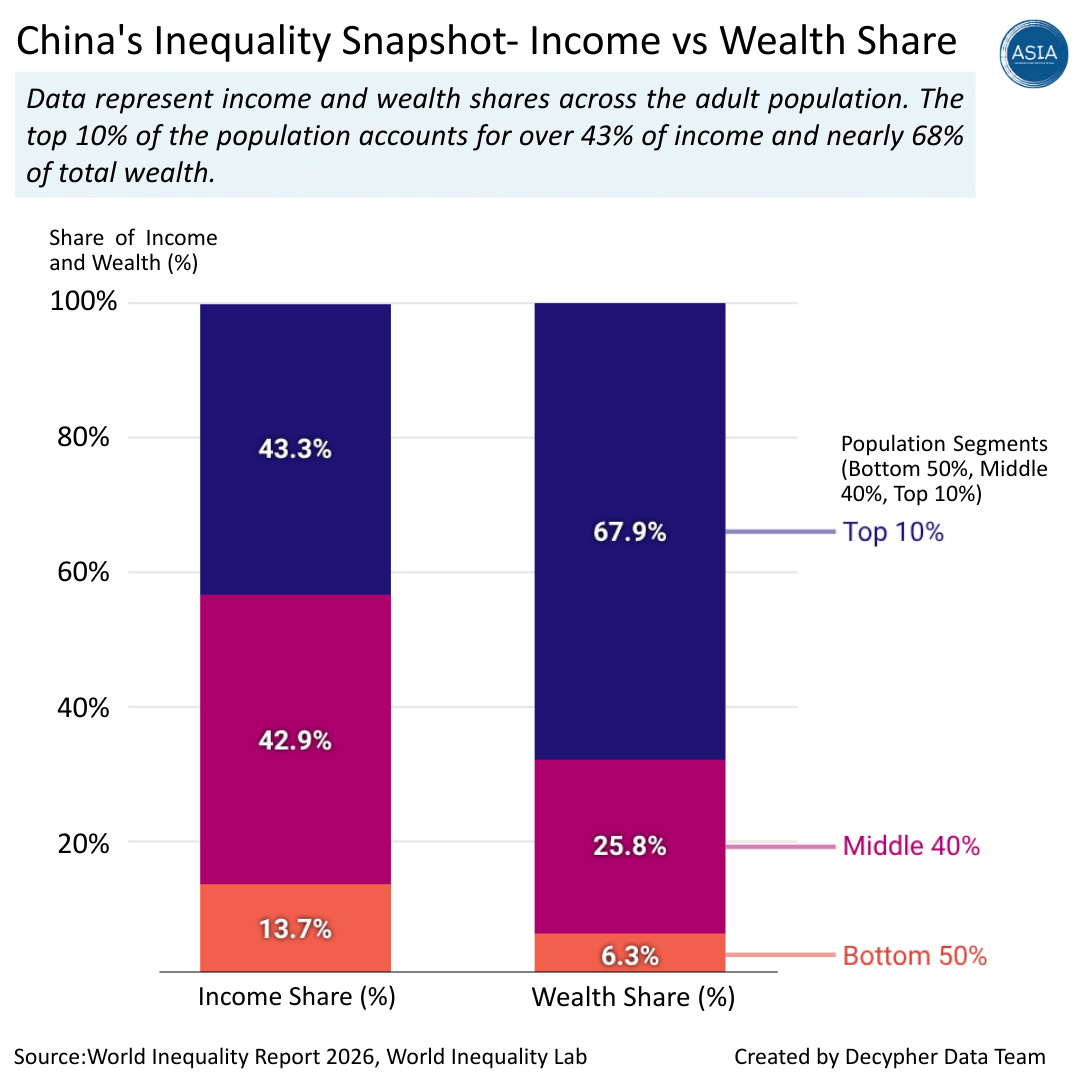
According to the World Inequality Report 2026 by the World Inequality Lab, income inequality in China remains significant but has stabilised after years of rapid growth. The top 10% of earners receive about 43% of national income, nearly the same share as the entire middle 40%, while the bottom 50% receive just 14%. Wealth inequality is far more pronounced: the richest 10% hold nearly 68% of total wealth, whereas the middle 40% own about 26% and the bottom half of the population just over 6%.
— — —
Data By Bhupesh
Edited By Aurko
Content Inputs from Manash & Priyanka
Produced by Decypher Team in New Delhi, India
— — —