


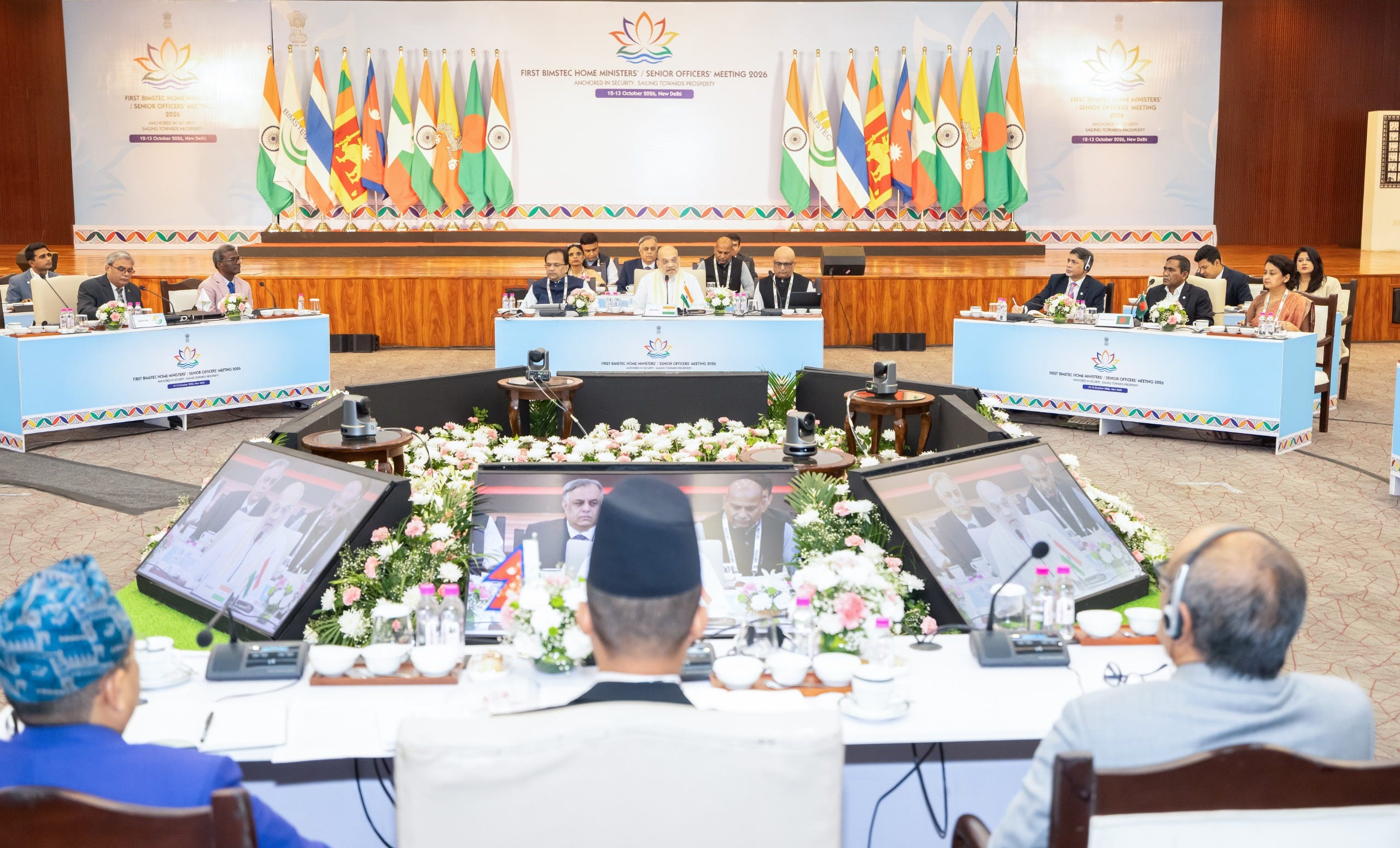
On 13 October, the home ministers of seven countries stretching from the Himalayas to the Andaman Sea met in New Delhi. It was the first meeting of its kind in BIMSTEC’s nearly thirty-year history. The Delhi Declaration covered terrorism, organised crime, drug and human trafficking, cybercrime, money laundering, and information-sharing, adding another mechanism to an organisation that now has a permanent Secretariat, a Charter, seven sectoral pillars, and its first long-term vision. Yet the free trade area first agreed in principle in 2004 remains unfinished. The contrast is usually folded into a familiar judgement about BIMSTEC: institutions and declarations have accumulated faster than integration. But nearly three decades of survival make that judgement insufficient. An organisation that has failed to complete some of its foundational economic ambitions has not withered. Instead, it has gained more political attention, more formal machinery, and a wider range of activities. The question is therefore not simply why BIMSTEC has integrated so slowly, but what kind of regional institution has emerged from that experience.
BIMSTEC has gradually adapted to the absence of regional convergence by making cooperation less dependent upon it. Different sectors can move at different speeds, and participation in one does not require equivalent progress elsewhere. That flexibility helps explain the organisation’s durability, but it does not make its functional model politically neutral. Once cooperation moves from meetings and agreements into grids, roads, ports, trade concessions and security relationships, differences in geography, capacity and bargaining power return to determine what can actually be implemented. The history of BIMSTEC is therefore as much about where regional politics reappears as it is about finding ways to keep politics out.
From functional ambition to institutional adaptation
The organisation began with a deliberately practical agenda. The 1997 Bangkok Declaration brought Bangladesh, India, Sri Lanka and Thailand together as BIST-EC; Myanmar joined later that year, while Nepal and Bhutan entered in 2004. Its early agenda concentrated on trade and investment, transport and communication, energy, technology, tourism and fisheries. The geography itself was unusual. Rather than reproduce South Asia as an established political region, the grouping connected states conventionally divided between South and Southeast Asia through the Bay of Bengal and a set of problems they might solve together.
There was an implicit logic to this arrangement. Practical cooperation could begin without agreeing on a political conception of the region, and connections in one sector could make cooperation elsewhere easier. Transport could facilitate trade; trade could create demand for simpler customs procedures and common rules; energy links could produce material interdependence. The 2004 Framework Agreement on the BIMSTEC Free Trade Area represented the most ambitious expression of this logic. It envisaged liberalisation not only of trade in goods, but also of services and investment, along with measures to facilitate economic cooperation.
What followed, however, was expansion without equivalent integration. Six priority areas eventually became fourteen, adding agriculture, public health, poverty alleviation, culture, environment and climate change, counterterrorism and transnational crime. The range of problems described as regional grew much faster than the machinery available to manage them. BIMSTEC’s own retrospective account acknowledges that its founding declaration created no formal working structure. Representatives in Bangkok largely coordinated meetings, while documentation and follow-up remained weak enough for the grouping to function more as a regional forum than an organisation.
That institutional thinness lasted remarkably long. The Permanent Secretariat in Dhaka was established only in 2014, seventeen years after the Bangkok Declaration. Until then, an organisation whose agenda had expanded across fourteen sectors had no permanent bureaucracy to sustain cooperation between meetings. The mismatch matters. BIMSTEC’s early problem was not simply insufficient political enthusiasm for regional integration. Its functional agenda expanded before the institution had the capacity to preserve decisions, coordinate implementation, or distinguish priorities from aspirations.
BIMSTEC nevertheless survived. That deserves more attention than the familiar observation that it moved slowly. Regional institutions do not automatically acquire greater political investment after failing to complete some of their foundational projects. BIMSTEC did. The question is therefore not only why integration lagged, but how the organisation adjusted to that experience.
The political context of the mid-2010s undoubtedly helped. The 2016 BIMSTEC Leaders’ Retreat in Goa coincided with the collapse of that year’s SAARC summit, and India’s decision to bring BIMSTEC leaders into its BRICS outreach gave the grouping considerably greater political visibility. The Goa outcome document renewed attention to trade, connectivity, energy, counterterrorism and institutional cooperation. But treating 2016 as the moment BIMSTEC became a substitute for SAARC obscures the longer trajectory. Its connection between South and Southeast Asia, and its organisation around the Bay of Bengal rather than South Asia’s political geography, had existed since 1997. Goa increased the strategic value attached to an existing institution; it did not invent its regional logic.
The more consequential response came through institutional reform. By the 2018 Kathmandu Summit, members acknowledged that the proliferation of sectors had become a problem. They called for the areas of cooperation to be reviewed, restructured and rationalised in pursuit of tangible results. The group eventually reorganised fourteen sectors into seven, each led by a different member. The BIMSTEC Charter, adopted at Colombo in 2022 and brought into force in May 2024, subsequently gave the organisation a formal legal foundation. The Sixth Summit in Bangkok in 2025 added formal rules of procedure and Bangkok Vision 2030, the first long-term vision document in BIMSTEC’s history.
This was not integration by another name. BIMSTEC had responded to the limitations of its first two decades by changing the machinery through which cooperation occurred. The organisation became more formal, but also more capable of allowing different parts of its agenda to proceed independently.
Cooperation without convergence
Under the newer architecture, progress in one field does not depend upon equivalent movement elsewhere. Security cooperation can acquire its own mechanisms while trade negotiations remain unfinished. Maritime transport can advance through a separate agreement without waiting for a regional motor vehicles agreement. Disaster management can develop through exercises, technical coordination and specialised institutions without the existence of a common market. The lead-country structure formalises some of this unevenness by distributing responsibility for different sectors among different governments rather than requiring the organisation to move uniformly.
The first BIMSTEC Home Ministers’ Meeting illustrates how this works. The Delhi Declaration called for stronger cooperation against terrorism, organised crime, trafficking, cybercrime, money laundering and terrorist financing, alongside better information-sharing, specialised training and implementation of existing legal instruments. A day earlier, senior officials had worked through proposed conventions and action plans covering trafficking, illicit financial flows, drug control and disaster management.
Yet even this apparently functional field shows why the distinction is not simply between areas in which BIMSTEC succeeds and those in which it fails. Members signed the BIMSTEC Convention on Cooperation in Combating International Terrorism, Transnational Organized Crime and Illicit Drug Trafficking in 2009. It entered into force only in March 2021 after ratification by all seven governments. Five years later, the Delhi Declaration still emphasises implementation of existing legal instruments alongside the conclusion of proposed ones. Functional cooperation does not remove friction. It lowers the threshold at which cooperation can begin.
That experience complicates the assumption that practical cooperation necessarily produces spillover, with integration in one area generating pressure for integration in another. BIMSTEC increasingly looks more modular. A government can participate in disaster management without making equivalent concessions on trade. Maritime cooperation can move forward without completion of the FTA. Security officials can exchange information even while other regional projects remain stalled. Difficulty in one field does not have to paralyse every other one.
This quality is not entirely accidental. BIMSTEC’s official principles of cooperation describe its activities as complementary to, rather than a substitute for, its members’ bilateral, subregional, regional, and multilateral relationships. The organisation therefore does not require its seven states to make the Bay of Bengal their exclusive, or even primary, regional framework. Thailand remains embedded in ASEAN; Nepal and Bhutan participate in other subregional arrangements; members retain bilateral relationships that often carry greater immediate economic or security weight. BIMSTEC can operate alongside these relationships rather than displacing them.
Seen this way, unevenness is not only a record of what BIMSTEC has failed to accomplish. It has become part of the way the institution functions. An unfinished trade agreement does not invalidate cooperation on disaster response. Political disagreement in one relationship need not formally suspend technical cooperation among all seven members. Several different depths of regionalism can coexist within the same institution.
There is a price to that flexibility. Cooperation becomes more politically demanding as it moves from creating mechanisms to producing material outcomes. A working group can agree that connectivity is desirable; a transport corridor must pass through particular territory and be financed by somebody. Governments can endorse regional energy cooperation; electricity must travel through an existing grid. Trade liberalisation reaches domestic producers, tariff revenues and regulators. Information-sharing depends not merely on creating an institutional channel but on governments trusting one another enough to use it. The further cooperation moves from coordination towards implementation, the harder it becomes to keep individual sectors insulated from the political relationships underneath them.
BIMSTEC’s institutional evolution has therefore not removed politics from regionalism. It has changed the point at which politics enters. Its functional architecture allows cooperation to begin without requiring the seven members to converge on a common economic or political project, and that flexibility helps explain why an organisation with so much unfinished business has nevertheless endured and acquired greater institutional density. But once agreements have to operate through actual territory, infrastructure and national institutions, institutional flexibility cannot determine who supplies the necessary capacity, who bears the costs, who sets the terms or which members retain alternatives when those terms become unattractive.
Regionalism around the Bay of Bengal asks little of its members’ politics, and that is usually offered as its main strength. Cooperation is cut into problems such as power trade, disaster response and transnational crime, each of which states have a reason to solve without first agreeing on what the region is. This claim is tested against the one variable it leaves out: imbalance. The functional model works because India is so much larger than its partners, and that the same asymmetry sets the limits of what the model can do. A hub can supply goods without when no one agrees on a political vision for the region. Goods supplied by a hub still arrive on the hub’s terms.
The size of the gap
In 2016, India accounted for 74 per cent of BIMSTEC’s combined GDP, against 13 per cent for Thailand and 7.3 per cent for Bangladesh. Nepal and Bhutan each held under one per cent. These figures are old. Trade among the members is thin by comparison. Intra-BIMSTEC trade was 6.7 per cent of members’ total trade in 2023, while ASEAN’s share is around 25 per cent. The free trade framework signed in 2004 is still unfinished in all six of its parts, and an op-ed in the Dhaka Tribune reports that officials are now weighing whether to finalise only the parts closest to agreement. Dependence runs one way. Members other than Thailand and Myanmar import over seventy per cent of their rice from India, so a disturbance in the Indian rice trade is felt in their markets.
Imbalance can be treated as four distinct things, since each explains a different failure. Material imbalance is the gap above. Geographic imbalance is India’s position as the land bridge and the grid for its neighbours. Institutional imbalance concerns who hosts, who chairs and who drafts. Alignment imbalance is the ability of smaller members to hedge, chiefly toward China.
The institutional dimension is visible in the first Home Ministers’ Meeting, held in New Delhi on 13 October, where the members adopted the Delhi Declaration. The text puts information sharing, mutual legal assistance and extradition first, and it condemns cross-border terrorism by name while affirming sovereign equality and non-interference. India hosted and chaired the meeting, and the disaster management centre it endorsed would sit in Jamnagar, Gujarat. Formal authority sits elsewhere. Bangladesh took over the chair at the Bangkok summit and the Secretariat is in Dhaka. The gap between formal roles and actual weight is what the wants to examine through three cases that end in different ways.
Electricity: supply without politics, on India’s terms
The best case for the functional model is power. In October 2024 Nepal, India and Bangladesh signed a tripartite agreement under which Nepal sells 40 MW to Bangladesh through Indian transmission lines, from mid-June to mid-November each year. It was the first time Nepal could sell electricity to a third country. None of the three governments needed to agree on a vision of South Asia. They needed to agree on wheeling charges.
The terms of the deal show the imbalance at work. Nepal must send India its list of power projects for approval before their output can go to Bangladesh. In 2019, when talks had stalled waiting for Delhi to convene a meeting, India proposed that Nepal and Bangladesh trade through an Indian commercial entity, and Nepal argued for paying regulated surcharges instead. The 2024 agreement was executed with India’s NTPC Vidyut Vyapar Nigam as the third party, and Bangladesh pays India a trading margin. India’s preferred arrangement outlasted five years of negotiation.
The trade itself is commercially real. One assessment from an Indian university puts Nepal’s sales to India at over 1,100 MW, up from 39 MW when India first approved cross-border trade in 2021. For the argument cooperation worked because India controlled the grid and was willing to share it. Nepal and Bangladesh trade as far as India permits, and every success of this kind makes the hub more central.
Bangladesh: what hedging looks like
Bangladesh shows what smaller members do with the room they have. During a visit to China in late March 2025, Muhammad Yunus described India’s Northeast as landlocked and Bangladesh as the region’s guardian of the ocean, and he invited Chinese economic expansion. In April, India ended the transshipment facility that had let Bangladeshi exports reach third countries through Indian ports and airports. The Ministry of External Affairs gave congestion as its reason, though Indian press reports tied the decision to Yunus’s remarks. ORF noted that Delhi left Dhaka’s transit rights to Nepal and Bhutan untouched, which points to a measured use of leverage.
The February 2026 election changed the tone more than the structure. A BNP government under Tarique Rahman took office on 17 February, and Delhi said it wanted to deepen ties. Still, Rahman, in his capacity as BIMSTEC chair, reportedly skipped the outreach session of the BRICS summit in New Delhi despite an invitation. Dhaka’s home minister was reported to be skipping the Home Ministers’ Meeting, with a senior bureaucrat leading the delegation. The member that chairs BIMSTEC and hosts its Secretariat was therefore represented one level below its minister at the first security ministerial. Extradition, a declared priority, is where the bilateral politics bite hardest. Sheikh Hasina has been in India since 2024, and an Indian explainer expects Dhaka’s new government to face pressure to seek her return.
Hedging is the smaller state’s instrument and access is India’s. Transshipment, transit and grid access all sit inside functional fields, which means a political quarrel can switch functional cooperation off. The narrow model asks less of regional politics only on paper.
Kaladan: when a member cannot deliver its territory
Kaladan shows a different limit. The US$484 million project, agreed with Myanmar in 2008, would link Sittwe port to Mizoram and give the Northeast an alternative outlet to the sea. It has missed deadlines in 2014 and 2020. The Arakan Army captured Paletwa in January 2024, and reporting in The Week suggests Indian officials concluded the project could not be finished without the group’s support. In March 2026 Mizoram’s government said the project area was now under Arakan Army administration and that it keeps good relations with the group, with completion slated for 2027.
The state India signed with no longer controls the ground the road crosses. India’s connectivity agenda in this corridor now depends on dealing directly with an armed group inside a fellow member. This is the geographic dimension at its most acute. A hub can supply what others need only if the route through a spoke is open, and a spoke in civil war cannot open it.
What the model gains and loses
The model gains durability, and some of that durability comes from subtraction as much as from functionalism. SAARC’s hardest dispute is outside the room. Pakistan vetoed a SAARC-wide motor vehicles agreement in 2014, and four members went ahead as BBIN. India boycotted the 2016 SAARC summit in Islamabad over cross-border terrorism, and BIMSTEC drew attention as an alternative. The Delhi Declaration carries SAARC’s grievance forward and drops its veto holder.
BBIN also shows how fragile such arrangements can be. Bhutan’s National Council rejected ratification by 13 votes to two, and the other three agreed to proceed through an exchange of letters. A hub’s agenda can be carried by a smaller coalition, but only where the states left out have no veto.
The losses fall into three groups. Agenda-setting follows India’s priorities, as the emphasis of the Delhi Declaration suggests. Cooperation lasts only while the interests of hub and spokes overlap, as Bangladesh shows. And none of the three cases offers evidence of spillover, meaning functional ties that produce political trust able to survive a quarrel. Extradition and intelligence sharing demand far more trust than electricity wheeling does, and they now sit at the centre of the agenda.
Projection for next 5 years
Over the next five years, BIMSTEC is therefore more likely to become denser than uniformly deeper. The institutional changes of the past decade make a return to its earlier dormancy less likely: a permanent Secretariat, regularised sectoral mechanisms, clearer responsibilities and a long-term agenda now allow cooperation to continue even when individual projects stall. But the same architecture also permits progress to remain uneven. By 2031, security, disaster management, energy or particular connectivity arrangements could deepen while trade liberalisation and wider economic integration continue to lag.
There are five things to be watched. The first is whether the FTA is finalised in parts. The second is whether Kaladan opens in 2027 as Mizoram expects. The third is whether the Jamnagar centre moves from proposal to operation. The fourth is the level at which Bangladesh attends BIMSTEC ministerials, together with the Hasina question. The fifth is whether power trade through India grows beyond the first 40 MW. If these move together, the narrow model is deepening. If security cooperation grows while the trade and connectivity indicators stall, fragmentation along bilateral and minilateral lines is the likelier path, and that is where the evidence points today.
The more important test is whether cooperation begins to travel across these boundaries. If energy links create demand for wider infrastructure, connectivity begins to facilitate substantially greater regional trade, or security mechanisms generate habits of cooperation that survive bilateral disputes, BIMSTEC will have begun moving from modular cooperation towards a more integrated regional order. If progress remains confined to separate sectors and smaller coalitions of willing members, then unevenness will have proved not a transitional weakness but BIMSTEC’s durable institutional form.
Essay:
Preksha Jalan - Associate Fellow, Digital History Lab at The Advanced Study Institute of Asia (ASIA).
Maseera Shaik- Research Assistant (Security, Crisis and Strategy) at The Advanced Study Institute of Asia (ASIA)
Produced by Decypher Team in New Delhi, India