


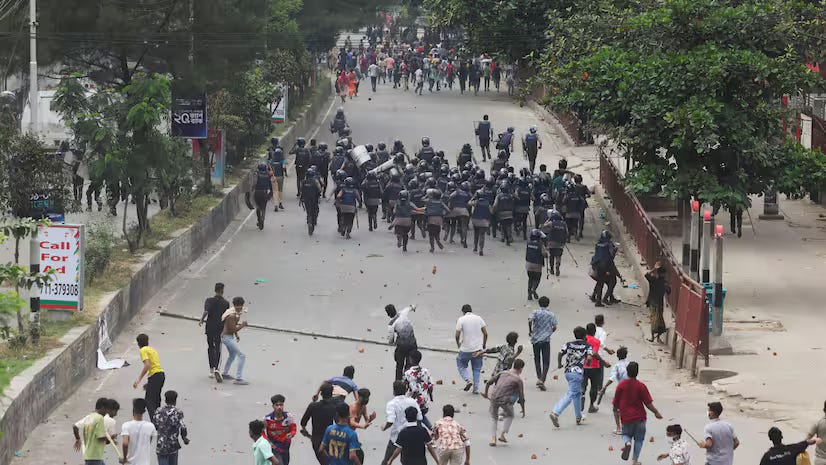
More than 500 garment factories in Bangladesh shut on 1 November as workers demanding a minimum monthly wage of 30,000 Bangladeshi taka took to the streets. The existing minimum is 12,500 Bangladeshi taka. The government constituted a wage board, police used tear gas and water cannons, and manufacturers warned that continued disruption could jeopardise export orders. Factories reopened the following day, only for renewed clashes to force hundreds to suspend operations again. The scale of the disruption reflects something larger than the wage dispute itself. Ready-made garments employ around four million people and generate more than 80 per cent of Bangladesh’s export earnings. A confrontation concentrated in a few industrial districts can therefore quickly become a national economic problem.
That concentration stems from one of South Asia’s most consequential economic transformations. Bangladesh entered the global garment industry in the late 1970s with little manufacturing capacity. Garment exports were worth around $1 billion in 1990; by FY2024–25, they had reached roughly $40 billion. Bangladesh is now the world’s second-largest garment exporter. The industry created employment on a scale few manufacturing sectors in the region have matched, drew millions of women into paid work and helped move the country away from the overwhelmingly agrarian economy it inherited at independence. Today, garments account for approximately 85 per cent of exports, according to the IMF. The current unrest does not show that Bangladesh chose the wrong development model. Garments worked. The more difficult question is what accumulated around that success.
Export-led growth matters for more than the foreign exchange earned when goods cross a border. Its larger promise is that producing competitively for international markets creates capabilities that spread through an economy. Firms learn new production methods, workers acquire skills, suppliers emerge, logistics improve, and governments acquire incentives to build infrastructure. One internationally competitive industry can then make it easier for another to emerge. Some of this happened in Bangladesh. The garment sector itself became considerably more sophisticated. Domestic textile and accessory industries developed around it; factories acquired the scale and organisational capacity necessary to supply major international buyers; and compliance with global production standards became increasingly important, particularly after the Rana Plaza disaster in 2013. Today’s industry bears little resemblance to the small export sector that emerged in the late 1970s.
The problem is therefore not that Bangladesh failed to accumulate capacity. It is that much of that accumulation remained concentrated around the industry already succeeding. The concentration of these capabilities around garments also reflects the particular conditions under which the industry grew. Bangladesh did not simply discover that it possessed cheap labour and begin exporting clothes. From the late 1970s onward, the sector developed through a combination of foreign partnerships, access to imported inputs and machinery, preferential trading arrangements and domestic policy choices that progressively made garment exporting easier. The early collaboration between South Korea’s Daewoo and Bangladesh’s Desh Garments is often treated as a foundational episode because Bangladeshi workers and managers were trained in Korean production techniques before carrying that knowledge into an expanding domestic industry. What began with a small number of firms subsequently generated its own ecosystem of factories, buying houses, textile producers, accessory manufacturers, logistics providers and experienced labour.
This history matters because it shows what successful industrial accumulation actually looks like. Once a critical mass had developed, entering garments became easier for the next Bangladeshi firm than creating an entirely new export industry. Entrepreneurs could hire managers who understood international buyers, draw workers from an existing industrial labour force, find suppliers familiar with production schedules and quality requirements, and operate within a policy environment already shaped by the sector’s needs. Success therefore became self-reinforcing. The capabilities generated by garments were real, but many were also industry-specific.
The same process helps explain why diversification cannot be treated as a simple decision to export something else. A pharmaceutical, engineering or leather producer does not inherit the garment industry’s international buyers, supplier relationships, testing facilities or regulatory expertise merely because both firms operate in Bangladesh. New industries have to build their own ecosystems before they can compete internationally. This is where the distinction between export earnings and productive transformation becomes important. The first can arrive much earlier than the second.
Bangladesh’s policy environment has also made that transition more difficult. The World Bank and Asian Development Bank have repeatedly pointed to high trade protection and the incentives it creates for firms outside garments to sell into the domestic market rather than bear the costs of becoming internationally competitive. Garments, by contrast, developed mechanisms that allowed exporters to obtain imported inputs at world prices and operate with fewer of these disadvantages. An economy can consequently possess a highly competitive export enclave alongside industries that remain protected from international competition. The problem is not simply that entrepreneurs failed to imitate garment manufacturers. They faced a different set of incentives. This makes Bangladesh’s experience more revealing than a straightforward story of excessive dependence on one commodity or industry. Garments created precisely the kinds of learning, investment and institutional adaptation that export-led development is supposed to generate. What proved harder was transmitting those gains across sectoral boundaries. The systemic risk lies in that gap. The more successful the established sector becomes, the easier it is for employment, finance, infrastructure, and government attention to keep flowing toward it; yet the economy becomes more dependent on the very industry whose success makes diversification seem less urgent.
Successive governments have identified leather and footwear, pharmaceuticals, agro-processing, light engineering, plastics and information technology as possible alternatives to garments. Several have grown, but none has approached RMG in terms of foreign exchange or industrial employment. The Asian Development Bank identifies obstacles that extend well beyond the performance of individual firms: high tariff protection, weak standards and compliance systems, the cost of doing business, and policy-induced biases that make production for the protected domestic market more attractive than exporting outside garments. This distinction is important when discussing underinvestment. Bangladesh has not simply suffered from an absence of investment. The harder problem is what investment has produced. An economy can maintain substantial capital formation while still failing to build the energy systems, transport links, financial institutions, workforce skills and firm capabilities required to create new internationally competitive sectors. The question is less how much investment occurs than whether it makes the next exporter easier to create.
Bangladesh’s present slowdown exposes several of these weaknesses at once. The World Bank expects growth of only 3.4 per cent in FY26 and FY27, with investment weakening and inflation continuing to raise household and business costs. Energy constraints remain significant. Financial-sector vulnerabilities have damaged credit intermediation and investor confidence; non-performing loans reached 33.2 per cent in June 2026. Government revenue amounted to only 8.3 per cent of GDP in FY26, leaving limited fiscal space for the public investment required to relieve some of these constraints. These problems reinforce one another. Weak banks make it harder for firms outside established industries to obtain capital. Energy shortages raise the cost of manufacturing. Low revenue limits what the state can spend on infrastructure and skills. Firms that might otherwise attempt to enter international markets therefore face costs that an established industry, with decades of accumulated networks and policy support behind it, is better positioned to absorb. Export concentration can consequently reproduce itself even when governments formally want diversification. The garment wage dispute reveals the consequences from the other end. Workers argue that 12,500 Bangladeshi taka no longer covers rising food, housing, transport and healthcare costs. Manufacturers operate in a sector where international buyers remain highly price-sensitive and warn that a large increase would squeeze margins and weaken competitiveness. Both pressures are real. But their collision becomes nationally consequential because Bangladesh has few alternative industries capable of absorbing labour or replacing garment earnings at anything approaching the same scale.
Diversification, in that sense, is not simply a matter of adding more products to an export basket. It changes the distribution of economic risk. If several industries could employ large numbers of workers, labour would have more alternatives. If foreign exchange came from a wider set of activities, disruption in one sector would have less immediate national consequence. If firms competed more intensely for workers with transferable skills, improvements in wages would depend less heavily on periodic confrontations over a statutory minimum. A broader productive economy creates room for adjustment that a concentrated one does not.
Bangladesh now has additional time to create that room. It had been scheduled to graduate from the UN’s least-developed-country category this month. On 29 October, however, the UN General Assembly extended the preparatory period until November 2029. The extension followed an assessment of persistent structural vulnerabilities and came with an expectation that the additional period would be used for significant domestic reforms.
The delay matters because the international environment in which the garment industry developed cannot be assumed to remain stable indefinitely. Preferential access has helped Bangladeshi exports enter important markets, although the effects of graduation will vary by trading partner and transition arrangements. Bangladesh’s competitiveness has never rested on wages alone. Scale, supplier networks, established relationships with buyers and accumulated manufacturing expertise all matter. But as trading conditions change, containing labour costs becomes an increasingly narrow way to protect competitiveness. Higher productivity, movement into higher-value production and the emergence of additional export sectors require investment before they generate returns.
There is evidence that such capability-building can work. A World Bank-supported export diversification programme focused on non-garment industries including leather goods, footwear, light engineering and plastics. It helped firms meet environmental, social and quality standards, integrate into global value chains and enter new markets. The programme reports nearly 180,000 jobs created and 570 firms receiving export-readiness grants. The numbers remain small beside garments, but that is precisely what makes the example useful. New exporters did not appear simply because Bangladesh had spent decades earning money from garments. Firms needed technology, standards, skills, finance, and market connections before they could compete outside the country.
Bangladesh is the sharpest version of a wider South Asian problem, not a template for every economy in the region. Their sources of external income differ considerably. Pakistan remains heavily dependent on textiles for merchandise exports; Sri Lanka combines apparel with services and tourism; Nepal relies heavily on workers abroad and remittances; India has a much larger and more diversified economy with globally competitive services. Collapsing these experiences into a single regional “export model” would conceal precisely the differences that matter.
What recurs is a more basic problem: external earnings do not automatically create a deeper domestic economy. A successful garment industry, tourism sector, services industry or flow of labour income can relieve the foreign-exchange constraint while it is performing well. It does not by itself create the firms, infrastructure and workers capable of replacing that income when conditions change. The regional constraint is therefore not best captured by investment rates alone. South Asia has repeatedly demonstrated an ability to mobilise capital around activities that already generate returns, whether export manufacturing, construction or urban services. The harder task has been sustained investment in the less immediately visible foundations of structural transformation: reliable energy, freight and logistics systems, technical education, urban infrastructure, research capacity and financial institutions capable of directing capital towards new productive firms. These investments often take years before they create an exporter or a large employer. Their absence is easier to tolerate while an established source of foreign exchange continues to perform. It becomes much harder to ignore once that source weakens.
This is also why domestic underinvestment and export dependence should not be treated as competing explanations for vulnerability. They reinforce one another. A narrow export base makes governments more dependent on preserving the competitiveness of existing earners; that dependence can encourage policy to remain organised around established sectors rather than the uncertain returns of new ones. The resulting lack of alternatives then makes disruption to the established sector more dangerous. What begins as concentration can, over time, become a constraint on the very investment required to escape it.
South Asia has little room to choose between exports and domestic development. It needs both. Around 280 million people will reach working age across the region over the next decade, while merchandise exports amounted to only around 12 per cent of regional GDP in 2024, roughly half the share in other emerging and developing economies. The region needs greater access to international markets, not retreat from them. But opening an economy and finding one successful export are only the beginning of the process.
The systemic risk appears when an external source of income becomes large enough to conceal how little has accumulated elsewhere. A strong sector continues to supply foreign exchange, employment and growth even when the productive base remains narrow. The weakness becomes visible only when conditions change: an energy shock, weaker overseas demand, the erosion of trade preferences, a collapse in tourism or a wage confrontation. A problem that begins inside one industry then moves through employment, household incomes, foreign-exchange availability and government finances.
Resilience is therefore not simply the capacity to preserve the sector that already succeeds. It is the capacity to produce alternatives. Infrastructure matters because new firms need to move goods reliably. Education and skills matter because workers need to move between industries. A functioning financial system matters because firms require capital before they have established buyers. Revenue mobilisation matters because governments cannot build these foundations while collecting too little from the economy they are trying to transform.
Bangladesh’s garment industry remains an extraordinary development achievement. The present unrest does not diminish it, and dependence on garments does not make the industry itself a liability. The risk lies in asking one successful sector to perform too many economic functions indefinitely: employ millions of workers, provide most export earnings, remain competitive in price-sensitive international markets and absorb rising domestic expectations over wages and living standards. The more useful measure of export-led development is therefore what gets built after the first export success. Bangladesh has spent four decades proving that a South Asian economy can create a globally competitive manufacturing industry. Its next challenge, shared in different forms across the region, is to make such success less exceptional. What accumulates during the good years determines how much room an economy has when conditions turn against the sector that produced them. Without that accretion, export success can continue for decades while systemic risk quietly grows underneath it.
Essay: Preksha Jalan - Associate Fellow, Digital History Lab at The Advanced Study Institute of Asia (ASIA).
Produced by Decypher Team in New Delhi, India