


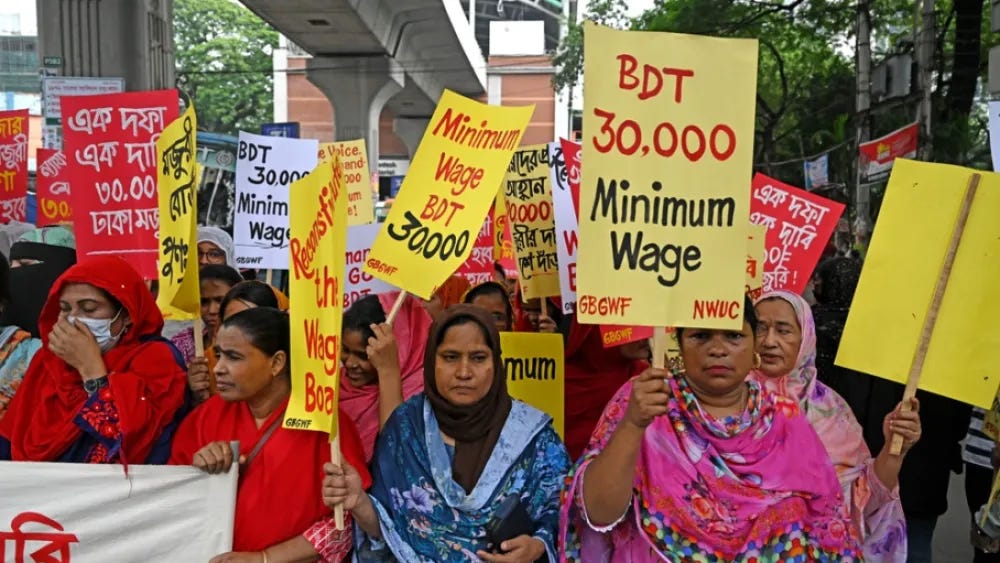
Bangladesh’s latest garment wage dispute has acquired an overtly political dimension. On 2 November, Home Minister Salahuddin Ahmed alleged that factory owners associated with the former Awami League government, including former ministers and parliamentarians, were helping instigate unrest across the country’s garment-producing districts. Workers had been demanding an increase in the minimum monthly wage from 12,500 Bangladeshi taka to 30,000 Bangladeshi taka, while demonstrations, factory closures and clashes with police disrupted production. According to the BGMEA’s situation report cited by The Daily Star, at least 529 factories declared holidays on 1 November. The minister’s allegations remain unproven, and workers’ grievances cannot be explained away as political manipulation. Yet the confrontation raises a larger question: what happens to the influence of an industrial elite when the government with which parts of it were closely associated loses power?
Bangladesh’s garment manufacturers have gained considerable influence over trade policy, industrial regulation, and labour relations over four decades of export growth. The sector employs approximately four million workers and generates more than four-fifths of the country’s merchandise export earnings. Its importance gives manufacturers leverage that extends beyond their personal political affiliations. The Awami League’s departure in August 2024 and the Bangladesh Nationalist Party’s return to government in February 2026 have changed the country’s political leadership. Whether they have altered the distribution of influence between manufacturers, workers and the state is less clear.
Garment manufacturers’ political power did not arise solely from allegiance to a particular party. It emerged from the institutions that helped build Bangladesh’s export economy, the organisation of industrial interests and the industry’s growing importance to national economic management. Political turnover may rearrange access to government without necessarily changing the conditions that make such access valuable.
From industrial success to political influence
The relationship between garment manufacturers and the state predates Bangladesh’s contemporary political divisions. When the industry emerged in the late 1970s, the country possessed limited experience of large-scale export manufacturing. Its subsequent expansion required more than inexpensive labour or preferential access to international markets. Firms needed production knowledge, access to imported inputs, international buyers and administrative arrangements that would make exporting commercially viable.
The collaboration between Desh Garments and South Korea’s Daewoo provides an early example. As documented in the World Bank’s Tales from the Development Frontier, the two companies established a partnership involving technical training, machinery, production supervision and international marketing. In 1979, Daewoo trained 130 Bangladeshi employees at its facilities in South Korea. Their subsequent movement into other enterprises helped spread managerial and technical knowledge through Bangladesh’s emerging garment industry. The collaboration mattered not simply because it established another factory, but because it helped build a domestic pool of industrial expertise. Government support was equally consequential. Bonded warehouse facilities and back-to-back letters of credit allowed exporters to import materials and finance production while avoiding some of the tariff and credit constraints affecting other manufacturers. These arrangements reduced the risks of entering international markets. They also established a relationship in which manufacturers depended on specialised state support, while government agencies increasingly relied on the sector to generate employment and foreign exchange.
Political economist Mushtaq Khan’s study of Bangladesh’s political settlement helps explain how such arrangements operated. The garment industry developed through entrepreneurial learning, collective organisation and negotiated access to state institutions. Its growth did not require eliminating political relationships from economic decision-making. Instead, particular arrangements between manufacturers and public authorities helped overcome constraints that might otherwise have prevented investment. This was an important source of Bangladesh’s industrial success, but it also shaped how political influence was distributed. Manufacturers increasingly organised through the Bangladesh Garment Manufacturers and Exporters Association (BGMEA) and the Bangladesh Knitwear Manufacturers and Exporters Association (BKMEA), which became intermediaries between factories and the ministries, customs authorities and regulatory agencies governing production. These associations performed necessary functions. They coordinated manufacturers’ demands, facilitated administrative procedures and helped address problems that individual factories could not resolve independently. Yet their position also gave organised industrialists considerable influence over the rules under which they operated. As garments became central to employment and export earnings, demands for favourable taxation, uninterrupted utilities, export incentives and regulatory accommodation could be presented as necessary to protect the national economy.
The relationship became more politically consequential as industrial ownership expanded into formal politics. A BRAC Institute of Governance and Development report on the state of governance examines the relationship between business interests, political authority and the governance of the garment sector. Industrial influence operated through formal positions and relationships with public authorities, placing labour relations within a wider configuration of political and economic power rather than treating factory disputes as isolated workplace conflicts. The relationship intensified during Sheikh Hasina’s long period in government. A study published in the Journal of Management Studies examines the political connections through which factory owners exercised authority over workers and industrial relations. It identifies garment manufacturers among Awami League parliamentarians and describes relationships between factory ownership, political office and administrative power. These findings show how political connections could strengthen employers’ position within factories, although they do not establish that all manufacturers enjoyed equivalent influence. Bangladeshi garment manufacturers are not a homogeneous political constituency. Large exporters, smaller factories and subcontracting producers operate under different commercial conditions and possess unequal access to government institutions.
A study published in Human Relations, based on interviews with owners and managers at 86 factories, documents this hierarchy. Smaller manufacturers described politically connected BGMEA leaders as possessing regulatory influence and access to public authorities unavailable to ordinary members. The researchers found that association leadership helped maintain common practices among manufacturers, facilitated dealings with government agencies and reinforced its own authority within the sector. The findings complicate the assumption that industrial associations simply represent a shared business interest. Large manufacturers were often better positioned to obtain international contracts, absorb regulatory costs and negotiate with officials. Smaller producers sometimes regarded association leaders as exercising authority over them rather than merely speaking on their behalf.
The aftermath of the 2013 Rana Plaza collapse exposed these differences. The disaster, which killed more than 1,100 people, prompted major changes in factory safety oversight through arrangements involving international buyers, manufacturers and regulators. The Accord on Fire and Building Safety and the Alliance for Bangladesh Worker Safety brought greater scrutiny to factory conditions. Yet compliance imposed costs that the industry did not share equally.
Human Relations research shows how smaller manufacturers struggled with the cost of safety improvements while international buyers resisted corresponding increases in purchase prices. Large factories were generally better placed to finance upgrades and maintain relationships with major brands. Industry associations consequently occupied a complicated position: they helped coordinate necessary reforms while also negotiating how to distribute costs. Labour relations developed within this same structure. Bangladesh’s minimum wage system formally includes government, employer and worker representatives, but the participants enter negotiations with unequal resources. Manufacturers can invoke international competition, employment and the possibility of factory closures when resisting higher costs. Workers must organise in an industry where employment insecurity and restrictions on collective bargaining have historically weakened their position.
The BRAC Institute’s research on labour organisations identifies a longstanding political settlement between governing elites and garment manufacturers that has constrained independent trade unionism. Its findings suggest that formal recognition of labour organisations does not necessarily translate into effective representation when workers face institutional and workplace obstacles to collective action. The political influence of factory owners therefore cannot be measured solely by counting industrialists who enter Parliament. It also operates through associations, administrative relationships and institutions that determine how the costs of industrial competitiveness are shared. These arrangements helped Bangladesh develop a successful export industry, but they also established unequal bargaining positions within it.
A new government, an established industrial constituency
The fall of the Hasina government in August 2024 created an opportunity to reconsider these relationships. The interim administration under Muhammad Yunus introduced a period of political and institutional transition, while the February 2026 election returned the BNP to government under Tarique Rahman. Political turnover was substantial, but the economic importance of garments remained unchanged. Governments continued to depend on the industry for employment and export earnings, while manufacturers still required access to ministries, regulators and financial institutions.
The parliamentary election provides a concrete indication of how industrial interests adapted. Ahead of the vote, The Financial Express identified at least seventeen apparel and textile factory owners or family members contesting seats, predominantly under the BNP banner. Among them was Mahmud Hasan Khan, managing director of Rising Fashions and president of the BGMEA, who contested Chuadanga-2 but lost. His defeat demonstrates that industrial leadership did not automatically translate into electoral success. The industry’s parliamentary presence nevertheless survived the change of government. On 26 February, the BGMEA hosted a reception for sixteen members of the new Parliament whom it identified as belonging to the apparel industry. The association’s list included former BGMEA vice-president Md Lutfor Rahman, elected from Tangail-4, alongside representatives from Munshiganj, Cumilla, Brahmanbaria, Chattogram and other constituencies. State Minister for Commerce Md Shariful Alam and other government representatives also attended.
The gathering was more revealing than a routine meeting between business leaders and politicians. BGMEA president Mahmud Hasan Khan publicly said elected representatives should raise manufacturers’ concerns in Parliament. He identified export diversification, the cost of doing business, and industry development as issues requiring their attention. Lutfor Rahman similarly affirmed that parliamentarians associated with garments would work to advance the sector. The association was therefore identifying a direct parliamentary channel for industrial interests. Its influence was not confined to informal meetings with ministers or negotiations through trade bodies. It extended into institutions responsible for making and overseeing economic policy.
The continuity is measurable, although it should not be overstated. The Daily Star reported that the BGMEA had similarly honoured nineteen garment-linked MPs following the 2024 parliamentary election. The figures are based on the association’s identification of its parliamentary constituency, rather than a comprehensive survey of industrial ownership. Nevertheless, they demonstrate that manufacturers continued to possess formal political representation after the Awami League’s departure. This does not establish that garment-linked parliamentarians act as a unified bloc or invariably place business interests above those of their constituents. Nor does it mean that the BNP’s relationship with manufacturers is identical to that of the Awami League. Particular networks have lost access to government, while others have gained it. The evidence shows that industrial ownership still provides a route into political authority, while the BGMEA remains able to articulate expectations about how elected representatives should advance the industry’s concerns.
The November wage dispute offers an immediate test of whether institutional bargaining has changed alongside political leadership. Following protests demanding a 30,000 Bangladeshi taka minimum monthly wage, the government established a new Minimum Wage Board on 1 November. Its membership includes employer and worker representatives, along with an independent member.
At the board’s second meeting on 9 November, workers’ representative Babul Akhter, general secretary of the Bangladesh Garments and Industrial Workers Federation, proposed a minimum monthly wage of 32,000 Bangladeshi taka, with 30,000 Bangladeshi taka for newly recruited workers. Employers’ representative ABM Shamsuddin, a BGMEA director, requested seven working days to prepare a counterproposal but was granted four. The board indicated that it would proceed if employers failed to submit their proposal within the extended deadline.
The proposed wage structure details are significant. According to The Financial Express, the workers’ proposal would make basic pay 60 per cent of the gross wage, with additional allowances for housing, transport, food and medical expenses. The composition of wages affects overtime compensation and other employment benefits, so the settlement’s structure matters as much as the minimum amount. The board also agreed to visit factories and examine workers’ living conditions, while its independent member was tasked with reviewing international wage-setting indicators. The revised wage structure is intended to take effect in December, with workers receiving increased pay in January 2027. The final amount has not yet been determined.
The disagreement concerns how to distribute the costs of maintaining Bangladesh’s international competitiveness. Workers argue that existing wages no longer cover basic living expenses. Manufacturers face rising energy, freight, and production costs while international buyers continue to pressure prices. These commercial pressures are real, but they do not establish what workers should be paid. International buyers also influence the distribution of returns through purchasing prices and delivery requirements, while factories differ substantially in scale and productivity.
The government’s response has introduced another complication. Salahuddin Ahmed’s allegations against former Awami League-linked industrialists locate part of the unrest within the contest between the current and former governing parties. If particular owners are deliberately financing or encouraging disruption, that would require evidence concerning identifiable individuals and their activities. Without such evidence, the allegation cannot explain the protests as a whole. There is also a broader difficulty with locating industrial influence exclusively among supporters of the previous government. Doing so risks treating the relationship between manufacturers and political authority as a legacy of Hasina’s rule rather than a feature of Bangladesh’s political economy developed over several decades. Evidence of manufacturers entering the new Parliament suggests that industrial interests continue to find routes into politics under the new arrangement.
The deeper question, then, is what has changed in the institutions governing the industry. Can workers organise and negotiate without retaliation? Can regulators enforce labour standards independently of manufacturers’ political relationships? Has representation within industry associations become more responsive to smaller producers? And can wage negotiations respond to living costs without being determined principally by the need to preserve low production costs?
A single wage settlement cannot transform industrial relations, just as one round of unrest cannot prove that the previous political order has survived intact. The eventual wage decision, its enforcement and the treatment of worker organisations will provide more substantial evidence of whether the transition has altered the balance between employers and labour. Bangladeshi garment industry presents a difficult case because its political influence rests partly on genuine economic achievement. Manufacturers helped build a globally competitive industry that created employment and transformed the country’s export economy. Their importance to national development gives them bargaining power that cannot simply be legislated away. But that achievement does not make the interests of factory owners, workers and the wider economy identical.
The political transition has changed who governs Bangladesh and reorganised the routes through which industrial interests reach political authority. Whether it changes how the garment industry itself is governed remains unresolved. As long as governments rely heavily on garments for employment and foreign exchange, manufacturers will retain considerable leverage over economic policy. The test of political change will be whether that leverage continues to determine the terms of labour regulation, or whether workers and public institutions acquire greater capacity to shape them independently.
Essay: Preksha Jalan - Associate Fellow, Digital History Lab at The Advanced Study Institute of Asia (ASIA).
Produced by Decypher Team in New Delhi, India