

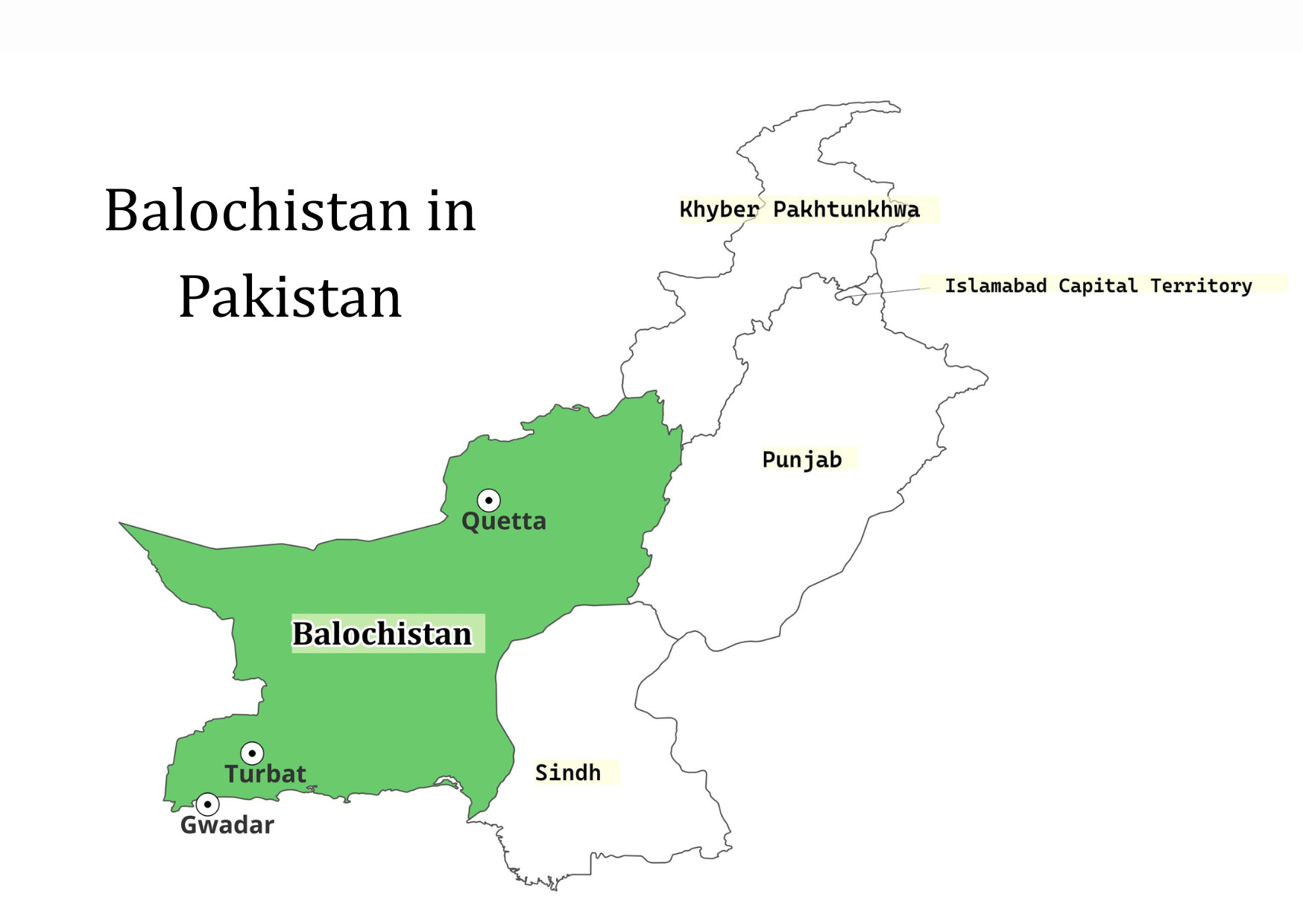

When Mahrang Baloch was arrested in March 2025, the case moved across two maps of Balochistan at once. One was intimate: a father killed in 2011, a brother disappeared in 2017 and later returned, families carrying photographs of men the state had not produced or accounted for. The other was strategic: Gwadar, the Arabian Sea coastline, copper, gold, gas, coal, long borders with Iran and Afghanistan, and the most exposed stretch of Pakistan’s China-linked development project. For Islamabad, Balochistan is a security frontier and corridor province. Beijing is where CPEC reaches the sea. For many Baloch families, the same geography is read through waiting, detention, funerals and unanswered names.
Mahrang did not invent peaceful Baloch resistance. Families of the missing had already carried out protests, Voice for Baloch Missing Persons, press-club camps, and long marches. In 2014, Al Jazeera reported on relatives of disappeared and killed Baloch walking more than 2,000 kilometres towards Islamabad. Mahrang belongs to a later phase of that repertoire: younger, women-led, civic, international and harder to keep provincial or invisible. TIME placed her on its 2024 TIME100 Next list, noting her advocacy against disappearances and killings; UNPO later reported her 2025 Nobel Peace Prize nomination. Her significance lies not in founding the movement, but in making an older wound more visible to Pakistan and to the world.
The province around that wound is not marginal to Pakistan’s development imagination. The Government of Balochistan describes Balochistan as Pakistan’s largest province by area, covering nearly 44 per cent of the country’s landmass, and rich in natural gas, coal, copper and gold. Yet the strategic value of Balochistan has not translated into social trust. The World Bank’s 2025 approval of $194 million for education and water projects points to deficits beneath the corridor map: school access, learning poverty, water security, climate resilience and basic services. Balochistan is not poor because it is irrelevant. It is poor while being strategically overvalued. Roads, ports, and security units can make a corridor function; they cannot, by themselves, make a population trust it.
The state’s account of Mahrang’s case is not that it punished an activist solely for visibility. On 22 June 2026, an Anti-Terrorism Court in Quetta sentenced Mahrang Baloch and Sibghatullah Shah to life imprisonment over the killing of paramilitary soldier Shabbir Baloch during a 2024 BYC rally in Gwadar. AP reported that prosecutors alleged the two activists incited a mob that attacked a security vehicle, seized the soldier and beat him to death; the case had been moved from Gwadar to Quetta for security reasons, with witnesses testifying remotely amid reported intimidation and protests. Reuters reported that the court cited eyewitness and medical evidence. At the same time, Chief Minister Sarfraz Bugti defended the verdict as justice for a soldier killed on duty and as accountability for those who use violence under the guise of protest.
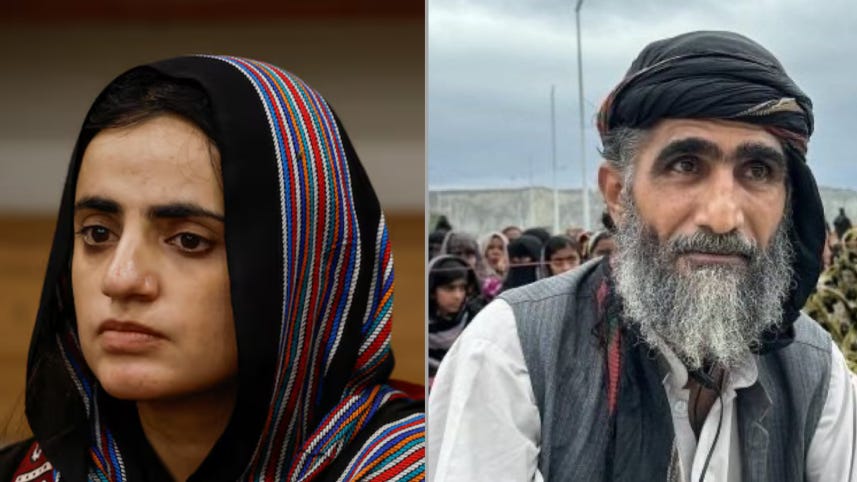
A soldier’s death is not a footnote. A humane account of Balochistan cannot turn state personnel into abstractions while insisting that the disappeared be named. The difficulty begins after that point. The legal case concerns a specific death at a specific protest. The political case being made around it is wider: whether the BYC should be treated as a civil-rights movement operating in a violent province, or as a political surface of militancy.
The security environment gives the state its strongest argument. The BLA has escalated attacks on security forces, civilians, infrastructure and Chinese-linked projects. In March 2024, Pakistani forces repelled an attack near Gwadar port; Reuters reported that the BLA claimed responsibility and that Gwadar is pivotal to CPEC. In August 2024, after coordinated attacks across Balochistan, Reuters reported that Prime Minister Shehbaz Sharif accused militants of trying to stop CPEC and damage Pakistan-China ties. In March 2025, the BLA hijacked the Jaffar Express; Reuters reported that 31 soldiers, railway staff and civilians died.
In that environment, the line between protest and insurgency is genuinely difficult to police. Armed groups and civil movements draw from the same field of grievance: disappearances, resource extraction, militarisation, provincial exclusion and mistrust of development projects. Difficulty, however, is not indistinction. AP reported the state’s allegation that the BYC is linked to the outlawed BLA, while the BYC denies the charge and calls itself a peaceful human-rights movement. Dawn reported former senator Farhatullah Babar’s warning against labelling Mahrang, the BYC or anyone else “terrorist” without evidence or trial. That warning captures the gap in the public record: the state has a prosecutable incident, but it has not publicly established that BYC, as a movement, is a militant front. Anti-terror law matters because it allows for a larger leap in the procedure.
This is where Balochistan’s next phase becomes clearer. Islamabad is likely to expand legal and security pressure around activists it sees as blurring into insurgent politics. Beijing is likely to push for tighter protection around Gwadar, Chinese personnel and CPEC-linked assets. Militants are likely to keep treating those assets as proof that Balochistan’s resources are being secured for others. Civil movements will find it harder to separate themselves from the counterterror frame, even when they reject violence.
The likely outcome is neither settlement nor simple escalation. It is a securitised stalemate: more protection around CPEC, more militant targeting of Chinese-linked infrastructure, more prosecutions under anti-terror law, and less space for non-violent Baloch politics. Islamabad may gain control without legitimacy. Beijing may find that project security cannot be solved only by more guards. Washington should read Balochistan not only as a counterterror problem, but as a test of how a nuclear-armed Pakistani state manages dissent in a province central to China’s corridor politics.
Mahrang Baloch’s case is not the whole story of Balochistan. It is where several parts of the story now meet: missing families, a dead soldier, Gwadar, CPEC, Chinese security, anti-terror law and a civil movement the state has not convincingly separated from militancy in public evidence. Pakistan can prosecute violence. It cannot make Balochistan more governable by making grievances harder to express politically.
Essay: Preksha Jalan- Associate Fellow, Digital History Lab at The Advanced Study Institute of Asia (ASIA), affiliated with SGT University, Gurugram.
Produced by Decypher Team in New Delhi, India